Archive for the ‘Prayer’ Category
How to Hold God Accountable
3 Surprises About the Almighty

There is an old story of a wealthy man whose seven sons and three daughters continually held rounds of parties. The sons and daughters would meet at one son’s house to eat and drink. Next day they all met at the next son’s house for more food and drink. And so it went, day after day until all had hosted. Then they began again.
The wealthy man was pleased at their joy but worried that some son or daughter might curse God in a fit of exuberant boasting or perhaps just deep in her or his heart. So he took steps: after every cycle of feasting and drinking, he would rise early in the morning and make offerings. In this way he consecrated his children.
The wealthy man was known far and wide for his wealth but also for being a blameless and upright man. Everything seemed to go the right direction for this man and his family.
Until it didn’t.
In this old story, the man absorbed a one-two punch: he lost all this wealth and his children. Then he lost his health. Like any absorbing movie, that’s where the story really begins.
You may recognize the story of Job. A lot of people read themselves into Job’s story: things are going well and then whammo—the winged monkeys descend outa nowhere. And then as one professor liked to say, you are left to “sit with” the problems, the questions and the profound distress, scraping your sores with broken pots. If you can make it through all 42 chapters of Job, you’ll notice some surprises.
- Surprise #1: Job’s pals comforted him with arguments any of us if-we-do-good-we’ll-receive-good theorists might use. In each case they were sorta right but mostly wrong.
- Surprise #2: Life is full of a fair amount of un-knowing. Well that’s no surprise. But it’s worth repeating in our culture where we demand black and white answers to most of life’s vexations. Sometimes stuff happens and we never really know why/how/who/what.
- Surprise #3: God can be held accountable—at least as far as our questions go. Which is not to say we’ll receive answers. But the questions…it’s the questions that spur conversation. And in Job’s story God was interested in the conversation.
Wait–stay with me:
This third surprise is tricky and I’ve added a gloss that does not quite ring true. We may want to hold God accountable for the bad stuff that happens, but there are a lot of reasons why we cannot (just) do that. We could talk more about that and have a thrilling conversation. But what I can say after living with Job for a couple months is that conversation with God is, well, it just may well be everything. The most important thing. The central thing—especially after the winged monkeys and sitting with job loss or death and the scraping of open sores with broken pots—the central thing may be this conversation.
###
Image credit: Lara Shipley and Antone Dolezal via Lenscratch
Juxtapose: How To Build a Church that Counters Culture
 Theological Roots and Practical Hope for Extreme Listening and Honest Talk
A couple nights ago Mrs. Kirkistan and I had dinner with old friends we’d not seen in some time. It was refreshing to catch up and there was lots of that free laughter that happens when old jokes and forgotten quirks reappear. At one point someone asked whether we were hopeful about the state of the evangelical church. We each offered an opinion.
Mine: “No.”
It’s actually a qualified “No”: my sense is that the evangelicalism has largely lost its way following industrial-strength, church-growth formulas and it has also sold its soul to political machinery. Following these tangents we’ve lost the essence of what it means to counter culture by speaking the words that stand outside of time.
I’m actually quite hopeful about what God is doing—especially in the Minneapolis/St. Paul area. We’ve seen a number of groups trying very new things while employing deeply-rooted devotion to sacred texts and veering from partisan nonsense. So my sense is that evangelicalism is morphing and, frankly (I hope) growing up.
For a couple years now I’ve been laying down about a thousand words a day toward this book dealing with the theological and philosophical roots of communication. It’s been a one-step-forward-seven-steps-back process. But I’ve just finished Chapter 8 and by the end of July I’ll deliver the manuscript to my editor friend. I’ll likely self-publish it later this year—I’ll probably have to pay people to read it (Know this: I cannot afford more than $5 a reader. So both of you readers give a call when you are ready. I’ll put a fresh Lincoln in the Preface.)
The book offers new ways to think about the ordinary interactions we have every day. It draws on a few philosophically-minded thinkers and reconsiders some old Bible stories to reframe the opportunity of conversation. It also provides a kick in the butt to move out of our familiar four walls to engage deeply with culture—but not from a standpoint of judgment, rather from a deep curiosity and love. I’ll be sharpening the marketing messages over the next few months, but here are the chapter titles so far:
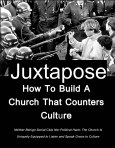
Would you stop browsing at Barnes and Noble long enough to pick up a book that looked like this?
- The Preacher, Farmer and Everybody Else
- Intent Changes How We Act Together
- How to be with the God Intent on Reunion
- Your Church as a Conversation Factory
- Extreme Listening
- A Guide to Honest Talk
- Prayer Informs Listening and Talking
- Go Juxtapose
Let me know if anything of what I’ve said sounds like you might actually be interested in reading. However: I can only afford to buy a limited number of readers.
###
Image credit: Daniele Buetti via 2headedsnake
What Your Village Looks Like Right After Assad Bombs It
Frontline: Syria Behind the Lines
It is a practice of the regime to target [bomb] groups of men.
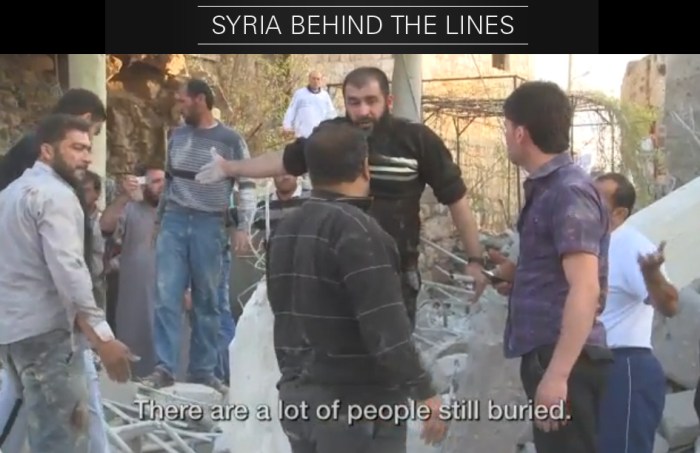
I won’t muck the works with my comments, but this first-person account of a village being bombed shows, well, you can judge for yourself. Be forewarned: this is graphic. Listen for the rhetorical twists and turns from the videographer’s commentary and the crowd.
Given this was from PBS, I assume it is real footage. If someone knows better, please tell me. Kudos to Olly Lambert for filming this and making it available.
God have mercy.
###
“He may be short, but he’s slow.”
Of inauspicious beginnings

That’s what my sixth grade gym teacher said as he watched my friend run the cinder track in a time trial. Some days feel like this: nothing doing, no big expectations and no real signs of progress, let alone genius. Some days seem to perfectly satisfy low expectations, like a poem from John Tottenham:
A long time ago I made a decision
to become a failure. It wasn’t
as easy as I thought: browsing through life
from one distraction to the next, while waiting
for the last lost moment to become unseizable.
As if there were some fundamental honesty
to not striving: There wasn’t.
I suspected it all along. (The Measure of a Man, John Tottenham)
For the past week I’ve been working with an old, old story. I can’t let the story go because I want it to frame a chapter I call “Extreme Listening.” I need the story to hint at what is accomplished when we listen very closely to the voices in our lives. I keep retelling the story to myself, emphasizing different elements to see what it is really about, but it remains elusive.
My story is of a Mighty Narrator and a Woman and a Man and Another Man born of humble beginnings. The Woman wanted a baby so badly she would do anything, including dedicating the yet unborn child to God—which meant the child would grow up apart from her. In her desperate soul-searching and panic of spirit and bargaining with God, she appeared drunk and senseless. The man, an observant official who was himself on a long, slow dereliction of duty, said as much:
“How long will you go on being drunk?” he said. “Put your wine away from you.”
“No,” she said. “I am a woman troubled in spirit.”
“Go in peace,” he said. “And may God grant your petition.”
The Woman had the baby and carried out her promise. The Man continued to abandon his duties and became widely known for how he let things slip. The baby grew into Another Man who took over the Man’s abandoned duties and then steered a nation into (yet another) vibrant beginning.
What intrigues me about this story is the mighty narrator. Because behind the scenes much larger things were happening, things that showed themselves as tip of the iceberg stuff in the conversations between the Woman and Man. So…listening and talking that resulted in pivotal actions (human and well, Other).
I think it is a good story—but who was listening to whom?
###
Image credit: Nikita Nomerz via 2headedsnake
Even My Agnostic Friend Says: Pray Your Day
Multiple Causation Skeins
 A thinker I respect—someone who continues to pop out a learned book for her tribe of university professors every year or two—told me one of her habits for writing. As she gets down to the task each day, she records a “wish” in her journal.
“Call it a wish,” she said. “Call it a prayer. But it’s a focus. It is a thing I ask.”
This thoughtful friend comes from a Christian tradition but doesn’t abide the wonder these days. I’m hacking her advice to note this practice: I find myself asking—no, make that recording specific questions, specific prayers, at specific times as I start various projects through any given day. My ask/prayer is for all kinds of stuff that is on my plate for the day, from paragraphs of copy to working out a tangled manuscript to organizing my client’s technology tell.
My friend practiced her “ask” because of the focus it presented. The focus helped her move forward. That is what I want to do as well. And more: I still suspect there is wonder tied up in the minute by minute actions of any given day. I still think our meaning-making is composed of “multiple causation skeins,” to quote Mark Noll. So my ask is directed and hopeful and often historic (yesterday’s ask text) and tries to make room for much bigger things that could be at play through my tiny actions.
###
Image credit: Built of books by Frank Halmans via 2headedsnake
There Is No Litmus Test for President
There is only conviction and thinking and prayer and conversation.
 And even that conversation will vary within your community.
I’m reminded of the paradoxes of the old culture wars. A couple decades ago when politics were just as heated and dialogue just as rare, Mrs. Kirkistan and I lived in a rough section of South Minneapolis. People of faith in our community—I’ll call them Christians—routinely voted “for” Democrats. Given the particular demographic quirks of the area, it was easy to understand why those candidates did better. For a variety of reasons (economic, housing, vision, spiritual) we ended up moving miles away. We eventually found ourselves at a large suburban church where the assumption was that everyone voted “for” Republicans. Mind you, much of this was never said aloud. It was all just assumed.
After all, Republicans were anti-abortion and that’s where God hangs out—right?
After all, Democrats cared for the poor and that’s where God hangs out—right?
The danger of litmus-test thinking is that it promises some clear, unassailable answer: the candidate is this or the candidate isn’t this. Case closed.
I argue that leadership is and always has been about more than one thing. There is no litmus test because the human condition is complex and society and culture are exponentially complex. And while I’m certain God is all about creating life, the Creator is also bent on sustaining life, so listening to the poor, the widow and the orphan take up a lot of column-inches in our common, ancient text. But even those are not litmus-like tests, because which party will actually do those things best?
I’m hoping the faith communities around the country will have conversations that help their members vote not according to some mandate from a culture-wars war-room, but instead according their growing convictions from dealing with texts, from conversation and from prayer.
It’s time the church led by being counter-culture.
###
Image via thisisn’thappiness
Pray Like You Talk. Talk Like You Pray.
How to be.
 Back when I was newish to this notion of pursuing reunion with the Creator, I began to wonder about prayer. Was it just a kind of thick wishing; full of detail and electric longing, uttered into the silence? The practices of prayer remain mysterious to this day, but way back then my buddy said something I’ve never forgotten:
“Look. Just pray like you talk. Simple stuff. Forget the impressive words. Just talk.”
That proved useful. It still makes sense to me today.
Prayer is an articulated event. A speech-act that causes things to happen out in the world—though not exactly the way you might hope. This is what people who pray believe (people like me): that by talking to the One who controls everything, laying out the case, and leaving it there, stuff starts to happen. Of course, dictation and demands are fruitless. So are bargains. Prayer doesn’t work that way—it’s not exactly a reciprocal relationship.
But what if my friend’s advice worked the other way too: what if that easy conversation full of detail and electric longing was a part of our daily, hum-drum human conversations? So rather than utter desire into silence we uttered it into relationship? That does not sound like wishing into the silence. People would be listening—the very people right around you. They would hear. And sympathize. Or challenge. You’d get known. Your peaks and valleys would be known. There would be no hiding. If our talk were like our prayer, there would be a measure of freedom, and a whole lot of assumptions about the level of interest in our conversation partner.
No. Now I see that would never work.
But. Wait—that characteristic of being known is a peak human experience. What if we were designed for that very thing?
That would be something.
###
Image Credit: Kris Graves via Lenscratch
You’re Soaking In It—Creative Unresolve and the Good Life
The issues that roil your nerves and kick you in the gut may be instrumental in pushing you forward.

let creative unresolve lead you forward
A few days back I wrote about sitting with unresolve as long as you can, as one method for producing creative ideas. John Cleese had a few choice words on the topic. After talking about this in class and listening to Mr. Cleese and experiencing it afresh with my own writing, I realized a couple of ancient voices had been swarming around, punching me in the face with this very point—only applying it to the rest of life.
One voice is a warrior-poet. Aside from being handy with a lyre and deadly with a sling and stone, he had a very lucid and descriptive (often prescriptive) way of asking God to do terrible things to his enemies. And yet, though he often had the power and opportunity to take action, he didn’t. Instead, he turned from the shortcut, obvious solution and waited. We all know that waiting for God seems to take longer than anyone likes.
Same thing with another Old Testament character—Habakkuk. He saw bad stuff coming (a brutish band of thugs coming to decimate his homeland) and decided also to fix his attention on God. And wait.
Something happens when we wait. Sometimes we can fix things in life right away. Often we can’t. So we wait. And just like when we’re working through a creative solution to a thorny business or communication problem, we sit with unresolve and let the discomfort itself push us forward.
Same thing with life. We wait and seek and wait. And–this may be most critical—we reach out. We reach out when things are not right with us. And reaching out is nearly always worthwhile. Reaching out looks like a phone call. Reaching out looks like an email. Like prayer.
Some students from my copywriting class are graduating. Everyone says it’s a low-energy job market—difficult for the job hunter. I sympathize. To these graduates I simply offer the notion that your creative unresolve can lead you forward into networking, conversation and, yes, to reach out in prayer.
I still maintain that the best stuff in life happens in and through the choices and actions made directly from chaotic, creative unresolve.
###
Image Credit: itchy banquet via thisisnthappiness

 conversation is an engine
