conversation is an engine

A lot can happen in a conversation

Archive for the ‘social media marketing’ Category

Where does loyalty come from?

with one comment

Gift Economy and Loyalty Programs

This is a tale about where loyalty comes from. It involves making a garbage man very sad.

The second home we purchased was left with all sorts of furniture by the previous owners. We called them and put the furniture in the yard. But they never returned and their furniture sat in our new yard for too long. Rain and sun and more rain—these people never came.

GarbageBurner-3-08112014

But Ace Solid Waste came. And they took it all for free. And they won our loyalty. Is this a commercial for Ace Solid Waste? Maybe, although I am not employed or directed or in any communication with Ace Solid Waste. In fact, I pay them. On time (mostly).

Their gift of removal (you might say Ace blessed us with the absence of a soggy couch and other wet furniture), is easily and quickly remembered by Mrs. Kirkistan and I, still, to this day.

In The Gift (NY: Vintage Books, 1983), Lewis Hyde described how a gift economy works: people give gifts to each other as a sort of payment. But not in the transactional way most of us expect today. One gift was not given in exchange for another gift. No, Hyde described how gifts move on. Or, you might say, moved forward. The gift you gave me, I gave to someone else, and so on in an endless cycle of giving. In the gift economies Hyde cited, trade was greased by gifts.

Of course, gifts carry with them an obligation: a sort of unwritten sense that I must pay this back, or “I owe you one.” Gifts also carry a sense of relationship. We give gifts to friends or relatives. It is a way of saying, “Hey buddy!” or “I’m thinking about you.”

One long-time strategy for business is to give gifts to woo loyalty. I buy plumbing supplies at Beisswengers because they are patient with my simplistic plumbing questions. They provide answers along with the new drain. The answers are even more valuable than the drain. All sorts of free apps become so indispensable we finally buy them. We frequent the vendor who gives away their knowledge.

A competing garbage gentleman stopped at our door with an offer of savings. When I said I wasn’t interested, he probed:

Why?

I told him my story of the furniture that wouldn’t go away and how Ace helped us out.

Will you be in debt to Ace for the rest of your life?

And here is the surprise: as I listened to my own words, I wondered at the strength of the feeling and the depth of loyalty for this good deed done to us—and the longevity. Maybe our retelling of our furniture story kept giving fresh reasons to continue.

Maybe.

And so the man of seeming excellent garbage-manship walked away sadly.

So that’s one way to build loyalty: help someone with a need. And as you help, try not to see the gift as a transaction.

###

Image credit: Kirk Livingston

Lady Gaga: Onstage Vomit Sells Doritos? Of Course.

leave a comment »

“Selling In” Not Quite Opposite “Selling Out”

One adorned in a plastic tarp need not "sell out."

One adorned in a plastic tarp need not “sell out.”

Lady Gaga made a plea for “selling in” at SXSW last week. Doritos sponsored her onstage vomit-art, which attests (she said) to her artistic success. But read the Rolling Stone article and you’ll find a more complex, nuanced notion that falls short of completely bowing to the demands of the sponsor.

When Kerry Miller (@DailyCircuit @KerriMPR) wondered aloud what people thought about “selling out,” she echoed a sentiment borne decades before when the big rock and rollers first roamed the earth and bowed to the demands of advertisers to create art to propel commerce. Ms. Miller’s comment generated responses from scholar Patrick Cox (@patrickcoxMN) and others on just what corporate sponsorship was beginning to look like.

Ms. Miller’s generation (also my generation) labeled such people “sell-outs” and tried to work up disdain for them even as we bought the cans of soda or beer or whatever they shilled. Even as we ourselves sold out to the company we worked for. And never mind that the notion of patronage has been around for as long as artists have starved.

Watch the recent Frontline “Generation Like” and you’ll get a sense of how Millenials approach the art vs. commerce question. Gen Y seems largely happy with getting free swag and brandishing logos on their social spaces/shirts/tattoos/hair cuts.

“What’s the big deal?” [They might ask.]

Ms. Kerry’s generation (my generation) is quick to point out that “You, sir, have sold out.” The Millenials I teach might return: “You, sir, have also sold out.” Which would be entirely accurate.

Maybe Gen Y has done us a favor by repackaging the connection between art and commerce: That repackaging looks more like an articulation of authenticity. It is a voice we need to hear today. I’ve been arguing that craft and service (and art and faith) do better together than separated into holy, inviolable silos.

Gen Y is articulating some of this. Not perfectly, but they are closing some gaps and opening others. The “selling out” conversation has changed.

###

Image credit: Michael Buckner/Getty Images for SXSW via Rolling Stone

Written by kirkistan

March 17, 2014 at 9:36 am

What to toss to drive forward?

leave a comment »


It’s 2014, we have license and the tools to look at new models without
having to wear the straight jacket of models past, or buzzwords of the
moment. Narrow-casting can be done without narrow-mindedness.

–Valeria Maltoni, Conversation Agent, in comments after her “Why have a blog” article

###


Written by kirkistan

March 15, 2014 at 9:26 am

Minnesota Representative Garofalo: “There is not a racist bone in my body.”

with 8 comments

The short, turbulent life of a tweet.

What we say and do demonstrates who we are. We cannot help but draw conclusions based on the actions we see and the comments we hear. In the end, no one of us can know more than that about each other.

That’s how communication works.

Representative Garofalo’s Sunday Tweet landed on ESPN Monday morning. Tweeters were quick to jump on the tweet, denouncing Mr. Garofalo’s latent racism, Republicans and politicians generally. Colleagues lambasted the tweet and national media held it up for examination, which is to say, the typical circus-posse was formed around these 140 characters. Mr. Garofalo denied racist overtones but ultimately apologized for the tweet as the water got hotter.

https://twitter.com/PatGarofalo/status/442805513697628160

Mr. Garofalo’s apology was unusual because he is an outspoken Tweeter and communicator who remains unafraid to confidently assert. The apology was also sort of usual: “to those NBA players and other who were unfairly categorized by my comments….” So, typical of public apologies, this one creates distance even as it acknowledges pain and takes responsibility.

https://twitter.com/PatGarofalo/status/443067758306017280

I’m interested in what happens in our quick responses. Responding to each other is one of the fun bits of conversation. Our quick responses are often revelatory: sometimes they show us things about ourselves we did not know. I wonder if in Mr. Garofalo’s case—despite his confident, well-reasoned quote on top—his quick tweet peeled away layers to reveal unseemly categories.

I suspect we all have those layers. Maybe we need to tweet and talk all the more rapidly so we can do the work of peeling the layers.

It can be a painful work—all the more so when put it in the form of a tweet that catches the national eye.

###


Pinterest Knows Me!

with 3 comments

Pinterest has a wonderful plan for my life.

I’m new to Pinterest. I really have no clue to what it is about, but one team from my Social Media Class focused on Pinterest—so I’m right there! So far I’ve search for (pinned?) exactly two things: an attic fan and a pair of boots.PinterestFail-03082014
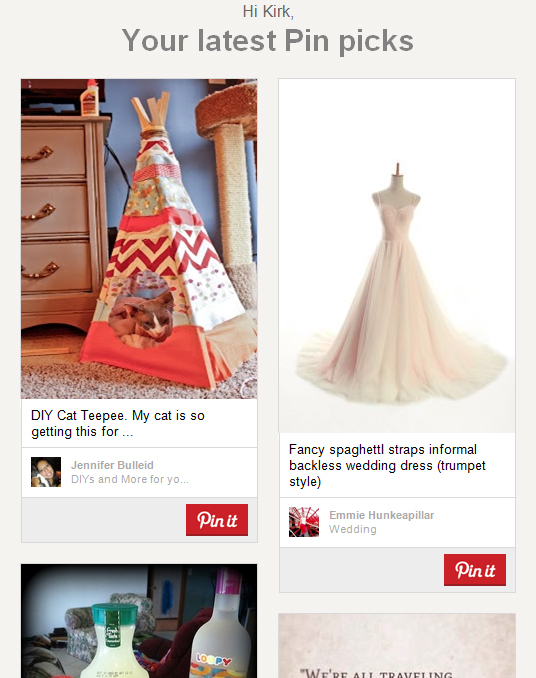
Yesterday Pinterest came right back at me with…a DIY cat teepee. And a backless wedding dress.

How did they know?

I’m no cat fancier. And I’m more of a rent-a-tux kind of guy who enjoys being (already) married to Mrs. Kirkistan. But all this failure makes me wonder if Pinterest is curating my life into some odd, unforeseen direction. What is Pinterest’s wonderful plan for my life?

Pinterest: you scare me.

###

Written by kirkistan

March 8, 2014 at 5:00 am

I love the smell of failure in the morning

with 5 comments

Fail faster!

Reading student critiques of their social media experience is a highlight for me.

Everyone fails.

It’s impossible not to.

No one achieves the thing they set out to do, mostly because what they set out to do was so vaguely defined as to be well, impossible.

Which is perfect.

The class succeeds exactly because everyone fails. Not failing grades (mind you), but failure at achieving some vague world-altering purpose. It’s safe, convenient and inexpensive to fail in this class.

And worth every penny.

Because the lessons learned from trying something and hearing a target audience respond (or not, silence teaches many lessons as well) are entirely applicable to most any job these students will look for post-graduation. By trying and failing, they’ve learned lessons about specificity in word choice, the need to set a realistic purpose for engaging an audience, that social technologies can be fun and frustrating and that those tools require guidance and vigilance. They’ve learned a bit about what it takes to get heard in a crowded room and they’ve each had the joy of getting a response from out of the blue. Which, of course, makes a writer’s heart sing.

We’re coming away from failure quite optimistic, because we’ve counted the cost (to quote the biggest failure who succeeded beyond anyone’s wildest dreams) of influence and we know the tools and all of us have a sense of exactly how we’ll pick up those tools next time. We’re also coming away optimistic because we’ve exercised our passion in putting words around ideas that make us hum. And that is thrilling stuff.

To recap: fail faster so you can begin setting realistic steps to tackle your world-changing proclivities.

###


What is Your Purpose with Your People?

with 5 comments

Can You Articulate Your “Why?” and “What for?”03042014-URBimp2

I’ve been gushing over Improv Wisdom lately, this 2005 book by Patricia Ryan Madson. I’m thinking of buying a number of copies to give away and wondering how I can incorporate it as a supplemental text in my next classes. The book is easy to read, memorable and full of actionable wisdom all directed at staying in the moment and building something with others. Ms. Madson—a drama professor at Stanford, improv maniac, eager collaborator and kind-hearted encourager—brings a lot of life to how we can work with others. Now I find myself ordering the primary source texts cited by Ms. Madson.

Ms. Madson has been kind enough to respond to my tweeted epiphanies when reading her book. I am impressed by the longevity and timeliness of certain ideas. Ms. Madson’s 2005 book will likely be relevant for a long, long time.

As I finish with my Social Media Marketing class, I’m reading reflections from the students. One near universal regret was not having a clearer sense of their purposes for the communities they were trying to create. We spent focused time on this early on in the class, but forming a crystal clear picture of what we want to accomplish with others is neither easily understood nor often practiced. I know this from the number of companies I’ve been in that operated every day without a clear sense of what they were trying to do with their audiences.

Students resist the tightly-formed purpose and the close definition of their audience because it feels so restrictive. It just feels easier to write anything for everyone. At least that’s how the class always starts. But at the end of the class, there are multiple confessions about how the tight purpose and close definition actually freed them to say much, much more to their target audience. This experience fits with a bit of improv wisdom Ms. Madson offered:02262014-Cover-burgundy

Rather than asking “What do I feel like doing?” when a free moment arises, instead ask “What is my purpose?

I love this question for my class and I love this question personally. The question presupposes I have a purpose and assumes I know that purpose. The question assumes I am conversant with my purpose and assumes I am in the habit of articulating it to myself and others.

All these presuppositions and assumptions are worth pursuing. Going back to our purpose again and again sounds like bearing fruit over a lifetime.

And this: Patricia Ryan Madson should write more books.

###

Image credit: imgur

Power Distance Vs. Skunkworks (Shop Talk #8)

with 3 comments

Don’t Fax Me In

I’m anticipating a Social Media Breakfast Friday morning that promises dialogue about dialogue: how companies can get better at engaging employees for collaboration. Collaboration intrigues me because it forces this question:

How is it our organizations gather all these smart people and yet routinely fail to get them working together on big ideas? Why is true collaboration still a distant dream rather than today’s pressing reality?

Anyone can see we’re well beyond the “You talk. I Listen.” model of management relations. In my class we’ve been tracing the opportunity of social technologies backwards to where conversation bumps against command and control personalities and cultures. I’ve been coming to the conclusion that conversation is inevitable: with customers, with your own workforce. Especially with your own workforce. This is good news for anyone who works. To expect anything less than people talking back (where you can hear it or where you cannot hear it) is to settle comfortably into the pace and ethos of 1980 or 1990. Back when we might just fax in our order.

One celebrated model for collaboration is that of Lockheed Martin’s Skunkworks: smart people hiding from bosses (or some bosses) to work together on a particular passion. It was a skunkworks setup that allowed Steve Jobs to make his radical break that resulted in the Macintosh. The absence of bureaucracy and the concentrated abundance of resources contributed to innovation.

And this: slightly naughty has its own peculiar draw. If skunkworks promises to disrupt the social order, I’m in. So are a lot of other seemingly ordinary citizens.

Cubicle-dwelling life is often more about receiving messages rather than dialoguing. In my own life it was the rare boss (I count three) who was able to deeply engage teams and bring out the very best—the brand new stuff that would happen only when everyone talked.

My fear is that internal communication is mostly just another flavor-of-the-month HR stunt, only using new tools. Just another command and control technique that only climbers are interested in.

My hope is that leaders take their top positions and use them to demonstrate dialogue and make themselves vulnerable.

My observation is that a generation of Anti-Vladimir Putins and Anti-Kim Jong-uns is already emerging.

###


Why You Must Tinker with Your Social Media “Why?”

leave a comment »

Strategy is a fuse. You must light the fuse.

Say you’re writing a blog.

Any blog. Maybe…a blog where you want to get people to tell their stories (purely hypothetical example). Or this: maybe you are running a blog aimed at pulling in people looking for insights about what our national obsessions say about us, as told through the press. Again: pure theory. Just making this up. Both blog examples sound a bit vague—but that’s the groovy deal with social media: you try something and see what happens.

So, say you try stuff.

Say you fail.

But…you learn stuff. And you tune it up.

You go back to your original strategy document and realize: Oh! Our stories must be more than just well-told (though that is certainly the beginning point). They must pull people in with tight surprises or well-crafted morals. Or something. Because these stories are competing with Angry Birds and Facebook and actual paid work—all manner of distractions that keep people from reading our blog. So those stories gotta be good. They’ve got to be better in a way we’ve not quite yet devised.

And so your strategy evolves.

Congratulations: this is what forward movement looks like.

These are the questions any brand faces, with the added goal of trying not to devolve into a selling spiel. This social media world is no static, set-it-and-forget-it deal. It’s more like a living, breathing conversation in a room full of people constantly walking in and out. And for your brand to be heard, for your blog to be recognized, for your insights to be caught, you must continue to tighten the focus on who you are trying to reach and get better at laying out the right content for your target audience to feed on.

And this: there is an aspirational part to providing strategic content. I like how Kristina Halvorson and Melissa Rach says it in Content Strategy for the Web:

Aspirational: it’s a stretch for the organization, focusing on what you want to become ideally (not what you can feasibly do).

Content must paint a picture of who we are that is slightly in the future and slightly a wish list. Brands do this constantly, of course, which is why people buy BMW or Coke or Apple. They buy into the vision as they purchase the product.

How can we do that for the community we want to build with our blog content? It starts and continues with focused attention on what this audience needs, today, tomorrow and the next day. Our content must paint a picture of we can be at our best.

This will always be a moving target.

###


Let’s Infect Ourselves: The Logical Conclusions of Social Media

with 4 comments

Just Walk the Opportunity Backwards and You’ll See

It’s easy to love the tools of social media and become all enamored by what they do and the sorts of connections they make. Brand new connections you would never have made before. But connecting takes a lot of energy and frankly, lots of vigilance. One must keep atop one’s game. And if you stop (connecting), well, you lose it all.

In this ever-connecting world there is a growing sense that the old marketing monologue, the one we used to interrupt and hypnotize potential customers, is being boxed and shelved. Over at Clarity Coverdale Fury they talk a lot about the characteristics of the Conscious Consumer, how purchasing choices are coming from a more thoughtful place. And students in my Social Media Marketing class confirm that the threshold for seeking information on even common purchases is getting lower and lower. Why not get a review on a cup of coffee before you buy? It’s too easy.

Some smart folks will gather to discuss what employee collaboration looks like in companies today. Deep collaboration seems a logical conclusion of connecting, especially as we pivot away from command and control styles of leadership. I’m curious to hear how the innate rewards of being a boss and being in charge fit with the goal of bringing out the collaborative best in people. So I signed up to attend the breakfast. My experience is that those intent on ascending the corporate ladder have neither the same desires nor the skill sets as those who enable collaboration. Of course, they are not always mutually exclusive

But this is where we are going: Deeper employee collaboration. Deeper collaboration between customers and companies, where customers have a voice not just for getting support but now for product development.

This is the logical conclusion of connecting.

It is written.

###