Archive for the ‘Uncategorized’ Category





Spain Lottery Commercial
Cyber Grand Prix at Cannes
Despite the lottery being a complete waste of money and attention, this is a fetching commercial.
But how about that soundtrack? Wow.
What we mean when we say “PC”
Conversations will sometimes offend
“We’re all so PC today.”
When I hear this I wonder what the speaker means:
- Does she mean we work so hard to not offend each other that what we say is meaningless?
- Or does he mean he wants to get back to days of privilege (white, male, boss, pastor/priest, authority—name your privilege), back to when a part of our daily lexicon meant disparaging others deemed “less” because they did not line up with us?

If political correctness impinges on our ability to speak freely, that is not good. We must find ways to speak our thoughts—even if it means threading our words through verbal and perceived obstructions and pitfalls. Even if it means offending. But that’s the same with any relationship. Our conversations aim toward pulling others in more than pushing others away (Otherwise why talk at all? Just walk away.), so we take care speak to where our conversation partner is coming from. The end game of speaking our thoughts to each other is greater freedom, better articulation, and deepening friendships. Comedy sometimes makes that leap quickly by abruptly articulating a hidden thought. Those hidden thoughts, when exposed to air, can carry great meaning.
If there is one positive to come from the mouth of the patent-medicine salesman Trump, it is recognition that privilege exists in our nation and now we simply have to talk about it as a nation.
But if political correctness makes us long for a return to days of privilege where we verbally bully anyone perceived as different, then we must work against that. Others are to be understood, not hated. If political correctness helps us begin to see the inherent blindness of our particular place of privilege—let’s embrace that and learn.
We are at our best when connecting with each other.
We are at our worst when building walls.
###
Image credit: Kirk Livingston
Hey—You Can’t Say That
On Students Subverting Form
Some of my copywriting students were eager for more direction on how to use the forms of communication. Some were eager to go species-by-species and list out the formulas for producing them: How to write a print ad. How to write a direct mail. How to script a broadcast ad. How to write and then say the magic words that get you hired.
I taught that class a few years back. It was all about working through the various forms of corporate communication and learning to write in just that style and toward just that end. I taught it for years until I realized everything inside me was shouting for students to run, to break with the form and find a new way to say what they need to say.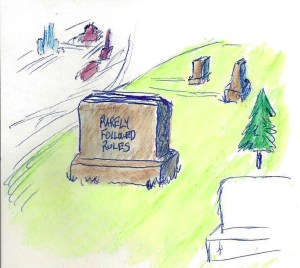
For today’s copywriting students I was able to point to my beloved copy of Alastair Crompton’s The Craft of Copywriting (long out of print, I believe). Mr. Crompton offered lots of rules that probably worked well in 1979 and some of which still apply. Various copywriters have offered sets of rules over the years. Some stick. Some don’t. Bernbach, Burnett, Ogilvy and Reeves all visited our classroom from time to time in written and oral form. They each had a golden rule or two. And, of course, James Webb Young’s old Technique for Producing Ideas.
In truth, there are some general notions and guidelines and, well, forms (if you must) that apply. But over the years I’ve thought of those as only the receptacle of the really important thing: the idea. It is the idea I’m fixated on and I tried to communicate that to students. Ideas come from grappling to combine something old and something new, something borrowed (from an audience need or desire) and something that can woo. As far as I can tell, there are no formulas for producing ideas, only the setting up of conditions that may lead to ideas.
But, you know, no guarantees.
As many of my students said, “You can’t manufacture ideas.” To which I would always respond, “Or can you?”
Forms and formulas are there and they can be useful. But forms and formulas don’t carry much life. And mastering the forms and formulas, for a beginning copywriter, seems like a starting point. But is it a good starting point? I don’t think so.
The writer’s task is to breathe life into an old form or subvert it or discard it. The key is always and forevermore to put life on a page.
Forms and formulas will always bow before life on a page.
###
Dumb Sketch: Kirk Livingston
The Lies We Love
How to Believe the Preacher’s Story
Let us now name this category of lie: The Preacher’s Story.
We’ve all been here: sitting in church or a political meeting or even in class. The preacher/politician/professor behind the lectern tells a story that illustrates her or his point perfectly.
Too perfectly. And we think:
Wait-that sounds almost too good to be true. So then it must be… false. But who cares? I agree with the point and I’m in agreement with that way of looking at the world. I’ll just check the “true” box for that story.

The Preacher’s Story is a quasi-factual tale the congregation wants to believe and will believe. The point of the story isn’t whether or not it is true, but whether the story advances our cause. We’ve gathered to stoke our fires and that semi-truthy story works just fine for that purpose.
I’m putting most Trump talk in the category of “The Preacher’s Story”: though demonstrably false, still believed because it stokes the tribe’s purposes. Trump’s not alone in this, of course, his preacher’s stories are just the most recent potent poison.
Writers continue to try to make sense of evangelical support for Trump. The last few days have produced several articles citing similarities between the current batch of authoritarian presidential candidates and the authoritarian leadership style many megachurch pastors exhibit (for instance, Katelyn Beaty’s opinion piece from The New York Times). Authoritarian leaders depend on the willing to turn off their fact-meters as they absorb the preacher’s stories. Evangelicals are possibly more willing because of close familiarity with this rhetorical tool.
Can we now name the downside of “The Preacher’s Story”? It appears we’ve been groomed to be gullible.
###
Image credit: Kirk Livingston
On Creating: “Hello Problem, Please Sit with Me”
From Distraction to Focus
We stare at the problem until we can’t think straight. And when blood runs from our ears, then we have just begun.
This quote from a Minneapolis copywriter describes the creative process that drives his role in the industry. What does it take to come up with a creative solution that is beyond the first 5, 10 or 20 thoughts that pop into anyone’s head? What is creativity, anyway, and why should I care?
- First the bad news: creativity requires deep focus.
- And now the good news: you are capable of deep focus.

“Look Again: Expanding Feminist Possibilities,” Groot Gallery, St. Olaf College
In our age of near constant distraction, how does anyone slip into the focus-cave? How does anyone keep distraction at bay, apply sustained attention, and lose track of time in the process? It turns out there are solid answers to those questions. Those answers arrive from a mix of personal experience from people who create regularly, from a bit of theory, and then from experimentation with what works for you.
One thing is certain about focus: it can bring a healing wholeness with it. Just ask any person who regularly creates, and hear them talk about “flow” or the zone or getting into that space of just doing it.
Creating is not for the faint of heart. Because to create is to dwell with ambiguity: could be this. Could be that. If you change this piece—or flip the entire story or image—everything looks different and maybe even makes more sense. Very little is defined when creating and, in fact, you are doing your own defining
A group of students and I have turned a corner this week. We’ve gone from feeding the internet with content that builds communities to feeding creativity that can solve real-world problems. And just like when we work different muscles with cardiovascular versus weight training, this move from rapid creation to deep problem-solving wants a different set of brainwaves. We’re moving from intense listening and rapid creation to sitting with a problem and iterating our way out.
One of our bigger tasks is to train ourselves not be satisfied with the first, easy solution. We’ll learn how to bend time and write fast while you still know nothing, and how to lift and separate and how to map your way around a problem and how to start at the top again and again. And how to grind through to get to a better solution.
But all that needs focus.
And focus means not picking your phone up for 60 minutes.
And that is a struggle.
###
Image credit: Kirk Livingston

 conversation is an engine