Archive for the ‘What is remarkable?’ Category
Lift and Separate (Copywriting Tip #12)
An idea is a new combination of old elements
This part comes after.
After the interviews and after reading the transcripts, after absorbing the journal articles and revisiting the notes from discussions with various experts. After taking in as much as you can, there is the sitting-back and ordering of facts and impressions.
Maybe you use an outline. Maybe you use index cards. Maybe you use a mind map or a white-board. Maybe you draw figures or icons on the back of corporate memos. But this is an essential creative exercise: sorting through and lifting up what keeps coming to the top. This creative exercise is about identifying and corralling the really important stuff. The stuff that simply must be transmitted.

Take steps to see more.
A shortcut to this essential phase is a conversation. If a colleague interrupts you with “What’s that project about?” The first three things out of your mouth—those things worth remarking on aloud—those three things need to find their way into the copy. Often they become the main topics.
Sometimes I’ll just start writing to see what I say. Give yourself 10 minutes to answer “What is this about?” and you will come close to producing an outline for the piece.
Or you can write a letter to a smart ten-year-old. Molding an idea into a simplified (but not simplistic) presentation has a clarifying effect.
The point is that your mind needs to find a grapple with myriad facts and figures and impressions and data—to sort minor from major and to begin to find the story that makes sense to you and to your target audience.
I like the wide-open blank page aspect of this exercise. I also like that brand new stuff presents itself during the exercise:
…an idea is nothing more nor less than a new combination of old elements.
–James W. Young, A Technique for Producing Ideas (NY: Thinking Ink Media, 2011)
###
Image credit: Kirk Livingston
For Some, The Past is Still Present
One Wall in North America’s Only Walled City

This art wall reminds me of Wendell Berry’s The Memory of Old Jack.
###
Image Credit: Kirk Livingston
Here’s the Story of a Man Named Quady
Who was living with three alloys of his own
Yesterday I met Quady* for coffee. I was impressed all over again by the executive function of his brain: how he seems to effortlessly order complicated systems and businesses and talented people and even his own life. Quady** told me how he was weaving consulting with business acumen with creativity. I could not help but be impressed with the forward motion the guy exuded.

…and here’s the dumb sketch you ordered.
In fact, it was about ten years ago I met Quady at (yet) another Dunn Brothers on another side of Minneapolis to talk about how he grew the business he was running at that time. He was president of a firm that placed creative people in creative positions and his firm was on fire (that is, busy). At the time he gave me some solid advice which I resisted for years until embracing it fully: make a daily/weekly habit of reaching out to make contact with varieties of people.
And listen to them.
These days Quady is weaving together a consulting life that draws on his outsized executive function and his creativity plus a desire to walk alongside people. He’s a kind of CEO-for-hire and he’s currently working some high-level gigs. It’s the melding of these three threads that seems to open doors for him: the organizing gene plus the creative gene plus the people-smarts gene. Because he understands the moving parts of business, he can give solid, real-world advice to people. He gives the kind of advice that encourages from some deep place: the sort of advice like,
“Look. You’ve got this. It’s a stretch, but you can do it.”
And who doesn’t want to hear that?
###
Dumb sketch: Kirkistan
*Not his real name.
**His real name was Markothy.
Sam Amidon Owns His Process
And wait for the story about sleeping on the fuzzy brown donkey.
Yesterday I wrote about owning your process. Sam Amidon owns his process: check it out. He’s an original.
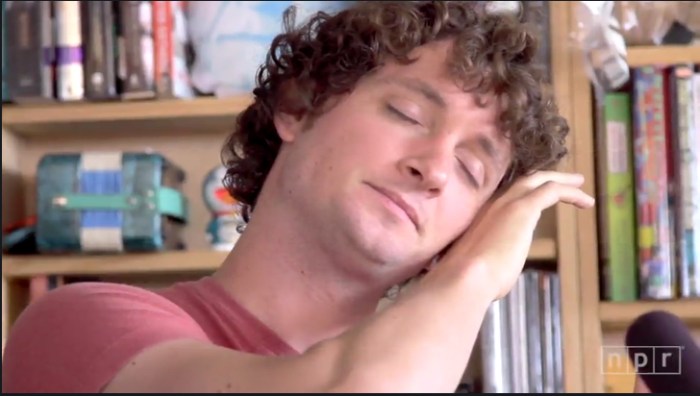
Click to play.
Plus Bill Frisell as back-up guitarist! What?
###
Suhita Shirodkar: Sketching The Everyday
Seeing for the first time again
I’ve made a dumb sketch every day so far in December. Maybe I’ll continue the discipline through 2015. My hope is that these dumb sketches progress from “negative” to at least “0”: from “dumb sketch” to just “sketch.” But if nothing else, sketching provides a few moments of seeing things in a different way. I am inspired by the work of OneDrawingDaily (a regular commenter and daily sketcher). I am also inspired by the work of Suhita Shirodkar, a sketcher in San Jose, CA.:

Sketching the everyday makes me look at it closely and appreciate it more than I otherwise would.
Lots more little everyday sketches here on flickr,
–Suhita Shirodkar
A sketch catches something different from a photo.
###
Stop On The Way
Ask: “What do you see from there?”
Mostly we hurry from this to that.
In this season we move from party to party. At work we move from meeting to meeting, hardly stopping to breathe, let alone reflect or appreciate the unique spot we’re in.
We do this because we are crazy-busy (always the right response in our culture). And sometimes reflection is uncomfortable, especially between things. No one really wants to dwell in the space between. But the space between has things to say as well. Things you would never hear otherwise.

Always “crazy-busy.”
We all know someone stepping between things. Maybe our friend has left a job or school or some relationship. Maybe we ourselves own some piece of life that has less than secure footing. All of us caught in between want the solid ground of the other side.
But we gain perspective by asking what we see from this liminal space. What does life look like from this uncomfortable, slippery place? What is important here—and should that thing be important when our footing is more secure?
Perhaps we do our friend a favor by asking what they see from that uncomfortable place—could it even be bit of mercy to ask that question?
###
Image credit: Kirk Livingston
“…shouldn’t give away your pie with breakfast—it makes you look cheap.”
The Reading Pulls the Funny from the Words
The Diner is an old Saturday Night Live skit (1989-1990/Season 15/aired 21 April 1990) with the late Jan Hooks and Alec Baldwin. It is a bit of genius in the way the language does double-duty, pointing at meaning far beyond the sublimated exchanges. The characters and their inevitable conflict are showcased in the writer’s words (read the transcript here). But it’s the words exchanged between Hooks and Baldwin—words that seem almost physical—that move the skit forward.
![[Click to play.]](https://conversationisanengine.space/wp-content/uploads/2014/12/alecbaldwinsnlthediner-12262014.jpg?w=700&h=477)
[Click to play.]
[https://screen.yahoo.com/brenda-waitress-000000407.html]
Read the transcript. It does not come across as powerful as it does in the hands of Hooks, Baldwin and the rest of the cast.
But that holds for lots of things.
Words come to life when spoken or acted on by a human. If that seems too philosophical, consider how much copy you read that is lifeless because you cannot hear any human voice. This is why press-release quotes from CEOs sound so wooden. No human speaks that way. On the other hand, some books remain in our lives precisely because they capture the human voice so well. For me, the old poet-king and the gospel writer John portray the human voice so accurately that I return to them daily. Ian McEwan’s Atonement also did that for me recently.
What words will you act on in 2015?
###
Image Credit: SNL/Yahoo
Please Say More, My Radical Lesbian Feminist Friend
Mary Daly: Voice from the Fringe
Well, “fringe” for me.
I’ll confess: I’ve not been so conversant with feminist theology or philosophy. And this: it had not even occurred to me to think about it.

Sometimes a different perspective helps cut the fog.
But then I read our daughter’s college paper on Kierkegaard and his potential exclusion of women. Our daughter’s reference to the self-described radical lesbian feminist Mary Daly and her Beyond God the Father: Toward a Philosophy of Women’s Liberation (Boston: Beacon Press, 1973) was something like click-bait for me and I had to order the book. I’m glad I did. Mary Daly’s voice has been a playful, combative, eye-opening excursion into seeing things differently. I’m only a chapter in, but already she has named patriarchal theology and turned it on its ear. Ms. Daly has suggested all sorts of thought-exercises that would never occur to anyone living in the usual theological/philosophical grid system:
For example, women who sit in institutional committee meetings without surrendering to the purposes and goals set forth by the male-dominated structure, are literally working on our own time while perhaps appearing to be working “on company time.” The center of our activities is organic, in such a way that events are more significant than clocks. This boundary living is a way of being in and out of “the system.” (43)
You don’t have to be a theologian or philosopher (or even a radical lesbian feminist) to appreciate the different way of seeing things Ms. Daly offered. A quick glance through her Wikipedia entry suggests there was personal a cost to seeing things differently—especially in the male-dominated structures she worked within.
What I like about this particular quote is how it points beyond authority to the organic or self-directed work each of us knows as our own. Much has changed since Ms. Daly wrote this in 1973. We still have male-dominated structures and maybe those are changing, though too slowly for many.
But think about “structures” for a moment.
Reading the quote as a freelancer and entrepreneur, I cannot help but notice how exactly her description fits anyone with a growing sense of their own work or mission—especially where that work or mission differs from the work or mission handed down from authority.
Regardless of gender.
The point is not to agree with everything Ms. Daly said. The point is to begin to hear. And to begin to see—so then we can begin to name the framing system we live within. By noticing and naming, potential solutions may begin to appear.
###
Image credit: Kirk Livingston
Who We Are Who We Aren’t.
A lot rides on identity
- We aren’t torturers, that’s for sure. Except for…wait, it looks like we are (read the report here).
- We believe in the rule of law, unless we’ve been violated. Then we stand above the law.
- We believe in the level playing field, where everyone has the same opportunity. Except bankers and corporate boards and Wall Street and race are exposed nearly every week as rigging the game and handing big money and privilege to the rule makers.
- We’re not a police state, except for when we are. And it looks like we are building in that direction.

The personal and local and national conversations we need to have are getting harder and much less comfortable. Maybe that’s because we’ve put them off so long and been in denial for so long. Maybe it is because we remain afraid of talking with people unlike us.
But we need these conversations. These are the conversations that help us figure out who we are. These are the conversations that help us move forward.
###
Image credit: Kirk Livingston

 conversation is an engine