Archive for the ‘What is remarkable?’ Category
Steven Woodward: Dictionary, 2005
How did you think of that?

Apart from [extensive world] traveling and reading, the majority of my adult life has been spent alone in a very larger room, imagining what I wanted to see and how to create it.
Read more about sculptor Steven Woodward here and the James J. Hill House Gallery here.
###
Image credit: Kirk Livingston
When Walking To The Podium, Remember This.
Resolved: “You are gonna dig this.”
No one will argue that public speaking is petrifying. On this we all agree. Even seasoned performers routinely get the nerves before they walk on stage. In my limited experience, the one thought that calms nerves and spurs me forward is that something I’m about to say will help someone.

Next?
This occurred to me recently in working out the details for launching ListenTalk. Someone suggested a party and my first reaction was, “Ugh—I hate being the center of attention. No thanks.” But on reflection I found myself at a decision point: do I want to give my best effort toward helping this book succeed or will I follow natural impulses and just drop the published book off on Amazon’s front steps, ring the doorbell and run. Because if I do the latter, I am guaranteeing a narrow audience.
On further reflection, and perhaps with a bit of divine intervention, I realized the message of ListenTalk is much more about this hope I’m starting to entertain: that readers will begin to happily engage in and explore their own daily conversations with something of a treasure-hunter’s gusto. That’s the good thing I want readers to understand. That’s the thing people are gonna dig—once they get it.
So, for those about to engage in public speaking, or for those looking for motivation to move forward with some public task, ask yourself: How am I helping the person I’m about to engage?
It’s always good to refocus on the other person.
###
Image credit: Kirk Livingston


No, Really: What does a Philosopher do?
When Adjuncts Escape
Helen De Cruz has done a fascinating and very readable series of blog posts (Part 1, Part 2, Part 3) tracking the migration of philosophical thinking from academia into the rest of life. As low-paid, temporary workers (that is, “contingent faculty” or “adjuncts”) take over more and more university teaching duties (50% of all faculty hold part-time appointments); smart, degreed people are also starting to find their way out of this system that rewards increasingly narrowed focus with low pay and a kick in the butt at the end of the semester.
Ms. De Cruz has a number of excellent interactions with her sample of former academics (at least one of whom left a tenured position!). I love that Ms. De Cruz named transferable skills. What would a philosophy Ph.D. bring to a start-up? Or a tech position? The answers she arrives at may surprise you.

Why the Nichols Station Apartments look different.
I’ve always felt we carry our interests and passions and skills with us, from this class to that job to this project to that collaboration. And thus we form a life of work. Possibly we produce a body of work. We once called this a “career,” but that word has overtones of climbing some institutional ladder. I think we’re starting to see more willingness to make your own way—much like Seth Godin described his 30 years of projects.
The notion of “career” is very much in flux.
And that is a good thing.
Of particular interest to me was the discussion Ms. De Cruz had with Eric Kaplan. Mr. Kaplan found his way out of studying phenomenology (and philosophy of language with advisor John Searle!) at Columbia and UC Berkeley to writing television comedy (Letterman, Flight of the Conchords, and Big Bang Theory, among others). If you’ve watched any of these, it’s likely you’ve witnessed some of the things a philosophical bent does out loud: ask obvious questions and produce not-so-obvious answers. And that’s when the funny starts. It’s this hidden machinery that will drive the really interesting stuff in a number of industries.
Our colleges and universities are beginning to do an excellent job dispersing talent. That thoughtful diaspora will only grow as time pitches forward.
###
Image credit: Kirk Livingston
“Good to Know” and a Failure to Communicate (DGtC#23)
I’ve said too much already.
If you hear this, you’ve said too much. You’ve said more than someone wanted to hear. “Good to know” is a polite way for your listener to indicate, “Please. Shut it.”
Why do we say too much?

Maybe we are excited about a topic. People will often have mercy with this motive. Sometimes the excitement rubs off. Our favorite professors and speakers demonstrated their enthusiasm for a topic by going on. And on.
Maybe it is a nervous tic that flows from fear of awkward silence.
Maybe we are hiding our tracks, like the alcoholic filling up verbal space to avoid the obvious question. Maybe our rush of words is like throwing everything at the wall to see what sticks, to throw our interrogators off our track.
Maybe we’re signaling dominance. Stringing together buzzwords at a rapid pace is a time-honored tactic in corporate meetings where you have no clue how to respond. The tactic usually ends in promotion because higher-ups read “kindred spirit” in your fast mumbling. Maybe our club or church or group listens for key words to show who is in and who is out, so our rush of words is a frantic attempt to show we are in.
“Good to know” is a proper, dismissive response to much of the advertising done to us: superfluous, out of step with regular life and an obvious pitch for our pocketbook.
But when we hear “Good to know,” it may be worth stepping back and getting momentarily meta, and thinking, “Oops. I might have misjudged this person’s interest. How can I get back to connection?”
Connection is the place to be. Connection gets along well with enthusiasm and does not mind probing into track-hiding. But connection does not abide dominance.
See also: How be a verbal philanthropist (#14)
###
Image credit: Kirk Livingston
I dare you to watch this entire video.
Just so.
Did you do it? I did.
And life on this side of the video is…astonishing.
###
Via Kottke.org
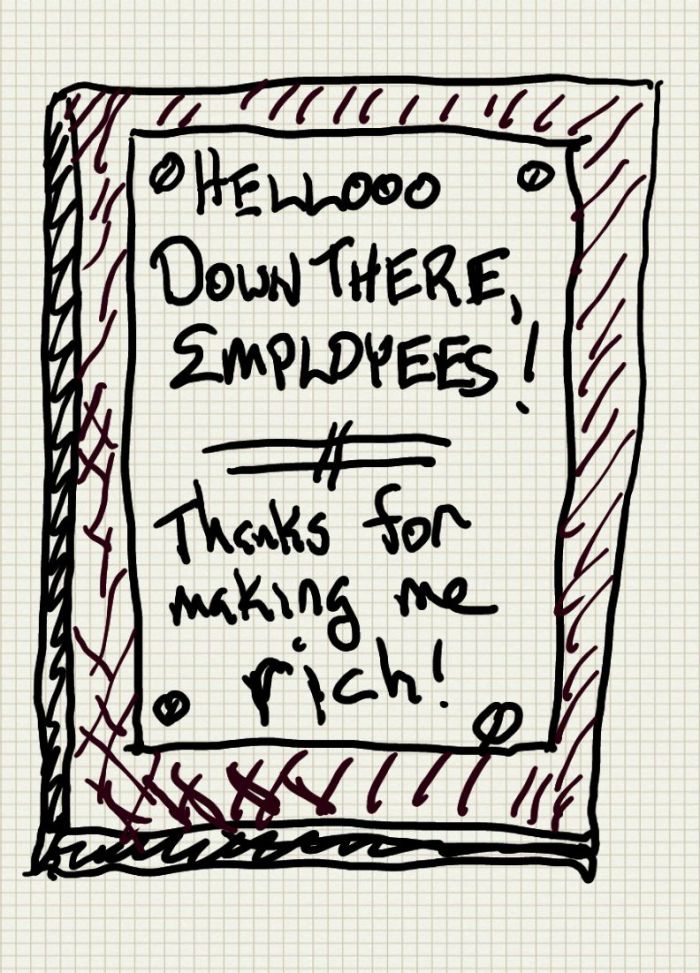
Stephen Hemsley, UnitedHealth Group, took home $28,139,070 in 2013
Here’s my plaque-concept for employee appreciation
$2-3 million for an engraved plaque for every employee? Totally worth it.
 ###
###
“Do You Know Bob? You Should Meet Bob.”
Listen when your friend says this.
After your friend hears what you have to say and then responds with,
Hey—have you ever asked Judy about that? Because Judy talks constantly about that very thing.
Listen.
And then go meet Judy. Or Bob.
Because a friend’s recommendation—after seeing a similarity or spark of sameness—can be telling. The connection your friend saw to make the recommendation implies you have something in common with this other person. Some way of thinking that will form a third-rail for communication.
And that is worth following up on.
I think Keith introduced me to Steve—likely through some offhand comment. Steve is a C-suite communication guy who also teaches and we talk about communication strategy, corporate life versus freelance life, life in agencies and the demands of teaching. I’ve had coffee with Steve a couple times and I honestly don’t think I could find more wisdom and excellent advice and weathered perspectives if I paid Seth Godin’s consulting fee for an hour of talk.
We have no clue what might happen with a connection. No idea where a conversation will go.
This remains amazing to me.
###
Image credit: Garry Winogrand via MPD

 conversation is an engine