Archive for the ‘Writing’ Category
Listen to Your Story
What I Learned from NaNoWriMo 2015

Just do this to write a novel.
How much different is writing from life?
In both we make decisions that carry us forward. Sometimes those choices work out well. Sometimes they drop us in a dead end. Mostly it is not clear where the choice leads, and so we carry on.
Writing 1667 words a day through November’s National Novel Writing Month forced me to look at every scene and imagine how it might move the story forward. Within the first few days, every scene, every action, nearly every word seemed full of, well, pivot. The story could turn 180 degrees—except the commitments my characters held worked time and again as a rudder, pulling their choices along a true direction.
Choice after choice makes the story. Along the way we interact with characters who enter the story because of our choices. And these characters bring with them yet more choices. Our commitments impact how we choose, drawing us like a lodestar consistently one way or another. But even those long-term commitments enter the choice-making machinery of writing and life.
Do you agree that writing and life move forward in a similar way? One difference is that with writing you get to go back and change the story.
You can’t do that with life.
Or can you?
Producing my story brought to mind Parker Palmer’s book Let Your Life Speak, a book I’ve recommended to many friends. Palmer’s advice gets at the nub of both writing and living: peering into the facts so far and taking a courageous view on where those facts could lead. Palmer realized, in looking back over his life, that a particular commitment had been leading him in ways that did not fit with what was happening and where he was meant to be.
In writing you lop off a sentence (or paragraph or chapter) to move the story forward. In life you make tough but wise choices that put you on a better trajectory.
###
Dumb Sketch: Kirk Livingston
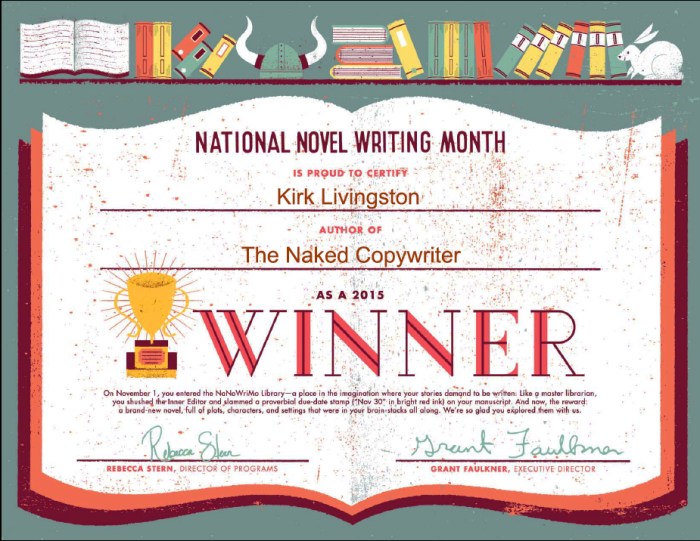
The Naked Copywriter (NaNoWriMo)
I’ll be absent for a month or so.

November is National Novel Writing Month. Last year I wrote the 50,000 word Fresh Water Fetish. This year’s 50,000 words are dedicated to story and explication around what it means to live a creative life. This may be a novel. It may be creative non-fiction. But in 30 days and 50,000 words I’ll have a better idea.
If, in my absence, you wonder what “conversation is an engine” might say about any particular topic, just type your term in the search bar. There are more than 1130 posts here–feel free to browse.
Alternatively: write your own novel for NaNoWriMo!
###
First Person Tooter
Let others pull philosophy out of your story
It turns out the story of a person’s life is interesting in a way that we have a hard time looking away from.
- How they got to where they are.
- Who were their influences?
- What were the shaping forces that drove them: poverty as a child? Loneliness? Were they ostracized or bullied?
- What was behind their particular quest?
All of this is story.

We each tell our stories in different ways.
I’m reading Louis L’Amour’s Education of a Wandering Man despite myself.
I’m not a particular fan of L’Amour’s writing. I have no great interest in cowboys and western shoot-em-up stuff, still I cannot put down his biography. It’s how his personal story unfolds and his depiction of the times he lived that are so gripping. And because I know where it all leads—at least to some degree. L’Amour’s education consisted of working on migrant fields across the U.S., and the merchant marine, and boxing and in reading whatever little blue books he could lay his hands on. He listened to hobo stories and seamen stories and drinking stories and murder stories. He also wrote very clearly—so that I almost don’t even realize I am reading.
This strikes me because much of what I read calls attention to itself in thousands of ways, from pedantic language to detailed concepts that demand rapt attention to self-indulgent fluff to the simply boring. And I’ll confess to committing some of those very language sins myself on pages.
But what if a philosophy book told a story rather than parsing dry doctrines and tentative tenets? In fact, that is exactly what stories and novels and films do: package thought into a compelling narrative.
Story keeps pulling us back in.
###
Image credit: Kirk Livingston
Wait: Can we talk too much?
Feed your existential intelligence
I’m gearing up to teach again: freelance copywriting and social media marketing. My understanding of communication and writing and the volunteer social-media tethering we do continues to evolve. I can talk and teach and speculate about what works for communication and how to provide what a client needs. I can talk about how we need to help our clients think—that is a piece of the value-add a smart copywriter brings to a relationship. But these days I’m seeing more limits and caveats—especially in the promises inherent in social media.
These are English students and communications and journalism. Some business students. Juniors and seniors. Many are excellent writers. Many, if not most, have worked hard to develop an existential intelligence, as Howard Gardner puts it. I teach at a Christian college, and from very many discussions with students, I know they will seek a place for faith in their life and work and life-work balance. Many if not all are just as eager to make meaning as they are to find a job.
That pleases me.
That’s one of the reasons I like to teach there.
One thing I’ve learned is that work alone does not satisfy the meaning-making part of life. Nor does work itself feed the existential intelligence. Craft comes close. Especially when we grow in our craft as we seek to serve others. But work and craft and meaning-making must be purposefully-pursued.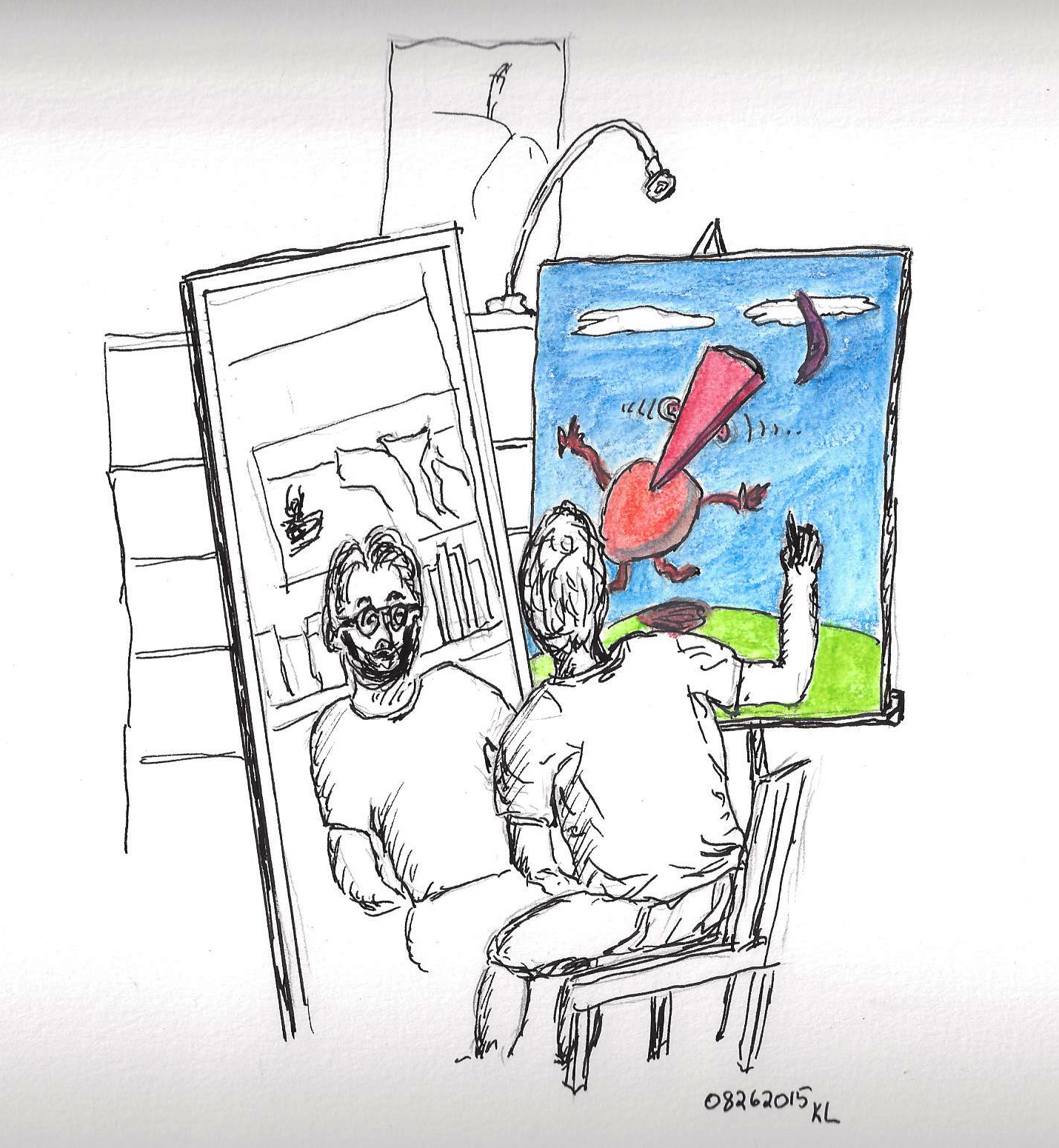
Intentional-like.
Because if we don’t pursue them, we fall prey to entertainment. We gradually anesthetize ourselves and starve the existential intelligence with the well-deserved zone-out time in front of the big screen TV. I’m starting to wonder if some of our social media habits also starve our existential intelligence.
I wonder because I wrestle with these impulses.
No. One does not fall into meaning-making. It takes work to make meaning.
I suppose that is the work of a lifetime.
###
Dumb sketch: Kirk Livingston

Dilbert: Maybe try writing something.

More Scott Adams: http://dilbert.com/strip/2015-08-11
Recast Your Story
Melt. Turn. Form. Repeat.
More and more of my work is recasting. Telling an old story in a new way: finding the locus of interest for today, for these people, living right now. These people who don’t care how the story used to be told—it meant nothing to them and seemed irrelevant if not invisible.

My industrial-controls client wants a new way to talk about a neglected product. I write to find the words and the approach to make it interesting for today’s audience. My medical client wants to recast the backbone of their selling proposition with proper science and citations (versus just their own internal studies, which were not wrong, just limited). A consulting client wants to turn their expertise into a broader story that pulls in people outside the narrow audience with which they’ve been successful.
My process is to play with the story element. That’s why writing often seems like play or goofing off. It must be so: that’s where key discovery happens. Sort of like the process in my daily failures at Dumb Sketch Daily. I don’t know what’s right until I draw it wrong.
It occurs to me this recasting process is going on all over my life. Writing and faith and parenting and exercise are all changing before my eyes. A new story keeps getting told about each and it is important each story is told—telling and retelling the story helps me understand life. Maybe the retelling is all about making meaning.
What’s changing in your life and what story do you need to recast or retell? And who might benefit from that retelling?
###
Image credit: Kirk Livingston
Find Work Where You Can Draw Your Own Lines (Shop Talk #10)
Color inside your own lines
I’ve had several conversations lately with people looking for ways to bring writing into the rest of their lives. Some want to make a living as writers. Others want to flesh out a particular passion that been dormant behind the demands of their day job.

In each case I suggest drawing their own lines.
What I mean is to look for opportunities where you can define the problem yourself (or in collaboration with a few). When you define a problem yourself, you set the focus and you begin to take ownership. Then your brainpan starts spinning in a fresh orbit that lets you locate resources to help solve that problem. Defining the problem is a way of looking at the topic of your passion and finding what about it that excites you and where that might be a problem/solution for others. Inevitably you want to send your topic out so others can begin to care as well—or perhaps you send it out to find those other few who care.
Writing something is a way of drawing your own lines.
I know this from (literally) drawing lines of definition: over at Dumb Sketch Daily (currently at dumb sketch #152) I’ve been trying to learn to draw. I’ve found that an ink pen does a kind of definition work that my eye longs for. Sometimes I wonder if ink is a crutch: outlining before filling in detail with color or graphite. Do I really need those lines? But then I think
I don’t care.

I’ve got your precious Brussels Sprouts right here.
Because there is something about the crisp line that yields a bit of loony joy. Yes, it is true, that line does not exist on the edge of my Brussels Sprouts. Not really.
Still.
Seeing something clearly feels worth that particular fiction.
What definition work will you do today?
Where will you draw lines?
###
Image credit: Kirk Livingston
Dumb sketch: Kirk Livingston
See also: “Can 78 bad sketches change your life?”

 conversation is an engine