Archive for the ‘Writing to build community’ Category
Wait—English Majors Win in the End?
Start Writing Your Own Future
- Announce your goal to lose weight and chances are better the pounds will flee.
- Sign up for NaNoWriMo and chances are better you will actually write that novel (no matter how badly it turns out).
What we tell each other has a way of happening. What we tell each other about our preferred futures has a way of guiding next steps.
- Write a letter to your collaborative, inventor friend about a business idea and find yourself planning concrete marketing and distribution steps at Spyhouse Coffee.
- Write a business plan for your startup and suddenly remember your friend who became a venture capitalist. And then remember the friend who bootstrapped her idea.
See the pattern? Each step forward started with communication. You may say,
“No. the idea came first.”
True—maybe.

Create in real time as you go.
But consider: the communicated idea created a spark. And—given the right collaborative conditions—the spark lit a fuse. And the fuse burned, gathering other ideas until the explosive, disruptive future no one had considered.
What if English majors learned entrepreneurship and began to see their talent for orderly, persuasive, deeply-rooted writing as a way to help themselves imagine new futures and chart forward-movement for others? What if they learned to solve real-world problems with story and emotion and analytics? Their solutions would drop-kick the spreadsheet & PowerPoint crowd. What if some English majors created Lake Wobegon while others created the next Google?
What if English majors learned business lessons alongside the standard fare of reading and writing? What if they were expected to serve up the occasional business plan or marketing strategy along with the usual essay, short story and poem?
If that happened, English majors would connect earlier in life that art and work and commerce and fiction and meaning-making all fit together in the same world. And they would begin to write their own future vocation.
By the way: 16 Wildly Successful People Who Majored in English
###
Caveat #1: I was never an English major.
Caveat #2: I teach English majors. They are smart, innovative people.
Image credit: Kirk Livingston
Should a Doctor Blog?
Only if they want to grow their practice. Or connect with other physicians. Or with patients. Or provide thought-leadership.
Greg Matthews, author of Missing the Forest for the Trees, has been studying the online presence of physicians for years. He’s found that the credibility of their position and the connections within that position can translate to large and devoted followings today.
But all that was counter-intuitive in 2007.
Back when Mr. Matthews was formulating his questions about physicians online.

Back then he was sure—we all were sure—that talking about health information online would never fly. It’s just too personal. What kind of nut would diagnose and prescribe in public/online?
Plus, well, HIPAA.
But some physicians found a way to talk with regular folks (that is, us non-experts who live on the web) about pressing topics. Diagnosis and prescribing on the web was a non-starter, but presenting topics in a way that made sense to regular people did happen. And as we all took to the web to sort our maladies, these authoritative, personal voices became trusted sources of information.
According to Mr. Matthews, today 61% of physicians access social media weekly, 5000 physicians post daily to blogs and Twitter, and 50 physicians are followed each by more than 500 other physicians. Some physicians even feel “ethically obligated” to share on the web. Download Mr. Matthews PDF for more stats.
In this blog (conversation is an engine) we talk about conversation. We’ve noted how conversation is a two-way street: not just in words exchanged, but actually causing conversation partners to go and do different stuff. We leave our best conversations changed and with new resolve for the most important things facing us. It’s a sort of speech-act theory for anyone willing to take a dumb-sketch approach to life.
And even physicians and even patients can gain from this. And what they both gain is far more than mere information.
It makes me wonder what paths might open for collaborative conversations in lots of different work settings.
###
Groundswell Plus: Please Write a Plus-Sized Book about Today’s Social Media Opportunities
Beyond Li & Bernoff’s Groundswell
Groundswell was published by Charlene Li and Josh Bernoff in 2008 (Boston: Harvard Business School Publishing). I’ve used it a couple times to frame this new opportunity and give social media marketing students a sense of the possibilities of communication beyond liking a snarky comment, link or photo on Facebook. I’ll use the text again but I’m also prowling about for newer texts.
Groundswell is a grandfatherly text by today’s standards. Published (counting fingers: 9-10-11-12) more than five years ago and much has changed. I like the book for the authors’ optimism about building and maintaining communities. And that is precisely where it is starting to wear thin. It turns out building communities is a much more complicated endeavor that works best when flesh and blood people talk with flesh and blood people. The social media piece is a nice and useful add-on, but students need to see a larger picture.
I’ve got other texts that give details about best practices and content strategy. We’ll certainly discuss the disciplines of editorial calendars and fine-tuning their understanding of their audience and tightly defining what their audiences need/want. And, as always, we’ll write and share and write and share and learn what works for ourselves.
Groundswell is firmly focused on taking full advantage of business opportunities. That’s why I first started reading it and it may be why I end up with something else next time. My students tend to be a devoted bunch: they attend this Christian college and their writing (most are English students with a professional writing focus, plus a few journalism and business majors) bubbles up from deep theological streams. Many will say they have no interest in business right up to the point where they realize they actually have to pay off their school loans. That realization attenuates their post-college work vision. One my teaching goals is to help students start to see just how much those deep theological streams can pour through the world of work with all sorts of happy results (an income comes to mind, but also making a difference in real life).
What I’d really like is a Groundswell Plus. I’d like a version of Groundswell that paints a larger picture of the community-building opportunities. Perhaps Groundswell Plus tells stories from the Arab Spring (for instance) or Ai Weiwei and points readers toward organizing for social change. Maybe this plus-sized version of Groundswell could point readers toward unearthing social problems (along with business opportunities) that might respond to collaborative energies.
Because in the end, students want to give themselves to things that matter.
Just like the rest of us.
###
Why We Need a Science of Collaboration
Whatcha talkin bout Willis?
When I assign a report that must be completed as a team, my college writing classes get very still. When I explain the assignment will be graded as a team, I hear barely audible groans and see ever-so-slight grimaces. (These are polite writing students, after all.)
It is much simpler to be an individual contributor than a collaborator. The fun of writing is in the discoveries you make as you write. Collaboration seems to negate all that.
So many unknowns in collaboration: will my team care the way I care? How will we divide the work? What if that slacker is on my team? Who will lead this group?
(“Please let it not be me.”)
(“Please, not me.”)
(“Please.”)

Elegant work from Ogilvy, Honduras
And yet working together—collaborating—is one of the essential skills our business communities (and academic communities and faith communities) desperately need. This story from the Association of Clinical Research Professionals (via the ACRP Wire) highlights just how big the stakes might be for future collaborations:
An essential new way to move discoveries forward has emerged in the form of multistakeholder collaborations involving three or more different types of organizations, such as drug companies, government regulators, and patient groups, write Magdalini Papadaki, a research associate, and Gigi Hirsch, a physician-entrepreneur and executive director of the MIT Center for Biomedical Innovation.
The authors are calling for a new “science of collaboration” to learn what works and doesn’t work; to improve how leaders can design, manage, and evaluate collaborations; and to help educate and train future leaders with the necessary organizational and managerial skills.
Part of the problem is that we think collaboration will just happen on its own.
It doesn’t. Someone needs to organize the task. That organization can look like top-down authoritarian leadership or it can look like colleague-helping-colleague asides. Both approaches have their place, as well as the infinite variety of other ways to help a team move forward. People who study and practice these things are my heroes.
I can’t help but agree with Papadaki and Hirsch in calling for a new science of collaboration.
And for those of the writing persuasion, I plead for patience with group work.
Because sometimes the lightning bolt of writing also strikes in a conversation.
###
Image via Ads of the World
Juxtapose: How To Build a Church that Counters Culture
 Theological Roots and Practical Hope for Extreme Listening and Honest Talk
A couple nights ago Mrs. Kirkistan and I had dinner with old friends we’d not seen in some time. It was refreshing to catch up and there was lots of that free laughter that happens when old jokes and forgotten quirks reappear. At one point someone asked whether we were hopeful about the state of the evangelical church. We each offered an opinion.
Mine: “No.”
It’s actually a qualified “No”: my sense is that the evangelicalism has largely lost its way following industrial-strength, church-growth formulas and it has also sold its soul to political machinery. Following these tangents we’ve lost the essence of what it means to counter culture by speaking the words that stand outside of time.
I’m actually quite hopeful about what God is doing—especially in the Minneapolis/St. Paul area. We’ve seen a number of groups trying very new things while employing deeply-rooted devotion to sacred texts and veering from partisan nonsense. So my sense is that evangelicalism is morphing and, frankly (I hope) growing up.
For a couple years now I’ve been laying down about a thousand words a day toward this book dealing with the theological and philosophical roots of communication. It’s been a one-step-forward-seven-steps-back process. But I’ve just finished Chapter 8 and by the end of July I’ll deliver the manuscript to my editor friend. I’ll likely self-publish it later this year—I’ll probably have to pay people to read it (Know this: I cannot afford more than $5 a reader. So both of you readers give a call when you are ready. I’ll put a fresh Lincoln in the Preface.)
The book offers new ways to think about the ordinary interactions we have every day. It draws on a few philosophically-minded thinkers and reconsiders some old Bible stories to reframe the opportunity of conversation. It also provides a kick in the butt to move out of our familiar four walls to engage deeply with culture—but not from a standpoint of judgment, rather from a deep curiosity and love. I’ll be sharpening the marketing messages over the next few months, but here are the chapter titles so far:

Would you stop browsing at Barnes and Noble long enough to pick up a book that looked like this?
- The Preacher, Farmer and Everybody Else
- Intent Changes How We Act Together
- How to be with the God Intent on Reunion
- Your Church as a Conversation Factory
- Extreme Listening
- A Guide to Honest Talk
- Prayer Informs Listening and Talking
- Go Juxtapose
Let me know if anything of what I’ve said sounds like you might actually be interested in reading. However: I can only afford to buy a limited number of readers.
###
Image credit: Daniele Buetti via 2headedsnake
Why I Want To Do What Others Don’t (Shop Talk #6)
Guest Post from Kayla Schwartz

From The conchological illustrations, by George Brettingham Sowerby, London, 1832.
[A few of us have been discussing what fulfillment looks like for a professional writer. The entire discussion was in a response to a question from Kayla Schwartz, a professional writing student at Northwestern College. Check out these six essays filed under Shop Talk: The Collision of Craft, Faith and Service for more on that. Kayla’s back with this guest post that contains a few of her thoughts and conclusions.]
“Technical writing? That’s so…interesting.”
This is the response I usually get when I tell people what I’m studying. As a professional writing major, I’ve done journalism and PR writing, but I’ve been most drawn to technical writing.
Why? I had not given it much thought. Most people think of technical writing as boring or tedious. So why pursue it? What really drives technical writers?
As I’ve thought about these questions and talked to technical and other professional writers who’ve been at it much longer than I, I’ve gleaned a few potential answers.
- It’s useful. Some people find a lot of satisfaction in their ability to help others understand things. They feel they are making a difference.
- It’s necessary. Technical manuals may not always be read by customers, but they are a necessary step in the process of distributing the product. There is satisfaction in contributing to a company’s success.
- It’s interesting. For people who are naturally curious, technical writing offers an ideal situation: learn about new ideas and products, and get paid for writing about them.
- It’s lucrative. Yes, some people are just looking for something that pays the bills.
All of these are valid reasons to do technical writing. However, none of them really expresses my motivation (although the last one is starting to look pretty good when I think about my student loans).
I’m pursuing technical writing because I genuinely enjoy it. I like creating an organized, easy-to-follow document. I like figuring out how to use words effectively and concisely. I’m a bit of a perfectionist and don’t mind spending time on “minor” details. I suppose I enjoy learning about new things or knowing that I’m helping others, but ultimately, it’s a way to do what I love.
Maybe this makes me the exception among technical writers, but I hope not. Technical writing isn’t for everyone, but for those of us who enjoy it, it can be just as satisfying as any other career.
###
Image credit: George Brettingham Sowerby via OBI Scrapbook Blog
What is Remarkable—in Your Industry?
Connect the Dots for Your Clients and their Customers
 Over at the Same Rowdy Crowd, Joe Loveland wrote about the best and worst of the Blogosphere. One of the points Loveland made is that the blogosphere is less about creating and more about aggregating. Nothing new there: we’re all curators today. But in aggregating, we are also connecting the dots for ourselves and for each other. This actually is a value-add: because I get to see how you are thinking about life today. Which also points to the ephemeral side of social media. Like tweets, blog posts are mostly of the moment. Meant to be read and discarded, much like verbal conversation: as we announce something, it is gone. That is the nature of sound.
Blogging and tweeting (and etc.) are simply tools of remarking. My working definition of “remarkable” is that a thing is remarkable when I choose to tell someone about it. Bear with me: there’s more to this. If I remark on something to someone, I think they’ll care. And I think they will find it interesting. I won’t remark on something to a friend if I think they’ll not care or if I think they will find it boring (like my 10-year-old friend thought me yesterday).
So the work of social media, in many ways, is that of connecting the dots by remarking on things we think people—our audiences—will find interesting. And along the way we show our expertise (or reveal our shallowness) even as we invite our audiences to think with us about one slivery facet of a topic. One small thing. One small thing that is of today.
It is this one small thing, this one slivery particular that has the power to pull in the outsider. This is because we can become fascinated by the inner workings of someone else’s world. It is the momentary pulling aside of the curtain that both reveals what is inside and draws others in.
Over at Clarity Coverdale Fury they are running a series of posts on the conscious consumer. Rob Rankin remarked about how his wife rented a dress for a Christmas party rather than buying one. He called the organization she used the “Netflix of fashion” and went on to hint at how this model of commerce will intrude into yet another industry. That is interesting and remarkable and a nice connection for most any audience.
One challenge of communication today has to do with finding those remarkable things you can share with insiders—and industry outsiders—which they will find interesting. It’s a language challenge. And a focus challenge. But since the days of monologue and the bully pulpit are long gone, this is our invitation.
###
Image credit: via Frank T. Zumbachs Mysterious World
Gay Marriage and the Desperate Times/Desperate Measures Argument
People of faith can do better
 Amy Bergquist’s powerful editorial (“This man shouldn’t get the last word on gay marriage”) in today’s StarTribune makes a strong argument about treating people as adults. Read the comments (59 as of 10:10am, 135 as of 2:50pm) and you’ll be reminded of what a lightning rod issue this is for our culture. Setting aside the lightning and the working parts of Christian conviction in a multi-religious nation for a moment, I believe Ms. Bergquist is exactly right about Frank Schuber/Schubert (The Strib printed his name both ways) methods:
Running emotion-driven ads at the last minute does not give room to debate, discuss or even engage one’s mind. It’s all visceral. It’s all knee-jerk reaction—which is the point: We all know that every institution and cause, from the Axis to AIDS, has played on emotion to move people to action. We each tune out countless of these messages every day.
As a copywriter and a student of persuasion and a Christian, I question Mr. Schuber/Schubert’s tactics: while his ads may move the vote, they do not promote transformation. Transformation happens as people engage with an issue and think it through and talk it through (and pray it through). On a personal level, it is one-on-one conversation that makes things happen. The notion of ambush communication tactics may give short-term gains in Jerry Falwell’s culture wars while leaving the nation’s current inhabitant’s thumbing their fact-checkers as they walk away.
I know these tactics well as a copywriter. But anyone can see that advertising and marketing communications are moving away from the trick-you-into-buying mentality. The marketplace is much more conversational and becoming more so every day.
As a sometime faculty member at Northwestern College where Mr. Schuber/Schubert was interviewed weaving his emotional magic, I wonder if the faith community that supports the college can call for better, more mature, truly Christian communication. I doubt the college sanctioned Schuber/Schubert’s particular work, though clearly the marriage amendment would have a lot of support from the evangelical-minded folks aligned with Northwestern College. But I would challenge the community to find ways to engage people in conversation—sort of like Jesus and Paul did—rather than supporting more rapid-fire emotional outbursts.
Let’s grow up.
Together.
###
Image Credit: Famous Movie Quotes via thisisnthappiness
What does a “social” church look like?
What Does a Social Anything Look Like?

hey-let's unlock our solipsism
We talk a lot about “social” but often marketers and corporate communicators practice the same old monologue and one-way messaging characteristic of the last century—they just shrink and divide their messages into packets of 140 characters and broadcast them through the channels people happen to be listening to at the moment.
For most of us “social” means only broadcasting through relatively new channels. We mostly don’t get the listening part of dialogue. This deafness comes from a deep place: this human tendency to see ourselves and our thoughts—our messages—as the axis for all that happens in the world. How could it be otherwise, given that we experience every part of life through our senses: the world comes to us as images, sounds, tastes, feeling and odors?
Certainly that is the case with profit-seeking entities like corporations. We monologue because we want people to buy our stuff. Same with churches: leaders broadcast what they want followers to hear and act on. Same with any organization.
3 Lessons and a Revolution
I’ve just finished my third run at teaching Social Media Marketing at Northwestern College and yesterday was my favorite day: when the students present what they learned from their social media excursions and community building activities. They learned:
- That the most tautly-orchestrated rhetorical strategy falls apart pretty quickly in the face of the opinions and interests of their audience. Students become completely captivated by hearing others respond to their words and ideas. These responses are especially enticing after years of writing papers only for the professor’s eyes.
- Try-Fail-Adapt was a motto we took from our texts and nearly universally adopted. This is the way forward with building communities using social media.
- That vague “interesting” titles and headlines don’t pull readers nearly as well as solid simple titles and headlines. And that putting a number in a headline produces a bit of magic. Something women’s magazines have practiced for decades.
One notion that threaded its way through the presentations was this subversive, revolutionary aspect of working with social media. When you look beyond today’s tools as just more broadcast channels and see that people are given a voice, the world starts to tilt differently. People with a voice. A voice that agrees with leaders. Or not. Voices that speak back to power. We’ve already seen those voices collecting around the Arab Spring, Putin’s Russia and our own Occupy movements. What will that look like as people slip into ownership of the church? Because it is sure to happen there as well. Will leaders learn to lead collaboratively and by pulling people toward them? Or will leaders rely on pulpits and authority structures for their power? And how long will that tactic last?
###
Image credit: Neatorama
Take This Word to Rehab: “fellowship”
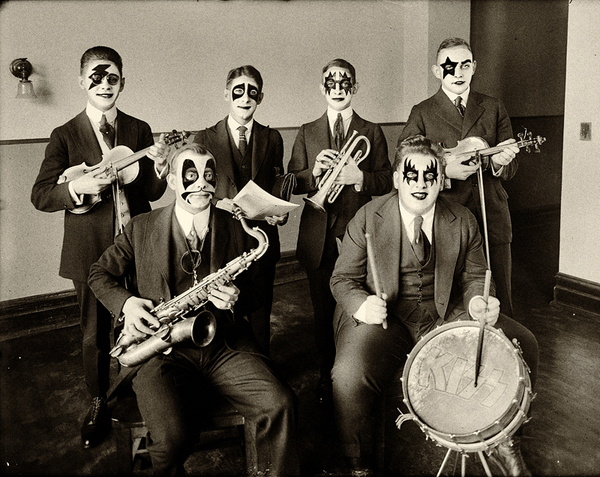
Old becomes very, very new
If it makes you think of blue-haired older women drinking tea and serving Jello salad in a musty church basement—like I did—then you need rehab.
A few of us are making our way through an ancient text: a very old letter from around the first century. The writer said he had seen and heard and touched a man claiming to be God. This writer, eager to connect with his audience, was also eager for his audience to connect with this Man (the writer said his “joy would be complete” if they also had “fellowship”). That’s because there was something about “fellowship” that was not just “nice” and way more even than “robust.” As one of our readers put it: “these first few lines are awesome.” The writer opened an invitation to some kind of life and some kind of relationship that was well beyond ordinary human experience. The open invitation hints at far more than idle conversation. The writer invites full-on partnership/participation/relationship with this God and God-Man and the other people known to both.
Which is awesome. And becoming more so every day.
I see the notion of “fellowship” changing before my eyes.
###
Image: MyModernMet.com

 conversation is an engine