When do Technical Details Need a Public Face?
 A sharp friend and colleague asked my opinion on what blogging has to do with technical writing. Both of us teach professional writing classes to upper-level college English majors. Her technical writing students recently opted to deliver assignments as single files rather than modifying them to fit a blog format. I see why: blogging requires a further step of engagement with a wider set of audiences. Blogging has a public face that is wide of the mark for writers who usually compose directly for audiences with specific technical motivations.
Blogging Is The Nonchalant Public Face
In some ways, blogging is a perfect venue for technical communication: the communicator can be as specific as she desires without worrying about capturing audience attention because the audience will find the information. Or not. While blogging must never be boring, the right audience will find details and specifics as scintillating as any steamy romance novel. But I applaud the instincts of my friend’s students. In true college student fashion, why do more work when less will suffice?
Blogging is the more spontaneous and casual cousin of technical writing that allows for quick and specific responses to real questions. Blogging allows more free-form communication about timely issues and provides room, resources and the expectation of responses from an engaged audience—all of which scares lawyers and regulators in a regulated industry. Blogging also makes information and specific insights searchable by a wide variety of people. In a college writing assignment, that public face is not needed and simply represents another process for the writer.
But there may be good reason for writing teachers to find ways to make blogging a more attractive part of the technical writing assignment.
Detail-Delivery Is Changing
For a long time the forms of technical communication have been stable: manuals, instruction sheets, assembly instructions, monographs and the like. We wrote these forms for the reading pleasure of the poor soul faced with a bag of parts or the new customer opening a new piece of software. But today audiences are using technical details in all sorts of new settings. Plus: my technical clients want very much to join the social media frenzy. They just don’t see how they can, given the narrow technical audience they cater to. What they don’t notice is that the very technical resources in their company that have focused on the traditional forms of communication could actually be repurposed for delivery of technical information outside the usual forms. This information could be loaded into a blog-type form that has the advantage of being searchable. The point: let customers find you.
Why go to this extra effort? Simple: no one likes being sold. Finding new forms for communicating technical detail may well be the best marketing investment your company can make. That’s why I think academics and industry, English professors, communication managers and marketers all need to open fresh ways for technical communicators to speak to wider audiences. The future I see has technical and promotional walking hand in hand to satisfy the human need for specificity.
###
I’m Writing a Book called “ListenTalk”
I’m writing a book about talking and listening. I’ve become crazy about what happens in our best conversations: we come alive. We learn something about another person and in the spontaneous moment of creation as we frame up words to describe our own situation, we often suddenly learn something brand new about ourselves. Something we didn’t know before we started talking. I’ve begun to think that when we are in conversation, we are more truly ourselves. And the best conversations have a way of making us very present to each other.
I call this book “ListenTalk: You’re Boring. Let’s Change That.” I think we were created to be in constant, deep, creative, spontaneous conversation. Not just with each other, but with God. That’s why parts of the book develop a theology of communication, starting with God’s act of creation, where His speech-act created dirt and air and giraffes and coffee beans and people, among other things. So you can see that with my book I hope to bring together something of JL Austin’s work on communication with a commitment to faith. Maybe I’m trying to do something impossible. I’m not sure. In a few days I’m scheduled to talk with a philosopher and speech-act theory expert at the University of Minnesota. I’m interested in his response to my notion of combining these things.
Two more pieces of this book project capture my attention in a big way.

Derrida and Welcoming the Other
One has to do with Derrida’s notion of welcoming the other. I recently finished James K.A. Smith’s “Jacques Derrida Live Theory” (Amazing: the book retails for $120! No wonder I cannot afford most of what I read) and was pleased to see a philosopher working from a faith perspective dealing with Derrida’s thoughts. I was impressed to see overlap between Derrida’s notion of welcoming the other into conversation and the God of the Bible’s commitment to welcoming the other. The Bible talks about reconciliation, and that definitely includes welcoming the other. What reconciliation does not mean (and here is where Derrida is particularly helpful in helping throw off some of my Christian cultural baggage) is making the other like me. We’re all tempted to make those around us like ourselves. But that effort misses the point of the kind of conversations that will sustain us.
Is Prayer a Model for Conversation?
Pulling more from theology than communication theory or philosophy on this last point, one of my chapters looks at prayer as the Bible talks about it and posits that we were meant to communicate with each other along these lines. Nothing really mysterious or unorthodox, I just wonder if the way we communicate with God (listening followed by moments of intense listening, and then very frank speech) is meant as a model for how we communicate with each other. Maybe listening is to take more of our effort than talking, which is a lesson advanced people of prayer seem to know.
Social Media is a Way Forward
This book ends with the notion that people of faith are currently presented with a rich opportunity to create and be in conversation. People of faith would do well to place ideas out in the public common areas, since there are far fewer gatekeepers, and see how people respond. This is part of the class I teach at Northwestern College called “Building Community using Social Media.”
What do you think? Would you read a book like this?
###
The farmer and the cowman can be friends, but would either want their kid to study English?
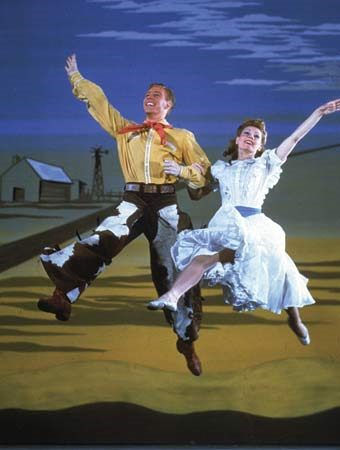
All it took in Oklahoma was a rousing dance—and a few right hooks—to convince farmers and cowmen–two different disciplines–they could hang together. But a few generations later, getting their grandkids to combine art and commerce in the college classroom requires a completely different kind of dance: one few are prepared for and even fewer seek.
 Momentum is building (again) for those questioning the value of a liberal arts education. Sameer Pandya, a lecturer at UC-Santa Barbara wrote recently in Miller-McCune, of his soul-searching when a student asked for advice: whether to major in something she found fascinating or something that might produce a job at the other end of the coursework. He said what anybody with a bias toward the liberal arts says: choose what you enjoy and the work will take care of itself. But privately he backtracked as he worked through the cost/benefit ratio: just how will the dollars spent reading F. Scott Fitzgerald help the student outside the classroom? And “Higher Education? How Colleges are Wasting Our Money and Failing Our Kids and What We Can Do About It,” a recent book by Andrew Hacker and Claudia Driefus, has given the debate legs, and will surely be a topic of conversation as students lament tuition bills and make the way back to school (or not).
It is clear we need a new educational model that rewards thinking and practical skills. But wait: who ever said thinking and practice were poles apart?
One of my jobs is to teach professional writing classes to college juniors and seniors. These are (often) talented students who have made their way through the rudimentary composition classes and exhibit ongoing interest in writing in a work setting. Some even envision themselves using the skill to make some coin. I teach because I earn my living as a copywriter, which means I serve organizations, companies and advertising agencies by thinking and writing. I teach because writing is fun (really!), and because these interested students are excellent communicators who participate in lively discussions. And I teach because I have an axe to grind with those who think they can find themselves only by writing poetry or short stories. Don’t misunderstand: I’m a great fan of poetry and short stories. But there’s a mood that begins somewhere in undergraduate education, perhaps even earlier in high school, that applies the romance of the fiction writer or poet to our own scribbly ways. We think the more we burrow into our selves, the more we tell our stories or embellish stories we make up, the more we’ll figure out who we really are. I believe there is much truth in that notion, but the burrowing-in may not lead where we want to go. And it may not lead to the place we need to be.
There is another way to personal formation.
I tell my writing students that poetry and short stories are good—indeed, very good—but that you can also learn quite a lot about yourself, you can grow in your craft, and put beans and rice on the table (even Spam sometimes), by writing for others. Yes—serving others through writing. It’s not an easily-caught vision for poets and fiction writers, frankly. Because of clients—they’re always changing my words! And because the technical detail clients use to serve their customers can feel, well, boring. There is very little room for plot or the arc of a story in a brochure or print ad. Right? And yet, it is precisely these missing artful bits that are helping to change the face of communication as restless writers find new ways to communicate with audiences—new ways that break down the old forms. I’ve seen the short-story writing student effectively bring story into a product brochure—to excellent effect. In our changing communication world, where corporate monologue is even now giving way to engaging dialogue, it’s the writers who resist the high walls of the old forms that will move us all forward.
That’s why I think the farmer and the cowmen’s grandkids will help us establish this new communication frontier as they find themselves making friends with art and commerce, with every use of their English degree.
###
Seattle Pike Place Market
 Among barkers and pitches and queries over price.
Prunes and potatoes and fish packed in ice.
A tiny man sat on a low stool
Lonely notes sounded, a string his tool.
One lone string sang strength and long-life,
And crossings and family and a well-loved wife
Of war and of peace
And of work without cease
In the market and deep in the throng
I heard clearly every man’s song.
###
Honest Defense Strategy: “My client isn’t just arrogant. He’s ignorant!”
You’ve got to admire a defense strategy that highlights that Blagojevich “talked big but was none too bright.”
Of all the things Blagojevich says, his lawyer is the easiest to believe–at least on this point.
Maxed Out: Good Scared
Within ten minutes of starting Maxed Out, I began thinking of cutting up my credit cards. The documentary sets out to expose the predatory practices of credit card companies. Like you might guess, the film is full of the pathos of people in over their heads. It’s gut level film that left me eager to do anything to avoid contributing to any credit card company’s bottom line.
Eye-opening moments:
- The film names the big national banks we recognize and trust that actually front the high-interest storefront cash advance businesses that prey on the poor—and make lots of money doing it
- Efforts to curb predatory lending by enacting national laws were thwarted again and again by the banks and their lobbyists
- George W. Bush encouraging the nation to go out and spend. I still remember my disgust when he was saying that, but capture in film brings it all home again
So—solid fun for a documentary and well worth watching. But please watch it with your brain engaged: watch for the rhetorical tricks that lead directly to your visceral reaction. The film presents one side well, and matches up faces and sad stories with the purpose of exposure. I would have liked to hear the other side. Not because I love credit card companies and bankers, but because there are occasional legitimate purposes for credit. I would also like to hear something about personal responsibility.
The film succeeded in scaring me—yet again—about easy credit. Yikes!
###
Are Words Always as Powerless as They Seem?
When we preach, our words often drop like stones from an overpass. And by “preach” I mean anyone who launches into a speech without a deep regard for her listeners. Pastors and priests can do it, but so do marketers, bosses, friends, even spouses. The guy at the party blathering on about his accomplishments—he’s preaching—and people walk away accordingly.
But our words need not fall like lead sinkers.
In 1955, the Oxford philosopher J.L Austin, gave a series of lectures at Harvard that became his book “How to Do Things with Words.” Austin proposed that there is a side to language where words actually cause stuff to happen out in the world. His famous example was with wedding vows: when the groom and bride say “I do,” and when the pastor/priest says “By the laws of the state of Minnesota, etcetera, etcetera, I now pronounce you husband and wife.” At that very point, something has changed in the world. Something changed because of the words spoken. Sure, those words gathered power from the context: the bride and groom, for starters. They agreed to get married. The priest or pastor officiating the deal contributed: the ordination process granted legal authority (at least in the eyes of the state) to pronounce these official words and have them mean something.

J.L.Austin
Why does preaching produce more leaden words than other kinds of talk? Again—not talking just Sunday sermon here. Corporations preach in their print ads and commercials and press releases. They collect a bunch of statements that are purposefully free from conversational context (you recognize this stuff by reading a brochure aloud. That’s when you realize no human talks like this). That kind of preaching that is more like wishing: wishing the world was a certain way. Wishing the reader was different from what he or she really is. The kind of preaching that tells others what to do or what the world is like, but is a lazy kind of talk that bears no resemblance to life. We all resort to this kind of talk that is unmoored from the people around us. Oh sure, we occasionally dress it up with an authoritative tone and we think we’ve accomplished something. But we haven’t.
Is there a way to get off our lazy butt of preaching and start saying things that make a difference in the world? Using words that instigate change? Is there a way to believe in the change our words signal?
I was reading the Gospel of Mark today, Mark 1, where Jesus starts the whole project. His first recorded words in Mark’s gospel are preaching: he preached the kingdom of God and invited his listeners to repent and believe (1.15). The rest of the chapter shows him, well, doing the stuff he preached. His talk about preaching and repenting and believing were not churchy words, meant only for the hour of the week where people piously peer up. No. His words demonstrated power by healing the sick. And the possessed. His were not empty sayings about a far-off God. They were words of invitation to taste something real. He was not just talk. He was walk.
Much more walk than talk.
How about your speech? Are you preaching to an audience who knows you are just mouthing empty words? Press release talk. Or are you saying things you can demonstrate? As a copywriter, am I doing this? And what kind of people do we need to be to deliver on the words we send out?
Makes me wonder.
###

 conversation is an engine