
Have That [fearful, painful, embarrassing] Conversation
It’s how humans move forward
We find all sorts of ways to not say something important.
I do this all the time: there are things I need to say to several people in my life—but I hold back, fearful of how my words might be received, questioning where the conversation will lead. Am I able to follow where this potential conversation might go? Do I even have the emotional capacity to stick with that conversation? Will I fall into weeping or fly into a rage?
I’m not talking about drive-by conversations that release a damning monologue and then run away. I’m talking about those sustained conversations with people we are close to, conversations begun with a desire to say and hear. True dialogue about something important—where our thoughts are modified by someone else’s—and something new arises.

Atul Gawande’s book Being Mortal: Medicine and What Matters in the End (Metropolitan Books, 2014) has reminded me of the need to get very specific when talking about end of life stuff—though the entire topic is crazy difficult. One simply does not know how much time anyone has left.
But it is not just death and life stuff that wants a conversation. There is life-direction stuff, talk about fears and hopes and dreams. Talk about how we understand something: what we think of faith now compared to what we thought 30 years ago.
Does that sound like a heavy conversation? It sure could be. But, in fact, we release bits and pieces of this stuff all the time. In conversation with those close to us we always find ourselves talking about these things. But sometimes those conversations need to be ramped up.
A couple years ago I wrote that it is better to have the conversation than not. More and more I think that is true. When we bring up a topic with a friend or family member or colleague, great things can happen. We can find new resolve, or new intimacy. Sometimes the talk conjures raw emotion. But on the other side is a movement forward.
What do you need to say today—and to whom?
###
Image credit: Kirk Livingston
MedAxiom: Can Physicians Work Out Loud?
Check out my guest post at MedAxiom.
First of a three-part series on helping your team adapt to a value-first environment.
###
“ListenTalk: Is Conversation an Act of God?” Get it at Amazon.
How do ordinary conversations change the course of your life?
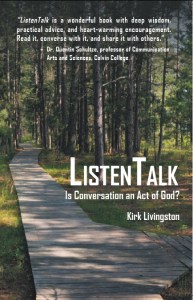
Now available at Amazon and other book sellers.
The smallest things you hear and say have the power to alter the trajectory of your life.
But you know this—just look back at a few of the most innocuous conversations you’ve had—the ones that led to a school and a life partner, or to the career you love, or to breaking with some substance.
ListenTalk rereads some old Bible stories for what God expected in conversation with women and men. A few wily philosophers show up in the book to quiz God—and us—about the power and promise of ordinary talk.
Read ListenTalk and you’ll come to look for and expect big things from even the most ordinary conversations that populate your day. Because ordinary conversations lead to far deeper connections than you’d imagine in your wildest fever dreams.
Feel free to give the book a 5-star review at Amazon.
Take me to Amazon this very instant with this link so I can order this odd but interesting book.
###
Classic Minnesota
How about a hike in the woods this weekend?

###
Image Credit: Kirk Livingston
Teach Your Institution to Speak
Developing a Bias Toward Dialogue
Dogs don’t talk, but they are great communicators.
We know what they want, mostly because they want the same things at the same times every day. They’ve trained us in exactly that way: Go outside. Eat. Rub my ears.
Dogs have conditioned us well.
In the same way our corporations and organizations and institutions train us to speak in certain ways. One company I worked for required a high level of sarcasm to get through the day—it was just the way employees interacted—all the way to the top dog. Another firm with a gossipy culture built impenetrable walls of mistrust and politics between colleagues, cliques and departments—walls that interfered with work and mission. One brave boss arose from the nattering class with a zag to the well-entrenched zig: when Employee A came with a screed about Employee B, this boss would immediately summon Employee B to the office and engage their complaints together. So before Employee A went off the rails about Employee B, they had to deal with the issue together, face-to-face. This became the beginning of a solution. People stopped gossiping to the boss, for starters. But they also found new ways to talk with each other. People picked up on the message that unhinged rants about colleagues will not do—at least with this boss.

Can you spot the Ole in this photo?
You might think that the only way to get an institution to have open, revealing, useful forward-moving conversations would be from the top down. If the big boss does dialogue, then everyone else does—so goes the thinking. But in fact, culture does not always move from the top of the pyramid to the bottom. Sometimes it starts in the middle. Sometimes it starts at the bottom.
And that is good news for the 99 percent of us without a bully pulpit.
A person who demands more of conversation will butt up against others who are not so demanding, and sparks will fly. Or not. If you cannot find a place for forward-moving conversation in your organization, chances are good you will leave to find an organization where your voice will be heard.
But there are not a lot of good reasons to put up with less than genuine conversation.
###
Image credit: Kirk Livingston
What Would it Take to Change Your Mind?
Let me draw you a picture
Howard Gardner, in his book Changing Minds: The Art and Science of Changing Our Own and Other People’s Minds (Boston: Harvard Business School Press, 2004) talked about the different kinds of intelligences he thinks exist. Dr. Gardner is a professor of cognition and education at the Harvard Graduate School, so he has solid reason to be espousing counter-intuitive theories of intelligence. Linguistic and logical-mathematical are two of the more primary and recognizable kinds of intelligence. And those two, in particular, are the focus of much our schooling.
But there are other kinds, says Dr. Gardner, including spatial intelligence, for instance, where one has “the capacity to form spatial representations or images in one’s mind, and to operate up them.” Sailors and airline pilots depend on this sort of intelligence, as do chess players. Or bodily-kinesthetic intelligence, where a person has “the capacity to solve problems or to create products using your whole body.” Artists, craftspeople, surgeons, dancers, football players, basketball players and many others work out problems in a very physical way.

Early in the book Gardner cited this important factor in changing one’s mind:
Presenting multiple versions of the same concept can be an extremely powerful way to change someone’s mind.
–Howard Gardner, Changing Minds, p. 16
I’m not yet to the end of Gardner’s full argument, but I suspect none of us are just one intelligence. We each have several (perhaps many) ways of knowing and depend on our different intelligences to walk through life. So hearing multiple versions of a concept may trigger something inside us that suddenly opens our eyes or our empathy. As advertisers well understand, presenting the beautiful woman next to the car or perfume bottle spurs an emotional leap that can bypass rationality. Words alone don’t do that as often.
My own daily experiments with drawing, though uniformly not up to par, have still showed a way forward with understanding. When stuck with words, I can switch to dumb sketch mode and begin to move forward again.
All this makes me wonder about the work we each need to do to find new ways to express those deep things inside that need to come out but have so far fallen on deaf ears.
###
Image credit: Kirk Livingston
The Sun is a Mass of Incandescent Gas
But sometimes it looks like a candy.

The sun, ladies and gentlemen.
###
Image Credit: Kirk Livingston
Make mistakes as fast as possible
And get yourself a steadfast interlocutor
![As the crane slowly lowered the casket-laden truck into the hole, the widow leaned over and whispered “He loved that ’58 Chevy Suburban more than anything or anyone.” And then, quietly, “That should hold him.” [Excerpt from a short story in progress.]](https://conversationisanengine.space/wp-content/uploads/2015/07/widowsaid-2-07022015.jpg)
As the crane slowly lowered the casket-laden truck into the hole, the widow leaned over and whispered “He loved that ’58 Chevy Suburban more than anything or anyone.” And then, quietly, “That should hold him.” [Excerpt from a short story in progress.]
I am learning to make mistakes in more media. Yesterday I commented on some quick sketches by an artist in Quebec, how simple they were and how definitive.
“It’s easy,” she said. “Just sketch the people you see on TV.”
“Not so easy,” I replied. “I do that as well, but my sketches turn out fussy and juvenile. And ugly. And sometimes I despair at how bad they remain.”
“Well, I do 12 sketches before I get the one I really like.”
I found that encouraging because she is quite accomplished. And of course we all know this is true. One need only think on Philip Glass or Hemingway to gain a bit of perspective.
The more time we commit to the thing, the more mistakes we make, the more we progress. But mistakes are part of the process. As far as I can tell, making mistakes in pursuit of our passion is the only way forward.
###
Dumb Sketch: Kirk Livingston

 conversation is an engine