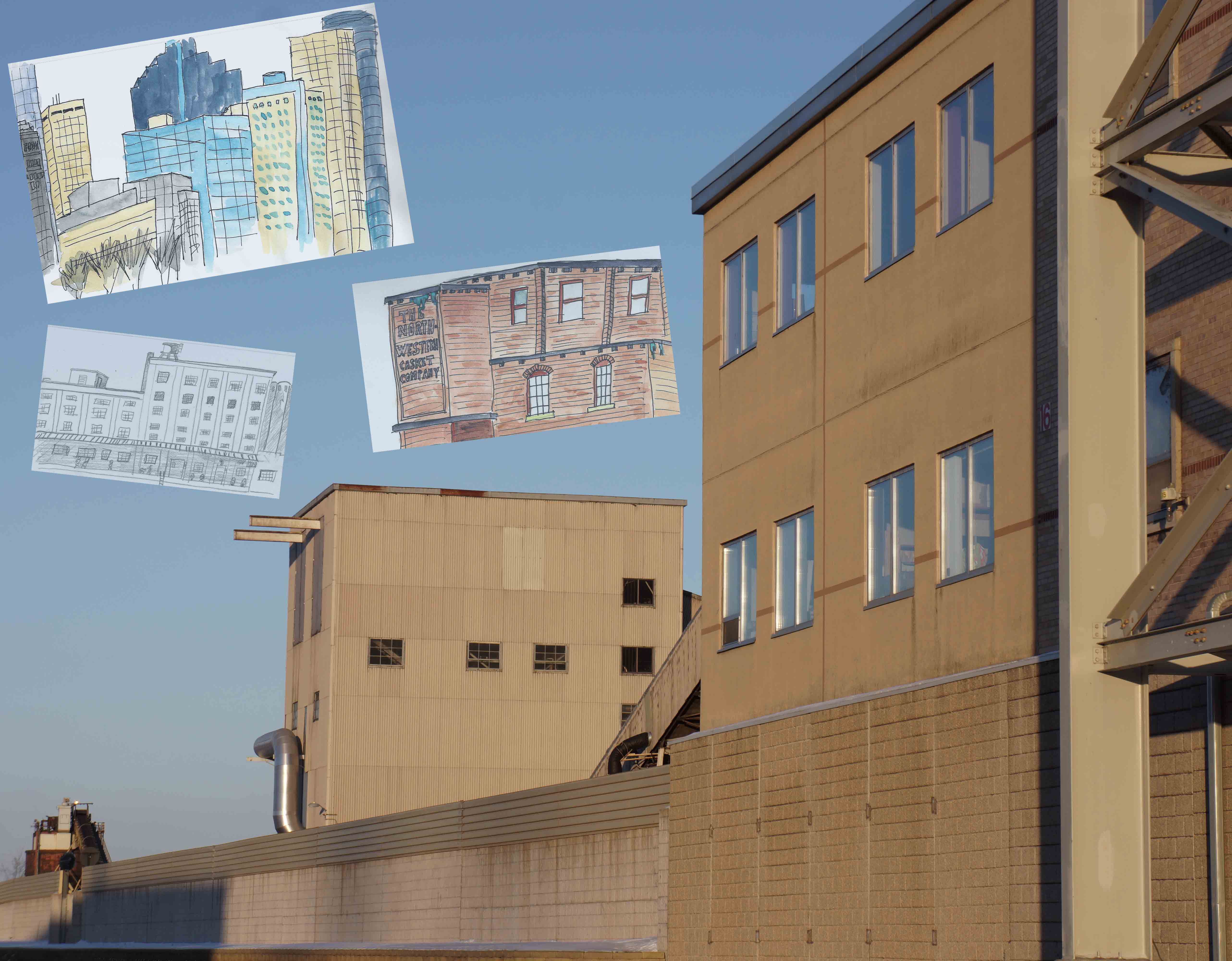
When Buildings Dream
###
Image Credit: Kirk Livingston. Dumb Sketch Credit: Kirk Livingston
Transhumanist Cautiously Optimistic over Apple Watch
A Fiction
Fridley, Minnesota—Lenny “Zoltan” Krzmarphlek slowly removed his new Apple Watch from the packaging, making tiny, deliberate snips with his scissors. He placed the watch carefully on his wrist and locked in the strap.
“He’s been grinning like this for a day,” said Lenny’s wife, Sarah.
“Ah,” he said. “Yes. I can feel it. It has begun.”
“It” is the change Lenny “Zoltan” has been anticipating for some time—the push of technology toward better. That is, better… everything.
Lenny “Zoltan” holds lofty goals: living far more than the staid four score years, knowing more than the other clerks at Home Depot (among other things)—even knowing what customers want before they speak.
Lenny “Zoltan” has been collecting bits of technology to help him do just that. He was an early adopter of Google Glass (despite being an Apple devotee: “One must make occasional compromises for higher goals,” he said). Mr. Krzmarphlek is never without his smart phone and constant Bluetooth connections to a variety of communication and diagnostic appliances littered over (and, ahem, in) his clothing and body.
“Zoltan is one of the most connected people you will meet this week,” said Sarah. Indeed, his blood pressure is displayed on the watch (“slightly elevated,” Lenny says) as he takes a call from his physician.
“No—just got the watch,” he says into his Bluetooth headset (which he wears even as he sleeps at night). He looks through his Google Glass at his wife and nods.
“Apple stock went down 1.8 percent and my core temp is up to 98.8 degrees,” he whispers, eyes wide.
“Apple stock will go up again,” said Sarah. “Have no doubt.”
She grins.
Lenny grins.
###
Walker Percy: Small disconnected facts have a way of becoming connected.
Cultivate a low-grade curiosity
Two years in the clink have taught me a thing or two.
I don’t have to be in a demonic hurry as I used to be.
I don’t have to plumb the depths of “modern man” as I used think I had to. Nor worry about “the human condition” and suchlike. My scale is smaller.

In prison I learned a certain detachment and cultivated a mild, low-grade curiosity. At one time I thought the world was going mad and that it was up to me to diagnose the madness and treat it. I became grandiose, even Faustian.
Prison does wonder for megalomania. Instead of striking pacts with the Devil to save the world—yes, I was nuts—I spent two years driving a tractor pulling a gang mower over sunny fairways and at night chatting with my fellow con men and watching reruns of Barnaby Jones.
Living a small life gave me leave to notice small things—like certain off-color spots in the St. Augustine grass which I correctly diagnosed as an early sign of chinch-bug infestation. Instead of saving the world, I saved the eighteen holes at Fort Pelham and felt surprisingly good about it.
Small disconnected facts, if you take note of them, have a way of becoming connected.
–Walker Percy, The Thanatos Syndrome (NY: Picador, 1987) 67
###
Image credit: Kirk Livingston
Where Can I Buy a Fine-Art Mode?
The Beauty of Knowing Nothing
I don’t have a fine-tuning mode that tinkers with physical detail. I draw and it is mostly crude. I cut plywood and pine shelves and they are rough enough to make my craftsman-father scoff into his hand. I make dinner and it is mostly broad-stroke stuff that requires very little finessing. I will confess my popcorn is a work of art, combining yellow and white kernels, salted and buttered and mixed to a sensuous, savory smack of flavor. And I am learning how words interact on a page—though it is slow going.

How does someone get to the point of crafting from rough cuts to fine finished detail? It is possible that in this age of ordering clothes, pizza and romance from a button on our mobile devices, that some things still take time. Some things require beginning at the beginning. The question for each of us: do I have the courage to begin at the beginning? To know nothing for a time and do things badly?
The beauty about not having been taught drawing is that you are in a position of the acquirer: the process of figuring it out might take a while, and you will most likely continue to figure stuff out as you go, but that process is yours. There are no shortcuts and no tricks. Just the plain practice of drawing, screwing up, and drawing some more.
–France Belleville-Van Stone in Sketch! (NY: Watson-Guptill, 2014)
You cannot buy personal processes. Not really. You have to make them from scratch—those processes that help you make meaning in the world. And you have to begin at the beginning.
Mistake will be made.
You will make those mistakes.
And that’s OK.
###
Image credit: Kirk Livingston
3 Lessons I Learned Hanging With 70 Artists
See. Do. Share.
A group of artists in the Minneapolis-Saint Paul area gathers monthly to sketch. They call themselves MetroSketchers. These are talented people with facility for capturing life on a page. Yesterday I showed up to sketch alongside them at the Como Zoo in Saint Paul.

- Look To See. It’s easy to spot these sketchers in the crowds at Como. They are the ones balancing a sketchbook, and possibly watercolors or an arsenal of color pencils. They are the ones looking up and down and up and down at the very scene I dismissed with a quick glance. It’s the lingering look with an intent on capturing what they saw that was meaningful to me. Sketchers linger far longer than the causal passer-by. They must.
- Do It. Right now. That’s it—just get it on paper. Whatever you can. This is a lesson that carries over for me from writing. Do it badly, but just get one good stroke on the paper. One good mark among many bad marks. My great contribution to the day’s artistry was the Polar Bear Butt (the only animal who insisted on posing). Bad as it is, it is still a move toward representation.
- Share It. These uniformly talented people were also great encouragers. To a person they were all about what you saw and the marks you made in response. They found good stuff to say even when good stuff was pretty well hidden behind lots of not-good stuff. They also loved to talk about paper weight, the best inks to use, how small they can pack a watercolor kit and, “…here, let’s just walk through my sketchbook together.”
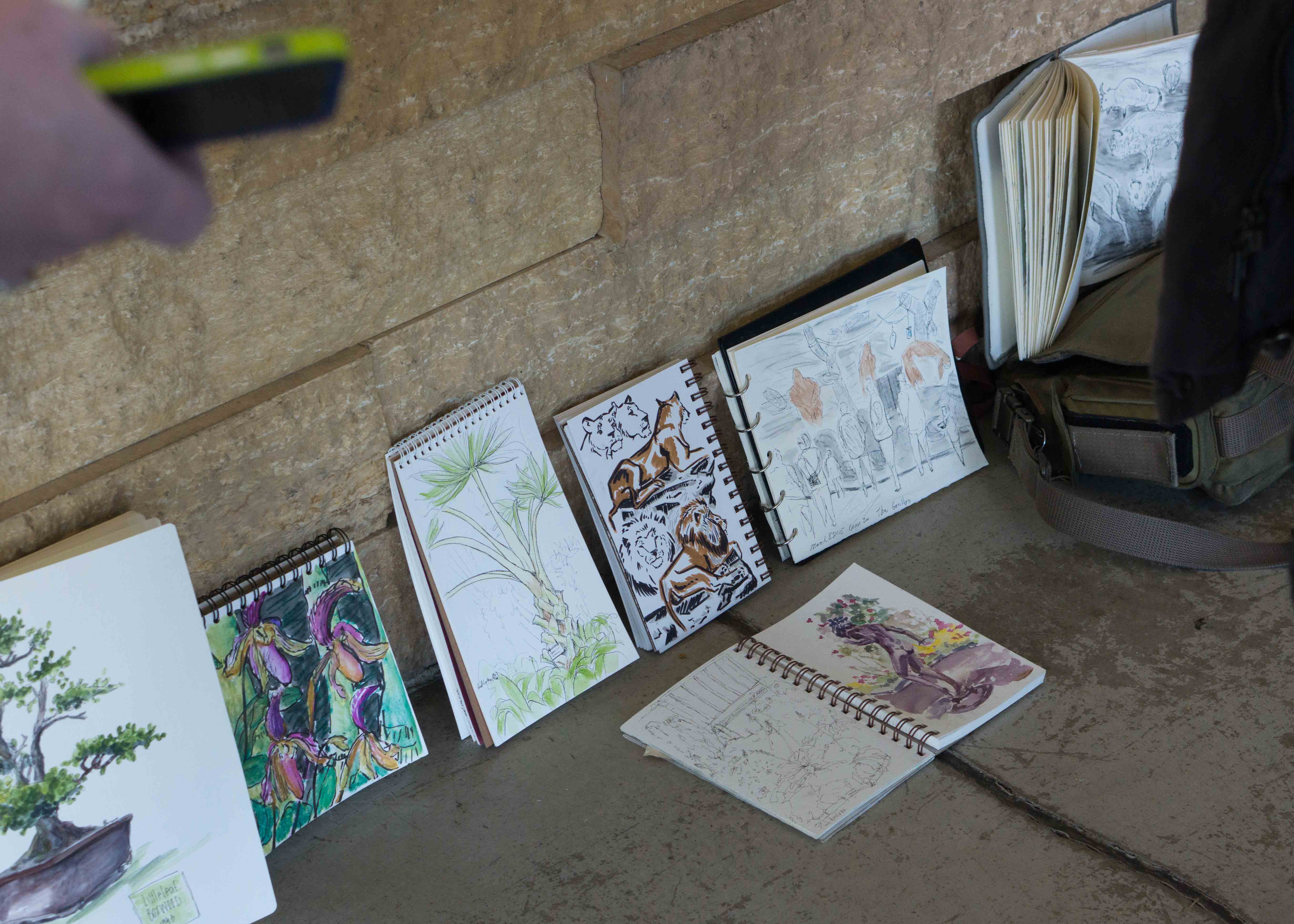
I spoke with many during the sketching and they were more than happy to show what they were doing, to describe how they were seeing and to talk about the difficulties in representation.
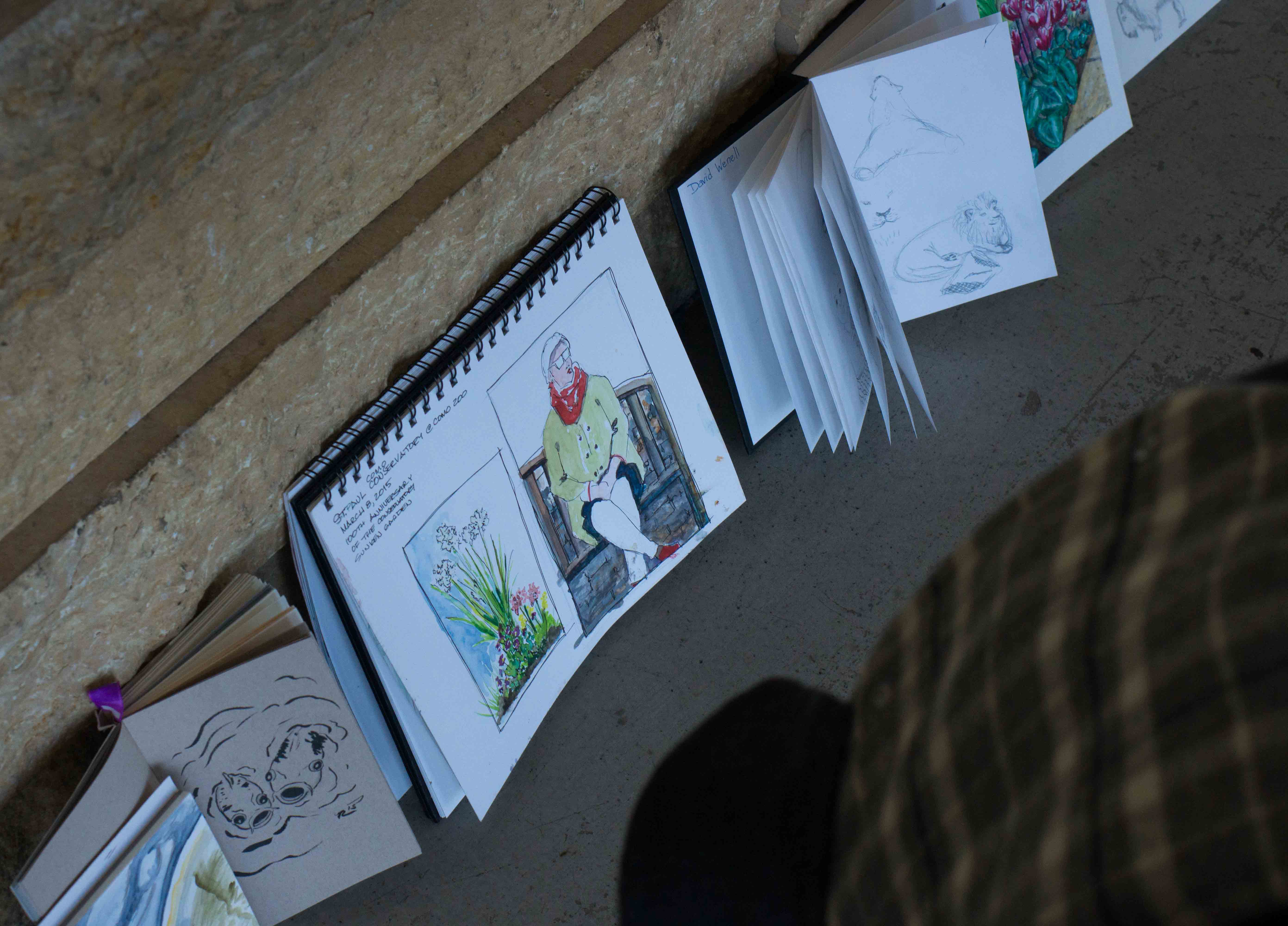
More than one sketcher expressed delight in what they were seeing—and if that is not a perfect reward for the interaction between drawing and seeing, then I don’t know what is.
###
Image credit: Kirk Livingston
We’re Bigger Than This
Helping Colleagues See the Larger Story
Bad manners and ill-treatment make headlines in personal conversations at most of the companies I’ve worked for. Just like in our newspaper or aggregated news sources online. People often say they wish the newspaper published good news, but they would not read it if it did. Good news—things going right for a change—few have time or interest for that.
Naturally this is so: stories of the people around us always take top billing in our conversations. Family, colleagues, neighbors, we love hearing what each other did and we love to relate a story about someone else, especially if funny or it has some emotional content that will get a reaction. It is the emotional content, whether funny, sad or repugnant that we really want to get across to each other.
It is our way of connecting: we want to stir a reaction.
It takes a concerted effort not to talk about the people who are not there. Leaders see personal interactions as an opportunity to steer interest toward something larger. But that larger thing is not the mission statement produced by the top brass or Human Resource, which is typically a lifeless bit of plastic. The real stories, the ones that make leaders out of ordinary citizens, are those stories where something of the corporate or group mission has made its way into and through an ordinary life.
One boss related a conversation she had with a far-away department. The department director praised specific people on the team and told of specific details that helped their group move forward. When our boss told this to the team in casual conversation, people blossomed.
We need more connection with larger mission—even if it seems hoky at the time. And we need less stories about how bad/abnormal/demonic are the people not present.
###
Image credit: Kirk Livingston
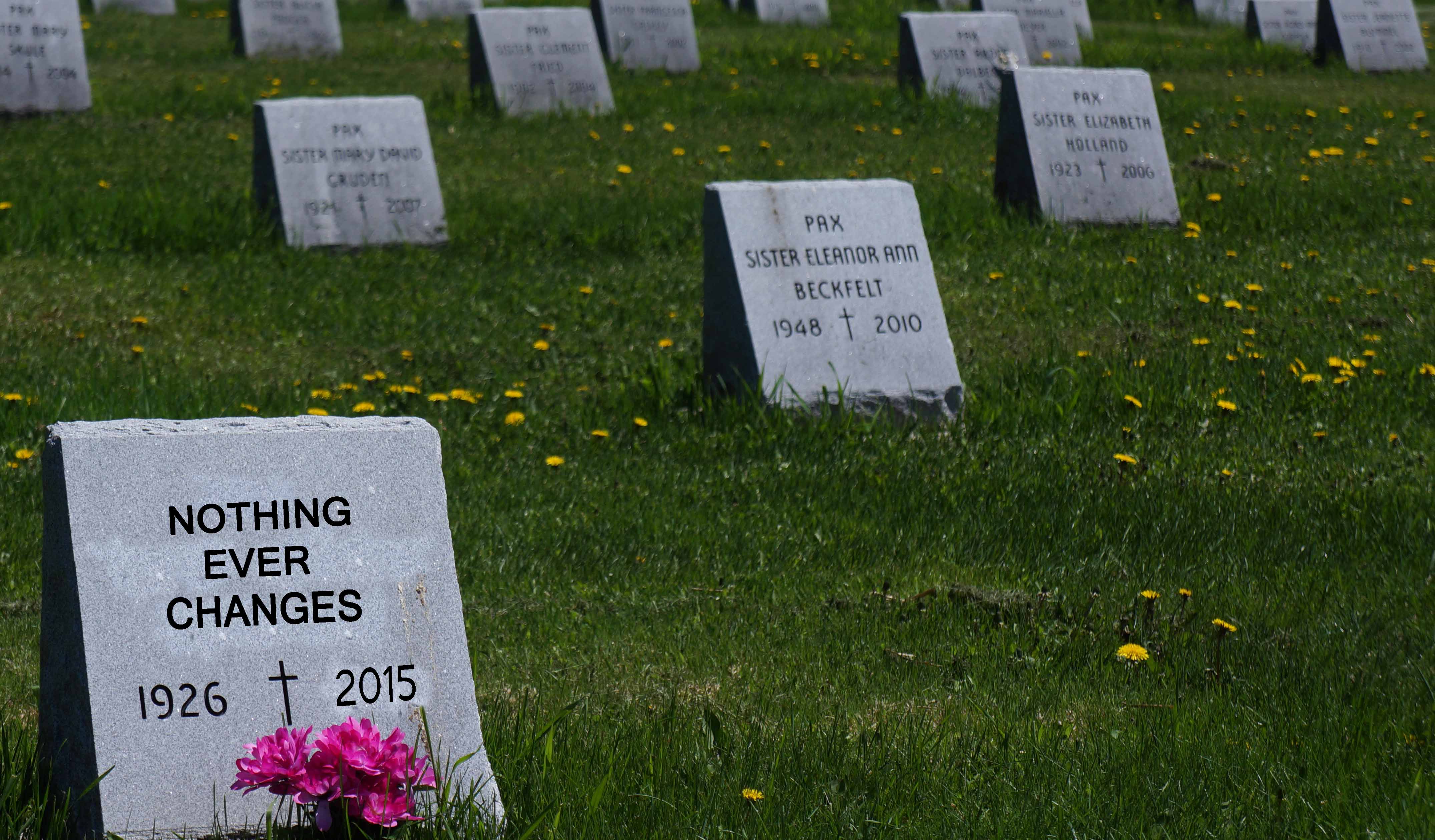
Someone Died and Everything is Different
Times Change Us.
A gentleman acquaintance—someone I barely knew.
Mrs. Kirkistan and I were in a meeting with him not two weeks ago, and now he is absent. It’s a shock—but our shock is minor compared to that of the grieving widow and children. They have our sympathies and prayers. I cannot imagine the shift in outlook this change has wrought for them.
Even for me, who did not know him, there is a clear hole where he once existed. A big nothing–a memory–where, moments ago, a person stood.
And so. Mourning.
“Blessed are those who mourn, for they shall be comforted.”
–Jesus the Christ
We usually want to stick those holy old, churchy words in a pew to visit on Sunday or Easter. But today, even from the distance where I stand, they hold a glimmer.
###
Image credit: Kirk Livingston
Mary Oliver: “Here you are, alive. Would you like to make a comment?”
Just so.

…for always the new self swimming around in the old world feels itself uniquely verbal. And that is just the point: how the world, moist and bountiful, calls to each of us to make a new and serious response. That’s the big question, the one the world throws at you every morning. “Here you are, alive. Would you like to make a comment?”
–Mary Oliver, Long Life (Cambridge, MA: Da Capo Press, 2004)
###
Image credit: Kirk Livingston
Electricity. All Around You.
Questions About Your Grid
How much connectivity do you lose by waiting for someone else to speak your language?

What would you gain if you reached out with what little you knew of a stranger?
###
Image credit: Kirk Livingston
Gadamer: A Tormented Relationship to Writing
The Best Writing Sounds Nothing Like Writing
Good writing is where you remember nothing about grappling with words but are instead transported with images and ideas that appeared in your brainpan. Effortlessly—or so it seems.
This kind of effortless reading is exceptionally rare with philosophers, who are well-known for obfuscation in their pursuit of parsing detail and cleaving difference from sameness. And yet Donatella Di Cesare, the biographer of philosopher Hans-Georg Gadamer, claims Gadamer’s writing style is “lucid” with “striking prose.”
We’ll see about that.
The lucid philosopher is the exceeding rare philosopher.

I’ve just picked up Gadamer: A Philosophical Portrait by Donatella Di Cesare (Bloomington, Indiana: Indiana University Press, 2007). In the introduction Di Cesare shared about her process:
There is a further difficulty that a monograph on Gadamer should not avoid, and that is his tormented relationship to writing. In order to get around his Socratic resistance to writing, he preferred the form of the lecture, the talk, or the debate. It is not an exaggeration to say that almost everything he wrote is based in dialogue.
She goes on to say Gadamer is “always careful to interrogate everyday language and to avoid rigid terminology,” so I am eager to see how his prose ends up as lucid and striking rather than simply tedious.
What piqued my curiosity was Gadamer’s alleged privileging of oral over written. It seems his inquiry was largely based in discussion, between people, rather than one man alone with a sheet of 20# bond and a pen. Again: I’m just at the beginning of reading Gadamer. I’ve got his big Truth and Method on order, but I know from my own writing that dialogue and conversation have a pull that abstract philosophizing rarely reaches.
The best writing sounds like a conversation with an interesting friend. I’m eager to see if Gadamer achieves that.
###
Image credit: Kirk Livingston

 conversation is an engine