You Gotta Find Ways to Tell Your Story
Don’t dumb down. Don’t be boring.
One client is a thought leader in her particular industry. She writes and presents papers around the world. In doing so she thinks brand new thoughts, adds to her credibility and drums up potential clients for her firm. She is disciplined about two timetables:
- Timetable #1: Industry Papers. She includes time in her schedule to research and write, which allows her to build out topics of interest to her customers. Those topics also interest editors of professional journals, so she maximizes her research and writing time to open up new venues to be heard as an expert.
- Timetable #2: Everyone is a Publisher. My client also understands that she is not just speaking to the industry-folks who crave the details she has synthesized. She is also speaking to a broader group of people—those who have a nominal but urgent interest and may benefit from what she has to say. This second, broader group of people drop their questions into the oracle of Google. My client hopes her investment in social media (her firm’s blog, Twitter, and Instagram accounts) will reach these people. She routinely takes papers she has published and breaks them up into smaller chunks that more easily relate to the rest of life.

We need your annotations.
But this second piece is less about research and more a journalistic/writerly function. This part is more about connecting the dots with the work and life and less about laying bare abstract research findings. She understands this second communication need has nothing to do with dumbing the topic down. In fact, just the opposite she employs her best writing to say things as simply as possible without relying on buzzwords and tribal knowledge.
Marketers of consumer products have long focused on Timetable #2. Academics and specialized industries have long focused on Timetable #1. How long before we all use Timetable #2 as the route to Timetable #1?
Remember: we are the gatekeepers now.
###
Image credit: Kirk Livingston
#NaNoWriMo Update: Twin Cities—15 Million+ Words in 15 days
24449 are mine
Nobody claims their words are any good—just to be clear. It’s all quantity over quality—so take that, Mr. Internal Editor. Anyway, that is the whole point of National Novel Writing Month.
I will say an unexpected suicide started the whole thing and now I think I see resurrection on the horizon. Loyalty and romance have turned up, plush a flash of skin and a skinny guy unafraid to take two jelly-filled donuts even with everyone watching. My main character is a strong, passionate woman who can make a CEO bite his lower lip–oh, and she’s been dead for at least a week. Did I mention the oracle named Franklin Delano Sjogren? I’d like to get a coffee with this guy and ask him my most vexing questions. My hometown of Stoughton, Wisconsin took a hit sadly. City fathers will not be pleased.

As always, I have no clue how (if?) this will all wrap up. But for now I’m rooting for a couple characters as I move toward 25000 before midnight. But I sense danger.
Does this count as working out loud?
###
Image credit: National Novel Writing Month
Wait—English Majors Win in the End?
Start Writing Your Own Future
- Announce your goal to lose weight and chances are better the pounds will flee.
- Sign up for NaNoWriMo and chances are better you will actually write that novel (no matter how badly it turns out).
What we tell each other has a way of happening. What we tell each other about our preferred futures has a way of guiding next steps.
- Write a letter to your collaborative, inventor friend about a business idea and find yourself planning concrete marketing and distribution steps at Spyhouse Coffee.
- Write a business plan for your startup and suddenly remember your friend who became a venture capitalist. And then remember the friend who bootstrapped her idea.
See the pattern? Each step forward started with communication. You may say,
“No. the idea came first.”
True—maybe.

Create in real time as you go.
But consider: the communicated idea created a spark. And—given the right collaborative conditions—the spark lit a fuse. And the fuse burned, gathering other ideas until the explosive, disruptive future no one had considered.
What if English majors learned entrepreneurship and began to see their talent for orderly, persuasive, deeply-rooted writing as a way to help themselves imagine new futures and chart forward-movement for others? What if they learned to solve real-world problems with story and emotion and analytics? Their solutions would drop-kick the spreadsheet & PowerPoint crowd. What if some English majors created Lake Wobegon while others created the next Google?
What if English majors learned business lessons alongside the standard fare of reading and writing? What if they were expected to serve up the occasional business plan or marketing strategy along with the usual essay, short story and poem?
If that happened, English majors would connect earlier in life that art and work and commerce and fiction and meaning-making all fit together in the same world. And they would begin to write their own future vocation.
By the way: 16 Wildly Successful People Who Majored in English
###
Caveat #1: I was never an English major.
Caveat #2: I teach English majors. They are smart, innovative people.
Image credit: Kirk Livingston
Tom Dimock: Work & Art & Plein Air
Do [not] Disturb
Leave me alone to do my art—and leave cash on the table on your way out.
Who doesn’t imagine free hours to focus on your art or craft?
I’ve been trying to connect with a local filmmaker to chat about how she balances art and commerce. She’s already hinted once that “Commerce wins.” And though she says that, the truth is that she keeps producing her own films, which screen locally and nationally.
At the recent Art Attack at the (ginormously huge) Northrup King Building in northeast Minneapolis I ran into painter Tom Dimock. His painting of Red Wing’s Barn bluff caught my attention—so much so I had to show it to Mrs. Kirkistan as well (making it “remarkable”). In particular, Mr. Dimock had two versions of the painting: one done outside in cool Minnesota air (plein air), one done as a re-creation from a photo. Here’s the plein air version:
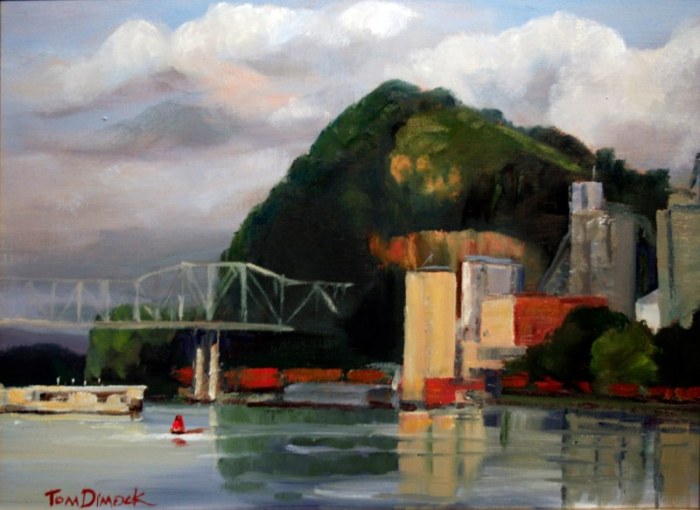
As much as we want to be free to practice our art: free of financial concerns, free of time constraints, free of any obligations, I rather think all those little tugs at our consciousness find their way into the art itself. To me, Mr. Dimock’s plein air version has a different feel than the painting produced from a photo (not pictured).
All of this to hint that waiting for enough time or enough inspiration to practice our craft or art is a fool’s wager. Instead there must be something of the plein air to our craft: doing it when we can. Practicing in whatever bits of open time we find, even out in the open. I routinely wedge bits of writing between work assignments . Big expanses of time are rare and unless I am practiced at my craft I’ll just waste time on everything but the work itself.
Plein air suggests the things we create are built more realistically in the moment, right in the context of everyday life, rather than separated and isolated. Things built in the moment, out in amidst the chaos may also yield a more true light, which is one of the keys to authenticity, whether in painting or writing or photography. It’s not hard to start applying plein air to lots of life’s bits and pieces.
Maybe plein air is the difference between what we used to call ivory tower thinking and boots on the street action (if you’ll excuse my badly mixed metaphors). Maybe that is why some of the books on my shelf go unread because they are so detached from real life while others drop me in the thick of human interaction time and again (Ian McEwen’s Atonement is doing that for me recently, as is John’s gospel).
How do you manage to practice your craft?
###
Image credit: www.dimockart.com
Brian Eno: “Everything Good Proceeds from Enthusiasm”
“Some people are more prepared to take advantage of opportunities than others.”
I’ve been a fan of Brian Eno since his Roxy Music days.
I’m not always crazy about every track from Mr. Eno, but he is always interesting. Speaking of Roxy Music here’s a first listen of Bryan Ferry’s new album “Avonmore.”

###
Via Valeria Maltoni, Conversation Agent
Image credit: NPR
Why Work Out Loud?
Living out loud—even at work
Way back when our first child was born (lo these many years ago), back before there was language, when crying and inchoate grunts were the sum total of signals this small being could muster (along with unblinking stares), a strange communication pattern emerged in our household: narration.
Mrs. Kirkistan and I both found ourselves narrating in real-time to this youngster. His wide eyes and (relative) silence seemed enough to make us think he was curious about, well, whatever. We narrated pacing the floor at 2am (“We’re walking back and forth because someone is crying. But we’re not pointing fingers. No sir.”). We narrated cooking and cleaning. We talked about sitting on the couch and driving in the car. We told the story of outside—every window had a story.
It seemed to work if only because it was met with silence which we took for interest. Eventually he started narrating back at us.

Thank you, Veterans.
I’m reminded of this as I read John Stepper’s blog and anticipate his book, Working Out Loud: How to build a better network, career & life (Due Feb, 2015). Mr. Stepper makes the case that we do ourselves a favor when we “work in an open, generous, connected way.” The benefit is to ourselves and to others. Check out his “5 elements of working out loud.”
Lately I find myself talking more with clients about how they communicate internally and externally. I continue to see the emphasis wrought by free and open social venues (Twitter, bloggery, Facebook) working their way backwards into the way organizations conduct business. I predict more collaborative encounters and less monologue from a guy with a tie and a pen to sign your paycheck.
Stepper’s “working out loud” codifies some of that collaborative energy that rises like Spring sap with honest and open communication. I think of it as another perspective on the “dumb sketch” approach to life.
Narrating our day, asking for input, remarking on a remarkable idea—it’s all part of human contact and cannot be separated from the business of making meaning.
###
Image credit: Kirk Livingston
Five days ago I killed someone. I had to.
Lessons Learned: 9000 Words into NaNoWriMo

- She took her own life, which shocked me. Maybe it was the best thing to generate all sorts of electricity in the people around her. For instance, I’m learning Irvina was fierce, respected and disciplined. She was a steady, planful presence. She was empathetic, maybe because of her failed first marriage and potential underworld connections. And now my characters are starting to wonder: is she really dead?
- Dialogue makes stuff happen. It also uses a lot of words, which is perfect for keeping up with the 1667 word daily goal. As Tim and Philip talk, I’m seeing the fierce loyalty they have to each other, their business, and to the woman who (potentially? maybe?) died. I was surprised to find out that Philip was an entitled SOB, but still likable. Who knew?
- The way forward is already present. Even with only 9000 words on the page, potential story arcs are presenting themselves. I’m seeing the whole thing laid out, and it remains interesting.
- Someone stuck an oracle into a fold of my story. Franklin Delano Sjogren showed up as a calm, deep presence. Where did this guy come from? I really want to sit at his feet and learn from him. I sure hope he circles back into the narrative.
Most of my usual writing is essay: persuasive, informative, educational. My work writing for clients is generally marketing copy for ad agencies, the medical device industry and other industrial clients, along with thought pieces and book chapters.
So writing a story for National Novel Writing Month is a new thing for me. So far so fun—but I hope Irvina survived.
Where can I find 1000 words before midnight?
###
Image credit: Kirk Livingston
Thought Leadership Takes (too much) Time
And don’t be deadly-boring
In content-creation, I talk with clients and potential clients about telling their story in a way that promotes them and their business as thought leaders. Most clients have a business expertise that is poorly understood outside their niche or industry. And that is always the way: who really knows or cares how someone else spends their day?
One of the big challenges with our social appliances (Twitter, for example, and blogs) is telling the details of our story in a way that, a) shows we know what we are talking about, and b) communicates something not-deadly-boring to a casual passer-by. This is a huge challenge because most of us are interested only in what we are interested in.
Telling what we know in a way that engages the passerby is the challenge. That’s why I often use the metaphor of talking with the stranger or telling something to a ten-year-old. When eyes glaze or when they simply walk away, then you know you’ve not told your story well.
The thing is, our social appliances do not let us off the hook with the casual passer-by. Yes, we write our messages to our core audience, those are the people we seek to help and serve and engage. But those messages still must have enough hook to stop and (possibly) engage the conscious human passing by our web page/tweet/handmade sign. Building our brand, whatever that looks like: whether marketing a medical device, marketing a specific line of knowledge about medical devices/healthcare or marketing your own book—all these require that we tell our story in a way that keeps detail in focus while showing why it all matters to life on this planet.

Of course, the best way to do this is to know your topic well. Once you know your topic, mix in notions of how a stranger or passer-by would react and adjust accordingly. I find that knowing a topic and then adjusting the topic to the needs and interests of a particular audience has a miraculous effect of providing something I simply must say:
https://twitter.com/AdviceToWriters/status/529996620620763136
And that is a beginning of thought leadership: building out from what you know, day after day. It is very time consuming but if you are passionate about a topic, product or service—or a particular way of looking at life—than you can hardly keep from building the topic anyhow.
By the way, whether you write or not, everyone on earth should follow Jon Winokur’s tweets (@AdviceToWriters). His tweets should make anyone eager to create.
###
Image credit: Kirk Livingston
But Vote (Out of Spite If You Must)
Just say No to Bilious Lies
It’s hard not be cynical around election season. The little bits of television I’ve watched have been be interrupted by the usual bilious lies presented by deep-pocketed political action committees. I’m guessing 99% of the nation exercises the mute button when one of the toxic deception-events plays.
But there are all still all sorts of reasons you should vote. It is our duty as citizens (of course, we hear that all the time), and a very minimal duty at that. It doesn’t take that long. And even if you are disillusioned, try to find a reason to go to the polls.

Shine today.
Two reasons motivate my voting today.
- I’m sick of the lies and twists and obstructionism the Republican Party puts forth again and again. Wait—don’t leave yet: my Republican friends (of which there are many) are entirely justified in leveling the same charges against the Democrats. It seems today all political persuasion amounts to one-sided arguments that even a child should question and reject.
- Democracy will continue even if you don’t vote. That’s because our corporations and institutions have a vested interested in making our democracy work—especially to make it work in their favor. One reason I want to vote—which is also a reason I’m becoming increasingly curious about the gears that turn our form of democracy—is to begin to lay bare how corporate interests have trumped the will of the people again and again. It’s simply not true that what is good for GM/Medtronic/UnitedHealth Group/Super Value is good for the rest of us—at least not without a few close questions. Those interests compete with the citizenry at times and they spare no expense to win their argument.
So vote.
If you cannot vote for something you believe in, vote against something you despise.
This system is an imperfect mess, but at least it is a mess that allows you to voice your (limited) option. Don’t sit out this opportunity to make your voice heard.
###
Image credit: Kirk Livingston

 conversation is an engine