Buzludzha: Bulgaria’s Elegant Monstrosity
Built When Communism Could Not Fail
That could never happen here. For example, the new Viking’s stadium: football will never go away.
Right?
###
Via The Economist
Blue Mounds: Broken
Blue Mounds State Park in Southwestern Minnesota is a surprise. This break with farmland rises amidst all the flatness. See for miles from the hiking trails along the top.

Sioux quartzite cliff 100 feet above an ancient quarry.
More on “broken” here.
###
Image credit: Kirk Livingston
If a Customer Shouts in the Forest and No Customer Service Rep is Around to Hear it…
Should she post a comment on Yelp?
Nancy Beiersdorf of Medtronic’s e-Commerce and global strategy hinted (in this SAP talk) at the medical device company’s evolution from a product company to a solutions and service company. One important ingredient in this new recipe will be hearing from the people with problems (people in need of a solution) and helping them solve those problems (that is, service).
But hearing from customers is not easy—even for other customers.
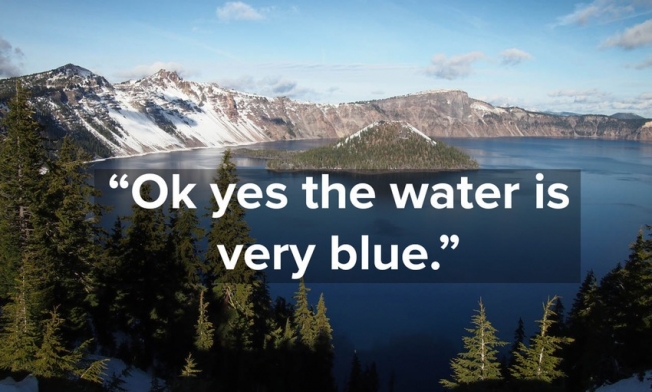
If you’ve ever used Yelp to locate a restaurant while traveling through a new city, you know to toss 30-50% of the comments as someone having (a) evil intent or (b) a bad day. Even our favorite national parks suffer from poor Yelp reviews:
Sorting fact from fiction has been a traditional problem with hearing from the customer. Customer service must wade through long, rabbit-trail narratives to finally get to the actionable item. That is the way of human conversation—sometimes it takes a while to get to the point. All this unquantifiable blather plays havoc with our quality systems. Surely customer service will soon chart a metric like “Time to actionable issue” and pay employees accordingly.
Hearing from customers is an inherently messy business. Especially for Medtronic: where reps once talked only with cardiologists and electrophysiologists now there will be all sorts of real people on the phone (or more likely, placing orders and comments on a web site).
All this conversation cannot help but change things upstream and downstream. In particular I expect at least two results:
- Increasing masses of consumer-to-company interactions will train consumers over time to use certain words and press certain buttons to get what they want. Much in the same way we are conditioned by repetition to bypass our bank’s introductions to get to a real human.
- Corporations may grow more sensitivity toward customer voices–the very thing Ms. Beiersdorf advocates. By that I mean conversations have a way of working backward into the machine-gears of a corporation. As solutions and service show up more clearly on the P&L sheets, people will start to pay more attention to human interaction.
At least that is what I hope.
Let there be more advocates for the customer voice.
###
Image credit via Adfreak
Don’t Bother Me. I’m on Fire.
Too Busy: 4 Takes
- My contact is too busy to talk about collaboration: “Too many deliverables, scheduled too tightly.”
- Another colleague laments the lack of time to think ahead about the broader picture. She chides the constant race to get stuff done.
- A friend observing the inner-workings of a logistics department 2000 miles from where he was trained could identify key process components missing. The very components that created the immediate chaos the team waded through each day.

We earn our keep by being busy. None of us want the boss to wander by and say, “Fire up that keyboard/drill press/classroom/spreadsheet and get to work.”
Busy is always good.
There are no exceptions.
And yet:
- We lament “busy” but secretly get a buzz from opening the adrenalin spigot.
- Busy looks productive. But looks can deceive. We easily deceive ourselves with busyness.
- When taken out of action (for instance, when downsized/right-sized/laid-off/fired), we suddenly have time to ask:
- “Where am I?” and
- “What (the heck) am I doing?” and maybe
- “What was I thinking?”
- No one likes the off-balance, adrenalin-free stance of waiting, watching, knocking and waiting. Are we genetically predisposed to seek action? After all, aren’t verbs the action-heroes in our favorite writing?
It’s hard work to look at the bigger picture and make difficult choices about direction, use of resources, usefulness. And yet those are the very questions that help us move forward. As the wheel of seasons grind toward winter in Minnesota, we might take a page from the farmer’s playbook and let snowy fields lie.
Even on purpose: the fallow field may allow us productive time to consider what it means to be productive.
Versus just busy.
###
Dumb sketch credit: Kirk Livingston
Talk With Those Who Talk With You (DGtC#25)
Humans just want to connect
Social media, like sales, seeks an ever-expanding public. All tweeters want more followers. All bloggers—same thing. Just like the TV networks of yore, where Nielsen Media Research rated efficacy by numbers (and types) of viewers they brought in. Which just happened to coincide with increasing amounts of cash they could wring out of a sponsor for a 30 second span of monologue.
How to measure audience (and collect cash) continues in today’s social media world as various metrics are embraced and/or disgraced: clicks, views, comments, engagement, time spent on a site.
But real humans in earnest conversation don’t care about size of audience. They care about connecting with a person to tell the important thing they have to say or to hear the important thing a friend or colleague has to say. They want to remark on what is remarkable.

Call me a mystic (please!), but I still embrace the notion that the people peppered through our lives are there for reasons beyond our understanding. And those talking to you—today, right now—have something you need to hear and they need to say. Those people right beside you are worth attending to. For their sake. And for yours.
It’s not wrong to widen your audience.
Just don’t lose sight of this moment with those right before you.
Also see:
- Listen to other people’s stuff (#6)
- Dialogue is a scenic bypass (#12)
- “Good to know” and a failure to communicate (#23)
###
Image credit: Kirk Livingston
Beware the Information Hoarders in Your Office
Collaboration opens as the sharing economy pushes back into your organization
Old-School Corporate Climbers held information and doled it out on a need-to-know basis. Knowing secrets was their key to moving up and sometimes they purposely withheld information so you might fail/they might succeed.
Maybe you know someone like this.
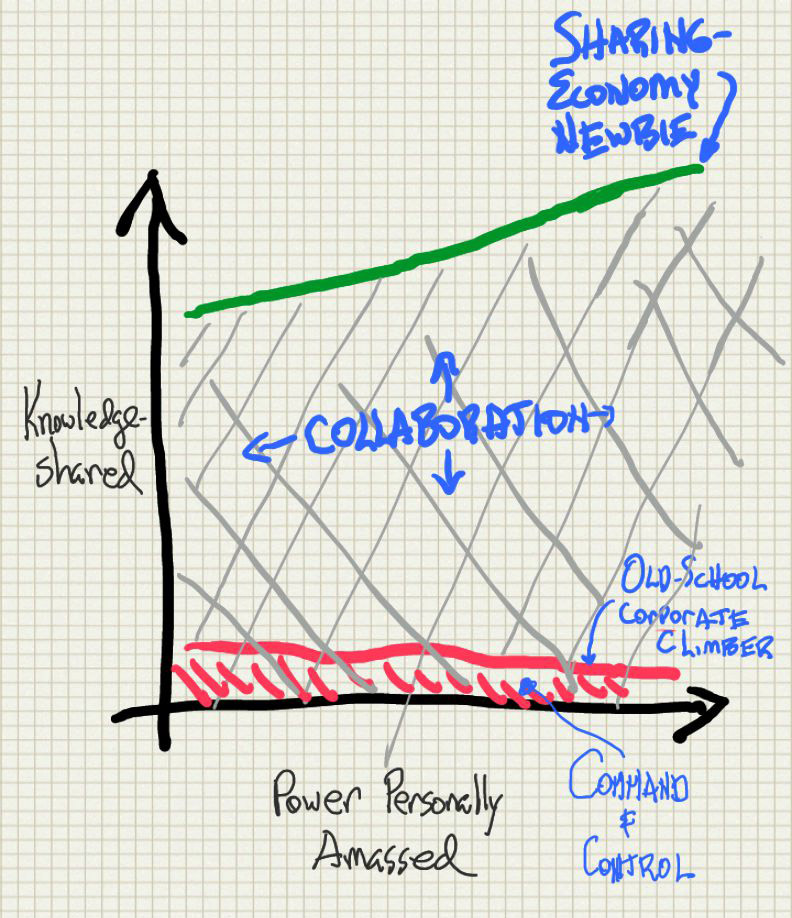
But as we watch the sharing economy slip free of social media venues and push back into organizations (simultaneously raising the expectation of being heard), I expect we’ll see another kind of corporate operative: the sharer. Maybe I’ll call that person the Sharing-Economy Newbie. In this new world of sharing information, the Sharing-Economy Newbie shares information freely and in a way that allows others to collaborate. The power the surrounds them will not be command-and-control power, it will be the power that invites participation.
Then again, human nature being what it is, there will always be information hoarders. Old-School Corporate Climbers will always find their way. But if we intentionally build cultures that reward information sharing and collaboration, the organization, its mission, and humanity are the big winners.
Maybe there are some who prefer a command-and-control culture of being told what to do at every turn, but there will be fewer and fewer every year.
###
Dumb sketch credit: Kirk Livingston
Clothe Your Team with Inspiring Briefs
Creatives are natural problem-solvers. Start them with a tantalizing puzzle to solve.
In stark contrast to the meeting where the boss wanted creatives morphed into analysts, Adrian Goldthorpe (Lothar Böhm London) has such faith in the creative process he thinks creatives are proper problem solvers. All they need is the right question, which turns out to be a really good puzzle to solve.

One Artist’s Solution: 262 Studios, St. Paul Art Crawl
The creative brief (as you know) provides a quick take on a new assignment. All too often the brief is prepared and presented as a sleepy, non-essential document. But for copywriters and art directors, that brief can and should be a vital link to starting with the right focus.
Goldthorpe laments the mindless filling of briefs and checking of boxes, which is how many creative projects begin. Instead, at a meeting in Moscow earlier this year, he recommended short, informative briefs that facilitate (versus block) creative solutions. The brief should succinctly answer five questions:
- What should the creative do?
- What do we want to achieve?
- Who is the audience?
- What is the brand proposition and how is that supported?
- What is the tone of the voice?
Of course there is more to say in a brief and we all experiment with different ways to communicate this information. But I like Goldthorpe’s succinct, concrete statement of the problem. It is enough information to provide a frame to begin the creative process.
Naturally the creative process is not just for “creatives” at an ad agency. Presenting our problem or opportunity for others to consider and collaborate with is something authors deal with, and parents and professors and bosses. And coworkers.
It behooves any of us to consider how we succinctly introduce a topic to others, especially if we want help.
###
Via POPSOP
Image credit: Kirk Livingston
Hospital Throughput at Fort Snelling
One room down from surgery

Early healthcare forged practical partnerships.
More on “interiors”
###
Image credit: Kirk Livingston
Fight Tunnel Vision. Explore Locally.
Start with the Saint Paul Art Crawl
Do two things to fight big money in politics:
- Locate the funding sources (start with OpenSecrets.org) for each particular 30 seconds of non-truth you see and recognize how those sources benefit from the twists presented.
- Stop listening.
Maybe you are tired of fame as our measure of success. Perhaps you’ve begun to realize the Kardashians are famous only for being famous. And that’s on us. That’s our fault—we keep watching, like gawkers at a crash.
Stop clicking.
If you’ve begun to think to think the NFL is a ridiculous combat ritual that channels blood-lust for the masses while siphoning public funding into the pockets of the rich—just tune out.
It’s time we dug deeper to find out what interests us rather than letting business and the business of media tell us what is important. Business and media will begin to get the message when we stop talking about their current media targets. Don’t link. Don’t litter your social interactions with keywords that build others’ businesses.
But that doesn’t mean “shut up.” Instead tell what interests you, whether it’s a local rugby game or the parks along the Mississippi or the Vietnamese Noodle Shop down the street.
We need to hear from each other.

One example: this weekend’s Saint Paul Art Crawl. Go see the crazy and inspiring stuff our local artists produce. The studios themselves are often eye-opening. You don’t have to be some effete arts patron to appreciate a welder transforming car parts into a 30-foot-tall sculpture. You’d have to be entirely heartless to not be moved by the artist who has set up shop in the back loading elevator—to sell her art as she drives the aged contraption from floor to floor.
This weekend: go and do. Maybe even…buy?
You can even get free Metro Transit passes to and from the Art Crawl.
###
Image credit: Kirk Livingston

 conversation is an engine