Aunt Jo’s Snack Mix Recipe + Mop Mop Mix Footage
Careful with that marimba!
Make it today so you don’t eat it all before the kids arrive. And don’t try to mix too closely to the crazy marimba tempo:
Aunt Jo’s Snack Mix
- 1/2 cup margarine
- 1.5 teaspoon salt
- 1 teaspoon garlic salt
- 6 teaspoons Worcestershire sauce
- 3 cups Wheat Chex
- 3 cups Corn Chex
- 3 cups Cheerios
- 1.5 cups pretzels
- 1 can mixed nuts
- 1.5 cup Cheese Nips
- Preheat oven to 250 degrees.
- Melt margarine in saucepan.
- Remove from heat; add salt, garlic salt and Worcestershire sauce.
- Combine cereals.
- Pour margarine mixture over cereal and toss (loosely imitating marimba beat).
- Add pretzels, cheese nips and mixed nuts.
- Toss until all pieces are coated.
- Bake for 45 minutes in large shallow baking pan, stirring occasionally. Cool completely and store in an airtight container.
- Try to not eat it all the first night.
You’re welcome.
###
Prayer is just magical thinking. Right?
Asking for your own private cascade of miracles
Magical thinking is the hope that something out of nowhere will happen and change everything. When I was a kid writing stories and got stuck, it was magical thinking that rescued: suddenly the space ship landed and my main character got on and was whisked away. These were not cohesive stories. As a kid I engaged in magical thinking when I had a speech to give the next day: “Maybe the Russians will bomb us tonight and I won’t have to give that speech.”
That seemed like a fair trade-off at the time.
Some of my friends will say religionists routinely engage in magical thinking. It is this notion that someone (God) will rescue me from the pit I’ve landed in or the cul-de-sac I’ve driven into. I cannot disagree: I often have more than passing interest in rescue to come from above. Whether a work issue or a personal issue, health or wealth or life or death. Any and all of this succumbs to magical thinking. And that is what prayer is, right? A request for rescue, the more magical the better.
Magic defies logic by definition. Buying lottery tickets is magical thinking. Wearing lucky underwear on game day is magical thinking. Avoiding the professor’s eye contact is magical thinking.
But is prayer magical thinking? Sometimes, certainly: I hope I did not pray for Russian bombs to avoid my fourth grade speech on the cold war. If I did I was engaging in magical thinking.
Is prayer always magical thinking? No.
Can you bear a bit of nuance?
Say there is a God (this is not a given for some readers) and this God hears pleas for mercy. It could be that God engineers circumstance in mighty, global ways that I can neither see nor understand. As a person of faith I believe this is possible and even likely. But magical thinking asks that it happen for me and mine. Magical thinking is always about my zip code, my location, my self-interest. This is precisely where magical thinking and prayer part ways. If there is a God (and I believe there is), then prayer for magical interventions in my life will fall short. That’s because God is not just for me. God is for others too. Many others. If God is bent on reunion with people, then prayer is not answered according to magical thinking, but instead according to some other logic. The person maturing in faith starts to parse out the differences between magical thinking and honest prayer by allowing for silence. The person maturing in faith looks for this other logic.

###
Image credit: benedetto bufalino via designboom/thisisn’thappiness
What Matters? Whatever She Says.
Ideology tells me all I need to know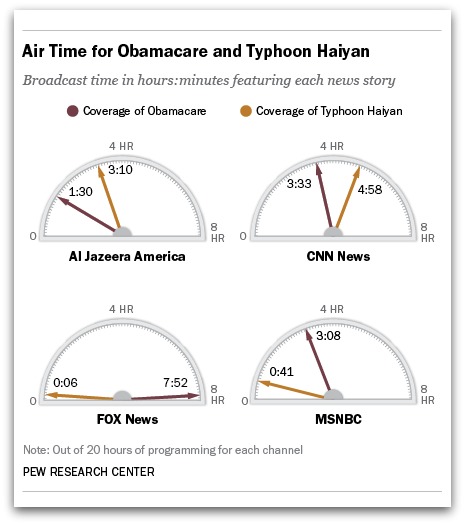
One curious thing about today’s entertainment mix is that we pick and choose where to get our news. And by “news” I mean the stuff happening in the world we want to know about.
Once upon a time the woman on TV with the engaging smile told me what was important at 10pm every night. Back in those old days the headline on the front page of the StarTribune also pointed at the critical big stuff of the day. And the people standing around the coffee machine at work confirmed what was important by talking about it.
Today we make our own choices—and unless we’re careful, we end up with a skewed version of the world. The Pew Research Center released a study of 80 hours of programming from four channels from Nov. 11-15:
The two channels with strong ideological identities in prime-time—liberal MSNBC and conservative Fox News—spent far more time on the politically-charged health insurance story than the overseas disaster. And the two organizations that built a brand on global reporting—CNN and Al Jazeera America, an offshoot of the Qatar-based Al Jazeera media network—spent considerably more time on the tragedy in the Philippines.
The panic machine called Fox News demonstrated that the Affordable Care Act rollout was much more important than the typhoon that claimed lives and property in the Philippines. MSNBC followed suit but with a bit more discipline. Al Jazeera America took a more fair & balanced approach to the two topics. You might argue that each organization was simply building their brand and giving their audiences what they sought. I agree. And I also think each organization continues to train their audience in what to want and what is important.
Humans are subjective beings so opinion and ideology always enter and inform our thinking and conclusions. Maybe the best we can do is to doggedly seek out alternate source of news, which is to say, purposefully hear from others (especially those different from us) about what is important. And given today’s multiplicity of channels, it would be a shame to think one organization can give a truly full perspective.
###
Image credit: Pew Research Center via The Future Journalism Project

Chris Armstrong Just Said Something Insightful About Work
Your Actions Keep Shouting To Me
Which is no big surprise—Dr. Armstrong, Professor of Church History at Bethel Seminary, often says insightful things.
But in the Fall 2013 issue of Bethel Magazine (if it were available online, it would be here) he pinpointed a theological missing link: that while people of faith think lots about God and Jesus the Christ and Heaven (and Hell), we have not thought much about what happens between the beginning and the end. Which also happens to be where most of us spend most of our time (that is, we’re all at various points between the beginning and the end).
Work is a key feature of what we often call “life.”
So we have Creation, Incarnation, and New Creation. But most of us are pretty fuzzy on these three key parts of the Bible narrative. And because we’re fuzzy, we super-spiritualize our faith. Faith is about the stuff we do on Sunday, at church. But darned if we knew how it’s supposed to connect with our Monday-to-Saturday life, most of which involves work. The only biblical way to get past this is to reconnect with Creation, Incarnation, and New Creation.”
(Armstrong, Chris. A Theology of Work. Bethel Magazine, Fall 2013. pp. 22-24.)
I like what Dr. Armstrong says and would encourage you to read the entire article. He draws on insights from Tim Keller’s work on work and points out, for instance, that Jesus the Christ had a first career as a contractor (building with wood and probably stone too) before he turned to the Christ business. Or this: the Christ part of his career was there all the time but latent for the first 30 years.
Allow me to adjust Dr. Armstrong’s insight with this: it’s actually our faith spokespeople who direct us toward beginning-and-end thinking. That’s where their expertise lies. You might say pastor/theologian types have (limited) authority and a free pass to talk about that stuff (especially what happens when you die). And so they do. Week after week.
But it’s up to the people living the life and doing the work to talk about what Incarnation says about, say, copywriting. Or craftsmanship. Or selling or surgery or teaching. Or digging wells (or graves). Or caring for kids or forests or the earth itself. And maybe we should look for action rather than sermons from each other, because that is how most of us talk: through the work we do.
I would go on to wager that most of us regularly draw from quite a collection of eloquent life-statements about meaning and work: both how to do it and how not to do it.
###
Image credit: Via Frank T. Zumbachs Mysterious World
All Made Outa TickyTacky
Best “Dirigible-Based Love Story” You’ll See Today
This spot is fun to watch but I have my doubts about whether it builds the Pelephone brand. Then again, I’ve never heard of the communications company Pelephone from Israel, so there is little to build on in this brain.
I started watching the Israeli version on Vimeo, which has a different soundtrack. The two ads have a slightly different effect, though I’ll admit to a very limited grasp of Hebrew (as in, nothing). One lesson I’m learning—which I am demonstrating right here—is that visual interest is sometimes enough to make a person stop and take notice.
Kudos to David Griner of Adfreak for discovering the category of “dirigible-based love stories.”
###
Via Adfreak
Talk as an Economic Tool
Flesh out your own opportunity
Grandad was a salesman. Talk was his tool. Talk and presence. He showed up with people to help them locate a house they could own. I doubt he talked many people into buying because he was careful about the economics of the deal. He dealt in houses long before our recent mortgage troubles. He sold houses back when mortgage interest rates were well over 10%. He depended on people keeping current with payments, and they did, mostly. At Grandad’s funeral more than one person told me how the opportunity to own a home had been out of their reach except for his help (which was cool).
Grandad talked his way through a house with a client, through a friendship, through a cribbage game, through dinner. Talk was his tool for getting stuff done, to the occasional exasperation of his wife and daughters. Talk made stuff happen for Grandad.
I’m gearing up for a couple classes that help college students take their writing out of the classroom and into the workplace and Grandad’s example comes to mind. What had been a rather solitary passion for these students—working out stories, poems and arguments for themselves or some instructor—can be made to have broader use in the world they’ll graduate into. This is my argument: enterprising writers use their writing/thinking/talking skills to serve others and actually find it satisfying. Even illuminating: it turns out that looking out for ways to serve others is also as much a knowledge-producing endeavor as the scouring of personal experience and/or feelings that become grist for a poem or story.
Moving writing from an inward to an outward focus begins with a firm grasp on what they can offer—a sort of inventory of one’s communication skills. And then comes some thinking about how those skills may help push forward an organization’s marketing objectives. And just like Grandad’s conversations, writing itself is the route in and the outcome. But it starts with hearing about a need, and that takes a different kind of dedicated listening.
###
Image credit: un-gif-dans-ta-guele via 2headedsnake

1906: Good Year for Traffic and Bowler Hats
Hey Kid: Get Off The Tracks
Let me distract you. Take a trip full-screen with this old (107 years+) footage from a cart-ride through San Francisco streets. Turn up the tunes for a nice 7 minute break from the incessant demands from the corner office.
It’s a chaos of traffic going every which way: horses, cars and kids popping from left to right and back again. You’d swear the swells and sharps in bowlers and snappy suits would be killed every day in this mess. But the whole thing moves at a slower, predictable pace.
I love the mix of technologies: all getting along, more or less.
###
Image credit: via northumbrian : light
Do You Miss Old Ads?
Me Neither
Once upon a time just showing smiling people next to a bunch of stuff was enough. I don’t miss this advertising technique. We’re still attracted to great piles of stuff, of course. It’s just that now we demand to be romanced. We want the stuff we buy to move us up to the next hipper rung on the status ladder. Or we want a word from a Steve Jobs-like character to tell us what the cool people care about.
Still, we’re in the season where just showing a pile of stuff is probably strategy enough to get us to open our wallets.
###

 conversation is an engine