Stop-Action Living & How to Pay Attention
Jean Laughton’s Mythic West Borders Her Real West
Put a frame around the scene before you and the scene changes. The frame creates distance from the action, which is both useful and off-putting.

Useful in that the frame helps you stop and see what is going on. Moving parts fall (momentarily) silent and you are released to think critically about the action. Note that critical thought need not be negative or a complaint or a sardonic aside. Critical thinking can result in even more whole-hearted agreement with the action. Critical thinking can also lead to backing away from the action.
Off-putting in that the frame truncates the scene and isolates it from everything else. Off-putting because the people in the scene see the camera and note you’ve switched from action to observer, which most of us find discomfiting. Pick up a camera or sketch pad and you’ve suddenly marked yourself as something other than what is happening right here and now. Pick up a camera and watch people freeze or back away.
Edmund Husserl (that 19th century mathematician/philosopher/phenomenologist) talked about leaving the “natural attitude” and bracketing his experience to come to fully understand/appreciate the experience. Actually, Husserl advised breaking with the natural attitude and bracketing experience to get on with his phenomenological work. Henri Cartier-Bresson always used a 50mm lens to capture the surrounding action, so his audience could see the central action in context and form stronger conclusions. Damon Young, in his Distraction, cites Henri Matisse in explaining how art became his way of looking at the world:
“I am unable to distinguish,” he wrote in 1908, “between the feeling I have for life, and my way of expressing it.”
Any way you cut it, paying attention and making your experience available to others are somehow linked. In Jean Laughton’s work, she takes her camera in the saddle and documents life as working cowgirl. The images she creates are mythic and telling and honest.
Walk through a few of Jean Laughton’s images and you’ll be glad she is paying attention. Laughton seems to have found a way to live in the scenes even as she brackets them. Her frames seem to not take her away from the action. The result is both memorable and accessible.

###
Image credit: Jean Laughton via Lenscratch
How do you know what you know?
What you know once belonged to someone else
When I was 19 I knew everything there was to know.
I had been plopped—fully formed—into a pair of sneakers to walk the earth. And so I did, learning and responding as one does, with fresh enthusiasm and proper disdain for the less-knowing who gadded about my footsteps.
A decade later I began to notice how much of what I knew came from the people around me. A decade after that I could locate some sources of my own knowing: family and friends. Professors, pastors and prisoners. Institutions and anarchists. Sacred texts and ephemeral whispers.
Some conversations were limiting. Some texts opened new ground. And vice versa. Gradually I came to understand how little I knew. About most anything. Especially the stuff I studied in school. Especially the stuff for which I would give my life.
And these connections: some electric knowing transmits when we connect.
These connections are not to be missed. These connections should not be easily dismissed.
And no one arrives fully-formed.
###
Image credit: William Heick via MPD
Why We Need a Science of Collaboration
Whatcha talkin bout Willis?
When I assign a report that must be completed as a team, my college writing classes get very still. When I explain the assignment will be graded as a team, I hear barely audible groans and see ever-so-slight grimaces. (These are polite writing students, after all.)
It is much simpler to be an individual contributor than a collaborator. The fun of writing is in the discoveries you make as you write. Collaboration seems to negate all that.
So many unknowns in collaboration: will my team care the way I care? How will we divide the work? What if that slacker is on my team? Who will lead this group?
(“Please let it not be me.”)
(“Please, not me.”)
(“Please.”)

Elegant work from Ogilvy, Honduras
And yet working together—collaborating—is one of the essential skills our business communities (and academic communities and faith communities) desperately need. This story from the Association of Clinical Research Professionals (via the ACRP Wire) highlights just how big the stakes might be for future collaborations:
An essential new way to move discoveries forward has emerged in the form of multistakeholder collaborations involving three or more different types of organizations, such as drug companies, government regulators, and patient groups, write Magdalini Papadaki, a research associate, and Gigi Hirsch, a physician-entrepreneur and executive director of the MIT Center for Biomedical Innovation.
The authors are calling for a new “science of collaboration” to learn what works and doesn’t work; to improve how leaders can design, manage, and evaluate collaborations; and to help educate and train future leaders with the necessary organizational and managerial skills.
Part of the problem is that we think collaboration will just happen on its own.
It doesn’t. Someone needs to organize the task. That organization can look like top-down authoritarian leadership or it can look like colleague-helping-colleague asides. Both approaches have their place, as well as the infinite variety of other ways to help a team move forward. People who study and practice these things are my heroes.
I can’t help but agree with Papadaki and Hirsch in calling for a new science of collaboration.
And for those of the writing persuasion, I plead for patience with group work.
Because sometimes the lightning bolt of writing also strikes in a conversation.
###
Image via Ads of the World
Just a train ride today
Don’t fall asleep–like you always do on the train
Wait. Was that Margaret Thatcher around 3:54?
###
via Sell! Sell! Blog
What Business Can Learn From Church #3: Build Relational Trust
Trust Takes Time. Talking Helps.
In conversation with Groundswell coffeehouse owner/Third Way Church pastor Seth McCoy, we discussed the overlap between business and community. Mr. McCoy pulled out a few business lessons that take a slightly different shape when seen from a faith perspective:
Mr. McCoy also noted how relational trust is essential for business and community.
Relational trust drives collaboration. Relational trust is what allows a collaborative leader to step away from shrill monologue and invite others to contribute their voices and experience. Leader trusts colleague (and vice versa) because they know each other’s intent and because they have recognized the giftedness each possesses.
Building trust things take time. Mr. McCoy voiced a principal that is worth examining: Make it easy to show up or leave a group. And make it hard to become a member. Because membership is the route of committing to shared direction. Spending a year in relationship with a person before marriage lets you see the person in all the seasons. Spending a year in a job helps you fully appreciate the economic cycles, urgencies and payoffs. Human just need time to process stuff. Over the course of four seasons, we interact, voice concerns, we are delighted at some things and taken aback by others.
The truth is that relational trust takes time and patience and lots of conversation. While there are no shortcuts, the words we bring to our time together have a way of spurring us forward and helping each other absorb the direction.
###
Image credit: we apologise for the inconvenience via 2headedsnake
What Business Can Learn From Church #2: Be Accountable—Especially After Conflict
Stop to Honestly Revisit Decisions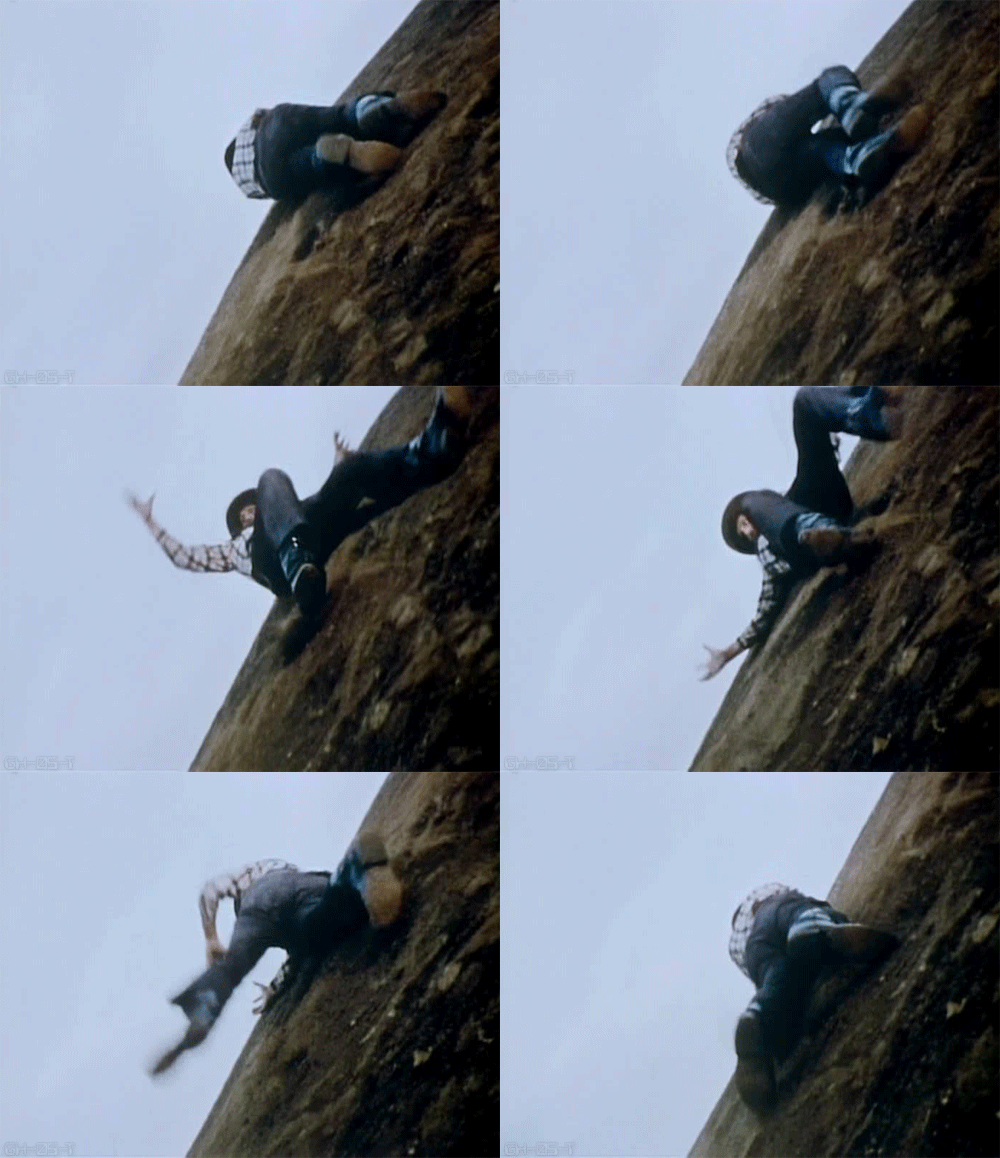
If everyone on your leadership team has an equal voice, how do you sort through conflicting opinions?
First, know that “equal voice” is as rare in teams as it is problematic. It’s likely some team members have a more equal voice—a voice that carries more authority (like the boss, for instance. Or the one who signs the bi-weekly pay stub). And, sadly, team-members willing to scream and throw a fit will often get their way through intimidation and/or sheer annoyance.
In this space between work, craft and carrying out community described yesterday, Seth McCoy talked about a leadership style that didn’t set the founding leader as the all-knowing, final-answer seer whose verdicts were solid gold. Instead, passionate committed leaders bellied up to give their opinions, expecting always to be heard. To continue to get full engagement from these leaders and their wide-open thoughts, team decisions must be revisited and discussed after the conflicting decisions.
Say your leadership team is conflicted on a pivotal decision. You need everyone behind the decision because you know each leader will motivate themselves and their teams based on the urgency of the task. You need them engaged. Whether your team takes formal votes on decisions or just gives a thumbs-up/thumbs-down, the mechanism that allows your leaders to respond to a decision should not be the final word. Allowing the team to revisit decisions in conversation builds trust—but those revisiting conversations must be open rather than defensive.
What business can learn from church is to build enough human to human accountability to actually, really, truly revisit group decision. To ask whether it works or not. And to offer honest assessments. And to build a solid history of honesty.
This is how any organization builds relational trust.
###
Image credit: gh-05-t via 2headedsnake
You may also be interested in:
What Business Can Learn From Church #1: Relational Trumps Transactional
Identify and Hear Gifted Voices
Seth McCoy runs a coffee shop in the Hamline Midway neighborhood of St. Paul. Groundswell makes an irresistible Chai Cinnamon Roll—especially warm.
Especially first thing in the morning.
Seth McCoy also pastors a church blocks away. A new sort of church that takes seriously the notion that people benefit more from dialogue than monologue.
Church and coffee shop each vigorously pursue their mandates: Groundswell makes tasty foods and strong coffee in a high-ceilinged, inviting neighborhood space. Third Way Church takes seriously the notion that community is much more than one guy sermonizing for an hour—you are likely to hear many voices if you show up at a gathering. Groundswell and Third Way Church inhabit the same neighborhood. This community connection also begins to bridge traditional divides, like the sacred/secular myth.
Talk with Seth the business owner and he may tell you how the leadership team works at Third Way Church: discussions can get “heated,” which is to say, leaders are passionate and vocal. One gets the sense they don’t hold back. On the church leadership team they’ve identified different giftedness or abilities in each of the leaders and they try to honor that particular voice. Often leadership voices in a church can follow some of the traditional patterns of prophet/apostle/evangelist/shepherd. Team members speak consistently from their expertise—which is also their natural bent—and they speak with authority.
 Our businesses are typically more transactional affairs. Employees are hired with a set of expectations (whether narrow or wide) and expected to go about their business. Our best work situations are those that move beyond merely transactional and begin to see the various bits of giftedness each employee brings—and then honors that voice. Most of us who have worked in organizations and companies where we remained unheard—and those work situations number among our least favorite. And those best work situations were where we were identified as the person in the know on some particular aspect of the shared vision.
Business can learn from church by recognizing the gifts, abilities and particular bent of employees and hearing the authority that employee speaks from. No matter what position the employee has, there is some authority/expertise/giftedness they bring.
We owe it to each other to move beyond transactional to relational.
###

 conversation is an engine