Table 7: The typist’s quiet laugh is every writer’s dream
Four minute film from Marko Slavnic
###
A Stage for Prince and a Grave for Tiny Tim: What Music Says About Minneapolis/St. Paul
Minnesota Theology of Place: Live Performance Matters in the Twin Cities

If one were rooting around trying to sort what values and practices make a place unique, music would be a good start. Jon Bream, music critic for the StarTribune recently wrote about why Minneapolis/St. Paul has become a home away from home for many rising musical stars. Bream cited four very different artists/bands (Dawes, Brandi Carlisle, Eric Hutchinson and JD McPherson) and noted how audience turn-out in the Twin Cities fuels these artists. Mr. Bream commented:
The key factors are open-minded audiences who love live music; a variety of venues that help artists build a career, and support from radio and other media.
The Current, of course, is a vocal apologist for the new music that grows outside the mainstream (and often, eventually, moves mainstream). I would argue the Cedar Cultural Center has been doing that same good work for years and years. Then there are the high profile, historied venues like First Avenue that have helped audiences and artists form connections. There are many more, of course.
A few days back I wondered aloud what a theology of place might look like for Minnesota. I cited all sorts of influences that would speak to that question.  Developing a theology of place is to look at a community from a perspective unfamiliar to most of us. It is a perspective that begins with a commitment to belief in God and then wonders what God is doing in that place, among those people, through their history. It’s a deeply rooted sort of activity: digging down and back to find out who did what and asking what they thought when they did it. And then asking how what they did affected others. And also asking how their belief structure enabled the outcomes before us.
To be intensely local for a moment, what would a theology of place look like for the Twin Cities—just starting with music? Bream’s observation of how audiences love live music fits with the general interest in theater in the cities. Apart from the Guthrie, there are dozens of small theaters in the cities that are producing memorable performances. Does a population that welcomes new music and new artists and helps support dozens of very small theaters mean we like the notion of “live performance” and see it as a way to connect with each other? Maybe we like to see our meaning made right before us—because we know that an audience is part of the meaning making.
Maybe the notion of a fondness for live performance accounts for the 20,000 people who showed up in St. Paul’s Lowertown last weekend for Northern Spark. And maybe our love for live performance accounts for the bike and craft beer cultures that are all about connecting (this year’s Artcrank pulled in an overflowing crowd).
Not that we’re unique in these things—but there’s something happening. As a curious person and one with belief in God, I cannot help but wonder what it means—even as I rejoice in the vibrant commitment to connection.
###
Overheard: “I’ve never felt more effective.”
Every Day We Create Conditions Around Us
My friend had finished his Ed. D but had no luck finding a teaching position. We blamed it on the glut of Ph.Ds and the poor economy and higher education cost-cutting and whatever. And yet as we talked he said this memorable phrase which I’ve rarely heard anyone voice: “I’ve never felt more effective.” In fact, my friend had continued with the same work he had been doing for the past two decades, but something was different. Yes he had expanded responsibilities and slightly-widened authority—but it still was not the final vocational resting place. Or was it?
Walk with me.
 There’s an old, old story about a warrior-king who wanted to build a house for God. But God said, “No—there’s too much blood on your hands.” So the warrior-king laid up stocks of all sorts of precious materials so his son could build this house.
Warrior-king died.
Poet-philosopher-son king took his place and commenced building the house for God. But the Poet-philosopher-king understood no building could house God. The best he could do was to make a place where people could come and seek God. The Poet-philosopher-king understood that despite his power and wealth and position, there was much of life still outside the control of even the most powerful person around.
Back to my newly doctorated friend: though he had not found the permanent faculty position of authority or leadership he wanted (yet), his old work yielded a fresh effectiveness. Why is that and how?
Feeling that you are in a place of effectiveness is a rare and memorable event—at least from my perspective. Much of life is spent wondering if what we do impacts anyone at all, let alone feeling effective at it. Sometimes we see results from our work, but not nearly as often as we might like.
I wonder if the best any of us can do is to work at creating conditions around us that help others walk as they are meant to walk. The Poet-philosopher king created a space where people could cry out to God with their needs. My newly doctorate friend bundled his expanded learning/vision into his old work found new ways to help the students he spent time among.
Maybe seeking out some fabled position of effectiveness is less the answer than finding ourselves effective where we live right now today this moment.
###
Image credit: Kirk Livingston

How To Speak Stupidier
To Know Deep, Speak Freely
My early college days taught me this valuable lesson: “Shut up.”
When I didn’t have a clue what was going on in class, when the professor appeared to speak English but I couldn’t make sense of his words, I remained quiet and took notes. Maybe the notes would make it clear. Eventually.
Later in college and then in graduate school I learned an even more valuable lesson: “Speak my ignorance.” I learned there are worse things than appearing foolish. Not knowing is worse than looking foolish. Bypassing an opportunity to learn is way worse than looking foolish. Looking foolish, it turns out, is not an inhospitable place to hang out. Today I’m settling into general foolishness quite comfortably, thank you. If I want to know how stuff works (how a millstone works, why Ulysses S. Grant didn’t buy a home in the swank section of Galena, Illinois, why flour explodes), I’ll need to risk looking foolish. I’ll need to ask.
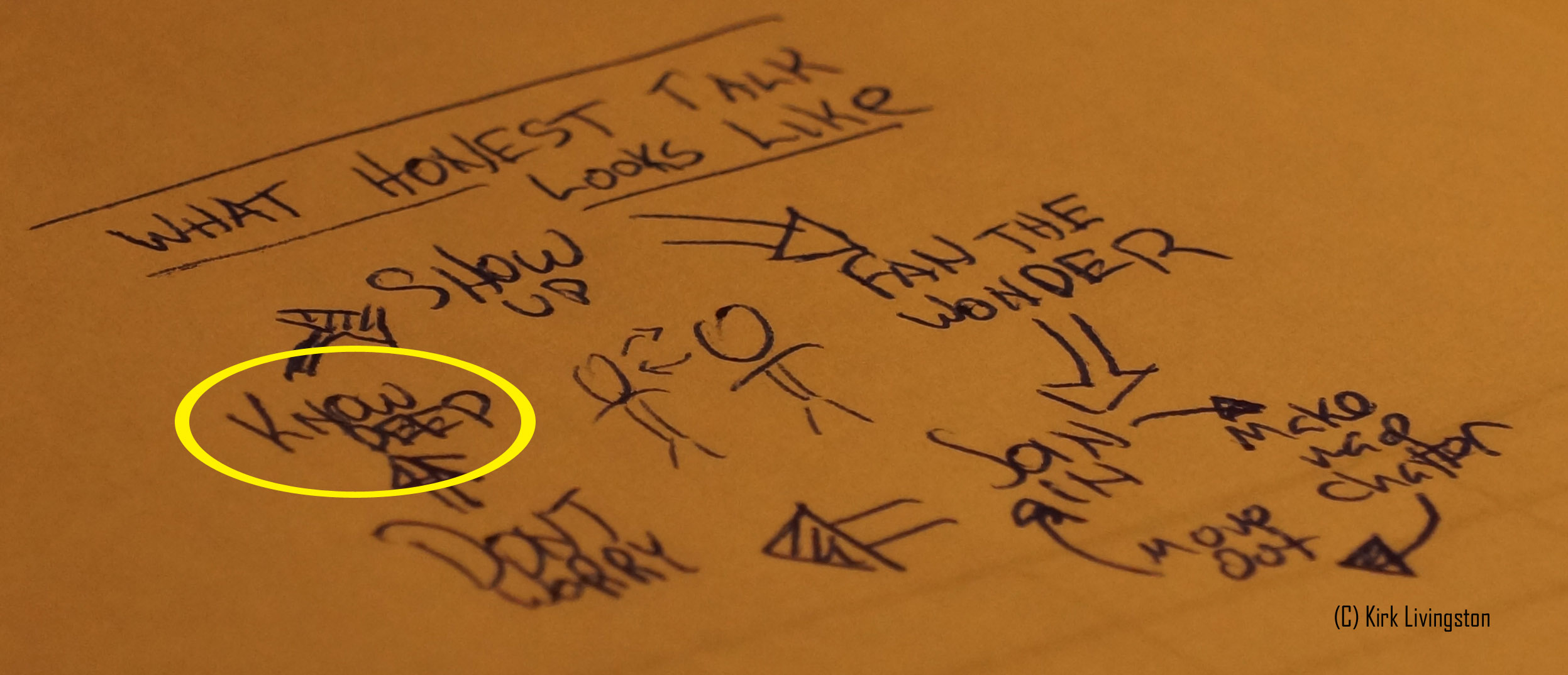 In this cycle of events that occur when we connect with each other, the “Know Deep” part is standing out to me today. What I know depends on what I’m willing to ask, which means I’ll need to reveal I don’t know something. Such revealing can be hard. But if I don’t tell someone what I don’t know, I risk never knowing. In the end, I must name the things I know so I can begin to realize what I don’t know. This may be a lifelong process.
Not knowing and being willing to look foolish can make for stimulating conversation: people like to help us know. And a child’s “why” and “how” questions can be refreshing, no matter what aged person they come from.
###
Song for the Land-Locked
Hounds of Finn: “Putting one foot in front of another”
I’ve recently discovered the Hounds of Finn. They make groovy music. I can’t stop listening to their “Ocean.” Yes: I need to go buy the music. This entire Radio Heartland interview is great but “Ocean” starts about 7:06”
###
I Don’t Have To Work. I Get To.
On Seth Godin’s 5000th post
 Seth Godin is a sort of apostle of forward. His posts routinely help me rethink why I do what I do and why I don’t do what I could. He is a spreader of ideas and a harvester of pithy phrases and a stone-by-stone mover of mountains. Today’s post is typical and there is a joyous bit about blogging in the middle that bears repeating:
My biggest surprise? That more people aren’t doing this. Not just every college professor (particularly those in the humanities and business), but everyone hoping to shape opinions or spread ideas. Entrepreneurs. Senior VPs. People who work in non-profits. Frustrated poets and unknown musicians… Don’t do it because it’s your job, do it because you can.
Do it “because you can” is wonderful way to approach any day. It gives fuel for the work and shines light for colleagues. I recently heard our son repeat a phrase that is often voiced around the People’s Republic of Kirkistan: “I don’t have to work, I get to.” His career is taking off and it is great fun to witness.
To find joy in your work is no small thing. I consider such joy a gift from God.
###
When I get discouraged about writing, I think on Philip Glass
Just Thick-headed Enough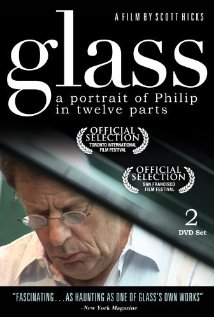
Philip Glass is known for repetitive structures in his music, among other things. Mr. Glass is famous (ish) today and you hear his music most commonly on film soundtracks. But not everyone likes those minimalist, repetitive structures (some members of the politburo of Kirkistan will sit for only limited doses of Mr. Glass’ music).
The 2008 documentary about Philip Glass contained quite a few unguarded responses to his music. Watch the film for the exact quotes, but the general sense people communicated to Mr. Glass as he developed his unique style was something on the order of “Please go away” or “Please stop playing that” or “I think we’ve heard enough of that. Can you do something different?”
In a 2009 Esquire interview, Mr. Glass, said this about his resolve:
When I struck out in my own music language, I took a step out of the world of serious music, according to most of my teachers. But I didn’t care. I could row the boat by myself, you know? I didn’t need to be on the big liner with everybody else.
I often think of Philip Glass when I get discouraged about writing.
Writing is difficult, so says anyone who writes. Just like with anything worth doing, there are all sorts of missteps and problems and wrong directions and mistakes involved with getting a thought on paper. And then there is the problem with the audience. I might call it the Glass Problem: prolific production of something no one wants.

But one continues forward. Despite responses. One must be just thick-headed enough to continue sorting out what it is one is trying to say. That’s what I understand when I think on Philip Glass: an infusion of courage to move forward despite all outward evidences that I really should stop.
###
Image credit: IMDB
Theology of Place: Minnesota
WWFD: What Would Fred Do?
Ever since I read of Fred Sanders’ work developing a theology of place in California, I cannot stop thinking what such a set of thoughts and conversations would look like for Minnesota. Mr. Sanders developed the notion after teaching a summer undergraduate class at Biola University focused on California authors and essayists.

Here’s Sanders describing his project from the EPS blog:
I wanted to apply that great books approach to California literature, about which I knew very little. I just had an instinct that the perennialist approach, in which we read the proven classics, “the best which has been thought or said” in the history of the western world, would benefit from a little dose of localism, where we investigate a regional heritage and get to know our own surroundings.
A Minnesota-based project would have a lot of moving parts.
There are the obvious Lutheran influences, of course. From Germany and Sweden. Catholic influences are also strong and vocal and from everywhere. The two cities where the majority of Minnesota’s population lives, Minneapolis and St. Paul (plus surrounding suburbs), are themselves launching grounds for waves of immigrant communities. Irish folks, Northern Europeans of every stripe. More lately Hmong and Somali folks have entered the area. There are communities of people from India and Ghana and Thailand. The Native American community should be an anchoring presence. Just walking the neighborhoods reveals much about what is important to the different groups.
Then there are the literature pieces: from F. Scott’s newly rejuvenated Great Gatsby to the benign(ish) Lake Wobegon characterization of Minnesota to Augsburg Fortress publishing insightful theological tomes to the nationally recognized Milkweed Editions. I’m missing lots and this is just for starters.
There’s all the science and medicine and vast amounts of research taking place at various colleges and universities. Medical devices and industry headquarters. The advertising and design and communication communities are clever and vocal. How would one start to get a handle on a theology of place: what are the priorities of the people of these communities? How does faith mix into the public and private lives of the people who live here? And what have the results been and what can we say about what is likely to develop in this vast mix?
Maybe the beginning point is to follow the lead of Minnesotan Andy Sturdevant who’s MinnPost column The Stroll is a weekly chronicle of pedestrian interestingness in the Twin Cities. Stuff we typically we don’t see because we rarely leave our cars.
Maybe we need our theologians and philosophers and artists to take group hikes through the cities, followed by a beverage and a discussion about what they saw and understood and what it all meant.
I’d sign up for that walk.
###
Image credit: Alli Livingston

 conversation is an engine