Can you tell the truth if your form is a liar?
Herzog & Morris & Searching for Sugar Man
The politburo of Kirkistan recently made its way through two documentaries. One paved the way to fully appreciate the other.

In Capturing Reality: The Art of Documentary, Director Pepita Ferrari set documentarians Errol Morris, Werner Herzog and others in front of the camera to show and tell how their work is entirely biased toward telling their story.
Why would anyone expect otherwise?
Except there is something about the documentary form that shouts “objective”—which turns out to be a profound misdirect. Some documentarians are not above setting up and staging shots in their passion for telling their story. This should surprise no one. And it is neither wrong nor a misrepresentation—depending on how the documentary is billed. As always: caveat emptor. And this: sometimes the story is true though not all the parts actually happened. Fiction writers lead with this all the time (the preface to Tim O’Brien’s The Things They Carried comes to mind).
Ferrari’s film was a perfect set-up for Searching for Sugar Man. This is an unbelievable tale of a washed out 70’s era Motor City singer/songwriter who helped foment revolution in South Africa—but who never knew it. This film exhibits breathtaking storytelling, with the paradox gripping you from the first scenes. It’s also a history lesson in how apartheid fell. I won’t give away the end except to say it is one of the sweetest stories I’ve heard in a long time.
How about taking in a documentary this weekend?
###
What, exactly, about the light?
Brillianted and Shadowed and Beyonded

What about the light turned mundane joyous?
Dorian asked. Great question.
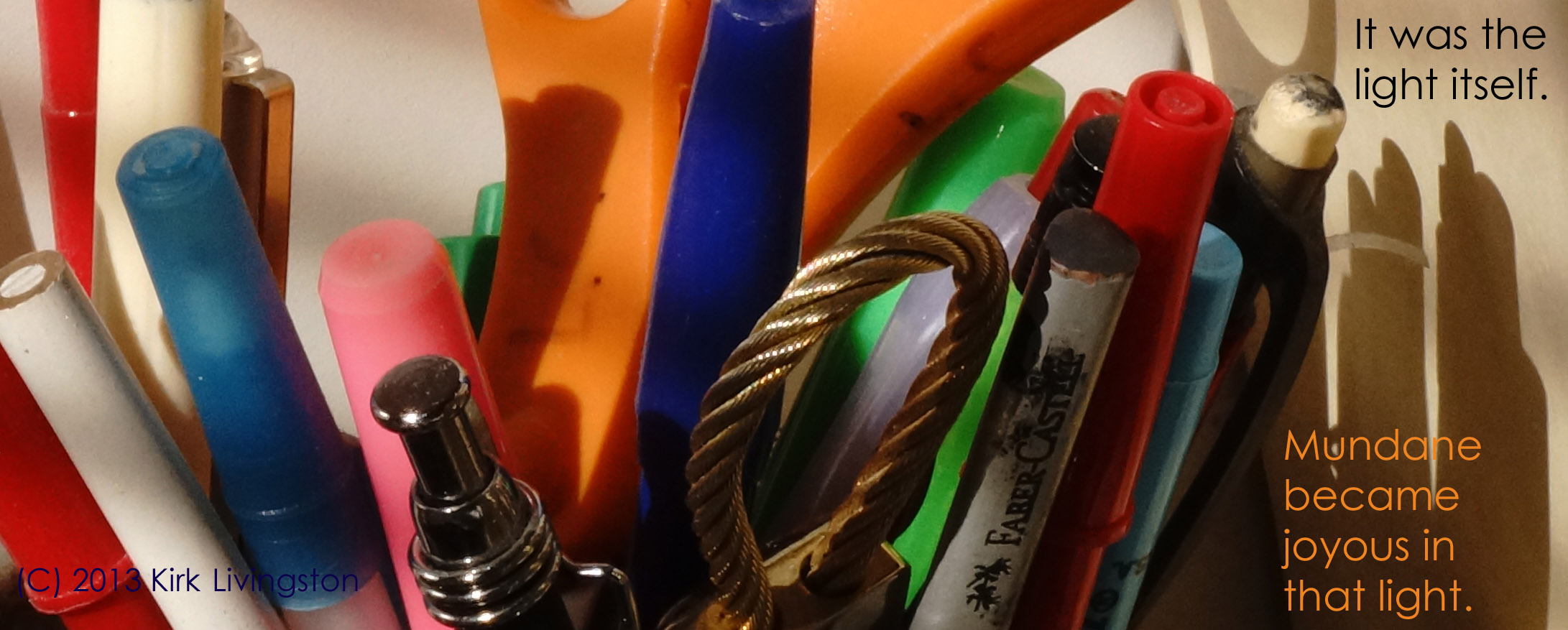
On May 23 at 7:32am I widened a set of blinds in a way I typically don’t. My office was brillianted (please, ma’am, can that be a verb?) in a light I don’t often witness. After our long winter and so many dark mornings, this unfettered, energetic beam lit tired old spaces. Intense oranges resulted. Jaunty slants of shadow led to spot lit scraps of yesterday’s thought pinned to the wall—the ordinary jetsam of my process.
This May light a minor miracle revealing what I had forgotten.
It was the visual parallel of smelling fresh bread or brewing coffee—arming my lazy brain and fortifying it for that day’s work.
That new old light still reminds me of the old gospel story where the man now walking was never the only paralyzed man in attendance. Shining light can make a person dance.
###
Image credit: mirrormaskcamera via 2headedsnake

Ray Becoskie: The Solution Should Always Have a Flag
Because There’s a Pistol in Her Purse
More Art-A-Whirl aftershock.
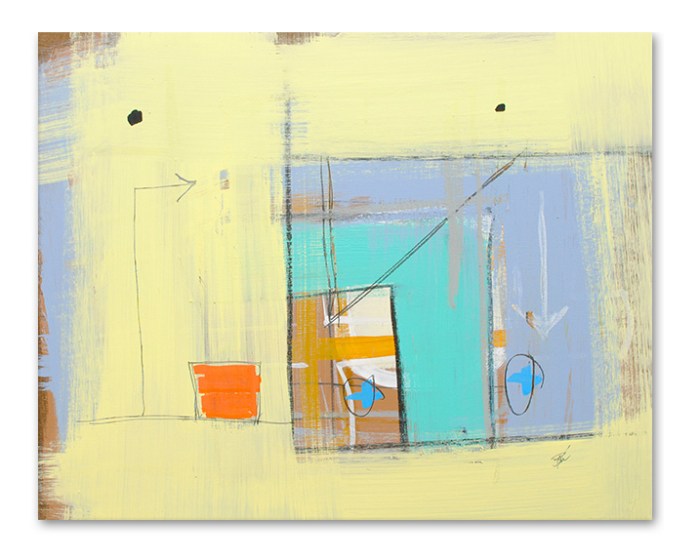
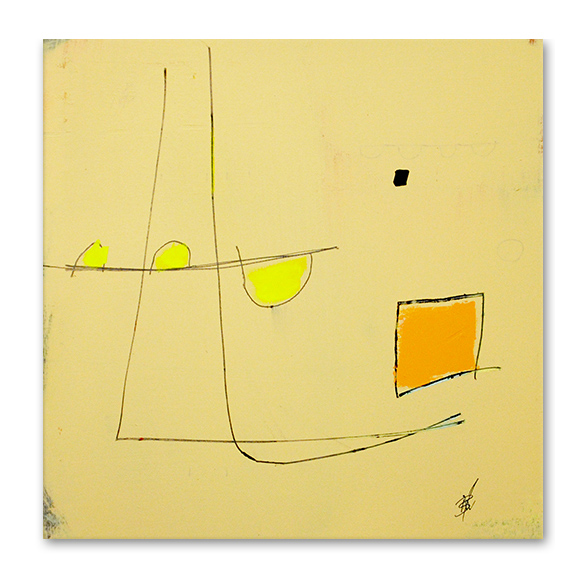
A few days back I wrote about Cody Kisel’s vision for consumerists. On that same floor of the massive Northup King Building, I had a hard time tearing away from Ray Becoskie’s paintings. Mr. Becoskie’s work transmits a wry humor and a fair amount of joy along with the puzzle of his titles.
The Solution Should Always Have a Flag
Here’s Becoskie on his process:
The work is generally constructed from three things. Things I know, things I believe, and things I make up. I get them all together in a room and I do my best to document the conversation that happens.
Like the Librarian Said
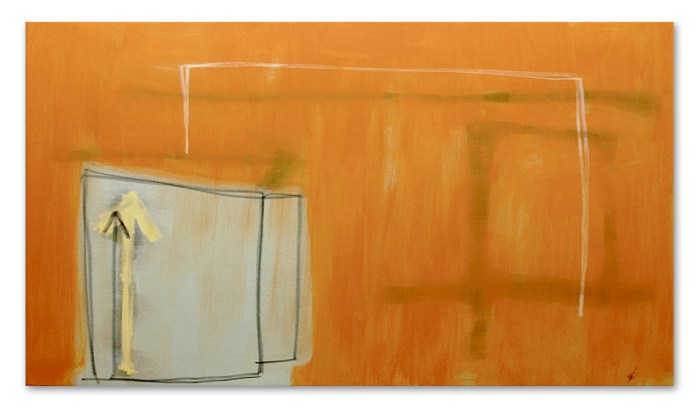
Because There’s a Pistol in Her Purse
###
Image credit: Ray Becoskie
“You can’t change something that doesn’t exist.” (Copywriting Tip #7)
Where to find courage to create
Designer/entrepreneur Mike Lundborg uttered it dozens of times over a few projects we collaborated on. For me this quote nearly perfectly encapsulates the dance between creativity and work that is the business of freelance life. That’s why I keep the quote front and center in my work space.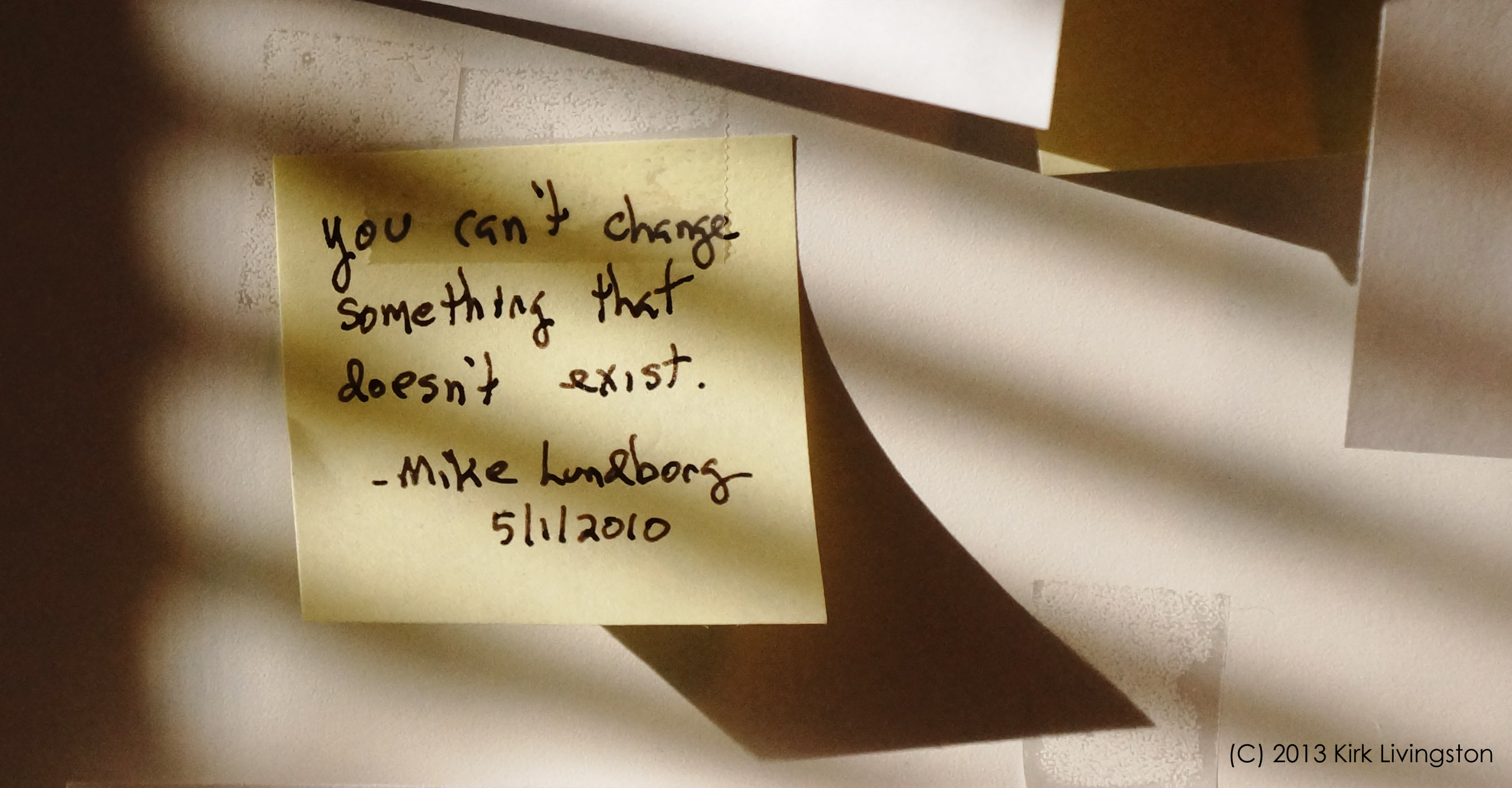
Even today I’m working on a story intended to invite prospective patients to participate in a clinical trial. But early review comments indicate my client wants to buff out the narrative parts (that’s right, losing the story itself) and swap it for clinical and corporate language. The story was meant to pull prospective patients toward a clinical trial, but it won’t if the corporation keeps talking.
But this is not a lament. It’s only a statement of reality and maybe a celebration—because this is how we create together. My sizzling hot interpretation of a marketing objective is held in the tongs of review and hammered into shape by my collaborator. And by me. This is my expectation for my ideas and the resulting words, just as it is my expectation for each part of the process.
And now this: as we release a few of the projects physical constraints, my story bounces back—which makes me glad. This is what collaboration looks like. Successive drafts change but the central objective continually informs all the collaborators as we take our turns shaping the project.
Amazingly, it is this very collaborative process that needs to inform my less commercial writing projects. The courage to create actually springs (again) from the sometimes difficult conversations that surround the project. But it also takes courage to produce a rough draft.
###
Can’t Judge a Bookist by Her/His Cover
What We’re Reading
Yesterday my second grade teacher, Mrs. Wheeler, stopped by with a sharp attitude. Her words made me watch how my assumptions and stereotypes changed as I saw what these strangers were reading.

“FRANKENSTEIN”, BY MARY SHELLEY
###
Image credit: Ourit Ben-Haim
Mrs. Wheeler’s Back. And She’s Gone Existential.
Fan the Wonder
Your 2nd grade teacher showed up. The one who always said “Listen to your neighbor.” She just dropped in—several decades later—but now she’s wearing a black beret, smoking unfiltered Gauloises and sipping espresso.
 Mrs. Wheeler is no longer concerned with making things simple for you. In the training for everyday life that was part of 2nd grade, listening was a critical skill. She thinks you’ve forgotten it today, based on how you treat people.
Mrs. Wheeler wants you to start seeing the people around you. And then she wants you to assign value to these others that surround you. Not just your gang. You already value them and you listen to them (more or less). It’s those others—those not in your group. The ones you barely acknowledge, let alone listen to. Mrs. Wheeler says a true interest in others means allowing those others to be themselves.
“Of course, Mrs. Wheeler,” you say. “How could it be otherwise?”
“Ah,” she says, smoke slowly drifting up.
And when people show up with words different than yours? Different language entirely? Or just a different set of words that are not the key words you watch for? What if these others wear clothes that are provocative? Or not at all stylish? What assumptions do you automatically process? And how do those assumptions affect how you listen?
“No,” says Mrs. Wheeler. “Pay attention. These others are saying something you need to hear. Fan whatever wonder you find.”
She slowly stubs her cigarette on the saucer.
“This is the way,” she says as she steps out your front door.
###
Image credit: Kirk Livingston, All Rights Reserved.
Cody Kiser: Painting the Consumer’s Irrational Fears
View from the backside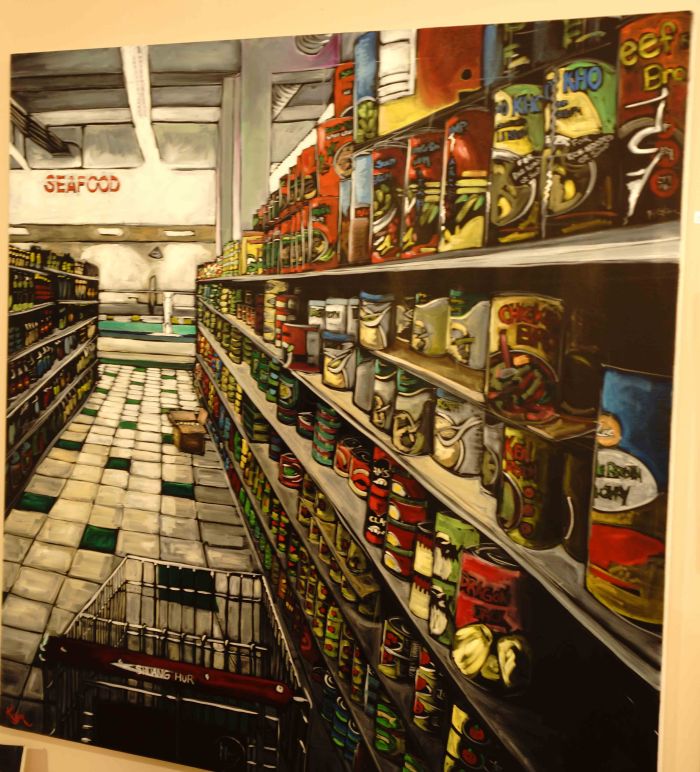

Cody Kiser paints his way into the mundane stuff of everyday life and resurrects it in a form that is both familiar and disconcerting. Mr. Kiser’s artist statement says his work functions as commentary on the irrational fears peculiar to people who self-identify as consumers. He strips away language and cultural barriers in his paintings and deposits the viewer on a not-so-distant shore with a view of the backside of our culture.
Mr. Kiser’s paintings drew in Mrs. Kirkistan and myself as we wandered through this year’s Northeast Minneapolis Art-a-Whirl. We like seeing things from a different perspective and Kiser’s work accomplished that instantly. But there is also a sort of gathering darkness to his work that hints at sinister ends. Where have the people gone? And how did I get to this place where I’m shopping for stuff I can barely identify?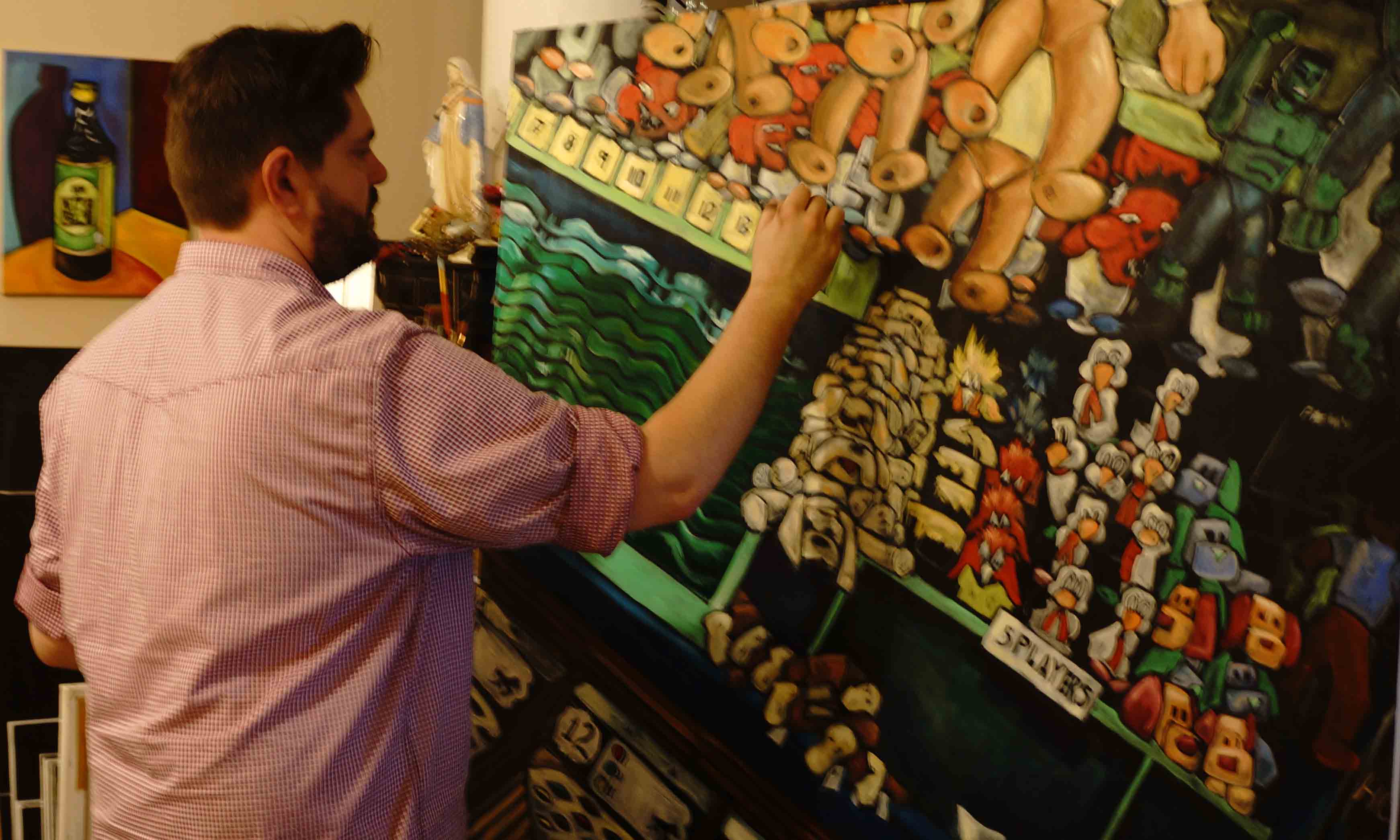
Finding patterns and vision in the dreary details of everyday life is itself inspiring. The surprise is that the closer we examine nearly anything, the more we see how wrong were our first assumptions. Upon a close examination, the hard surface becomes porous. Smooth becomes cratered under the right light. It’s funny how often that proves true.
See more of Cody Kiser’s work here.
###

 conversation is an engine