Marissa Mayer May Be Right: Show Up (How To Talk Series #1)
You can’t talk if you’re not there.
With your colleague, maybe with your spouse when you left the house. Maybe your sister on the phone, the friend in London using Skype. Nothing happens when you don’t show up.
 Today we continually fine-tune our understanding of showing up: we show up with a tweet, with a blog post, with a telephone call. We show up by email (and sometimes our explanatory emails mark us absent). And then there is actual, physical, atoms and genes-on-the-scene showing up. But even that is not so clear, because despite standing here as you jabber, my mind is seated on the couch reliving that scene from Terminator (was it II?) where the semi-truck-trailer shoots off the bridge to land in the concrete spillway to continue chasing our heroes.
Maybe this is part of the “Why?” behind Marissa Mayer monkeying with the Yahoo! work-from-home policy—to help people be present:
Mayer defended her decision by first acknowledging that “people are more productive when they’re alone,” and then stressed “but they’re more collaborative and innovative when they’re together. Some of the best ideas come from pulling two different ideas together.” The shift in policy affects roughly 200 of Yahoo’s 12,000 employees. (reported by Christopher Tkaczyk, CNN Money)
I hope and believe collaboration and innovation are at least partially behind the Yahoo! change (which is to say, I hope the change is not a retrograde movement toward tighter control of knowledge workers and the corporate monologues they produce). There is some truth in the move: we cannot collaborate without being present. Also true: there are a lot of ways to be present when the collaborator is not physically there just as there are a lot of ways to be absent even while your carcass sits upright at a desk.
So today, choose to show up. Signal your decision with active listening skills. Refuse to be put off by anti-collaborative rants and power plays—say what you need to say to contribute. Refuse the director’s feigned emotion over this or that decision and tell the truth.
Show up today. It feels way better than hiding on the couch and watching your internal TV.
###
Secretary of State Kerry: Please Send Dennis Rodman to North Korea to Sing This Song
It’s too late, baby, now it’s too late.
I doubt any of the Kim Jong’s have ever been “light and breezy,” though Un may be so with Mr. Rodman. But certainly they have just stopped trying.
Is it time to call North Korea’s bluff?

[Click to play]
Of course, the inbred regime may actually believe the rhetoric they spout—that is the danger. Un may well be unhinged enough to push the button—no one really knows.
On the other hand, is there a way to keep pressure while allowing them a face-saving out. Some way to move toward dialogue while not giving in?
###
Illegal Inscriber: We Are Brothers
Warning: NSFL Image (Not Safe for Librarians)
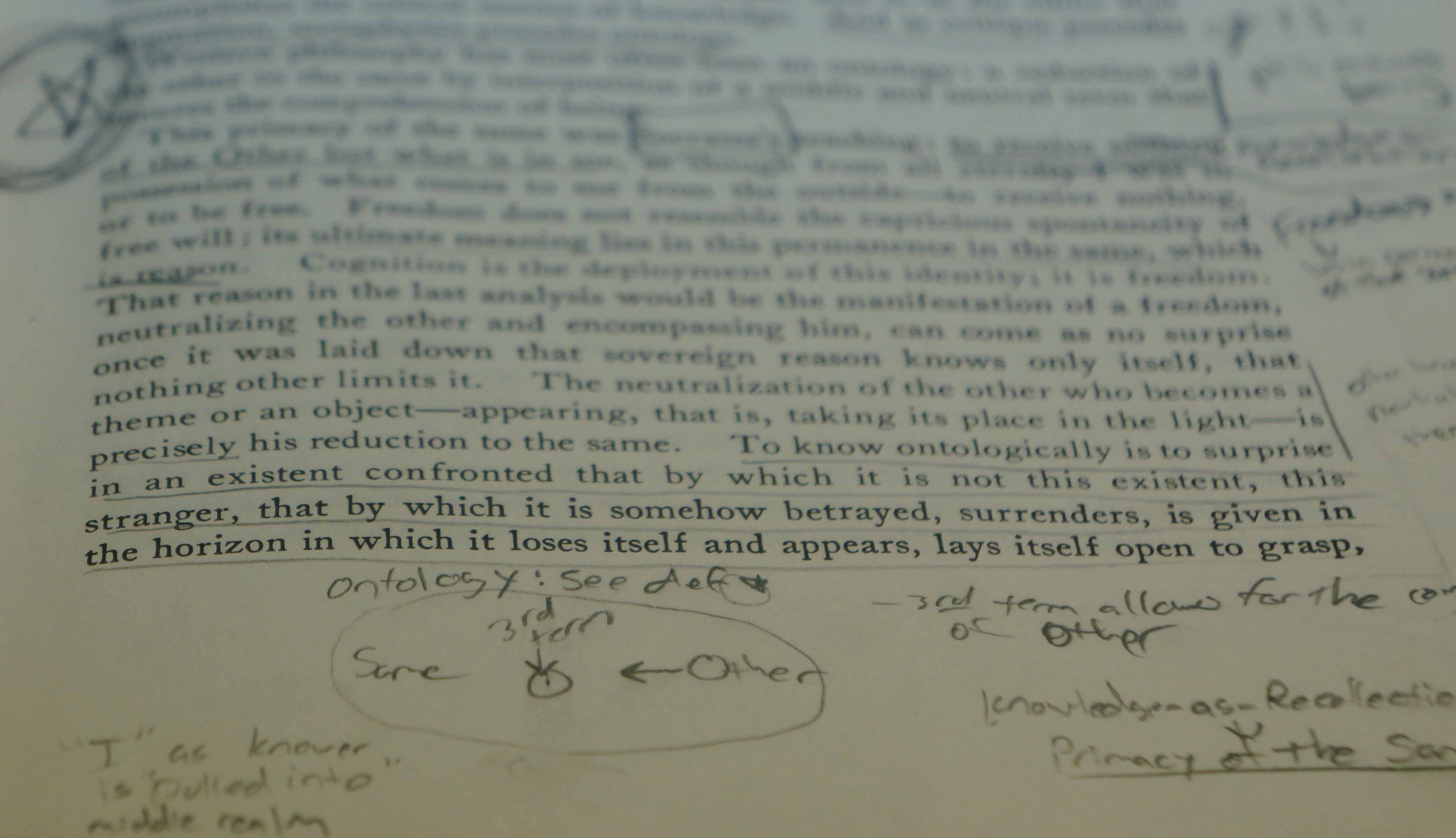 Sometimes Ramsey County goes far afield to procure my desired book through their interlibrary loan system. Not so long ago a book about Levinas written by Sean Hand made its way to me all the way from Janesville, Wisconsin. I had not thought of that working community as a hot spot for continental philosophy, but life is full of surprises.
This copy of Levinas’ Totality and Infinity came from St. John’s University in Collegeville, Minnesota. And somebody there did his thinking on paper. I say “his” because this scrawling looks like it was made with a masculine hand. I would like to buy this thinker a cup of coffee—his processing of the text is spectacular. He outlined sections of Levinas’ thought, he responded with gusto (exclamation points and double/triple underlines) to the sometimes obscure Levinasian sentences. His notations in the margins show him connecting Levinas to Hegel, Nietzsche, Sartre and Descartes. He is surprised when he finds “another way!” He offers a sad face upon realizing “the state is a totality.”
In fact the first 1/3 of the book is full of his incidental reactions and understandings, all scrawled in remarkably clear pencil in the margins. By half way through the book his interest seems to wane. The latter half of the book is free from all pencil inscriptions. Did he fall asleep in the library and miss his deadline? Did he finish his paper based “the same and the other” without ever getting to “exteriority and the face?”
I suspect so.
Even so, I’d like to have a chat with this illegal scribbler. This person has a lively mind, reaching out to make mental connections even as he reached out with graphite to record those firing synapses. Maybe this guy was even considering the poor dolt (this next other) who would pick up the text next—showing a kind of mercy on him.
I think the Ramsey County Librarian would also like to meet this scribbler. She wrote (for the tiny but loopy handwriting on the transfer label looks like a feminine hand to me) —wryly, to my mind: “pencil marks noted.”
###
The Boss Problem: When Does Your Purpose Become Mine?
Tell Me About It.
 One of my bosses gently chided me for my language: I kept saying “they” in reference to her boss and the leadership structure and the stated purposes of the medical device company we both worked for. She was exactly right: I did not use “we” because I felt separate from the decisions being made and the direction chosen. It was not a conscious choice on my part; I was just reacting to all the pre-conscious activity that happened outside my engagement. My language, which seemed to choose itself, was the telltale.
The boss problem is how to engage employees (or a team) with the problems and purposes at hand.
“What’s the problem?” you might say. “We pay these people so they should do with that boss says.”
That’s true, they should. And they likely will perform at some level, though giving an employee a reason for doing something is a step toward improving performance. Better yet: if the employee feels ownership, that they are personally involved in this task, that they have something at stake, perhaps that condition generates the best performance.
But getting someone to feel ownership for a task is something of an art. There is also an inherent compassion to it: a boss must understand that transferring ownership starts with a shared purpose that sits prior to her command. Sharing ownership begins with the relational approaches in the team long before the purposes and problems come in view. Sharing ownership brings risk for the boss—his reputation is at stake as well. Words by themselves—though always the beginning point—cannot accomplish the transfer if the boss does not believe it. Employees and teammates come equipped with highly-attuned BS indicators and can spot a fake before a word is spoken.
But isn’t sharing ownership the only reasonable solution when fully-grown humans are involved together in a work process?
###
Image credit: thorelimo via 2headedsnake


Clicktivism & The Power of Social Chatter
This subtle third rail
 Katie Humphrey writing in today’s StarTribune noted the proliferation of pink and red equal signs on Facebook (as the Supreme Court heard arguments on gay marriage) and wondered if social media chatter amounts to much more than chatter. It’s a good question and a good article. Humphrey cited U of M professor of communication Heather LaMarre:
For a lot of people, the mere act of posting relieves that need or feeling for them to be involved. They feel like they did their part….
Anyone who writes regularly understands this dilemma: you want to write about something. But if you say aloud to someone the germ of your idea too soon, your pressure to write diminishes. Same goes for action, apparently: we feel we’ve done something if we’ve said something.
But that’s not exactly wrong, is it?
To say something is to do something. We’ve communicated that something is important to us—important enough to remark on it. Yes our likes and endorsements (LinkedIn) and tweets are cheapened by sheer volume and ease with which we dispatch these opinions. But each says something. And each does something, however slight.
Our talking is the beginning of our acting. Our talking is also a signal that others could pick up on in conversation and in relationship. And when others join in on this important thing we’ve identified, it starts to carry power, like a third rail. I think we’re seeing this power in all sorts of minor and major revolutions.
###
Image credit: Francesco Radino via MPD

 conversation is an engine