
Chuck Hagel: Rogue Defense Conversationalist?
Quick: Put this guy in charge before he goes back on script

Phil Stewart writing for Reuters today caught the newly confirmed Secretary of Defense in an unguarded moment. In that moment—behold—candor:
“We can’t dictate to the world. But we must engage the world. We must lead with our allies,” Hagel said in what appeared to be unscripted remarks.
It sounds like Stewart was caught off-guard as well, but maybe he should not have been, given Hagel’s record and further comments quoted.
This seems like a positive development to me. Let’s quickly put Hagel to work before he reads and signs on to our usual defense script—maybe he can work out that dialogue before anyone realizes what’s going on.
###
Image credit: Reuters
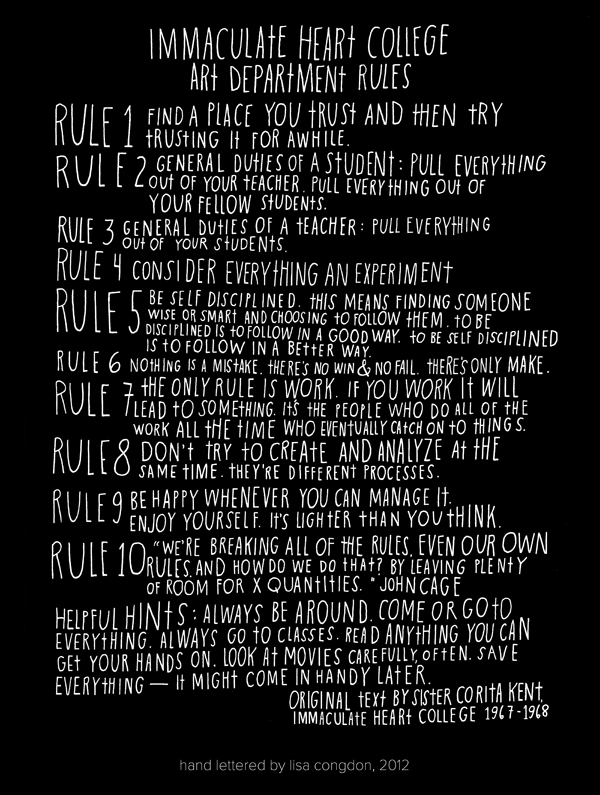
Sister Corita Kent’s Art Department Rules
 ###
###
Image credit: Lisa Congdon via thisisn’thappiness
Bending HIPAA Toward Spontaneity—Just for the Health of It
What if our propensity for over-sharing helped us get healthy?
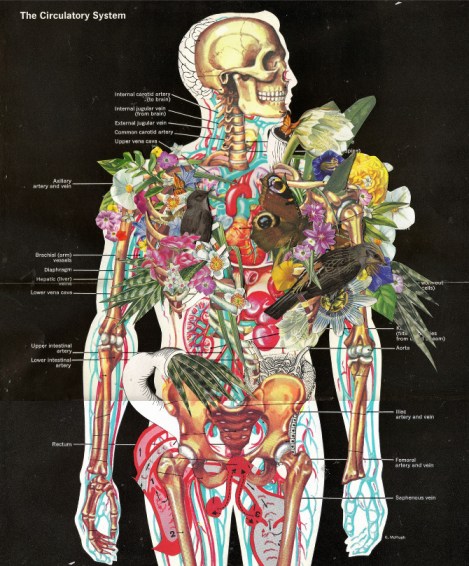 Writing for Fast Company, Jennifer Miller reported on a study that showed the amazing stickiness of Facebook status feeds over other literature. Miller queued up the notion as “mind-ready content,” which is a pithy way of getting at the heart of the study. It seems the immediacy and poor spelling and bad grammar we expect in status updates all have a way of indicating spontaneity. And one of the study experiments suggested:
…the remarkable memory for microblogs is also not due to their completeness or simply their topic, but may be a more general phenomenon of their being the largely spontaneous and natural emanations of the human mind. (Major memory for microblogs abstract: Mickes L, Darby RS, Hwe V, et al.)
We’ve been witnessing the rise of social media to help people lose weight, get exercise, eat right, among a sea of many other activities. It is the telling and the reading—all on a fairly spontaneous level—that has great persuasive powers. Not to belabor this point, but it is not just reading about others’ success that can motivate behavior change. It is when we ourselves record our progress (and lack thereof) (in public and not) that also motivates change. If you’ve ever recorded the calories you eat in a day or the money you spent in a day, you know how awareness jumps to high alert.
Can these facts about human motivation and memory be harnessed by physicians? Should healthcare have a social component…generally? Privacy on the web—always a moving target—would seem to have hit the immovable object of what the US considers protected health information: those rules the medical community follows to ensure medical records stay private. But encouraging patients to share what they are comfortable sharing, is there a possible positive health outcome in that? Maybe. Maybe not. Who is itching to read about their friend’s infection (sorry: bad word choice)? I have no desire to read colonoscopy stories. But on the other side, will we start to see spontaneous-ish declarations from our friend the corporate doctor/robot that encourage us toward healthful habits—based on our Facebook feeds?
One wonders.
###
Image credit: Ben Giles via 2headedsnake
Dustin O’Holloran & Wes Anderson & You
Art: To stop. To stare. To listen.
In the debate over art versus commerce (or fulfillment versus earning a paycheck), let me point out two bits of commerce guided by artists. Eric Harry Dustin O’Holloran wrote the score for this tourism commercial for Newfoundland & Labrador. The pacing of music and scene, from the first moments, present a different, irresistible world. I posted this commercial about a year again and have revisited it many times because it truly is a mini-vacation. The copy in the commercial is a let-down and a distraction: it’s expected and detracts from the persuasive work already accomplished by the score and visuals.
I’m a fan of Wes Anderson movies. Even his commercials are full of entertaining detail (Ad Age published a list of his great spots here). Here’s the famous American Express commercial, and then the Softbank commercial with Brad Pitt, which is itself an homage to another period of film-making. But it’s this Hyundai commercial that is chock full of detail in every frame. Anderson is known for his devotion to art direction and this commercial bears frame-by-frame examination to see the humor layered in: the kid in the cupboard. The kid in the white lab coat. The kid costumed for a Greek tragedy. I’m still puzzling over the dozens of robots that show up everywhere. I’m not sure this commercial sells cars, but it certainly fixed the carmakers name in my mind for a time.
If art is an invitation to reconsider what the world looks like, then Dustin O’Holloran and Wes Anderson have achieved art and were paid for it. Art is not about getting paid. But getting paid is not the worst thing in the world.
Check out this vimeo of Dustin O’Holloran inviting an audience to visit a different place, but without the pretty Newfoundland & Labrador visuals.
###
How to Regain Wonder
Target cannot sell you a loaf of wonder
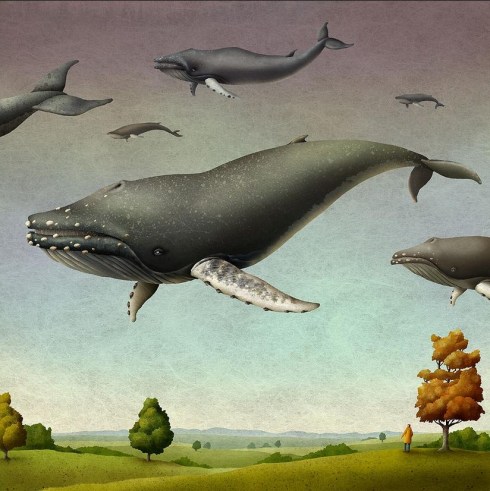 It would seem that life beats wonder out of us. This project went sour. That team sucks. My career seems more about false starts and abrupt ends than ascendancy to the corner office. The boss or CEO or pastor or professor are in it for the money or the power or both. People and institutions disappoint.
It’s easy to paint most anything black with the brush strokes of cynicism. Our culture largely applauds and rewards this attitude, often providing pulpits for the world-weary naysayers. It’s a stance we learn early in life. We chide optimists as Pollyanna and naïve.
But if you look around, it isn’t the cynics who make things different. It’s the people with faith. I’m not talking about religion, though faith in God applies big time. It’s the people with a sense that things don’t have to be this way, that there might be a better way. And beyond that: people with a basic wonder at how the world works. People with a sense of wonder and curiosity are the refreshing people who are fun to be around. They entertain just by pointing out the invisible stuff that we never thought to think about. These are the gratitudists, whose stance of thanks sweetens the well for all around. Their faith and wonder refuse to let today’s seeming realities push forward as tomorrow’s certainties.
Where do you find wonder in your life? Hostess has closed and Wonder bread may or may not be available. But I plan on seeking out those places and people where wonder presents.
###
Image credit: Adam Pękalski via 2headedsnake
Why Teach?
Teaching is an epistemological playground
 Yesterday I posted under the title “The unbearable sadness of adjunct.” I hope you read on to see it was a larger discussion about the price anyone pays to live a thoughtful life. I tried to show the realities of teaching as an adjunct (often agreeing with Burnt-Out Adjunct), especially noting the counterintuitive reality that some advanced degrees still offer jobs that force you to choose between buying groceries or paying the mortgage.
But there are also good reasons to teach. If you can afford it (counting the work you do to earn a living and/or opportunity costs of time spent on teaching), it is work that is full of meaning. Here are a few reasons I continue to seek opportunities to teach as an adjunct:
- There is a thrilling something about developing a coherent idea and presenting it to a class of students. Even more thrilling, when you see that they see the utility of the idea.
- Class times often become incredible conversations. Not always, but often poignant things get said that help move my thinking (and humanity) to a new level
- To teach is to learn. And learning is great fun. There’s nothing like trying to explain something to someone else to show how little you really know. As I explain, synapses fire and brand new stuff happens in my brainpan. Teaching is a kind of epistemological playground.
- Students are amazing. At the college I teach, I remain deeply impressed by the devotion and care and passion many (not all) bring to the work. I often encounter excellent writers and I want more than anything to help those people move forward.
- Faith and work belong together. Every year I teach I see this more clearly and I labor over (and yes, I pray about) how to explain the connection. My own work as a copywriter highlights and dovetails into this connection. I am very pleased to bring with me ancient texts that explicate the meaning of work and life.
Naturally, there is more to say about this. What would you add?
###
Image credit: Kelvin Okafor via 2headedsnake
The Unbearable Sadness of Adjunct
The Price of the Life of the Mind
 I’m having a lively conversation with PissPoorProf about the value of a Liberal Arts degree. He maintains that liberal arts should be corollary studies in college while I think they should be central. Others are chiming in. It’s a discussion I welcome because the topic goes well beyond the choice of undergrad studies. As Burnt-Out Adjunct so ably points out (in his many posts) the life of the mind does not come with an income. In fact, it requires an income to satisfy those lower elements in Maslow’s hierarchy, just to get to the point where one can, well, buy time to think/read/write/converse.
Agreed.
Also agreed: the treadmill that is adjunct work, with day and night responsibilities (Honest: preparing lecture/discussions, delivering those educational events, responding to questions and grading take way more time than I would have ever believed when I was a cubicle dweller with a steady paycheck) is relentless and seemingly possible only when you have another income. So when PissPoorProf describes adjunct teaching as “about as soul-sucking as a wage-slave job can get,” I tend to agree.
And yet, we agree that the life of the mind—whether taught or caught or pursued or scrimped and saved for—is a thing of value. Maybe part of our equipping for undergrads, as well as for those later in life who want to think, is to help each other understand we need to pay your own way to join the larger conversation.
There is so much more to say about this.
###
Image credit: BORONDO by Arte urbano Madrid via 2headedsnake
How did you become a philosopher?
Claude Lefort on Meeting Maurice Merleau-Ponty

The questions with which Merleau-Ponty was dealing made me feel that they had existed within me before I discovered them. And he himself had a strange way of questioning: he seemed to make up his thoughts as he spoke, rather than merely acquainting us with what he already knew. It was an unusual and disturbing spectacle.
— From “How did you become a philosopher?” by Claude Lefort, translated by Lorna Scott Fox in Philosophy in France Today (Cambridge: Cambridge University Press, 1983) 98
###
Image credit: Jonathan Zawanda via 2headedsnake
“It’s time for your enema.”
Robot & Frank & Listening to Your Machine
 That’s my favorite line from this melancholy film. Frank, the retired jewel thief in decline, doesn’t want the robot his son brought as a caretaker. Frank considers it an appliance with a voice and wants nothing to do with it. But Franks starts to warm to the robot when he realizes he can put Robot to nefarious ends under the guise of a “project.” Robot’s caretaker program takes priority over moral logic and Frank is back in business and seems to self-reboot as he plans minor heists.
“It’s time for your enema” is delivered by Robot after Frank starts to be OK with Robot’s scheduling of Frank’s day and the healthy vegetarian lunches Robot prepared. Just when Frank was thinking this may work.
It’s not the enema that attracts me to the story (despite this Florida couple who swears by coffee enemas four times a day). But it is the realization that the voice of a machine can have a profound impact on a human. My example is the treadmill I run on. Despite being voiceless, it tells me a truth (I’m still not sure it is entirely accurate) about the speed and calories consumed when running. And it helps me hold myself to a higher standard than when I run outside. There is an objectivity about it that I like, that isn’t swayed by my pleas to slow down.
In the end Robot & Frank is a downer. If you have anyone in your life with Alzheimer’s, the movie leaves you with a feeling of inevitability about the human condition, no matter what machines we employ.
###

 conversation is an engine