Lesson from The Queen of Versailles: Things Change
Is Acquisition Habit or Sickness?
The Queen of Versailles should be required viewing for anyone who has never entertained the notion that things can change. Which is most of us. Because we naturally assume finances/relationships/situations/lives/health remain the same.
And they don’t.
The documentary opens with timeshare mogul David Siegel and his happily enhanced wife (neither the wife Jackie nor the documentarian let your forget this fact) filmed at or near the top of their game. He’s making millions or billions (hard to say, it’s all so leveraged) as they sucker all sorts of “moochers” into becoming buyers of luxury timeshare condos. But the pair, with their eight kids and staff of 20+, are bursting out of their 26,000 square foot house. What choice do they have but to build? So they begin building a replica of the Palace of Versailles, which turns out to be the largest single-family home in the United States.
Then the market crashed and everything changed.
Dramatically.
This is one of those films where you expect to find greedy people to blame, but the filmmaker does a good job revealing the humanity of the main characters. David Siegel starts as a blustery, boastful businessman who loves “beautiful women” and is not afraid to take credit for George W. Bush’s presidency (and perhaps the Iraq war). But he ends the film in a much different spot. Jackie, who remained buoyant (figuratively and, well…) throughout the decline is no airhead or bimbo. I credit the filmmakers, with their thousands of hours of footage (had to be), with portraying struggles rather than just one-dimensional portraits. Yes, the film is a train-wreck in progress and for that reason alone it’s hard to look away. But it is also a sobering look in the mirror at the varieties of greed that drive any of us.
I would have liked to see the proposal or creative brief for the film. Because when they started filming, it had to be a sort of look into the lives of the rich and famous. But by the end, it is a meditation on avarice and habit gone compulsive.
###
DIY Drama Queen: a Cop, 2 Boots and a Homeless Guy
Tell Your Old Story in Today’s Conversation
 Not so many days ago a New York cop bought some boots for a homeless, shoe-less guy. The photo went viral because it was remarkable—stuff like that doesn’t usually happen. The telling of the story warms the heart and we want to share it.
Communication-types talk endlessly about stories and narrative and narrative arc. All this literary-criticism lingo has made its way from academia through the land of communication and advertising and out into mainstream speech of the news anchor, for instance. Behind all this talk is the simple notion that people respond to stories.
Because people respond to stories, we give assignments to our outward facing employees to snag potential customers and engage clients with precisely those stories that feature our product or service in a key role. Maybe the product saves the situation. Maybe the service is a vehicle of freedom. Certainly the product enriches the identity of the people using it.
But what about inside the company? Where are those engaging narratives in our ordinary, daily conversations? Does story have a place in our workdays? Should it?
One medical device company I worked for held a company-wide meeting around this time of year where patients came on stage and told stunning stories of how they could now walk (or stand or eat or breathe) again. They talked about how their lives were changed by the very products we all worked on.
And we all got weepy.
But ordinary, daily conversations produce no such tears—how could they? We’re all about work and getting stuff done, after all. We’re not here to tell stories. But some smart bosses are telling larger stories. Some meeting leaders are starting with the narrative arc that includes patients being healed and lives restored. Some team members are embedding in their discussion how their product makes it easier to turn solar energy to electricity—and why that has meaning for today’s work. Bringing those stories to the mundane conversations can seem like a cynical, manipulative ploy—but only to those intent on cynicism and manipulation.
It’s time to bring those stories back into our conversations. Not as ploys. Not as manipulative levers. But because of our universal need to make meaning. Especially to make meaning of our daily work.
We’re moving into a season where we tell lots of old stories: When I was a kid Christmas looked like this. When we were first married, we did this for the holiday. Way back when a virgin had a baby. In a stable. And everything changed.
Be the drama queen in your part of your company or organization. Take center stage and demand attention. And tell the remarkable story you heard.
Stories help us make meaning and are worth passing on.
###
Image Credit: Politix
Obama & Romney Do Lunch
Of gods and men
 Obama: “Coffee or tea—oh. Well. Never mind.”
Romney: “Water, please.”
Obama: “Milk?”
Romney: “Just…water. Please. Milk’s a bit too…celebratory.”
Obama: “So….”
Romney: “Yes….”
[7.7 seconds of silence]
Obama: “That 47% comment?”
Romney: “True then. True now.”
Obama: “Gifts to minorities? Really?”
Romney: “How else to account for….”
[9.3 seconds of silence]
Romney: “I could have been a god.”
Obama: “Whoa—sort of a high view of presidential power, wouldn’t you say?”
Romney: “No. Literally.”
Obama: “Oh.”
[12.6 seconds of silence]
Obama: “Vegetable medley? It’s locally-sourced.”
Romney: “Please!”
###
Image credit: OBI Scrapbook Blog
What Thinking Together Looks Like
Hint: Don’t picture a straightjacket for your brain or tongue
 A few days back I quoted William Paul Young who said he wrote “to create and open space, not to reduce it.” Today Seth Godin posted practical, context-building questions that help move clients away from the “I’ll know it when I see it” notion that is anathema to any creative person.
I was reminded of a long, involved eleven-step process that lurked in a space between marketing and communication in a big medical device firm I worked for some time ago. The process was the Communication Director’s darling and had a lot going for it in the sense that it was orderly and helped set priorities. But the order and priority-setting locked all participants (of which where dozens) into endless recurring meetings and production of PowerPoint decks to present to each other. Again and again. The process helped us move forward at the beginning but eventually the process itself took over and became an end in itself. I observed that smart, competent and innovative people started clamming up in these process meetings because the process itself dictated what we could say and when we could say it.
Both Young and Godin rely on something like intuition as they give priority to human relationships to help create environs the invite us to think together. I believe this process of opening-up—all while keeping your eye on your goal—is what gives us space to do our best work.
And there is no formula for that.
###
Image Credit: via 2headedsnake
Rob Bell and Our Costly Questions
Conversations to engage a generation of questioners
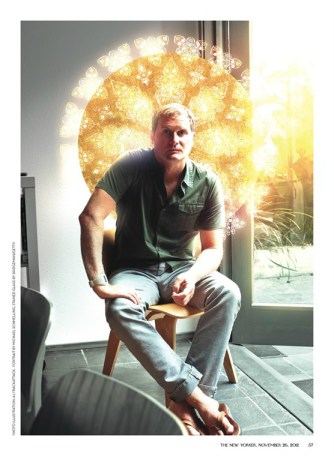 There’s a telling line in the recent story of Rob Bell in The New Yorker (“The Hell-Raiser”), where the author Kelefa Sanneh conjectured that in writing “Love Wins,” Bell was “dreaming of a world a world without arguments—as if the right book, written the right way, would persuade Christians to stop firing Bible verses at each other and start working to build Heaven on earth.” (60) Conjecture about what others are dreaming is often problematic. But Sanneh, like the rest of us, take our cues from what others say and write, which is standard operating procedure for human communication events. Conjecture is always fair game for conversation.
There’s a lot the author gets right in the article and there are a few places with loaded language and mashed-up history. For instance, the notion that the “church matured” (60) out of the notion of Hell as a physical place is too loose a summary to really work. Debates about interpretation rage today, from all quarters.
Sanneh’s focus on how a preacher became a questioner among a people who do not respond generously to larger questions makes for interesting reading. These are my people and I confess that I too have responded without generosity too many times. And yet these larger questions are exactly the conversational fuel that can help move forward this often awkward project called the church. Especially because the generations behind me are increasingly wed to questions rather than dogmatic answers.
Much of what Bell wrote resonates with me. In particular, I’m smitten by this notion that people can talk—even about very deeply held things—without demonizing or judging each other. The notion reminds me of those noble people who early in the history of the church were in conversation with the inveterate letter writer. They eagerly heard what he had to say then examined it on their own to decide whether it was true or not. I imagine them discussing with authoritative texts and possibly disagreeing, but maintaining their relationships.
Bell has done us a great service by voicing these questions, even though the penalties for him have been high.
###
Image Credit: The New Yorker
Your Cubicle Neighbor’s Bold Reveal May Be Your Salvation
One Lesson from Office Space
In Office Space, as Peter Gibbons descended down the dark tunnel searching out meaning in his work, he maintained friendships with other like-minded/cynical employees, Michael Bolton (no, not that Michael Bolton) and Samir N. And then there was Lawrence who heard everything about Peter’s life through the thin walls of the apartment next door. Together these friends reveal more and more to each other as the film progresses.
I’ve been blessed with great work friendships over the years. I believe the shared experience of dealing with the despot in the corner office and the silly conundrums she or he introduces can have a binding influence on co-laborers. Plus, the work of finding or making meaning in work often happens at the collegial level: the expertise, instincts and humor with which we approach our work has a way of rubbing off on those around us and vice versa. These friendships can and have lasted for years through changed jobs and kids and sickness and all manner of life change.
Not long ago I wondered aloud what would happen if God showed up at work. To that list I might add the people around us with whom we connect. These people in our shared work experience are way more than companions in misery—they may be part of your job’s salvation. Part of that has to do with what we reveal of ourselves to each other. And maybe the hope is that we share the stuff that matters with these people with whom we spend our days.
###
Image Credit: IMDB
Write Without Expectation
For writers, write. Write for those you care about. Write to get the inner world out. When you share your work, listen closely to those who don’t know you. Write to create and open space, not to reduce it. As best you can, write without expectations. When we can learn to live without expectations, everything is a gift.
—William Paul Young (Startribune Young’s second book a new act of faith,by Laurie Hertzel, 11/23/2012)
Drawing from Photos & Lost in Translation
Unwitting Perpetuation of Someone Else’s Mistake
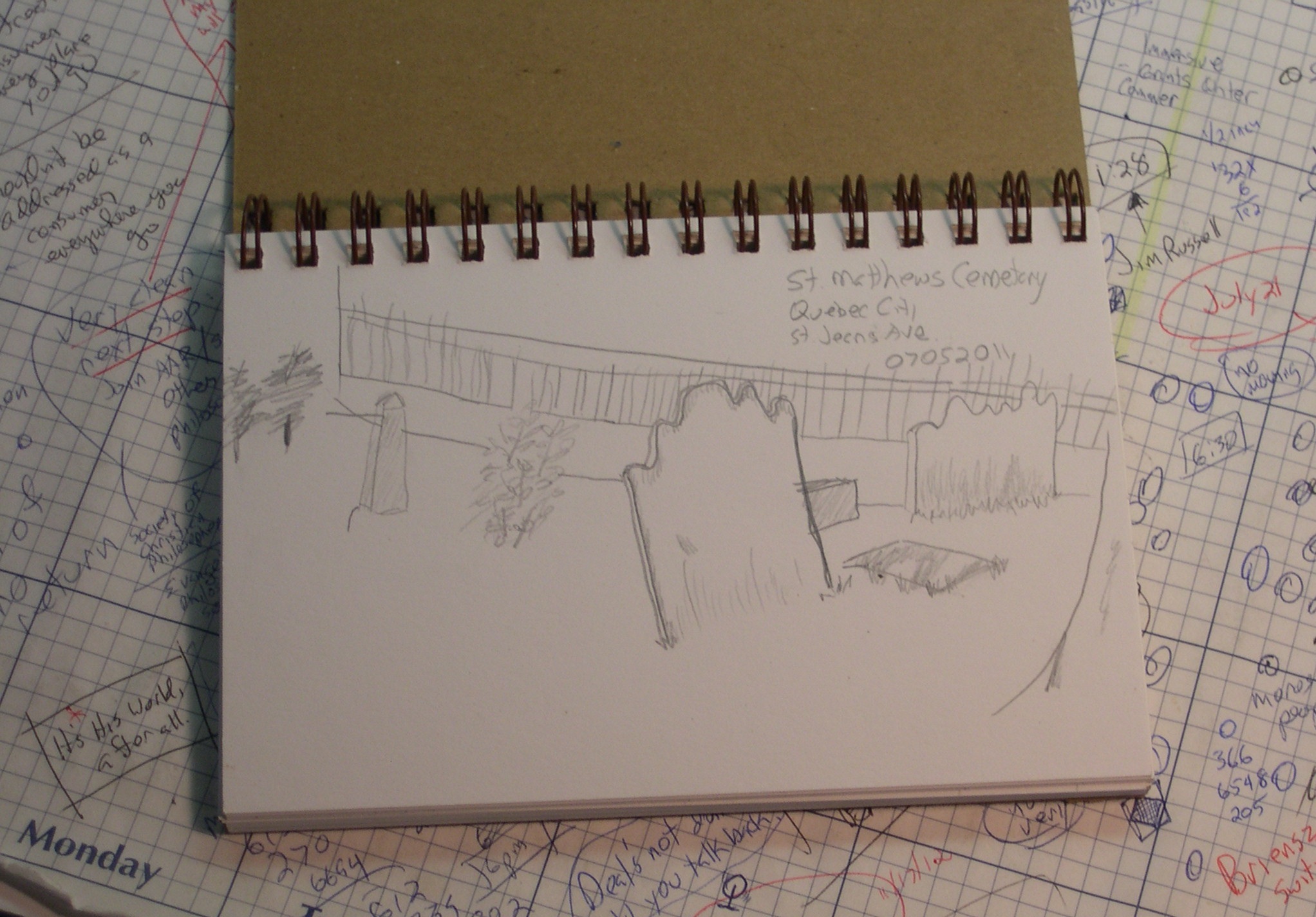
 Sketching from someone else’s representation can make for a bit of trouble. I learned this from our youngest as she tried to school me in the art of drawing. Drawing from a photograph, while not bad, limits my perceptive ability. The photo is one particular view. Some one’s particular view. But to step away from the photo and try to sketch my own perception of the Cimetiére Saint Matthew in Quebec City, for instance, is to grapple with light and shadow on my own, and proportion, and my own inability to capture what I see.
A few days back I had a chat with a local philosopher who described a problem with the way Bertrand Russell read René Descartes’ Meditations on First Philosophy. When subsequent philosophy students read Russell’s interpretation of Descartes, they accepted his assessment as the true and honest way things were with Descartes. But Russell’s perceptions left out or downplayed certain arguments which would later prove pivotal for the development of an entire branch of philosophy. It took smart readers to go back to the primary sources and reread and re-perceive to open this new and productive branch.
This is the beauty of going back to look at something fresh. At least as fresh as possible, given the baggage we carry into every perceptive situation. That’s why so many of our best teachers—and frankly our best friends—urge us to go back to primary sources. It may be a document. It may be a relationship. It may be a place. But seeing again the original and seeing with fresh eyes—it’s often worth the effort. Especially if we are bent on saying for ourselves what we are seeing, which can make a difference in our work, our faith and our relationships.
###
Why We Privilege Pleasure—It’s the Snooki in Me
I know I’m Alive On Black Friday
 It used to be that our privileged position was Descartes’ cogito ergo sum: I think, therefore I am. We think and so we know exist (even if we don’t feel fully alive from day to day). Emmanuel Levinas turned that notion to say that even before we know anything, we have a responsibility to the other around us. He wrote that ethics goes before being. The size and shape of our responsibility to others/the Other will vary by personality, culture and society (my words, not his). But as a basic starting point, responsibility takes precedence over being.
This is a tall order, of course. Especially given the example of the Christ guy, which I’ve been rereading here by that inveterate letter writer. And “example” is the right and wrong word: right in that we can try to be like He did. Wrong in that there is a partaking that goes beyond trying.
But today we’ve upped the ante: I know I exist not because I think, nor because of my responsibility to others. I know I exist because I’m drinking something intoxicating. Or eating something tasty. Or my mind is numb with television shows or the stupefying Fox News.
Or I know I’m alive because I’m buying stuff.
As we approach these two oddly juxtaposed holidays—giving thanks followed by our American orgy of frenzied purchasing—our media will move us quickly from one to the other. Clearly the important thing for us is to land squarely on Friday.
Whatever the source, it is my right as an American to pleasure my brain and taste buds. Life owes me pleasure and I’ll rise early Friday and buy some of that. Because buying creates a set of happy thoughts.
At least until the MasterCard bill arrives.
###
Image Credit: BobbyMoynihan.blogspot.com
Living On One—100 Pennies Per Person Per Day
How can I personally understand poverty and wealth?
 There is a fetching honesty to Living On One, the film from four documentarians out of the Claremont Colleges. These economics and film majors—all graduates within the year—set out to ask what it might look like to live on a dollar a day. “Living on a dollar a day” is one of those generalized statistics used to illustrate how a staggering number of people on our planet (over 1.2 billion?) live with so little.
The four friends set up shop (that is, a squalid camp) for a summer in a rural village in Guatemala and proceeded to shed pounds and acquire bug bites and diseases as they submitted to the economic rigor of making a life on the equivalent of 100 pennies per person per day.
Watching these friends sort out what to eat and how to eat it and how to cook it (firewood was a major draw on their 100 pennies) was a lesson in itself—especially when they realized that 1200 calories per person per day would not sustain them. They stepped over some invisible line the moment they bought their first bit of lard to cook in their daily ration of beans and rice—simply to get enough calories to keep lethargy partly at bay. They grew radishes, lusted after fresh fruit and longed for a chicken to nurture and then eat. The stories of the people who came to their aid and with whom they formed friendships are without question the most touching part of the film. All in all it’s an entertaining and affecting first-person account of trying to sort out the demands of poverty and wealth.
The honesty came in letting go of any pretense of actually being poor. They knew—and we the audience knew—they were choosing a particular limit. For a limited time. Resources were a phone call away, of course. But the thought experiment of trying to come to grips with a hand-to-mouth existence was compelling and begat practical lessons. The result was a kind of pragmatic knowledge that a textbook can never supply. I applaud their courage.
The Living On One bus stopped in Minneapolis a couple days ago. They played the film and took questions at the Bell Museum on the U of M campus, before a robust group of students and others. As they filmmakers took the stage I could see they were once again healthy people but also deeply affected by their experiment.
Their parting shot to the audience was to “Do something. Anything.” This final word was also an intrinsically honest call to action. The four friends had partnered with different micro-finance and poverty-fighting organizations, so they could and did recommend places to give cash toward the problem. But the big take-away was the struggle to personally understand this immense inequality.
That is a challenge that will stick with me.
###

 conversation is an engine
