Widerøe: A Most Winsome and Persuasive Airline
Have you ever seen a more organic selling proposition?
This quote, via the Bill Bernbach fans over at Sell!Sell! seems appropriate for this piece of communication:
Advertising doesn’t create a product advantage. It can only convey it.
###
The Decline of Fact in Our National Conversation (and How to Avoid Despair)
Louder Preaching is Not the Answer
It seems wrong to call it a national conversation when we mostly monologue at each other. And most of our monologues are meant only to reinforce the already-believers listening. Republican Paul Ryan’s recent string of verbal deceptions was a stunningly brazen example of half-facts delivered with full-on force—but both sides are equally guilty. That both Democrats and Republican play loose with facts is neither a surprise nor anything new. So it has always been: we persuade each other by twisting facts in our favor and choosing not to reveal the truths that would balance our cherry-picked facts.
 It is natural (though not necessary) to become cynical about our national exchange of monologues. Recognizing that any speaker is likely persuading you with only half the relevant facts is probably not a bad strategy to adopt for the next three months—or the next 30 years. It is also easy to see how this strategy only accelerates skepticism about the official word of any authority. And so “Question Authority” returns as a relevant bumper sticker, several decades later. Or was it ever out of style?
How to Avoid Despair and Reject Cynicism
Remaining skeptical of facts presented as truth is a good starting point. And perhaps seeking a generous spirit that questions facts even while looking behind the facts to ask what broader point the monologist is making. But we must speak up and expect dialogue rather than more indoctrination.
More preaching will not do.
###
Image Credit: Volkskrant Magazine via coverjunkie/thisisnthappiness
Today I start a Coursera Modern Poetry Class. I have over 29600 classmates.
It’s a big room.
 I’ve always had a hard time with poetry. Except for Billy Collins, Ted Kooser, and William Carlos Williams and a few others, I mostly don’t get it. Over the years a few smart and patient friends have helped me glimpse what I’ve been missing. Those few glimpses have made me hungry for more.
So I signed up for a Coursera course. This one is taught by Al Filreis through the University of Pennsylvania. It’s free to take and so far, even the readings look like they are freely available on the web. The fact that nearly 30,000 people signed up for the ten-week course seems to have shocked everyone, including the instructors.
Why Poetry When There is So Much Real Work to be Done?
Poetry and copywriting are joined at the hip.
I see you rolling your eyes.
Listen: reducing a big idea to the shortest, most succinct nugget that cannot be ignored by a target audience is the heart of copywriting. Yes, it’s true we often waste that succinctifying power on soda and beer and lingerie and the Reliant K-car. But not always: sometimes we write to expose human trafficking and to raise money for refugee crises or to invite people to reconcile with God. All these uses—whether mundane or transcendent—use that succinctifying muscle. Longer-term readers of this blog might argue that whether mundane or transcendent, the work of serving with words is valuable. I agree.
Sharpening that succinctifying muscle is what interests me. I hope that will be one outcome from the course, as I see what poets have succeeded at encapsulating experience into words and phrases. Of course, I’m guessing there will be much, much more to it.
###
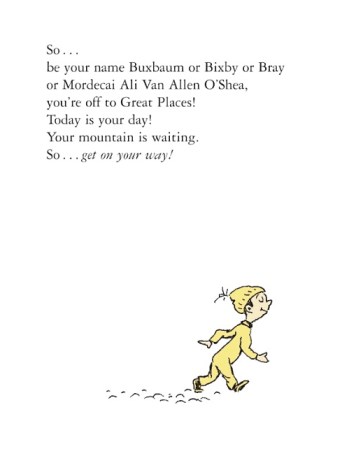
Image Credit: Dr. Seuss via thisisnthappiness
Encounters with Silence
Where does insight come from?
Only knowledge gained through experience, the fruit of living and suffering, fills the heart with the wisdom of love, instead of crushing it with the disappointment of boredom and final oblivion. It is not the results of our own speculation, but the golden harvest of what we have lived through and suffered through, that has power to enrich the heart and nourish the spirit.
–Karl Rahner, Encounters with Silence (Westminster, Maryland: Newman Press, 1965. 30)
###
Image Credit: Via 2headedsnake
Americans: Large Mass. Small Memory.
Hey Media: That’s not the Bill Clinton I remember
 Is this we’ll how we’ll be remembered? The people who enjoyed the fat of the land but couldn’t remember what happened from year to year? If anyone reads through our newspapers in 100 years, surely that will be their conclusion.
Even before Bill Clinton’s celebrated speech last night (I have yet to listen to it, but I will—Bill Clinton is a great speaker), we learned from various media outlets that he was a popular president and how both Democrats and Republicans remember fondly his tenure.
Really?
I remember him as the president known for oral sex with an intern. Who then lied about it on camera. I remember him as the president who allowed me to explain oral sex to our kids innocently listening to the radio news. He is the man who was impeached and a national disgrace. The man who was a running joke for late night comedians for several years.
I’m all for grace and fresh starts. And I’ve got my problems—I’m not judging, only remembering.
Bill Clinton a popular president? Yes, for the media and comedians. Maybe today if you look only at the economy during his time in office. But for me: my memory is decidedly mixed. At best.
###
Image Credit: Keith1437 via 2headedsnake
Dedication to Craft: Jiro Dreams of Sushi
There’s hardly a more fitting reminder of dedication to craft than the 2011 David Gelb documentary Jiro Dreams of Sushi. The film follow’s 85-year old Jiro in his daily routine of preparing sushi. From buying fresh tuna and squid at the market every morning to massaging the octopus (that’s right for 45 minutes) to talking with the rice vendor who refuses to sell rice to someone just because they ask for it. One of Jiro’s biggest fans is a local food writer who we follow into the restaurant again and again as he articulates the surprise that happens with every meal.
Jiro’s shop (“Sukiyabashi Jiro”) is extremely clean but modest. Located in a Tokyo subway station, it has only ten seats and serves only sushi. Jiro sets up two rounds of meals a day: lunch and dinner—which sounds like he serves 20 people a day. And yet sushi lovers from around the world reserve up to a year in advance (if my memory serves). Jiro is the only sushi chef to receive a three-star Michelin Guide.
The film is a meditation on craft, just as the copy says. Beautifully filmed with long shots of Tokyo life and the chefs’ concentration on their craft, including a mesmerizing classical soundtrack. The film is primarily about Jiro’s compulsion to learn all there is to know about making sushi. But along the way he influences his sons and seems to have changed the way sushi is prepared. In the end, both Mrs. Kirkistan and I felt we wanted to put heart and soul into our respective crafts.
For copywriters and writers, the parallels are clear. Several times in the film, Jiro says he is happiest when he is making sushi. Even at 85 years old, he continues to make a mark and continues to be mesmerized. In fact, there seems to be a push-pull between his work and the rest of his life. Craft is almost the reason he gets up. But it also is his main worry. Hearing what craft looks like from his sons’ perspective and the up and coming chefs that move through the restaurant.
Thanks to Scott Berkun for the recommendation.
###
Why Leaders Flee
A Tale of Two Organizations
 One organization was a for-profit and well-respected, with revenue growth of 15% per year and generally thought of as on the way up. The other was a non-profit, well-respected in the community, gaining hundreds of new attendees every year and generally thought of as on the way up. Both organizations had a mandate to grow leaders.
The for-profit harvested fresh MBAs from Harvard, Wharton, Kellogg and other high-octane B-schools to populate corner offices and lead the common folk. They provided these new grads with some authority, though few needed permission to whip the employees into shape.
The non-profit built a leadership program and invited people in for up to three years of hands-on experience. People came from all over the world to participate—for no pay—and were given all sorts of jobs to organize among the constituency.
In both organizations, the new leaders were issued mandates, which they interpreted and issued to the employees (for-profit) and constituents (non-profit). And work began.
“Well done,” said the top leadership to each other. “Things are getting done. These are the leaders we need.”
And so it seemed as they looked from the top down.
But from the bottom up, things looked different.
The employees and constituents realized the newly-installed leaders had energy but not experience. Worse: they didn’t know what they didn’t know. Even worse: the organizational leaders were now only talking with the newly-installed neophytes. The employee and constituent voices—the ones that shouted in joy at a shared mission and offered small course corrections the leaders had previously listened to—could no longer be heard. And as they realized this, the able thinkers, the natural doers, the low-key champions of the larger mission and the natural leaders started making exit plans to find a new place where they could again have a voice in the mission.
And while both organizations seemed instantly more efficient, their poverty would not become apparent for several years.
###
Image Credit: VVEINVENTVOU via 2headedsnake
“How Do I Expand My Work?”
Sustained, Focused Pursuit Is Itself Hard Work
 If you are an employee focused on the next eight hours, you might not think about “How do I expand?” It is certainly the opposite of “How can I make it through today’s work?” We all ask that second question from time to time, but when we ask the first question, we are typically in a much better emotional place. I say the two questions are related and both revolve around how you define your work.
If you are responsible for bringing in new business, “How do I expand?” is your primary question. If you are an employee and entrepreneurial, you might think about how to grow your department or to expand the charter of your department. If you are a freelancer, or part of a firm or agency (small or large) and tasked with bringing in new business, this first question can consume you.
A friend talked about the “catcher’s mitt” approach, where his ad agency is in the loop to hear about a formal or informal RFP (Requests For Proposal) from a variety of organizations, and they respond. As a freelancer, it is much the same for me—responding to requests from loyal clients and fielding requests from new clients.
But catching requests as they go by is only one piece of the pursuit. And maybe a small piece, though clearly important. A larger piece has to do with organizing yourself and your group for the work you want to do. Getting yourself and your team ready for the work you intend to do. Casting vision and organizing resources so they faithfully align with the work you are aiming at–a thing my friend is good at.
When I say organizing, I really mean trimming and pruning, because while the catcher’s mitt collects all sorts of work that is close and even very close to the anticipated, desired work, it may not be exactly on target. Organizing for the work you want means going through the difficult steps of asking what it is we are good at and what it is we want to pursue. And then moving toward that singular, or at least narrowed range of work in our outgoing conversations.
If this sounds like something that only happens in business, think again. I routinely talk with folks fresh out of college looking to set up their own business and wondering how to go about that. I often respond that they should look for opportunities to work with people and companies that interest them. And they should look for opportunities to use their communication, writing, design and thinking skills to serve (another tip from that inveterate letter writer) those people and firms they admire.
But this is not something just for new college grads. Defining our work and then trimming back and pruning it is a life-long pursuit. When we stop asking “How can I expand my work?” and start asking “How can I make it through today’s work?” we have given away a piece of our vitality.
And that looks like an end rather than a beginning.
###
Image Credit: unicornsandcuppiecakes via 2headedsnake
Nicely Done: Sharp Minds Trump Sharp Elbows.
I love the brevity and simplicity.
 The second phrase paints a clear image which points quickly to the negatives in our fighting/boasting/hard-scrabble economy. “Trump” is excellent, evocative and rather top-of-mind—and a bit ironic, given the Donald. The sign-off is full of promise for anyone considering why they would pursue education.
###
Image via Ads of the World

 conversation is an engine