Posts Tagged ‘advertising’
Italian Telecom Wind: Engage + Remind – Shill
Still selling, of course. But they pulled me in.
Lots of great “dad” moments in here.
What about those decades-long conversations we have with the people in our lives?
###
Getting Things Done: Better Call Agent 007-0827
Or should we call a prayer meeting?
“Agency” is a word for getting something done. In a philosophical sense, it is the capacity to act in the world. It has to do with choice-making and accomplishment and focus—especially focus. We hire an advertising agency when we need to offload some critical marketing element and make sure it happens. That agency accepts the mission and acts. And so we pay their fee.
Why hire agency? Because we don’t have the capacity to do it ourselves, whether that means talent or headcount or time or interest or focus or all of the above. But the critical thing needs to be done and must be done. So we get someone we can trust to do it. There is an entire industry set up around the notion of getting things done. Time management is always a hot topic for any gender in business or academia and in the rest of life.

But agency has a tricky theological side. Even non-theists debate determinism versus free will. And Christians, well—we’ll kill each other over our views of how the world works. Just find an Anabaptist and ask how their minority voice was received by their determinist rulers, way back when.
Why bring in theology when talking about getting things done in real life? Isn’t theology the useless opposite of getting things done here on earth?
Yes.
And, No.
Because while we can accomplish much with our time-management techniques, there is much outside our ability. Like changing someone’s mind. Or opening long-closed doors. Or protecting oppressed people from their brutal dictator. Or helping a nation care about all its citizens (versus just the privileged ones).
What the time-management industry does not answer and cannot answer is how to work with these very large questions that deal with agency in the larger world. So we back off and shut down and feel guilty.
Can we pursue agency that sees and acts on larger things? Some of my heroes are doing this and their agency consists of some combination of prayer and action and faith and presence.
###
Image credit: Kirk Livingston

“Good to Know” and a Failure to Communicate (DGtC#23)
I’ve said too much already.
If you hear this, you’ve said too much. You’ve said more than someone wanted to hear. “Good to know” is a polite way for your listener to indicate, “Please. Shut it.”
Why do we say too much?

Maybe we are excited about a topic. People will often have mercy with this motive. Sometimes the excitement rubs off. Our favorite professors and speakers demonstrated their enthusiasm for a topic by going on. And on.
Maybe it is a nervous tic that flows from fear of awkward silence.
Maybe we are hiding our tracks, like the alcoholic filling up verbal space to avoid the obvious question. Maybe our rush of words is like throwing everything at the wall to see what sticks, to throw our interrogators off our track.
Maybe we’re signaling dominance. Stringing together buzzwords at a rapid pace is a time-honored tactic in corporate meetings where you have no clue how to respond. The tactic usually ends in promotion because higher-ups read “kindred spirit” in your fast mumbling. Maybe our club or church or group listens for key words to show who is in and who is out, so our rush of words is a frantic attempt to show we are in.
“Good to know” is a proper, dismissive response to much of the advertising done to us: superfluous, out of step with regular life and an obvious pitch for our pocketbook.
But when we hear “Good to know,” it may be worth stepping back and getting momentarily meta, and thinking, “Oops. I might have misjudged this person’s interest. How can I get back to connection?”
Connection is the place to be. Connection gets along well with enthusiasm and does not mind probing into track-hiding. But connection does not abide dominance.
See also: How be a verbal philanthropist (#14)
###
Image credit: Kirk Livingston
Neville Brody: Making Space on a Page to Think
In the advertising business, it’s not in the interest of advertisers for people to think about what they’re presented with. It’s in the interest of advertisers that people choose to think in the way the advertisers intend them to. It’s a formulaic thing, where there’s only one possible outcome in advertising. That creates a space where the “right to thought” is taken away from people.
I’ve always tried to approach my work as being open-ended and with a degree of abstraction or ambiguity. This prevents it from being a monologue, because it is a dialogue. The work is only completed when a viewer has looked at it and made his or her own decision as to the full meaning of the piece.
From Debbie Millman’s, How To Think like a Great Graphic Designer (NY: Allworth Press, 2007) 72-3
Martin Weigel: Go to give. Don’t go to take.
Even advertising people are human.
In the spirit of “What is remarkable?” I offer Slide #43 from adman Martin Weigel’s excellent Slideshare on how brands fool themselves into thinking they matter in the grand scheme of real life.
They don’t.
Not when it comes to real human interaction.
No sir.
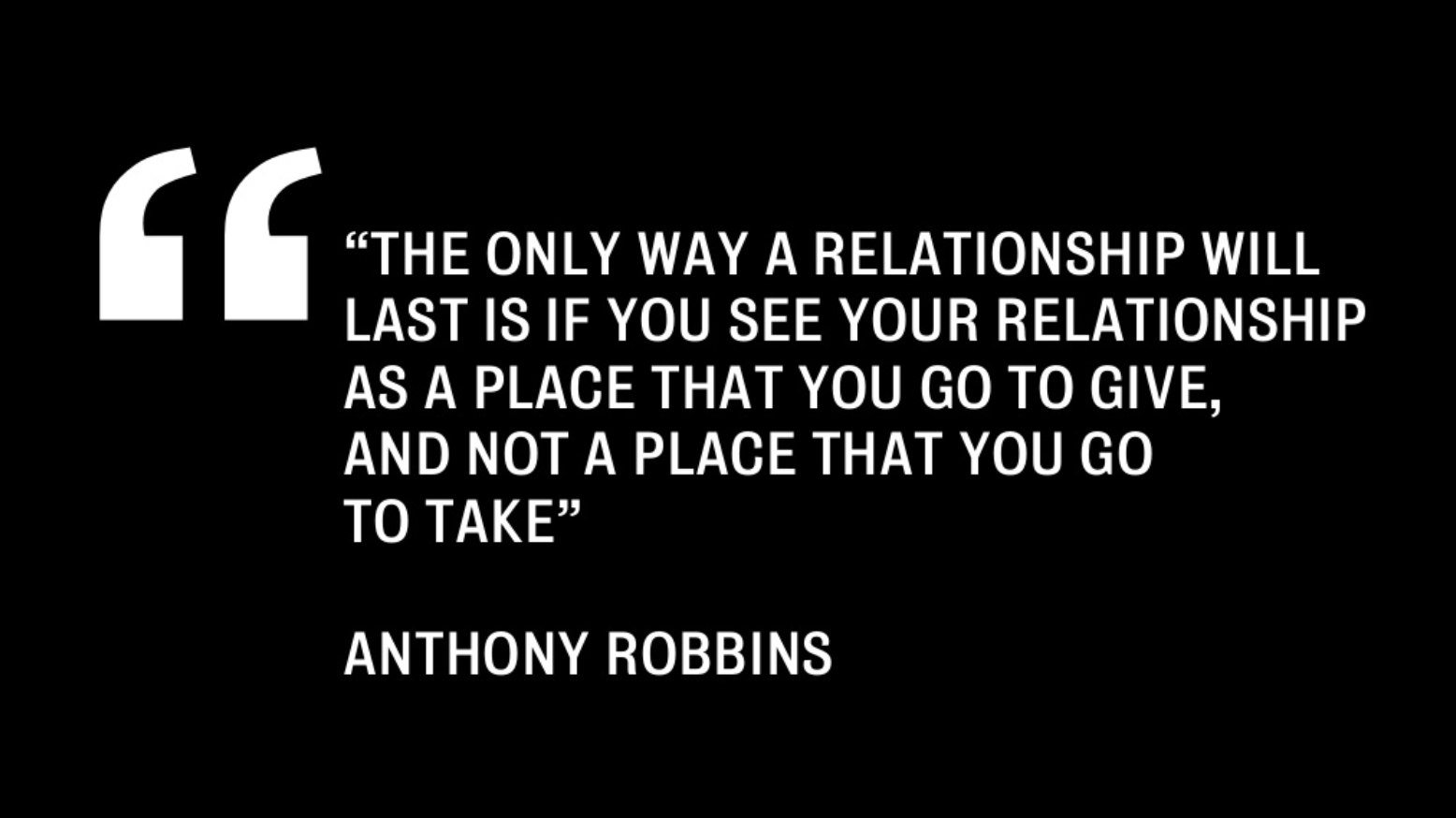
Can a brand serve? Yes. And I will argue that is the profitable space to explore.
I’m not generally an Anthony Robbins fan, but this quote has been stuck in my brainpan since I first reposted these slides. And that is remarkable.
###

 conversation is an engine