Posts Tagged ‘collaborate’
How To Talk Like Superman
Please, put the cape away.
Not so much the cartoon character, but think of the raconteur who magnetizes with stories and wit and rhythm. Or think of the person you go to when trying to sort some thorny issue. These are the people you find entertaining or interesting at least partly because they listen to you. And partly because you hear something useful from them.

That’s how to talk like superman: listen closely to what someone is saying and then respond with stories and probing questions that drill down a bit—staying focused on what you heard. To the person you are talking with, you just may be summoning superpowers. That’s because we never know when a casual word may be the linchpin that connects two or three sets of thoughts that set a life in motion.
We all have stories like this: the guy we talked with casually at the end of a club meeting mentioned a guy to talk with at the company we were interested in. We talk with that guy and he mentions someone else in the company…and then you find yourself in the company. Your online application and discussions with HR led nowhere, but a few conversations with the right people and you are in.
David Rock’s Quiet Leadership offers solid pointers about gathering the superpower of helping others learn what they already know. He shows how to help people make connections.
Please use your superpowers for good today.
###
Image credit: Kirk Livingston
Should You Make Your Boss Cry?
Just draw me a picture
In a conversation yesterday my new friend self-identified as one who enjoys the “messy work” of helping groups get on the same page. To that I say: may her tribe grow. Because that is messy work indeed—fraught with bruised egos, sullen colleagues and cross-purposed tasks.
I maintain there is a fair amount of artistry involved in helping a group begin to move forward. Those who help others catch a vision for a project or cause have a knack for painting pictures. These pictures help team-mates understand just what is at stake. Those pictures may be dumb sketches or verbal images. The word “picture” here is important because an image conveys emotive content often missing with words alone. Without the emotive content of a picture, we are back to just using our intellect. And intellect only carries us so far. We can know the reasons behind a purpose, walk through spreadsheets and examine data without ever getting our emotive selves involved.

For many of us, real meaning has an emotional nexus. Pushing forward together springs quite naturally from that place where reason and care have linked arms.
The picture my new friend painted drew people from different business units in her organization—each armed with very different purposes and possibly their own rhetorical axes to grind—into a shared objective. The painting of the picture and telling of the story helped gradually align those cross-purposes.
What pictures are you sculpting for those around you today?
###
Image credit: Kirk Livingston
Try “Yes, and…” Today
Let there be a Science of Deep Collaboration
When I hand out a group project in my writing class I hear audible groans.
It’s because we’re trained to work at things on our own—that’s how scholarship and schoolwork and academics have worked for a long time. The groans come from all the extra work of communicating and all the expectations around not knowing if others in the group will keep their end of the group-work bargain. The groans come from the anxieties that hover around roles and responsibilities and knowing you’ll have to sell your ideas.
I am eager for new and deeper research into collaboration. Let’s call it a Science of Collaboration. Maybe it is a social science. People like Keith Sawyer and Edgar Schein are moving this science forward—along with many others. I am fond of the work Patricia Ryan Madson has done around Improv, which seems the perfect gateway for anyone to learn the fun of collaboration. And Keith Johnstone seems to have spawned many thinkers along these lines.
 I’d like for this science to do (at least) two things:
- Invite people in who have been working alone for forever. But gently, and independent of the introvert/extrovert divide. I want the invitation to show the fun of the process. I want that invitation to promise more aha moments and then to quickly deliver on that promise.
- Show next steps to working together. What can an ad hoc team do to quickly get grounded enough to toss ideas that build on each other? There are techniques out there, certainly, but I’d like this to be second nature, part of our emotional intelligence, something we come to expect. Something we’ve grown up with.
“Yes, and…” seems a perfect place to start. This is the old improv notion of building directly on what the last person just said. And quickly, without lots of deliberation. It requires a certain fearlessness.
What if “Yes, and…” was built into our educational DNA from grade school up?
###
Image credit: Kirk Livingston
Please Read Dave Eggers: The Circle
In a world where everyone sees everything…
If you’ve ever wondered where complete transparency might lead—as I have—consider reading Dave Eggers’ excellent novel The Circle.

Don’t worry–no one’s watching.
Mr. Eggers has created a very comfortable world (for some) of deep collaboration, where everything is provided to those lucky enough to work for the Circle. The Circle, the corporation at the center of the story, looks more than a bit like our most celebrated high-tech companies brimming with smarts, cash and outsized ambition. Think Google or Apple or what Microsoft once was—and then add in a cast of characters each with an overweening and boundary-less high EQ—and you’ve got a world that is totally supportive—as long as you move in the same direction. The novel traces the story of Mae Holland as she “zings” (tweets) and “smiles” (likes) her way from outsider to the inner circle.
The story gets uncomfortable at times, especially when it shows the intent behind the use of social media and the social pressures applied. Especially when you start to recognize product placement on a very, very personal level.
Mr. Eggers has me rethinking my eagerness for employees up and down the corporate ladder to use their outside voice. I’ve been advocating, among my clients and when teaching Social Media Marketing, that helping employees reveal their work to interested outsiders is a move toward a new kind of marketing that looks less like selling and more like a conversation among interested parties. I still think that is a good move, but Mr. Eggers has explored the boundaries of that notion, and it is a bit, well, totalitarian.
I will consider using The Circle as a supplemental text for my next class on Social Media marketing. Well-written and consistently engaging, Mr. Eggers’ book is well worth your time.
###
Image Credit: Kirk Livingston, just before a recitation of photography rules within a non-public space
Can we finally reject being defined as “Consumers?”
How about “citizens” or “persons”? Maybe not “fleshists.”
Must everything in U.S. life be about ingesting?
Eating. Watching TV. Shopping. Listening to music. Watching movies. Amassing tablets and apps that allow us to consume more and faster and on-the-go. Talking about what we are eating/watching/buying. These are our pastimes. These are the things that define us. None are bad, many are necessary, but should they be at or near the core of our essence?
Is this why we landed on the planet?
I like all these things as much as anyone, if not more. But I wonder if my rush to consume has blinded me to other definition-inducing activities? Consuming is good for brand managers because they can play on this emotive, definitional piece of life and squeeze money from our attempts to be a certain kind of person. We buy this car or those dungarees or those shoes (or watch that show) because of certain aspirational desires. If we own that property, then we become that person. Yes?
In Cognitive Surplus, Clay Shirky makes the cogent point that watching TV is very like a full-time job for many of us. It consumes our hours outside of work like nothing else. I understand why: many of us are so busy at work, spending so many hours, stressed about so much that all we can muster—all we can look forward to—are those blessed, mind-numbing moments on the couch before the screen.
I’m right there. That’s me, too.
Shirky’s book goes on to point out example after example of people banding together in groups small and very, very large to accomplish things that would not otherwise exist. Wikipedia comes to mind, along with open-source software. As social media allows us to connect, I wonder if our collaborative selves will beckon us from the couch more and more often. It’s not some new magic of social media I’m talking about, it’s the very old and known quantity of human connection. Relationship stuff has always motivated our species.
But we’ll need to step away from constant movement and blessed numbness to get back to seeing ourselves as co-creators and collaborators. Relationship-builders rather than consumers.
###
Image credit: Kirk Livingston
Keith Sawyer: Surprising Questions Emerge
Where will you find transformative creativity?
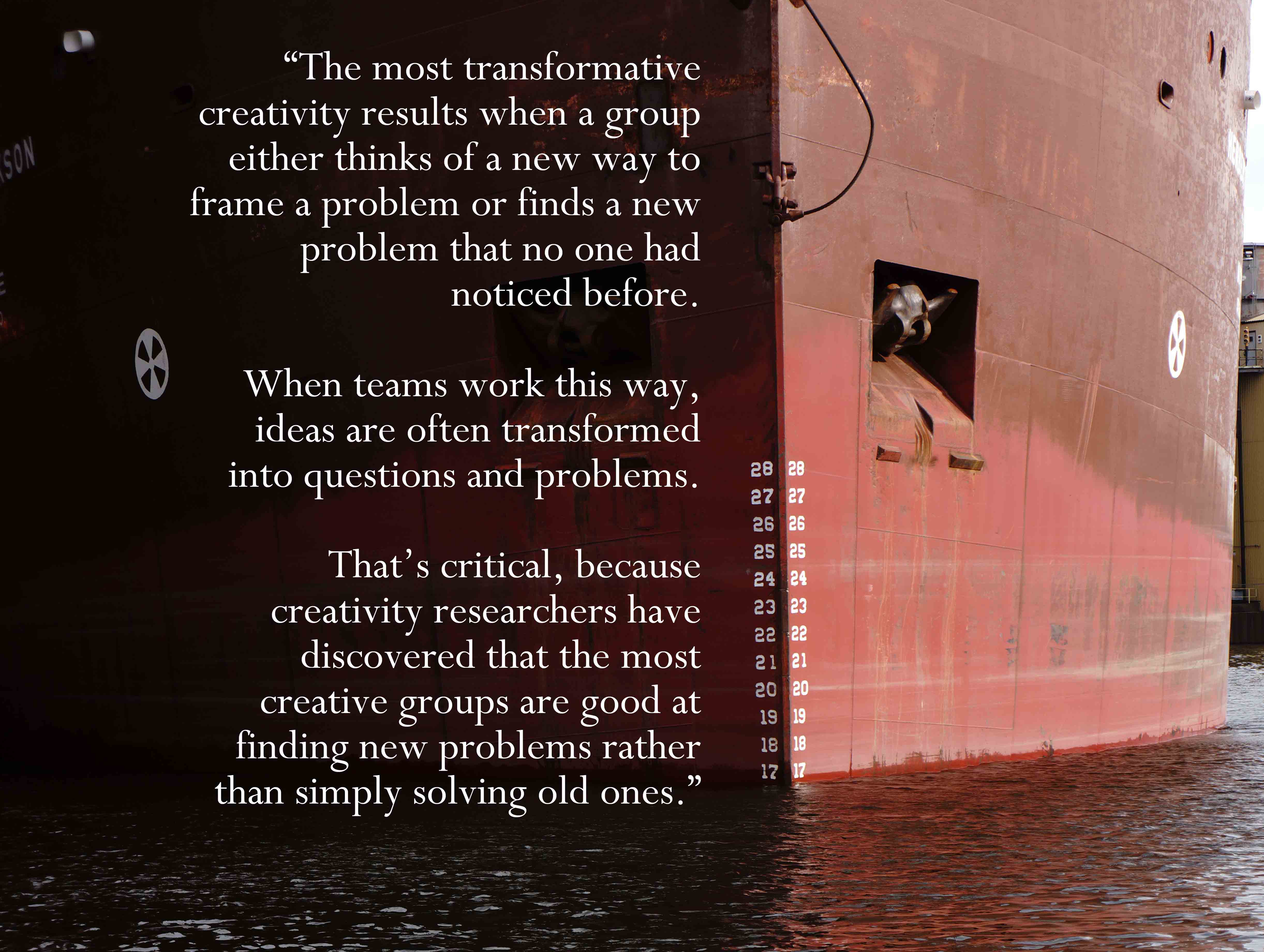
–Keith Sawyer, Group Genius: the Creative Power of Collaboration (NY: Basic Books, 2007) 16
###
Image Credit: Kirk Livingston
What is Your Purpose with Your People?
Can You Articulate Your “Why?” and “What for?”
I’ve been gushing over Improv Wisdom lately, this 2005 book by Patricia Ryan Madson. I’m thinking of buying a number of copies to give away and wondering how I can incorporate it as a supplemental text in my next classes. The book is easy to read, memorable and full of actionable wisdom all directed at staying in the moment and building something with others. Ms. Madson—a drama professor at Stanford, improv maniac, eager collaborator and kind-hearted encourager—brings a lot of life to how we can work with others. Now I find myself ordering the primary source texts cited by Ms. Madson.
Ms. Madson has been kind enough to respond to my tweeted epiphanies when reading her book. I am impressed by the longevity and timeliness of certain ideas. Ms. Madson’s 2005 book will likely be relevant for a long, long time.
As I finish with my Social Media Marketing class, I’m reading reflections from the students. One near universal regret was not having a clearer sense of their purposes for the communities they were trying to create. We spent focused time on this early on in the class, but forming a crystal clear picture of what we want to accomplish with others is neither easily understood nor often practiced. I know this from the number of companies I’ve been in that operated every day without a clear sense of what they were trying to do with their audiences.
Students resist the tightly-formed purpose and the close definition of their audience because it feels so restrictive. It just feels easier to write anything for everyone. At least that’s how the class always starts. But at the end of the class, there are multiple confessions about how the tight purpose and close definition actually freed them to say much, much more to their target audience. This experience fits with a bit of improv wisdom Ms. Madson offered:
Rather than asking “What do I feel like doing?” when a free moment arises, instead ask “What is my purpose?”
I love this question for my class and I love this question personally. The question presupposes I have a purpose and assumes I know that purpose. The question assumes I am conversant with my purpose and assumes I am in the habit of articulating it to myself and others.
All these presuppositions and assumptions are worth pursuing. Going back to our purpose again and again sounds like bearing fruit over a lifetime.
And this: Patricia Ryan Madson should write more books.
###
Image credit: imgur
The Problem with Collaboration: Can’t Touch This
You talk. We listen. (Not so) Simple.
Let’s trace social technologies backwards and watch them infiltrate the organizations that launched them. Social technologies carry with them an implicit demand to be heard—if not an outright demand for action.
That demand, from those voices, will—sooner or later—run smack into the command and control mentality: the top dogs who always delivered the monologues. The higher-ups and muckity-mucks who get their way.
This is a problem.
Is this a problem?
Because this problem may be the starting line for any company culture that wants to change. It won’t be pleasant. Because the kind of people that help facilitate the change are a different sort than the ones willing to tell everybody else what to do. There’s a happy move today, currently gaining cultural muscle, to identify the boss-bully in the corner office and make them play nice. This even as people throughout organizations are getting a vision for collaboration vs. command and control.

Letting employees and customers (and possibly congregants and constituents) into the smoke-filled rooms where big decisions are made. What a concept.
Groundswell offered the example of Salesforce.com, their Idea-Exchange and the grass-root effort to excise an annoying banner that always appeared. The company denied themselves, kept listening, and eventually removed the banner they loved and their customers hated.
Bravo!
The problem with collaboration is really an opportunity to become adept at identifying the things that cannot/must not change and holding the rest with an open hand.
###

 conversation is an engine