Posts Tagged ‘conversation’
How to Hack the Bully’s Monologue (Dummy’s Guide to Conversation #16)
Resist the rhetoric of control
Every person has worth. Every person has something meaningful to communicate to us and vice versa.
But sometimes the guy in the corner office just wants to yank your chain. Sometimes your colleague comes in your cube too close and berates you for something that riles only her. And sometimes these work contexts make you question your worth. Today we call this bullying and officially frown on it, though bosses of all stripes let their primordial managers get away with it as long as they post results.
 In the face of the bully’s monologue, we may need to set down our goals of understanding and hearing each other. We may need to pick up tools that will help protect us from the bully. And especially as our culture talks more about innovation, we must recognize that the enemy of innovation is the bully who uses monologue to quell thinking and drive over dissent.
- The hack begins with dropping sycophancy. Just because the VP of marketing is telling you a personal story about his cabin doesn’t mean he isn’t trying to put you in the low place he wants you. There’s no need to continue to play the prop: the underling enamored by all the person in power does.
- Be present. Don’t go to the Bahamas while the bully drives his verbal tank into position.
- Stand. Even if sitting, assume a mentally poised place to challenge.
- Challenge. Is there another way of looking at the perspective the bully shouts? What is the truth here? Speaking fast and loud does not make something true.
- Know two things
- You are a person, too. A person of value.
- That language can be encouraging or damaging. Every communication encounter has a shaping effect on both conversation partners. Don’t let the bully continue unchecked.
- Turn the other cheek. Yes: quite. Back to Jesus the Christ who knew something about handling the bully. He knew the most effective thing long-term was to offer the bully even more. Not in every case, but dealing with the bully from a place of peace and, yes—faith (in God)—may just cut power to the BS generator the bully madly operates. This counter-intuitive step holds much promise for moving forward as a human.
Some reading this may think no modern/post-modern workplace has bullies like this. You could not be more wrong. It is interesting that the tools used to shine a light on the bully’s madness are also effective in ordinary conversations.
How do you handle the bully’s monologues?
###
Image credit: Used with permission from Paul Rivoche via 2headedsnake
What Do You Need To Move Forward?
Applause? Permission? Donuts?
Twice in the past week I’ve asked myself this question.
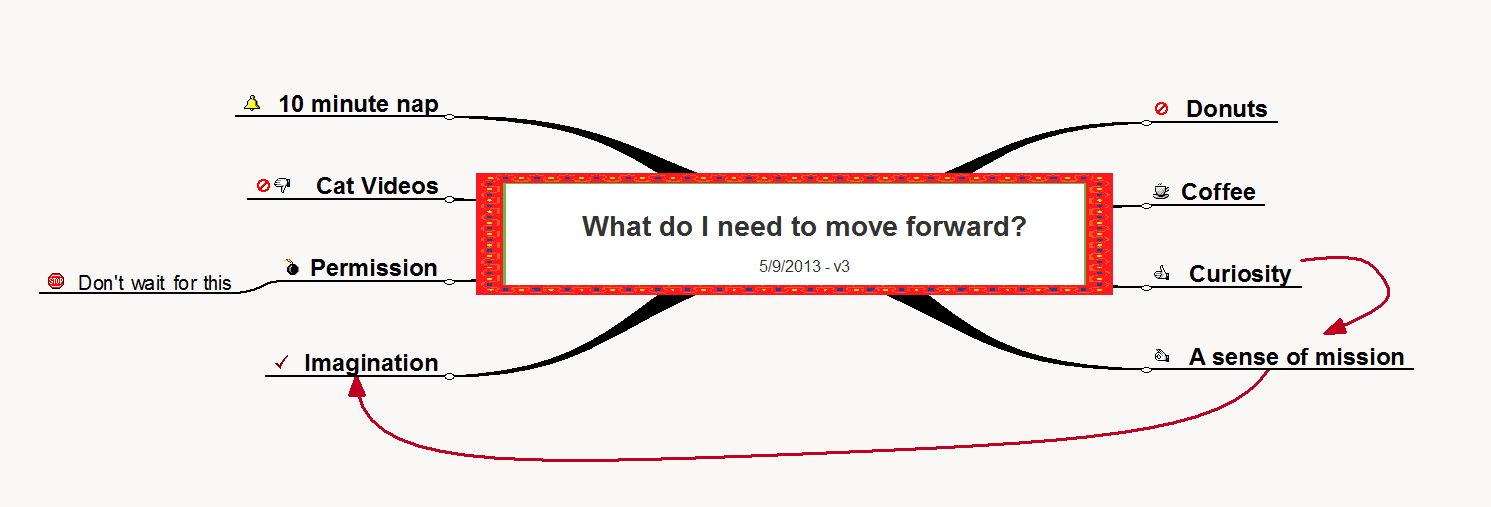 In one case I had just started a large writing project requiring all sorts of information that is not available and will not be available any time soon. My topic is partly in a shipping container in the Pacific, partly in a guy’s head in Scotland, partly in a set of computers in Minnesota and mostly nowhere near complete. But the need is approaching and my content must move on a parallel path with product development. A very specific audience needs very specific information.
In another case the blank page itself kept reminding me of the limitless intrigue of cat videos and TED talks. There’s nothing like a blank page to send you to all the advertising blogs and newspapers you’ve not checked on the web lately.
In both cases a conversation helped me mend the tracks to send the idea and task trundling forward. As I heard myself describing what I was trying to do with the idea and what I needed to complete the task, I realized I have the tools before me right now. There is nothing holding me back.
Waiting for permission to move forward is nearly as fruitless as waiting for someone to applaud your work or tell you what to do.
We move forward and the work has a role in showing us how to do it.
###
Image credit: Laurent Millet via 2headedsnake, kirkistan

Marissa Mayer May Be Right: Show Up (How To Talk Series #1)
You can’t talk if you’re not there.
With your colleague, maybe with your spouse when you left the house. Maybe your sister on the phone, the friend in London using Skype. Nothing happens when you don’t show up.
 Today we continually fine-tune our understanding of showing up: we show up with a tweet, with a blog post, with a telephone call. We show up by email (and sometimes our explanatory emails mark us absent). And then there is actual, physical, atoms and genes-on-the-scene showing up. But even that is not so clear, because despite standing here as you jabber, my mind is seated on the couch reliving that scene from Terminator (was it II?) where the semi-truck-trailer shoots off the bridge to land in the concrete spillway to continue chasing our heroes.
Maybe this is part of the “Why?” behind Marissa Mayer monkeying with the Yahoo! work-from-home policy—to help people be present:
Mayer defended her decision by first acknowledging that “people are more productive when they’re alone,” and then stressed “but they’re more collaborative and innovative when they’re together. Some of the best ideas come from pulling two different ideas together.” The shift in policy affects roughly 200 of Yahoo’s 12,000 employees. (reported by Christopher Tkaczyk, CNN Money)
I hope and believe collaboration and innovation are at least partially behind the Yahoo! change (which is to say, I hope the change is not a retrograde movement toward tighter control of knowledge workers and the corporate monologues they produce). There is some truth in the move: we cannot collaborate without being present. Also true: there are a lot of ways to be present when the collaborator is not physically there just as there are a lot of ways to be absent even while your carcass sits upright at a desk.
So today, choose to show up. Signal your decision with active listening skills. Refuse to be put off by anti-collaborative rants and power plays—say what you need to say to contribute. Refuse the director’s feigned emotion over this or that decision and tell the truth.
Show up today. It feels way better than hiding on the couch and watching your internal TV.
###
Clicktivism & The Power of Social Chatter
This subtle third rail
 Katie Humphrey writing in today’s StarTribune noted the proliferation of pink and red equal signs on Facebook (as the Supreme Court heard arguments on gay marriage) and wondered if social media chatter amounts to much more than chatter. It’s a good question and a good article. Humphrey cited U of M professor of communication Heather LaMarre:
For a lot of people, the mere act of posting relieves that need or feeling for them to be involved. They feel like they did their part….
Anyone who writes regularly understands this dilemma: you want to write about something. But if you say aloud to someone the germ of your idea too soon, your pressure to write diminishes. Same goes for action, apparently: we feel we’ve done something if we’ve said something.
But that’s not exactly wrong, is it?
To say something is to do something. We’ve communicated that something is important to us—important enough to remark on it. Yes our likes and endorsements (LinkedIn) and tweets are cheapened by sheer volume and ease with which we dispatch these opinions. But each says something. And each does something, however slight.
Our talking is the beginning of our acting. Our talking is also a signal that others could pick up on in conversation and in relationship. And when others join in on this important thing we’ve identified, it starts to carry power, like a third rail. I think we’re seeing this power in all sorts of minor and major revolutions.
###
Image credit: Francesco Radino via MPD
Don’t Provoke Me. Wait: Do.
The Power of a Question to Shape Discovery

Mrs. Kirkistan and I have been chatting about those people in our lives who show up with questions rather than answers. These are folks who wonder “Why?” and “How?” about the most ordinary, obvious things. We typically have great conversations with them even as they challenge, occasionally infuriate and often delight us. And quite often their questions and the acts they take to resolve those questions have a way of working into my brain through the week. And I find myself asking questions as well.
I treasure these friends.
I’ve been trying to understand a complicated philosopher whose writing was famously obscure. I recently came across two of his interpreters whose comments helped me flesh out the larger setting for this philosopher’s comments. Mr. Peter Dews and Ms. Diane Perpich helped me understand that there is more to Emmanuel Levinas than the Other and ethics as “first philosophy.” Ms. Perpich, in particular, has helped me begin to see that the stringent obligation Levinas puts on our encounter with the other may function less as an ethics manual and more as provocation. This makes terrific sense when I start to work out the details of my obligation to others (as Levinas might suggest). His comments become directional rather than prescriptive.
But even with the insights from Mr. Dews and Ms. Perpich, there is something about Mr. Levinas that moves beyond directional-only. His provokements have a way of landing at the most inopportune times: making me question the bosses’ speech in the conference room or the story of the revered leader. Making me wonder at my own treatment of others, from driving to the simplest conversation.
Such provocation seems a good thing—perhaps I’ll be shaken from my comfortable rut.
###
Image credit: marikapaprika via 2headedsnake
When Talking with the Queen: Do You Avoid Conversation Because of Social Status?
Have you had this experience?
Tell me in a comment (I won’t make it public unless you grant permission)
 Consider the lowly species of a short, thin 7th grade boy. This particular boy wants to ask a girl to the school dance. As a 7th grader, he is on the lowest end of the social structure: 8th– and 9th-grade boys cherry-pick the pretty and popular girls and have no problem asking out the 7th grade girls out. This particular 7th grader has his eye on a brown-haired girl he likes. She is pretty and popular and funny—and also very much out of his league. She seems to exist in an alternate universe at the center of activity and power in his 7th grade class. To even speak with this lovely being would be a huge, baffling step. How to accomplish such a feat from his place of dwelling in weakness?
This is one of the problems of conversation. We sometimes find ourselves tongue-tied around people we perceive as having higher social status. Talking with the teacher or principal or Queen or CEO or chief cardiologist or the pretty, popular girl can bring to mind our inadequacies. And with those neon inadequacies before us, we lose all semblance of ordered thought and advance toward becoming the tittering sycophant.
When our kids were in middle school and high school I sometimes tried to convince them that social structures and cliques were all enculturated figments of the collective imagination. Some people seemed more popular, some people seemed at the center of things, but if you asked them, nearly everyone felt alienated and isolated.
“Pretend power is the nature of our schools,” I would say. “Any school.”
Social structure is all make-believe: blow through it. Talk to whomever you like.
But then I would remember my own high school experience where cliques were both fiction and real and ruled the place—somehow the student body agreed on who the cool people were. How did that happen? And then I remembered the same unwitting agreement happened in other organizations. In fact, get a group together and there always seems to be some popular person at the center. And then there is everyone else.
But today: do you ever avoid conversations because you feel less powerful or less popular than the person you would speak with? And how do you overcome that? Do those feelings still exist in the adult world and if so, how do they hold you back?
###
Image credit: queataquemasgratuito via 2headedsnake
Lower Your Weapons of Mass Reduction (Dummy’s Guide to Conversation #15)
Put down your straw man. Back away slowly.
 To reduce someone else’s contribution to “just this” or “just that”—some single point—is usually more about getting ready to dismiss the point than it is actually hearing the person out. Reducing the complex to the simple is something our media is very eager to do, and something we Americans dearly desire. But over and again we do violence to our understanding, and more importantly, we do violence to our relationships with others when we force the complex into a box that we can understand.
Into a box we can easily shut.
We short-circuit relationship when we reduce this to that. It is a way of avoiding people and ideas that are different. It is a way of forcing people to be the same as us, even when they are quite different. And often we gather whatever personal power or social capital to shut out the dissenting voice. It is a sort of knee-jerk, instinctual reaction.
Listening takes courage and lots of it, just like a good conversation.
###
Image credit: June Kim via 2headedsnake
Stuffing Spinach and How Engagement Takes a Lifetime
Not page hits or likes, though comments get closer to true engagement

Anybody who has tried to communicate a message knows it takes time, effort and budget. Or if not budget, patience and persistence. But budget helps.
Our writers know this. Louise Erdrich in a recent talk at Concordia University about her National Book Award-winning “The Roundhouse” talked about how she incorporated themes that were important to her in a way that would still be read by readers:
“As a writer, I want to get this message across. But I’ll only do it if it is a suspense novel. I wanted to make a book that you could not put down.”
“And then I would stuff in the jurisdictional legal issues like spinach in a sandwich.”
Spinach stuffed in so you hardly realize it’s there. To get her message across, she had to write a story so compelling that a reader would willingly read on.
Today we talk constantly about apps and software and sites and techniques that allow a brand to engage with consumers. Paul Dunay writing for Forbes wonders if engagement advertising is the future of brand advertising. He thinks we are approaching a fundamental shift in brands talking with, not just at consumers. Dunay named innovative companies already pursuing dialogue over monologue using mobile platforms. Of course, we’ve been thinking about dialogue over monologue for quite a few years, but just now we’re starting to see technology that enables monologue with more ease and simplicity.
But it’s more than technology, of course. It is a firm’s willingness to listen. Listening is on the uptick. Listening is the new thing (which is so absurd it makes me laugh). It’s new because companies realize they left money on the table by constant monologue.
But getting people to care about the stuff you think is important: it’s the writer’s problem. It’s the brand’s problem. Both want to engage to such an extent that one actually takes action. Erdrich wants her readers to do something. Dunay wants to make it easier for all of us to buy the stuff we are thinking of right now.
I argue engagement takes a lifetime.
No brand manager wants to hear this, but writers in it for the long haul know this instinctively. They know they have to write to engage and inform, but engagement comes first. Teachers know this as well. Brands and their managers have yet to learn this. That’s because most engagement strategies still put the brand first, not what’s best for the consumer (though consumer need and desire rank high in engagement messaging). Those brands that have begun to succeed are learning to well, shut up and stuff the spinach inside.
###
Image credit: Street art by Nuxuno Xan via 2headedsnake
Chuck Hagel: Rogue Defense Conversationalist?
Quick: Put this guy in charge before he goes back on script

Phil Stewart writing for Reuters today caught the newly confirmed Secretary of Defense in an unguarded moment. In that moment—behold—candor:
“We can’t dictate to the world. But we must engage the world. We must lead with our allies,” Hagel said in what appeared to be unscripted remarks.
It sounds like Stewart was caught off-guard as well, but maybe he should not have been, given Hagel’s record and further comments quoted.
This seems like a positive development to me. Let’s quickly put Hagel to work before he reads and signs on to our usual defense script—maybe he can work out that dialogue before anyone realizes what’s going on.
###
Image credit: Reuters

 conversation is an engine