Posts Tagged ‘conversation’
Have That [fearful, painful, embarrassing] Conversation
It’s how humans move forward
We find all sorts of ways to not say something important.
I do this all the time: there are things I need to say to several people in my life—but I hold back, fearful of how my words might be received, questioning where the conversation will lead. Am I able to follow where this potential conversation might go? Do I even have the emotional capacity to stick with that conversation? Will I fall into weeping or fly into a rage?
I’m not talking about drive-by conversations that release a damning monologue and then run away. I’m talking about those sustained conversations with people we are close to, conversations begun with a desire to say and hear. True dialogue about something important—where our thoughts are modified by someone else’s—and something new arises.

Atul Gawande’s book Being Mortal: Medicine and What Matters in the End (Metropolitan Books, 2014) has reminded me of the need to get very specific when talking about end of life stuff—though the entire topic is crazy difficult. One simply does not know how much time anyone has left.
But it is not just death and life stuff that wants a conversation. There is life-direction stuff, talk about fears and hopes and dreams. Talk about how we understand something: what we think of faith now compared to what we thought 30 years ago.
Does that sound like a heavy conversation? It sure could be. But, in fact, we release bits and pieces of this stuff all the time. In conversation with those close to us we always find ourselves talking about these things. But sometimes those conversations need to be ramped up.
A couple years ago I wrote that it is better to have the conversation than not. More and more I think that is true. When we bring up a topic with a friend or family member or colleague, great things can happen. We can find new resolve, or new intimacy. Sometimes the talk conjures raw emotion. But on the other side is a movement forward.
What do you need to say today—and to whom?
###
Image credit: Kirk Livingston
MedAxiom: Can Physicians Work Out Loud?
Check out my guest post at MedAxiom.
First of a three-part series on helping your team adapt to a value-first environment.
###
“ListenTalk: Is Conversation an Act of God?” Get it at Amazon.
How do ordinary conversations change the course of your life?
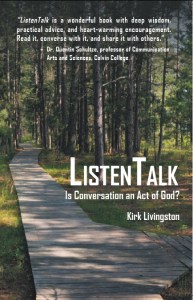
Now available at Amazon and other book sellers.
The smallest things you hear and say have the power to alter the trajectory of your life.
But you know this—just look back at a few of the most innocuous conversations you’ve had—the ones that led to a school and a life partner, or to the career you love, or to breaking with some substance.
ListenTalk rereads some old Bible stories for what God expected in conversation with women and men. A few wily philosophers show up in the book to quiz God—and us—about the power and promise of ordinary talk.
Read ListenTalk and you’ll come to look for and expect big things from even the most ordinary conversations that populate your day. Because ordinary conversations lead to far deeper connections than you’d imagine in your wildest fever dreams.
Feel free to give the book a 5-star review at Amazon.
Take me to Amazon this very instant with this link so I can order this odd but interesting book.
###
Teach Your Institution to Speak
Developing a Bias Toward Dialogue
Dogs don’t talk, but they are great communicators.
We know what they want, mostly because they want the same things at the same times every day. They’ve trained us in exactly that way: Go outside. Eat. Rub my ears.
Dogs have conditioned us well.
In the same way our corporations and organizations and institutions train us to speak in certain ways. One company I worked for required a high level of sarcasm to get through the day—it was just the way employees interacted—all the way to the top dog. Another firm with a gossipy culture built impenetrable walls of mistrust and politics between colleagues, cliques and departments—walls that interfered with work and mission. One brave boss arose from the nattering class with a zag to the well-entrenched zig: when Employee A came with a screed about Employee B, this boss would immediately summon Employee B to the office and engage their complaints together. So before Employee A went off the rails about Employee B, they had to deal with the issue together, face-to-face. This became the beginning of a solution. People stopped gossiping to the boss, for starters. But they also found new ways to talk with each other. People picked up on the message that unhinged rants about colleagues will not do—at least with this boss.

Can you spot the Ole in this photo?
You might think that the only way to get an institution to have open, revealing, useful forward-moving conversations would be from the top down. If the big boss does dialogue, then everyone else does—so goes the thinking. But in fact, culture does not always move from the top of the pyramid to the bottom. Sometimes it starts in the middle. Sometimes it starts at the bottom.
And that is good news for the 99 percent of us without a bully pulpit.
A person who demands more of conversation will butt up against others who are not so demanding, and sparks will fly. Or not. If you cannot find a place for forward-moving conversation in your organization, chances are good you will leave to find an organization where your voice will be heard.
But there are not a lot of good reasons to put up with less than genuine conversation.
###
Image credit: Kirk Livingston
A Confederacy of Onces
What could a national conversation look like?
Once upon a time mom and dad and kids gathered in the evening in front of the television to be entertained. This family, sitting patiently and expectantly, had three channels to choose from. Plus the boring public broadcast channel. Back when everyone watched the same variety show or mini-series or disruptive news special, national conversations occurred. Broadcasts that enraged or engaged would spur citizens to remark to each other. And since everyone watched the same channels, national conversations were born. So we talked about Selma or Vietnam or the moon landing or the most recent episode of “Roots.” Sometimes, not often, we talked about what was happening in Washington.
Before TV, radio did the same. Before that newspapers. Media has a way of spurring national conversations, though the attention lasts only so long, because the job of media is to immediately bring the next new thing. Day after day. That’s their revenue stream and business model.

When consolidated media ran the news business, it seemed to have more of a black and white/good or bad characteristic. With good guys and bad guys, a much better story emerged. And better stories sell more newspapers or generate better Nielsen ratings.
Social media removes some power from the established media. By hearing from different voices, context can be provided. Or not: Sometimes flame-throwing trolls dominate our inbox, just like on Fox News. The smart ones among us find ways to hear different voices, so we can see different ways to connect the dots. The rest of us relish getting riled with righteous rage by the people in our tribe who serve that function.
Lately for me and others, social media has connected dots and has turned a series of media one-offs into a bona-fide “thing.” Many find themselves paying attention and then cannot help but remark. Topics like the statistics around black deaths with police. It was blogs and tweets that explored nuance and connected the series of “onces” to show there is more—much more—than just a few one-offs. It was social media that kept the topic on the radar, not the established media.
Kerry Miller, on a recent The Daily Circuit, said she doesn’t like to use “national conversation” because it never happens. That is (I think she meant), national conversations never materialize. But I would argue that more and more often people are adding up the “one-offs” and putting them together in ways journalists and authorities had not predicted. It blindsided me that the Confederate flag flying over the South Carolina capital would prove a lightning rod. Gay marriage has taken the nation by storm right up to the point where it became the law of the land. And it was the call for statistics to be reported about deaths occurring in police custody. All of these have been explored by social media in detail.
All of this has proven fodder for national conversations. That is, new topics that we may never have dreamed we’d find ourselves talking about are now falling from our lips at the coffee bar or on the drive to work. And here is perhaps where today’s national conversation differs from those conversations mediated only by established media. Social media allows for nuance. It need not be black and white because we’re not selling newspapers here (some are, of course). But the nuanced voices are helping us talk without forcing one way or the other.
I see these conversations developing every day. And they move from online to offline to online again. I also see smart journalists from established media finding ways to bring in nuance at just the right time.
###
Image credit: Kirk Livingston
Judge Not: On Moralistic Judgments
#That’sJustTooHard: Think Before Speaking

There’s no stopping a word spoken.
One kind of life-alienating communication is the use of moralistic judgments that imply wrongness or badness on the part of people who don’t act in harmony with our values. Such judgments are reflected in language such as, “The problem with you is that you’re too selfish.” “She’s lazy.” “Their prejudiced.” “It’s inappropriate.” Blame, insults, put-downs, labels, criticism, comparisons, and diagnoses are all forms of judgment.
–Marshall B. Rosenberg, Nonviolent Communication (Encinitas, CA: PuddleDancer Press, 2005) 16
Which is not to say we do not have values and make judgments based on our values. Of course we do. But what if held back our knee-jerk spew of moralistic judgment about someone we’ve never met? What if we first talked with them?
A conversation could show us how wrong we were—or confirm our suspicions.
But…hear first.*
###
*Of course I am pointing to my own failure at this before pointing anywhere else.
Image Credit: Kirk Livingston
How to Tell Yourself the Truth (Hint: Start with an insult)
Where’s John the Baptist when you need him?
John’s task was to prepare the way of the Lord. That looked and sounded like insults to a crowd already well aware of the law and prophets and how to navigate the ancient texts. It’s just that the crowd’s navigation allowed them to do what they wanted while ignoring the invigorating spirit of the texts.
Thus John’s insults.

It’s easy and natural to take insults as insults (that is the intention, after all). But to see them as opportunities? That actually happens to most of us: insults become opportunities…ten years later. It takes ten years, or maybe twenty, to see the truth of what that busybody meddler said. And then in conversation with a friend or your grown-up kid or spouse you find yourself saying, “They were actually spot-on, though I denied it at the time.”
A few days ago an acquaintance called me out on one my typical innocuous and benign conversations about copywriting and communication—he resisted my assertions and would not back down. His insult landed wide of the mark and made no sense to anyone else either, but it got me thinking about my approach to a particular set of clients I work with. In fact, my acquaintance’s sharp barb started to reveal a truth about my approach that has since proved quite useful.
This is atypical.
I usually spend a decade stewing on an insult and devising comebacks and elaborate retributions. But what would life be like if I/we could be more open-handed about criticism?
That might help us grow beyond our blind spots—which might prove useful.
###
Image credit: Kirk Livingston
Cottonwood and Woolgathering
Many small impressions add to something—or not.
Cottonwood is everywhere this time of year in Minnesota. When driving at night, it looks like a snowstorm—light reflects off the airborne wooly-white so you ask yourself “What season is this?” Cottonwood catkins collect in inconvenient places (Example A). With all these loose seeds flying about, it’s a wonder Cottonwood trees are not sprouting from every bit of available soil.

Example A.
June cottonwood blizzards remind me of the collection of loose fears and wonderments that have been rolling through my brain lately. Little silences and absences that mean nothing until they gather into a solid-seeming impression. My friend whose cancer is in remission but whom I have not heard from for a long time. Couples I have not talked to together for many months. The out of work friend (s)—what are they doing and why have I not asked them?
As I combat cottonwood seeds today, I think I’ll see how my friend is doing.
###
Image credit: Kirk Livingston
Editorial Cartoon vs. Rough Sketch
Pique a place to begin.
Charlie Hebdo meant to disrupt and paid dearly. That is what every editorial cartoonist wants, well, not so much death as to disrupt. I’m a fan of Steve Sack at the StarTribune, who every day tips some social issue on its ear.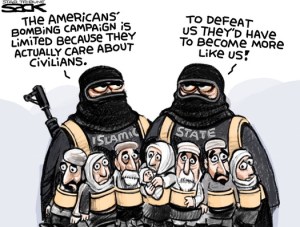
The contribution of the editorial cartoonist is to change the status quo conversation by putting forward an opinion in whatever outrageous way that gets attention and is instantly understandable. Most of their work is an image that evokes a passionate response. The editorial cartoon is typically polarizing, immediately dividing those in violent disagreement from this in violent agreement.
In contrast, the rough sketch is presented to people who are already with us. They may not agree with our nuanced vision of a project, but they at least have the project on their radar.
We use the rough sketch to present our vision for the project, to show more precisely what we mean and to invite discussion. The whole undone sketchy ethos of it can accomplish all those things.
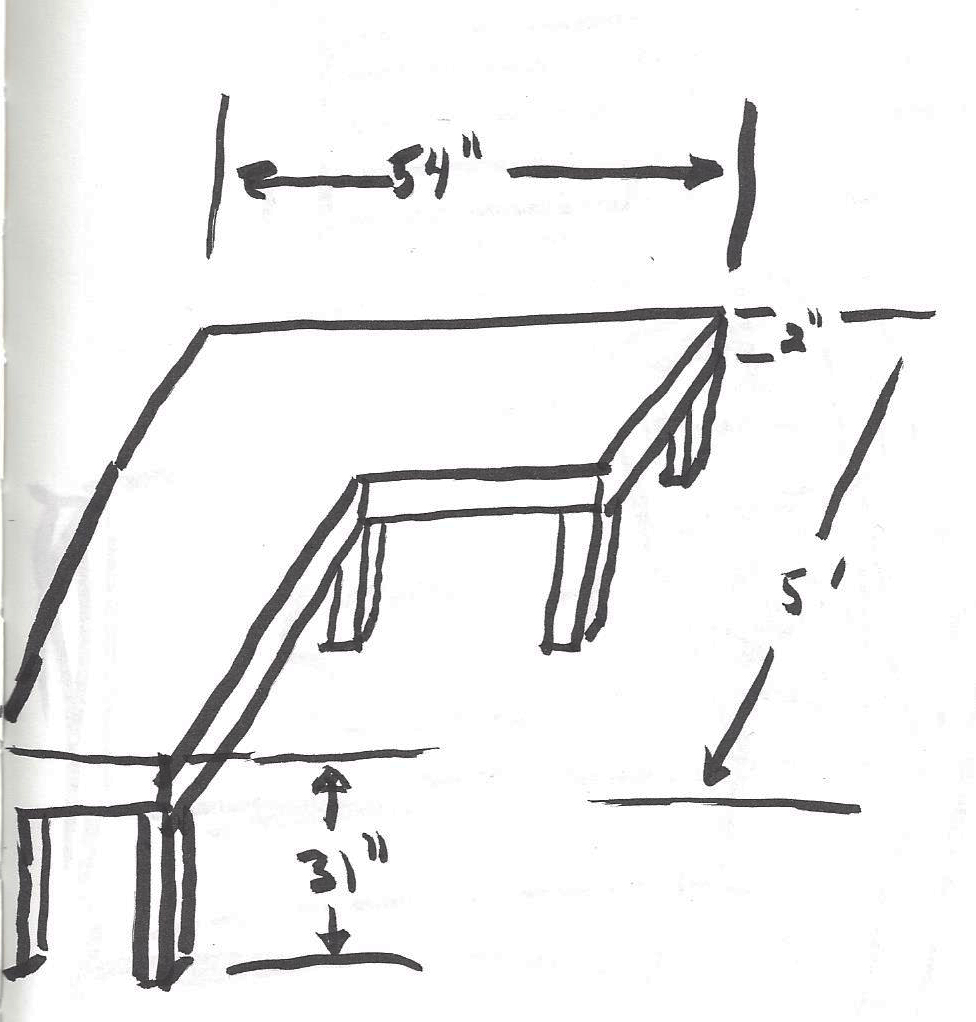 Sometimes we need a rough sketch to present our idea in the easiest possible way—so our friend or client cannot misunderstand us. And sometimes we need to disrupt a status quo conversation and risk passionate ire.
###
Image credit: Steve Sack, StarTribune
Dumb sketch: Kirk Livingston

 conversation is an engine