Posts Tagged ‘dialogue’
What is Your Purpose with Your People?
Can You Articulate Your “Why?” and “What for?”
I’ve been gushing over Improv Wisdom lately, this 2005 book by Patricia Ryan Madson. I’m thinking of buying a number of copies to give away and wondering how I can incorporate it as a supplemental text in my next classes. The book is easy to read, memorable and full of actionable wisdom all directed at staying in the moment and building something with others. Ms. Madson—a drama professor at Stanford, improv maniac, eager collaborator and kind-hearted encourager—brings a lot of life to how we can work with others. Now I find myself ordering the primary source texts cited by Ms. Madson.
Ms. Madson has been kind enough to respond to my tweeted epiphanies when reading her book. I am impressed by the longevity and timeliness of certain ideas. Ms. Madson’s 2005 book will likely be relevant for a long, long time.
As I finish with my Social Media Marketing class, I’m reading reflections from the students. One near universal regret was not having a clearer sense of their purposes for the communities they were trying to create. We spent focused time on this early on in the class, but forming a crystal clear picture of what we want to accomplish with others is neither easily understood nor often practiced. I know this from the number of companies I’ve been in that operated every day without a clear sense of what they were trying to do with their audiences.
Students resist the tightly-formed purpose and the close definition of their audience because it feels so restrictive. It just feels easier to write anything for everyone. At least that’s how the class always starts. But at the end of the class, there are multiple confessions about how the tight purpose and close definition actually freed them to say much, much more to their target audience. This experience fits with a bit of improv wisdom Ms. Madson offered: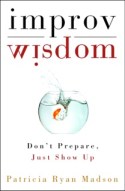
Rather than asking “What do I feel like doing?” when a free moment arises, instead ask “What is my purpose?”
I love this question for my class and I love this question personally. The question presupposes I have a purpose and assumes I know that purpose. The question assumes I am conversant with my purpose and assumes I am in the habit of articulating it to myself and others.
All these presuppositions and assumptions are worth pursuing. Going back to our purpose again and again sounds like bearing fruit over a lifetime.
And this: Patricia Ryan Madson should write more books.
###
Image credit: imgur

Working Together: A Final Frontier
Talk Inc. Buries the BS Meter
Collaboration is hard for a lot of reasons. One reason is the power distance between people in a company. How can I say what I really think when I know my boss disagrees? Can I have a real conversation with an automaton who spouts corporate messaging and controls my salary?
Talk, Inc.: How Trusted Leaders Use Conversation to Power their Organizations by Boris Groysberg and Michael Slind starts with good intentions: to lay out this new challenge of interacting with employees as if they had something worthwhile to say.
But I should back up: old styles of management were about command and control: I’m boss so I’ll tell you what to do. And you’ll do it. New ways of thinking about the work of leadership and managing tout a more generous and collaborative approach to personal relationships. But these collaborative ways still have a hard time sifting down through the ranks of gatekeeping managers who intuitively see their mission as that of controlling others.
Talk, Inc. has a terrific vision, but the first section (three chapters on intimacy) is off-putting in that it quotes CEOs and VPs and various bosses at length, each talking about all they are doing to encourage collaboration.  But Groysberg and Slind may have done better to start at the other end: giving voice to employees who have been given a voice. As it stands, the first three chapters are a difficult slog because anyone who has spent time in a corporation will recognize the smarmy PR tone of the program-of-the-quarter. My corporate BS meter kept pinging into the red.
The book gets better, but all the way through I struggled with the “trusted leaders” part of the subtitle. For a book that intends to talk about the power of conversation, there is still an awful lot of command and control monologue. Whether it was the suits from Cisco or Hindustan Oil talking, it was hard to take their comments seriously.
 Talk, Inc. is, however, smartly organized into four sections (Intimacy, Interactivity, Inclusion and Intentionality). Each section has a chapter that plays out the vision, followed by a chapter that shows a company trying to carry out that particular part of the vision, followed by a “Talking Points” summary that helps the reader play it forward. The Inclusion and Intentionality sections offer more thoughtful reasoning and vision-casting for changing corporate culture so real conversation can happen. Groysberg and Slind offer solid examples of organizations that work hard at listening. But this is a story that really needs to be told from the “newly-voiced” perspective.
###
Image credit: Bill Domonkos via 2headedsnake
The “Aha” Outta Nowhere
ListenTalk: Conversation is an Engine [One Page Summary of the Book]
Every once in a while you have a conversation that makes you say “Aha!”
I have those conversations too.

These are the conversations you did not see coming: The offhand comment from the guy in the next cubicle stuck in your brain. You turned it over and over and an hour later the phrase surprised you by unlocking some long-term vexation. The funny thing about these conversations is how they pop up at the most unexpected times—even from clear strangers—and how they can go on to solve pretty big problems. Even funnier: The person we are talking with can be entirely unaware of the importance of the thing they just said.
ListenTalk: Conversation is an Engine is all about where those “Aha” conversations come from and how to have more of them. In ListenTalk we grab conversation and hold it to the light and look at it from a few different angles. We look at what happens when we try to persuade each other of something (which we do constantly) and what happens when we listen deeply. In fact, three smart thinkers offer a refreshing take on what it means to really listen. These three show how the practice of listening gives back far more than it consumes. ListenTalk asks about what happens when our words get launched into a conversation. The answer is another surprise, because words tumble out more often as invitations than commands (even commands are really invitations because of how words bump against human agency). Words have the power to make permanent solid bonds in our physical world. They also have great destructive power.
ListenTalk spins a few ancient stories about how words worked when God talked with people and people talked with God. These old stories begin to make clear just how much is at stake in our ordinary conversations, not just for us but for generations to come. These old stories also hint at deep thick ways of forming insoluble communities that can withstand lots of pressure and still remain collaborative while becoming ever more hopeful. ListenTalk finally links ordinary conversation with the satisfying sorts of conversations humans were meant to have with God—and offers those conversations as a path forward.
[This is a draft summary of my book, which I’ll be shopping around to a few publishers shortly. Comments? Questions? Issues? Angry retorts?]
###
Image credit: imgur
Listen Your Way Into a Larger Story
Start to stop. Stop to hear.
There’s an old story of a woman who could not get pregnant. Her rival got pregnant with unrelenting, vexing regularity. Read the story here—it’s from an ancient text many of us privilege as telling true stuff about the world.

I keep returning to this story because of what it says about how desperation drives our listening habits. The truth is we don’t listen well. Often we don’t listen until we have to: maybe we need some information and it kills us to slow long enough for the clerk/cashier/spouse to spit it out. But we need that information to get where we need to go.
But what if we made a habit of listening? Intent listening. Close listening, rather than listening only when backed into a corner. What if we eagerly sought out answers in the conversations right around us?
What if the clue to the way forward after our recent lay-off was in the conversation we’ll have at 2:30pm with an old work colleague? What if insight for a growing doubt we’ve had about our faith was just inside the threshold of a chance conversation with an old friend? What if answers to our questions were spinning around us constantly?
That sounds like magical thinking, right?
The woman in the story prayed in her vexation and angst. She prayed so hard the feeble old guy watching her thought she was drunk. The old guy was no prophet and not all that well respected, still, his words formed an answer to the woman’s long-standing question. The story goes on to tell how the answer to her question was part of a much, much larger story with questions an entire nation was asking.
Questions and conversations can be a potent mix.
###
Image Credit: Kirk Livingston
Repeat, I say, Repeat Others’ Words
Weird Kid’s Trick that Boomerangs (Boomerangs!) in Your Own Brain
Someone told me about Lifehacker not long ago and I’ve been trying all sorts of the suggestions that flow through their stream of articles. But Melanie Pinola’s recent article “Make Better Conversations by Repeating the Other Person’s Words” caught my attention both for what she wrote and how the Lifehacker community responded:
If you want to be great at making and continuing conversations, you have to be a good listener. Barking Up the Wrong Tree’s Eric Barker points out one way to do active listening that hostage negotiators use to build rapport: repeat the last few words your companion said.
She goes on to give a very few specifics about repeating the last two or three words–it is enough to make you think about your own conversations. But the commentary that pops up after the article is almost as compelling as the article itself, with different folks chiming in by parroting the last two or three words. It’s actually not that easy to differentiate true interest from sarcastic banter. It’s all sorta hilarious.
Of course, kids learn repeating words early as a way to drive parents and siblings to the hard edge of sanity. I did it. My kids did it to me. But the surprise is that repeating others words—when not done with ill will or as a bit of customer service trickery, is quite cyclical: what you say again and again finds its way back into your own brain.
I have a client meeting today and I know that at some point I will repeat what my client says. Aloud. It almost always happens. It’s a basic part of understanding—it lets the other person know I am listening and it also gives me a chance to try on the words/concepts my client offers, to see if they make sense coming from someone else’s mouth.
We need more active listening in this world—but less repeating as a parlor trick.
###
Image credit: crazytales562 via Lifehacker
Getting at what others know but can barely say
We Learn When We Talk

A few days back I pointed to Nancy Dixon’s book Common Knowledge and her useful notion of tacit vs. explicit knowledge. Dr. Dixon’s recent post (Part II “We Know More Than We Can Say: How to Use Tacit Knowledge) over at Conversation Matters is worth a read if you are interested in how anyone ever gets at the depth and layers of experience of a seasoned colleague, for instance. Not surprisingly, face to face conversation with a person of deep experience transmits much more than the content of the words.
###
Image Credit: National Geographic Found
Do a Dumb Sketch Today
Magnetize Eyeballs with Your Dumb Sketch
 As a copywriter, I’ve always prefaced my art or design-related comments with, “I’m no designer, but….” I read a number of design blogs because the discipline fascinates me and I hope for a happy marriage between my words and their graphical setting as they set off into the world.
But artists and designers don’t own art. And I’m starting to wonder why I accede such authority to experts. Mind you, I’m no expert, but just like in the best, most engaged conversations, something sorta magical happens in a dumb sketch. Sometimes words shivering alone on a white page just don’t cut it. Especially when they gang up in dozens and scores and crowd onto a PowerPoint slide in an attempt to muscle their way into a client’s or colleague’s consciousness. Sometimes my words lack immediacy. Sometimes they don’t punch people in the gut like I want them to.
A dumb sketch can do what words cannot.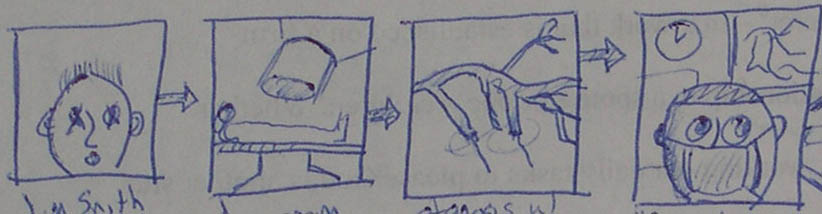
I’ve come to enjoy sketching lately. Not because I’m a good artist (I’m not). Not because I have a knack for capturing things on paper. I don’t. I like sketching for two reasons:
- Drawing a sketch uses an entirely different part of my brain. Or so it seems. The blank page with a pencil and an idea of a drawing is very different from a blank page and an idea soon to be fitted with a set of words. Sketching seems inherently more fun than writing (remember, I write for a living, so I’m completely in love with words, too). Sketching feels like playing. That sense of play has a way of working itself out—even for as bad an artist as I am. It’s that sense of play that brings along the second reason to sketch.
- Sketches are unparalleled communication tools. It’s true. Talking about a picture with someone is far more interesting than sitting and watching someone read a sentence. Which is boring. Even a very bad sketch, presented to a table of colleagues or clients, can make people laugh and so serve to lighten the mood. Even the worst sketches carry an emotional tinge. People love to see sketches. Even obstinate, ornery colleagues are drawn into the intent of the sketch, so much so that their minds begin filling in the blanks (without them realizing!) and so are drawn into what was supposed to happen with the drawing. The mind cannot help but fill in the blanks.
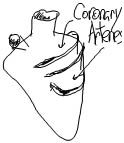
The best part of a dumb sketch is what happens when it is shown to a group. In a recent client meeting I pulled out my dumb sketches to make a particular point about how this product should be positioned in the market. I could not quite hear it, but I had the sense of a collective sigh around the conference table as they saw pictures rather than yet another wordy PowerPoint slide. In fact, contrary to the forced attention a wordy PowerPoint slide demands, my sketch pulled people in with a magnetism. Even though ugly, it still pulled. Amazing.
###

 conversation is an engine