Posts Tagged ‘photography’
Where Can I Buy a Fine-Art Mode?
The Beauty of Knowing Nothing
I don’t have a fine-tuning mode that tinkers with physical detail. I draw and it is mostly crude. I cut plywood and pine shelves and they are rough enough to make my craftsman-father scoff into his hand. I make dinner and it is mostly broad-stroke stuff that requires very little finessing. I will confess my popcorn is a work of art, combining yellow and white kernels, salted and buttered and mixed to a sensuous, savory smack of flavor. And I am learning how words interact on a page—though it is slow going.

How does someone get to the point of crafting from rough cuts to fine finished detail? It is possible that in this age of ordering clothes, pizza and romance from a button on our mobile devices, that some things still take time. Some things require beginning at the beginning. The question for each of us: do I have the courage to begin at the beginning? To know nothing for a time and do things badly?
The beauty about not having been taught drawing is that you are in a position of the acquirer: the process of figuring it out might take a while, and you will most likely continue to figure stuff out as you go, but that process is yours. There are no shortcuts and no tricks. Just the plain practice of drawing, screwing up, and drawing some more.
–France Belleville-Van Stone in Sketch! (NY: Watson-Guptill, 2014)
You cannot buy personal processes. Not really. You have to make them from scratch—those processes that help you make meaning in the world. And you have to begin at the beginning.
Mistake will be made.
You will make those mistakes.
And that’s OK.
###
Image credit: Kirk Livingston
3 Lessons I Learned Hanging With 70 Artists
See. Do. Share.
A group of artists in the Minneapolis-Saint Paul area gathers monthly to sketch. They call themselves MetroSketchers. These are talented people with facility for capturing life on a page. Yesterday I showed up to sketch alongside them at the Como Zoo in Saint Paul.

- Look To See. It’s easy to spot these sketchers in the crowds at Como. They are the ones balancing a sketchbook, and possibly watercolors or an arsenal of color pencils. They are the ones looking up and down and up and down at the very scene I dismissed with a quick glance. It’s the lingering look with an intent on capturing what they saw that was meaningful to me. Sketchers linger far longer than the causal passer-by. They must.
- Do It. Right now. That’s it—just get it on paper. Whatever you can. This is a lesson that carries over for me from writing. Do it badly, but just get one good stroke on the paper. One good mark among many bad marks. My great contribution to the day’s artistry was the Polar Bear Butt (the only animal who insisted on posing). Bad as it is, it is still a move toward representation.
- Share It. These uniformly talented people were also great encouragers. To a person they were all about what you saw and the marks you made in response. They found good stuff to say even when good stuff was pretty well hidden behind lots of not-good stuff. They also loved to talk about paper weight, the best inks to use, how small they can pack a watercolor kit and, “…here, let’s just walk through my sketchbook together.”
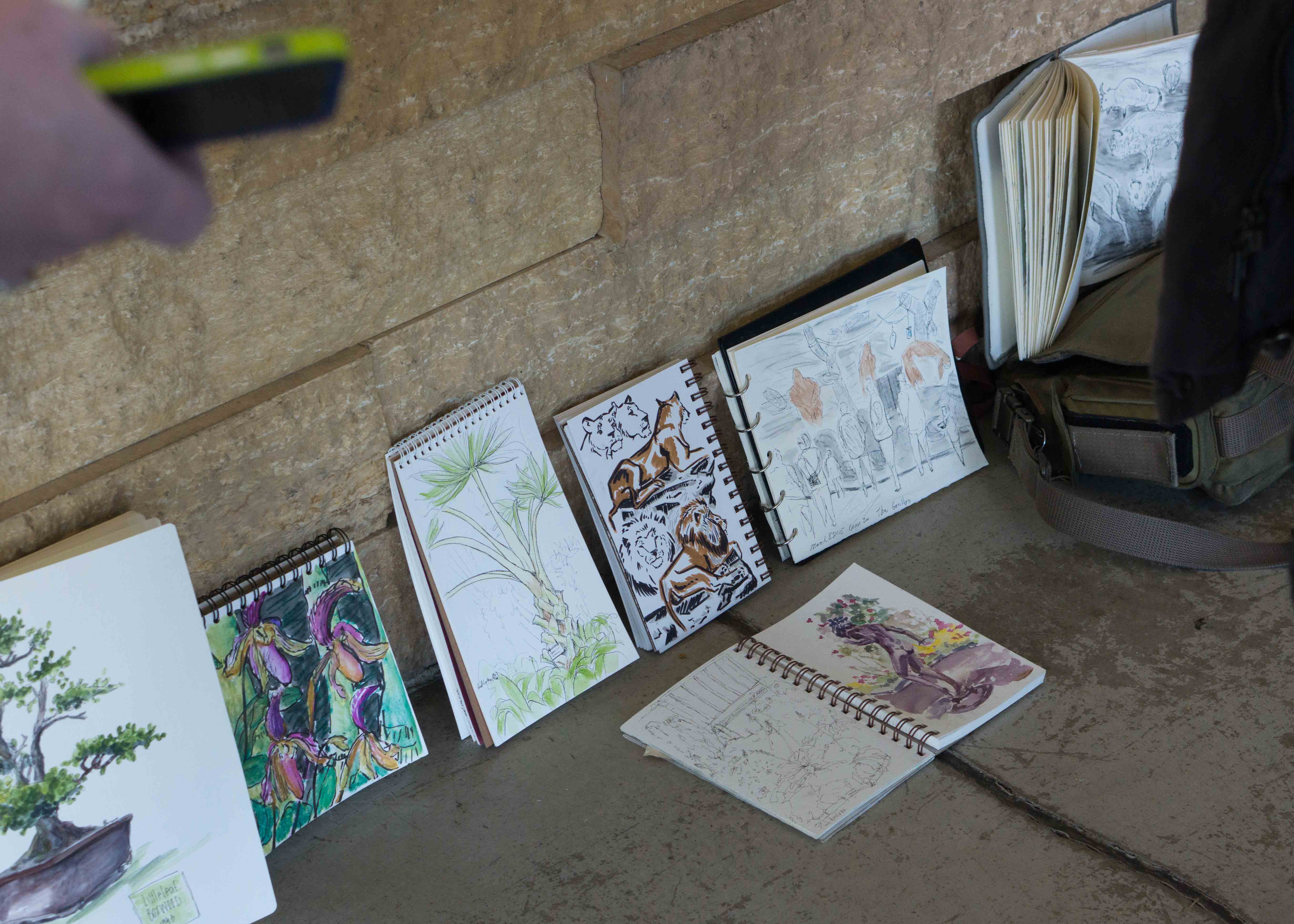
I spoke with many during the sketching and they were more than happy to show what they were doing, to describe how they were seeing and to talk about the difficulties in representation.
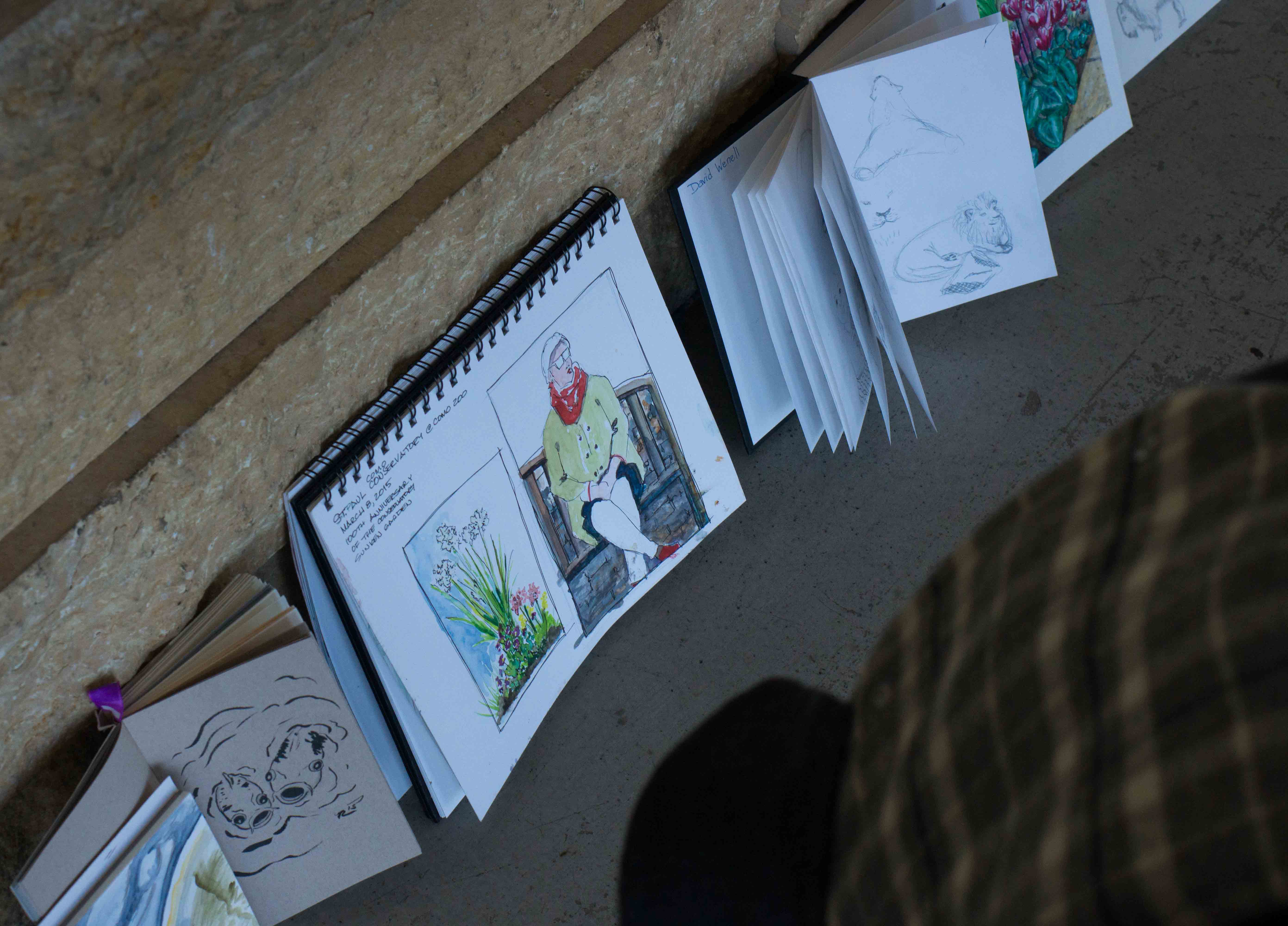
More than one sketcher expressed delight in what they were seeing—and if that is not a perfect reward for the interaction between drawing and seeing, then I don’t know what is.
###
Image credit: Kirk Livingston
Someone Died and Everything is Different
Times Change Us.
A gentleman acquaintance—someone I barely knew.
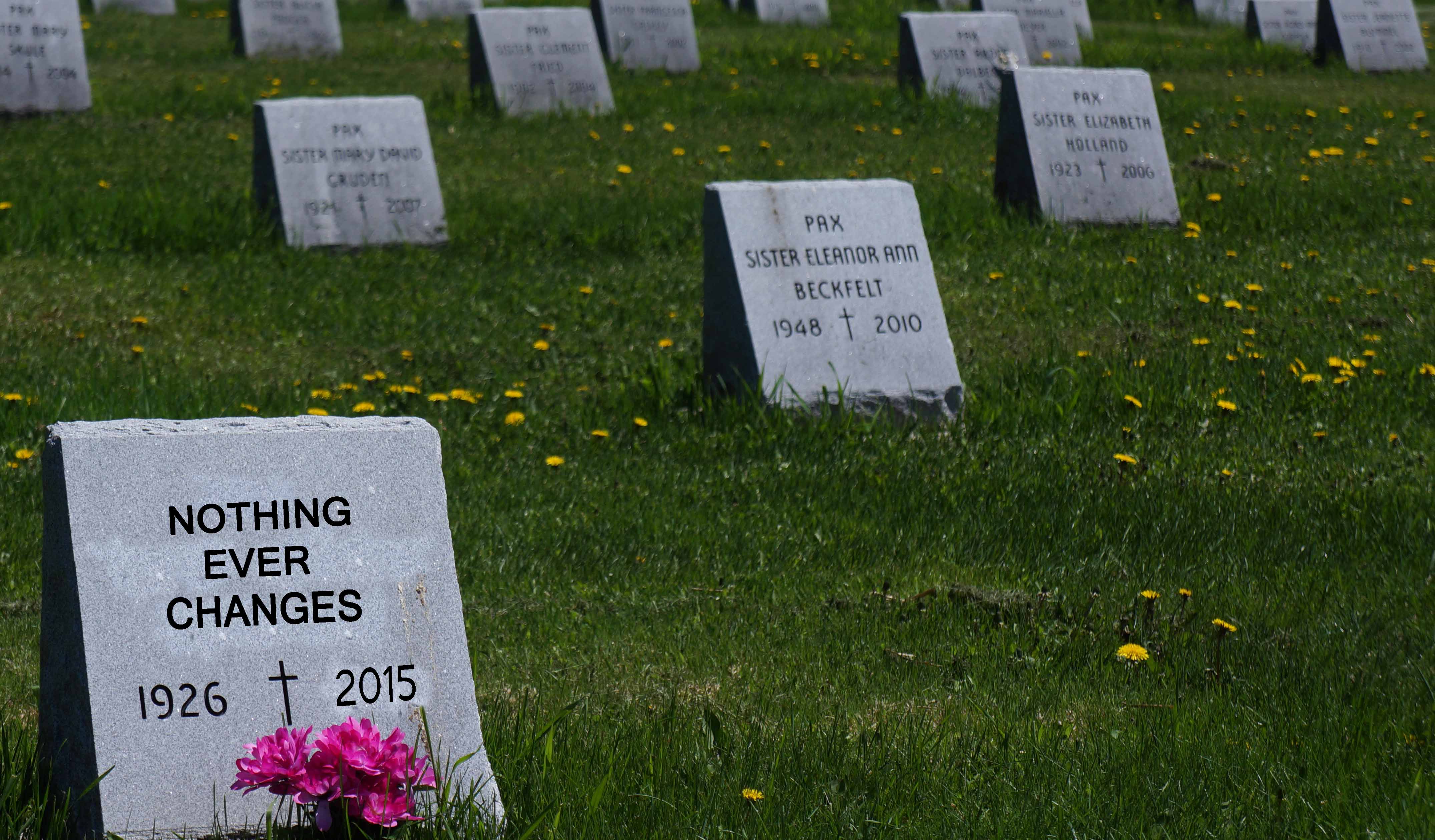
Mrs. Kirkistan and I were in a meeting with him not two weeks ago, and now he is absent. It’s a shock—but our shock is minor compared to that of the grieving widow and children. They have our sympathies and prayers. I cannot imagine the shift in outlook this change has wrought for them.
Even for me, who did not know him, there is a clear hole where he once existed. A big nothing–a memory–where, moments ago, a person stood.
And so. Mourning.
“Blessed are those who mourn, for they shall be comforted.”
–Jesus the Christ
We usually want to stick those holy old, churchy words in a pew to visit on Sunday or Easter. But today, even from the distance where I stand, they hold a glimmer.
###
Image credit: Kirk Livingston
Mary Oliver: “Here you are, alive. Would you like to make a comment?”
Just so.

…for always the new self swimming around in the old world feels itself uniquely verbal. And that is just the point: how the world, moist and bountiful, calls to each of us to make a new and serious response. That’s the big question, the one the world throws at you every morning. “Here you are, alive. Would you like to make a comment?”
–Mary Oliver, Long Life (Cambridge, MA: Da Capo Press, 2004)
###
Image credit: Kirk Livingston
Electricity. All Around You.
Questions About Your Grid
How much connectivity do you lose by waiting for someone else to speak your language?

What would you gain if you reached out with what little you knew of a stranger?
###
Image credit: Kirk Livingston
Gadamer: A Tormented Relationship to Writing
The Best Writing Sounds Nothing Like Writing
Good writing is where you remember nothing about grappling with words but are instead transported with images and ideas that appeared in your brainpan. Effortlessly—or so it seems.
This kind of effortless reading is exceptionally rare with philosophers, who are well-known for obfuscation in their pursuit of parsing detail and cleaving difference from sameness. And yet Donatella Di Cesare, the biographer of philosopher Hans-Georg Gadamer, claims Gadamer’s writing style is “lucid” with “striking prose.”
We’ll see about that.
The lucid philosopher is the exceeding rare philosopher.

I’ve just picked up Gadamer: A Philosophical Portrait by Donatella Di Cesare (Bloomington, Indiana: Indiana University Press, 2007). In the introduction Di Cesare shared about her process:
There is a further difficulty that a monograph on Gadamer should not avoid, and that is his tormented relationship to writing. In order to get around his Socratic resistance to writing, he preferred the form of the lecture, the talk, or the debate. It is not an exaggeration to say that almost everything he wrote is based in dialogue.
She goes on to say Gadamer is “always careful to interrogate everyday language and to avoid rigid terminology,” so I am eager to see how his prose ends up as lucid and striking rather than simply tedious.
What piqued my curiosity was Gadamer’s alleged privileging of oral over written. It seems his inquiry was largely based in discussion, between people, rather than one man alone with a sheet of 20# bond and a pen. Again: I’m just at the beginning of reading Gadamer. I’ve got his big Truth and Method on order, but I know from my own writing that dialogue and conversation have a pull that abstract philosophizing rarely reaches.
The best writing sounds like a conversation with an interesting friend. I’m eager to see if Gadamer achieves that.
###
Image credit: Kirk Livingston
To Flee Corporate Dysfunction or Not?
Where will you run?
My friend just quit her corporate job. She does not have another job.
“Too much dysfunction,” she said. “Why spend my days in a cube, following through on poor choices our leaders made under the guise of collaboration? There’s got to be a better way.”
“I hope you are honest in the exit interview,” several people said to her. Other top talent had quit as well and those remaining cherished a hope of productive work.

Every company has these bouts of employee-flight. Maybe the department director is a megalomaniac. Maybe the boss simply doesn’t know what to do next and is not open to advice. Maybe the department trolls rule the roost. Every so often dysfunction catches up with a department or company and talented people throw up their hands and march to the exit. It is more common when the economy is on the rise, but even in a down economy, talented people choose flight over fight, even with no job on the horizon.
So it is with my friend.
She had had enough and hoped to parlay her high-end employee history into a freelance life. I often talk with people considering this move. What I liked about this conversation was that my friend could identify a few key skills and passions that she wanted to pursue. And she had already begun to push on these passions. She knew what she wanted to build next. So her “I quit!” was less about fleeing and more about “now is when I do this thing I love.”
Because, the truth is, you can never be entirely rid of dysfunction.
“Why is that?” you may ask. (I can hear you.)
It is because you bring it with you. Disagreeing and disagreeable. Seeing issues from your personal, rigid perspective. Combative. Megalomania. These seeds are planted in every one of us. Sometimes it doesn’t take much to cause them to flower. A good conversation harnesses different potentials in those seeds and helps us move forward. A dysfunctional environment feeds the bad seed and strife rises to the surface.
Such is the human condition.
But moving forward toward our passion, finding time to do those things we love—the things we are meant to do, even if no one else cares—that feeds the productive functional seeds in us.
Is there a way to do the things you were meant to do today—right now—even as you wade through the current dysfunction?
That is the question.
###
Image credit: Kirk Livingston
Josephine Humphreys: When writing from the center of things
The world keeps aligning with what I just wrote.

Interviewer: When you’re writing, is it that you notice things more acutely?
Humphreys: Yes. You notice everything, and everything seems to be full of meaning and directly centered on the thing you’re writing about. I heard E.L. Doctorow say something like that—that when you’re writing, all experience seems to organize itself around your themes, which can give you some really strange feelings of coincidence and ESP. You start to think you’re onto the secrets of life.
–Josephine Humphreys, quote by Dannye Romine Powell, Parting the Curtains: Interviews with Southern Writers (Winston-Salem, NC: John F. Blair, 1994) 192
###
Image credit: Kirk Livingston
The Lamp Repair Man and the Factory Owner
How do business and passion mix?
A man had a small business repairing oil lamps. He repaired wicks or refilled lamps with oil—whatever was needed. He took his cart to different neighborhoods and called out for business: “Lamp repair” and “Fix your lamp.”
When people brought their lamps to the man, they would watch him trim or replace the wick, refill the oil and polish the glass. The man had a quick rhythm to his method: he sang a song softly that guided him through his process of checking each lamp. The man was unfailingly kind and full of joy and neighborhood kids loved to watch him as he worked. He would often say providing light was what he was meant to do.

One day a factory owner was home for the morning. He was feeling a bit unwell from celebrating late into the night after successfully negotiating deep concessions with the largest union at his factory. When he heard “Lamp repair” shouted outside and remembered his children exclaiming over the charms of the lamp repair man, he stood and picked up the lamp he had been reading by and made his way outside.
The lamp repairman took the lamp and quickly sang his song to himself as he checked it over. Then he trimmed the wick, polished the glass and handed it back to the factory owner since it was nearly full of oil.
“What do I owe you, Mr. Lamp Repairman?” asked the factory owner.
“Oh, nothing,” said the man. “That took no time.”
The factory owner would not have it.
“But surely your time is worth something,” he said. “Surely you have some small fee for checking and trimming and polishing. I own a factory and I must pay for every bit of my employees’ attention.”
“Well,” said the man. “I’ve found that I am most interested in how light works and what it provides. I love a well-lit page when I read and I am eager for good lighting for others. So it actually rewards me when I can get someone’s lamp working well.”
“But can you live on good feelings?” asked the factory owner. “Do your good feelings buy potatoes or flour? Can you pay your landlord with good feelings?”
“True,” said the man. “Good feelings don’t buy much in the open market. But good intentions find their way back. I have found that helping those along my regular route helps build my business. People return when there lamp needs repair because they know I’ll be fair and they know I’ll do my best to get their cherished lamp working. You give a little, you get a little.”
“I see,” said the factory owner. “Give a bit away free and then get rewarded with loyal customers. Good strategy.”
“Yes,” said the man. “It was a good strategy for many years. But today I am actually well-provided for. I’m not rich, but my wife and children and I have enough. I actually charge only rarely because I don’t need to and because I am interested in the lives of these customers who have become friends over the years. Children and grandchildren of long-time customers bring out their lamps. I am eager that they have enough light for the many books they read and drawings they make and conversations they have.”
The factory owner took his lamp and walked back to his home, thinking back to the work he did that started his own factory.
###
Image credit: Kirk Livingston
Pat Conroy: How to tell when the story has started
Sometimes Mr. Subconscious arrives at the work site before Mr. Conscious

I think dreams are very important. I think dream journals are important. Extremely important. I have dreamed the ends of books. When I start dreaming about the book, I know it’s now starting.
–Pat Conroy, quoted by Dannye Romine Powell, Parting the Curtains: Interviews with Southern Writers (Winston-Salem, NC: John F. Blair, 1994) 51
I can’t vouch for dreams, but I cannot help but notice how Mr. Conroy’s stories seem to start without him. Writing is hard work, but there’s no denying these bits where the subconscious fills in gaps at the work site before you even arrive.
###
Image credit: Kirk Livingston

 conversation is an engine