Posts Tagged ‘photography’
Your 10,000 Hours
Trust Your Process
There are times when you don’t know the answer and you cannot see a way to an answer.
There are times when you simply cannot see what to do next. This happens constantly in my work: even today I have a project that needs a unique kind of help. Help I cannot even quite imagine.
What to do?

My writing process seems to be all about working my way into a corner or a dead end. It happens again and again. But as I continue chipping away and working at it (which is to say, I keep writing), the dead end turns out to be a way to rethink something. Getting stuck in a corner turns out to be the necessary thing, the thing I needed to actually turn the corner.
Malcom Gladwell contends that you must put in 10,000 hours to become an expert at something. He may or may not be right about the numbers, but certainly an expert has worked out a process the she or he follows—some way they use to accomplish the thing they do. They’ve sorted some way to keep at it. And whether or not the outcome is perfect, the process itself is revealing.
That’s why one keeps at it: to see what the process reveals next.
What are your 10,000 hours revealing?
###
Image Credit: Kirk Livingston
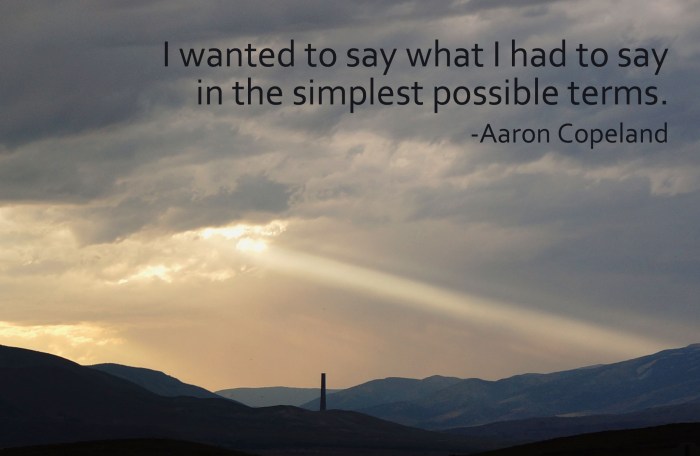
How simply can you say it?
Use Words As Necessary
 ###
###
Image Credit: Kirk Livingston
Think “Plant” Not “Preach” (Dummy’s Guide to Conversation #18)
Monologue is dead. Long live dialogue.
You’ll be much more effective if you give up telling people what to do and instead invite them into an idea.

It’s more work on your part, of course.
Inviting your conversation partner into an idea has the advantage of letting the notion grow in their native cerebral soil versus boxing them about the ears and head with your command.
Planting seeds can also change the shape of your internal discourse. And that can become a fresh, personal beginning point.
Check out the other 17 tips from the Dummy’s Guide to Conversation.
###
Image Credit: Kirk Livingston
Obviously.
To spell out the obvious is often to call it into question.
–Eric Hoffer

Though “obviously” can never be rehabilitated.
###
Image credit: Kirk Livingston

Try “Yes, and…” Today
Let there be a Science of Deep Collaboration
When I hand out a group project in my writing class I hear audible groans.
It’s because we’re trained to work at things on our own—that’s how scholarship and schoolwork and academics have worked for a long time. The groans come from all the extra work of communicating and all the expectations around not knowing if others in the group will keep their end of the group-work bargain. The groans come from the anxieties that hover around roles and responsibilities and knowing you’ll have to sell your ideas.
I am eager for new and deeper research into collaboration. Let’s call it a Science of Collaboration. Maybe it is a social science. People like Keith Sawyer and Edgar Schein are moving this science forward—along with many others. I am fond of the work Patricia Ryan Madson has done around Improv, which seems the perfect gateway for anyone to learn the fun of collaboration. And Keith Johnstone seems to have spawned many thinkers along these lines.
 I’d like for this science to do (at least) two things:
- Invite people in who have been working alone for forever. But gently, and independent of the introvert/extrovert divide. I want the invitation to show the fun of the process. I want that invitation to promise more aha moments and then to quickly deliver on that promise.
- Show next steps to working together. What can an ad hoc team do to quickly get grounded enough to toss ideas that build on each other? There are techniques out there, certainly, but I’d like this to be second nature, part of our emotional intelligence, something we come to expect. Something we’ve grown up with.
“Yes, and…” seems a perfect place to start. This is the old improv notion of building directly on what the last person just said. And quickly, without lots of deliberation. It requires a certain fearlessness.
What if “Yes, and…” was built into our educational DNA from grade school up?
###
Image credit: Kirk Livingston


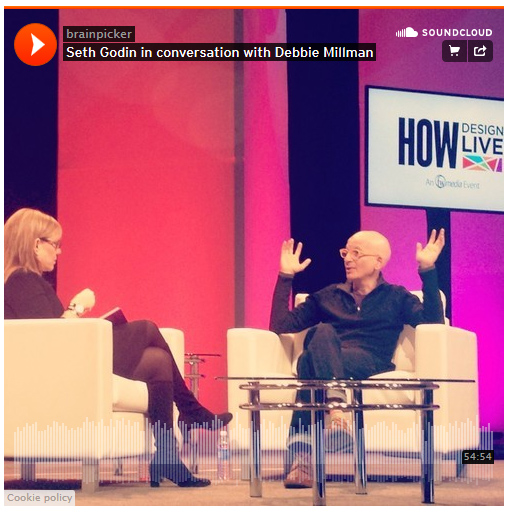
Anxiety is the experience of failure in advance–Seth Godin
There is no better apologist for freelance than Seth Godin

If you find yourself asking “What is my work?” listen to this interview with Seth Godin:
###
Via Brainpicker
Image Credit: Kirk Livingston
Creative Rebellion and Your DIY Career
Creativity + Freedom = Finding Your Work
We’ve finished our last session of freelance copywriting at the University of Northwestern—St.Paul. And now, after all the boring, blathery lecture stuff and all the portfolio additions and all the clever advertising we’ve seen, the bottom line is freelancing is a business of making it up as you go.

Just like no one can teach you to write (though teachers offer suggestions and direction, writing remains something one learns on one’s own), no one can teach you to rebel or to cultivate a disruptive presence in your work. Writing your way into and through creative rebellion is the beginning point to locating a solution to a problem that connects with an audience.
Freelance copywriting has by no means cornered the market on these qualities of creative rebellion. But those freelancers invited back provide value by looking at things deeply and differently. These are the folks who have organized their lives around creative rebellion and get antsy when asked to follow a party line.
Let there be more of this tribe.
###
Image credit: Kirk Livingston

 conversation is an engine