Archive for the ‘Advertising’ Category
Edward Bernays and Jolly Manipulation
Gather round, kids: here’s how you sway public opinion
Edward L. Bernays is called the father of public relations and his book Propaganda (NY: Horace Liveright, 1928) shows why. Bernays is absolutely jolly as he lays out the psychology of manipulation. He doesn’t just talk about the formulas, he gleefully demonstrates them in paragraph after paragraph. Much like one might describe building a shelter to a group of boy scouts, Bernays is positively beaming as he writes about how to pull self-interest into the equation to get publics to do your corporate bidding.
The modern propagandist studies systematically and objectively the material with which his is working in the spirit of a laboratory. (48)
Edward L. Bernays is the ur–flack.
If you can influence the leaders, either with or without their conscious cooperation, you automatically influence the group which they sway. (49)
Reading Propaganda today, it is clear Bernays thought corporations and government leaders and those in power would certainly use his manipulation techniques for good.
How could it be otherwise?

Look through here. You’ll see what you’re supposed to see.
But World War II was just around the corner and every nation developed their own propaganda machines. In the US, we still react viscerally to the imagery and code words used by Nazis. Today old Stalinist imagery has it’s own unique draw. The US had powerful PR apparatus as well. We continue to feed that machine. And since, then, of course, unending sets of military skirmishes/wars, each equipped with God-given reasons for why we must respond. Then Watergate and totalitarian despots revealed and deposed, and, well, it’s a long list of fails that contribute to today’s cynicism and “Question Authority” stance. People found their voice and collected it to push back with outrage at corporations and governments and to call attention to wrong doing when it appears.
Eighty-six years later, the entire population of the US—possibly the planet—is wise to Bernays’ techniques. Not that we’ve studied them: those techniques study us all day every day. Especially in countries like the US where consumption is our patriotic duty. We know manipulation from the inside out.
Bernays would be impressed were he alive to see it. I imagine him smacking his head and saying, “Wait—they know they are being manipulated, and …they still buy it? This is even better than I hoped.”
Why talk about manipulation? Not just because Bernays book is fun to read and easy to contrast with today. In particular, why would a copywriter talk about manipulation? Isn’t that secret sauce you trade in all day? Why pull back the curtain?
As a copywriter my goal is to tell my client’s story in the best possible light. I continue to argue that persuasion is a natural piece of how people interact with each other all day long. It’s part of the human condition. But I argue our efforts at manipulation damage actual conversation. When we use words and techniques with manipulative technique, we shut off further conversation. At that point it is about winning not connecting. Maybe there is a fine line between persuasion and manipulation. Propaganda is the textbook for manipulation.
As a copywriter, I want my clients to engage in conversations not endless manipulative monologues. That seems a more human approach to communication. I continue to think conversation is what today’s market will bear.
###
Image credit: Kirk Livingston
Big Data Will Never Write a Poem
Art & Craft in a Data-Driven Age
Big Data FTW.
With all the information we collect from you (and Bob and Carol and Ted and Ciley), we know when you’ll buy beer, buy steaks, invest in a crock pot, buy an engagement ring, get married, get pregnant, get divorced, get pregnant again, get diabetes, get congestive heart failure and, well, pretty much any of the human conditions. We know what kind of coffins people in your neighborhood buy. We know this because we track it.
We track everything from mouse clicks to toilet paper purchases.
Because we track things we can make offers you cannot resist because you just thought of it yourself. You just thought of what we already knew you’d think about.
This kind of knowing is the goal of the big-data wranglers embedded in most any marketing group these days, whether an ad agency, a car manufacturer, a hospital or my city leaders. Knowing all means better decisions—at least that’s the promise.

Years ago all this tracking would have set in motion a web of fears about being controlled. But since most of have agreed with Amazon and Netflix that we really should order this lens next and watch that movie next (because others did), we’re at peace with each day’s granular tracking.
Is there a place for the crafter in a world of analytics? I say “Yes” because despite all the predictive analytics, we still connect best with real people. Brands are not known for calling us back to our senses. As our buying and consuming gets easier and easier—which is not a good thing—we need the artists and the crafters and the writers and barista-poets to call us back to a life outside of consumption.
Big data is not likely to predict the veering humans are known for. Because, as they say: past performance does not guarantee future results.
Plus: big data will never write a poem—at least a good poem.
Long live the intuitives!
###
Image credit: Kirk Livingston
“Viral” is Fool’s Gold
People often have legs and feet. So do collaborative ideas.
Years ago we noticed the threshold to globalization falling to the point where anyone could step over it. Back then advertisers talked about music or images that could transcend language with television and radio. And it was true: cloak your message with a mainstream song and off your product flew to sell among lands and languages previously unknown.

Today we routinely interact with people across the globe. Tweets and Tumblrs and blog posts and comments can and do come from anywhere at any time (because it’s always 17:01 somewhere). It’s mostly asynchronous. But not always—my WordPress friend in Hong Kong responds to my morning posts (his evening) and I respond to his evening posts (my morning) and it feels like real time.
Marketers and advertisers want to promise a viral result from the work they do for clients. But the bar for viral gets higher every day: interweb participants stand amazed at less and less.
More realistic: go back to the old way of focus on the important people. In this we make sure our message can be carried in a style to which our target audience is accustomed. Making sure our messages are sticky for the primary and secondary audiences we care most about is better than shooting for viral. And the first step toward sticky ideas is to simplify (not the same as dumbing-down) so the idea is quickly grasped and possibly even elegantly presented.

This simplifying process is a natural result of collaboration. Just explaining an idea in the course of a normal conversation is a step away from Teflon toward sticky. That simple act of saying it aloud helps you realize what works and what doesn’t: it’s all written in the face of the person you are explaining it to.
Start with a simple collaborative conversation to begin to move toward sticky.
###
Image credit: Kirk Livingston
Zumba: Create Your Own [Alternative Dance] World
Learning from “Let it move you”
Advertising’s great advantage is making images that dismiss the real baggage real people carry into the real world. And that’s why we buy the product: we want to be that person so in the zone we don’t realize we’ve been dancing on the conference table in the middle of a budget meeting.
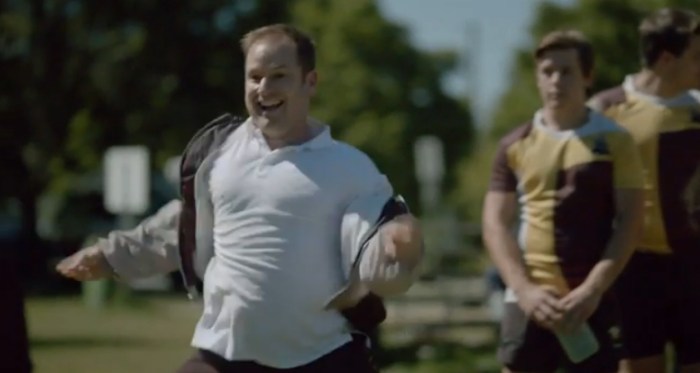
[Click to play at Creativity]
But is “dismissing real baggage real people carry into the real world” really so far-fetched? I’m starting to think not. We’re all marching toward some image of life that we’ve created or someone has created for us.
What are you marching toward?
What could you be dancing toward?
###
Via Creativity

 conversation is an engine