Archive for the ‘Audience’ Category
What about those hard conversations? (DGtC #27)
Are explosive words better from an authority or friend?
I am convinced that where people gather: a classroom, a department, a congregation, discussion is a more effective use of time than all of us listening to monologue. Many teachers explore the flipped classroom, where their time together is in discussion and the preachy monologues and lectures slide to a different time, place and pace. In general I am attracted to collaboration and many voices speaking. I keep hoping coherence will show up.
We may want to collaborate, but obstacles arise. We may want to be walking catalysts, but something stands in the way. Unsaid obstacles can block collaboration. And sometimes we need to have hard conversations, the kind where we not only disagree, but our different positions are emotionally charged. To assert my position will cut at my conversation partner’s position and vice versa. There may be anger. There may be tears. There may be power-plays. This conversation could be explosive.
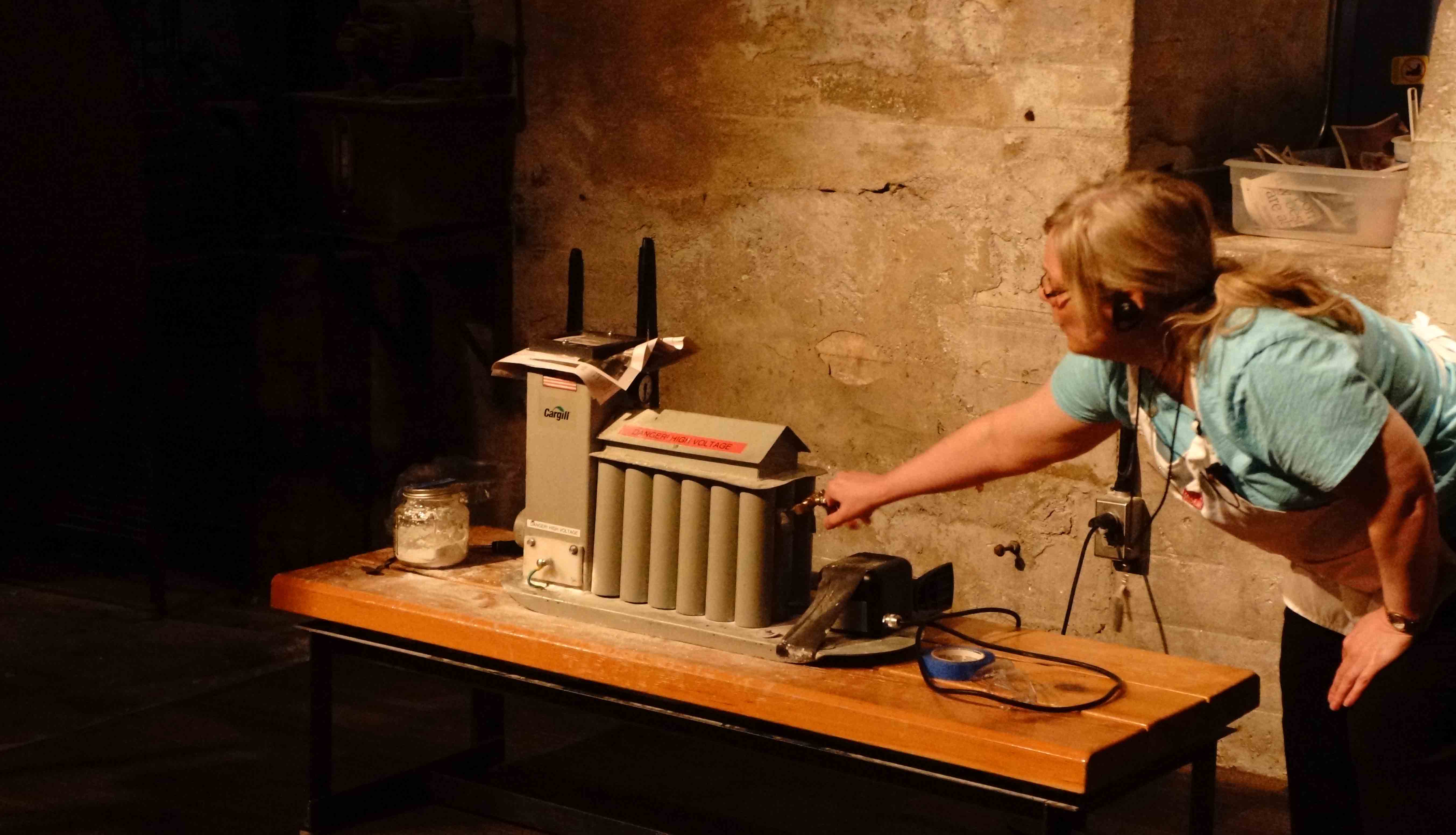
Demonstrating the explosive past for Minneapolis flour mills.
The late Wayne Booth advocated a kind of listening-rhetoric: listen intently enough to your conversation partner to faithfully tell their position (without denigration) while still holding to your own. This would not be the place for win-rhetoric, where your goal is to beat your message into someone else. Emmanuel Levinas might say we have an obligation to watch out for the person before us—this conversation partner. In fact, he might advocate that this person before us is our first priority. Martin Buber might say we continue to hold that person in high regard as a person, inviting them to consider this different perspective rather than trying to force our viewpoint. Even Jesus modified the law with love and compassion (he actually said love was the fulfillment of the law).
So…
- Say we take the listening seriously as we approach the hard conversation.
- Say we take seriously our commitment to the growth and personhood of this conversation partner (stay with me here). And we recognize this person as a person (versus an employee or student or lesser-being).
Given a kind of love for the person before us, we say the hard thing. And the explosion happens. No guarantees, but that blow up can be a worthwhile communication event. Good things can come from that, hard as they are.
Personally, I shy away from these explosive conversations.
But is shying away from a potentially explosive conversation doing a disservice to the thing that needs to happen between us?
###
Image credit: Kirk Livingston
Words Build Stuff Between Us
Words destroy stuff we’ve built
We all know this, don’t we? It’s perfectly obvious.
If words were money (words are definitely not money), we would be aware of our spending to inform or persuade or entertain. And just like people who make a hobby of “going shopping,” spending our word budget every day would be just another normal piece of everyday life for a U.S. citizen (or “consumer,” as business has renamed humans).
And that is actually how words work: We spend them.
With words we buy influence. We give some bit of knowledge or direction to someone else and win something in return. Some bit of psychic collateral. With words we buy context: we proclaim this or that in response to a situation at home or at work. Sometimes those around us agree with our context-setting assessment. Sometimes they don’t. Hint: if you want more people to agree with you, become the boss. Authority has a way of bringing believability with it, whether or not it is earned.
How we spend our words is worth thinking about. For many of us conversation seems instinctual. We say this in response to that. We inform, persuade, entertain with a joke. We do most of this without making conscious choices about our wordly-intentions.
But what if we did think of how we spend our words? What if we invested our words to accomplish some end? What if we invested our words with meaning—which is to say, what if we said things that were pulled from the well of what is important to us? That would make us vulnerable, of course. It would also be a platform for growth. Because when we say what is important, we learn something about ourselves and often a meaningful conversation can follow. The kind of conversation that has a chance of touching us deeply.

If you’ve not read Mistakes Were Made (But Not by Me), now is a good time. Tavris and Aronson have been referred to frequently as the Rolling Stone article on rape at the University of Virginia and news reader Brian Williams were found to have amped up their stories beyond anything resembling truth. Tavris and Aronson talk about cognitive dissonance and how we have such a hard time living with ourselves when our inconsistencies and personal malpractices appear—so we just change the story to coddle our precious psyches. The authors also demonstrate how memory gets built and rebuilt as we change stories:
Memories create our stories, but our stories also create our memories. Once we have a narrative, we shape our memories to fit into it.
–Carol Tavris and Elliot Aronson, Mistakes Were Made (But Not by Me), (Orlando: Harcourt, Inc, 2007) 77
I am advocating for conscious use of words, and for filling those words with stuff that is important to us—scary as that is. I see this as the opposite of small talk. I do, however, acknowledge that small talk is the precursor to big talk.
In my dream world, we use words to constantly build stuff between us rather than destroying relationships by purposely misunderstanding and showing we are better/righter/fitter/stronger/groovier.
###
Image credit: Kirk Livingston
Can 78 bad sketches change your life?
Don’t stunt your growth by reaching for fame
It’s funny we gauge personal success by numbers of followers. It’s as if we’ve adopted the business transaction as a model for every area of our lives.
Business wants more eyeballs for more attention for more revenue for more profit. And that makes perfect sense for our business goals.
What’s problematic is when we confuse business with what humans need to move forward: Doing what attracts attention and gathers “Likes” is often very different from the stuff our souls need to grow.

Your business factory is not a solid model for personal growth
One thing I’m learning from the artists and photographers I’ve been interacting with at Dumb Sketch Daily (currently at bad drawing #78) is that while today’s drawing is (clearly) imperfect, there is always tomorrow’s drawing. And I know what I’ll do different in that drawing. I know I’ll try this technique, or that view, or this topic. I’ll do it again and create yet another imperfect representation of the world.
And that’s OK.
Because the pursuit is about learning to see, learning how to draw, learning how to write. Learning how to tell the truth. Learning how to interact with each other. Learning how to be human. Perhaps even learning how to interact with God.
The goal is not fame, unless you really want to turn this pursuit into a business. But learning itself—whether crowds acknowledge you or whether you plod silently and alone—learning is its own reward.
But I still argue your growth is also a benefit to the humans around you.
And while I don’t think 78 bad sketches have changed my life, I can say with certainty that I see things differently than I did 78 days ago.
###
Dumb Sketch: Kirk Livingston
Gadamer: A Tormented Relationship to Writing
The Best Writing Sounds Nothing Like Writing
Good writing is where you remember nothing about grappling with words but are instead transported with images and ideas that appeared in your brainpan. Effortlessly—or so it seems.
This kind of effortless reading is exceptionally rare with philosophers, who are well-known for obfuscation in their pursuit of parsing detail and cleaving difference from sameness. And yet Donatella Di Cesare, the biographer of philosopher Hans-Georg Gadamer, claims Gadamer’s writing style is “lucid” with “striking prose.”
We’ll see about that.
The lucid philosopher is the exceeding rare philosopher.

I’ve just picked up Gadamer: A Philosophical Portrait by Donatella Di Cesare (Bloomington, Indiana: Indiana University Press, 2007). In the introduction Di Cesare shared about her process:
There is a further difficulty that a monograph on Gadamer should not avoid, and that is his tormented relationship to writing. In order to get around his Socratic resistance to writing, he preferred the form of the lecture, the talk, or the debate. It is not an exaggeration to say that almost everything he wrote is based in dialogue.
She goes on to say Gadamer is “always careful to interrogate everyday language and to avoid rigid terminology,” so I am eager to see how his prose ends up as lucid and striking rather than simply tedious.
What piqued my curiosity was Gadamer’s alleged privileging of oral over written. It seems his inquiry was largely based in discussion, between people, rather than one man alone with a sheet of 20# bond and a pen. Again: I’m just at the beginning of reading Gadamer. I’ve got his big Truth and Method on order, but I know from my own writing that dialogue and conversation have a pull that abstract philosophizing rarely reaches.
The best writing sounds like a conversation with an interesting friend. I’m eager to see if Gadamer achieves that.
###
Image credit: Kirk Livingston
“You Should Care” Versus “Why You Should Care”
Just Say No to this Toxic Assumption
This Sol Stein quote on high-powered facts failing to invite others in reminded me that we are at our best when we express our passion as an invitation. The best teachers are the ones excited about a topic. Their excitement is itself an invitation into the topic. The best salespeople are those humans who use the product and love it—which is why word-of-mouth remains the most sought-after form of advertising. The most persuasive evangelists are those whose lives have been altered by faith or by an Apple product (which is itself a kind of religion).

Alternatively, the worst college classes, the worst business meetings, the worst seminars are those where the professor/supervisor/speaker assumes you care as much as she does. That assumption leads immediately down deep into depths of details without painting the larger picture. And many of us are desperate for the larger picture. We want to see how our work or faith makes a difference in the rest of life.
A basic truism of life as an insider is that we stop talking about why we are here (in this company or department or group or church) because we’ve heard other people’s stories and we don’t need to go over that ground again. Pretty soon we assume we are all on the same page with the meaning of our activities together. Every once in a while the boss of your boss may say something about why we are here and why its important. But day-to-day it is largely assumed.
The outsider knows nothing of this.
The outsider comes to a group not with a blank slate so much as a slate marked by other groups he has dealt with. The person on the fringe trying to understand the group wants to hear the big meaning statements, the “Why we are here” stuff. And this is precisely where corporate talk falls flat. Corporate talk about meaning and mission and purpose is often vapid precisely because there is no human behind it.
But when the outsider makes contact with the insider who is properly enthused about the meaning-making activities of the company or group, that is a very different story. Mission and purpose come alive when demonstrated by another life being altered.
So—two things:
- Don’t assume the people around you are insiders.
- Keep talking about why we are here doing these things together. These orienting, meaning-making discussions help everyone. It is too important to leave to the VP of mission.
More takes on “transformation” here.
###
Image credit: Kirk Livingston
When Truth Sounds Like a Lie
And the lie that turns out true
Let’s make up a new term: the “aspirational lie.”
The aspirational lie is that thing that falls from your mouth before you can stop it.
- It is not quite true—that’s why you almost didn’t say it.
- But it is not quite false—something about it is true. Which is why you did say it.
That happened to me when talking to a writing class of business students. My professor friend let me come in and chat about freelance copywriting. She wanted her MBA students to see some different shades to how work gets done. In the course of our discussion we talked about how one prepares to write and about how one does the work.
I told one truth that sounded like a lie.
And I told a lie that turned out to be true.
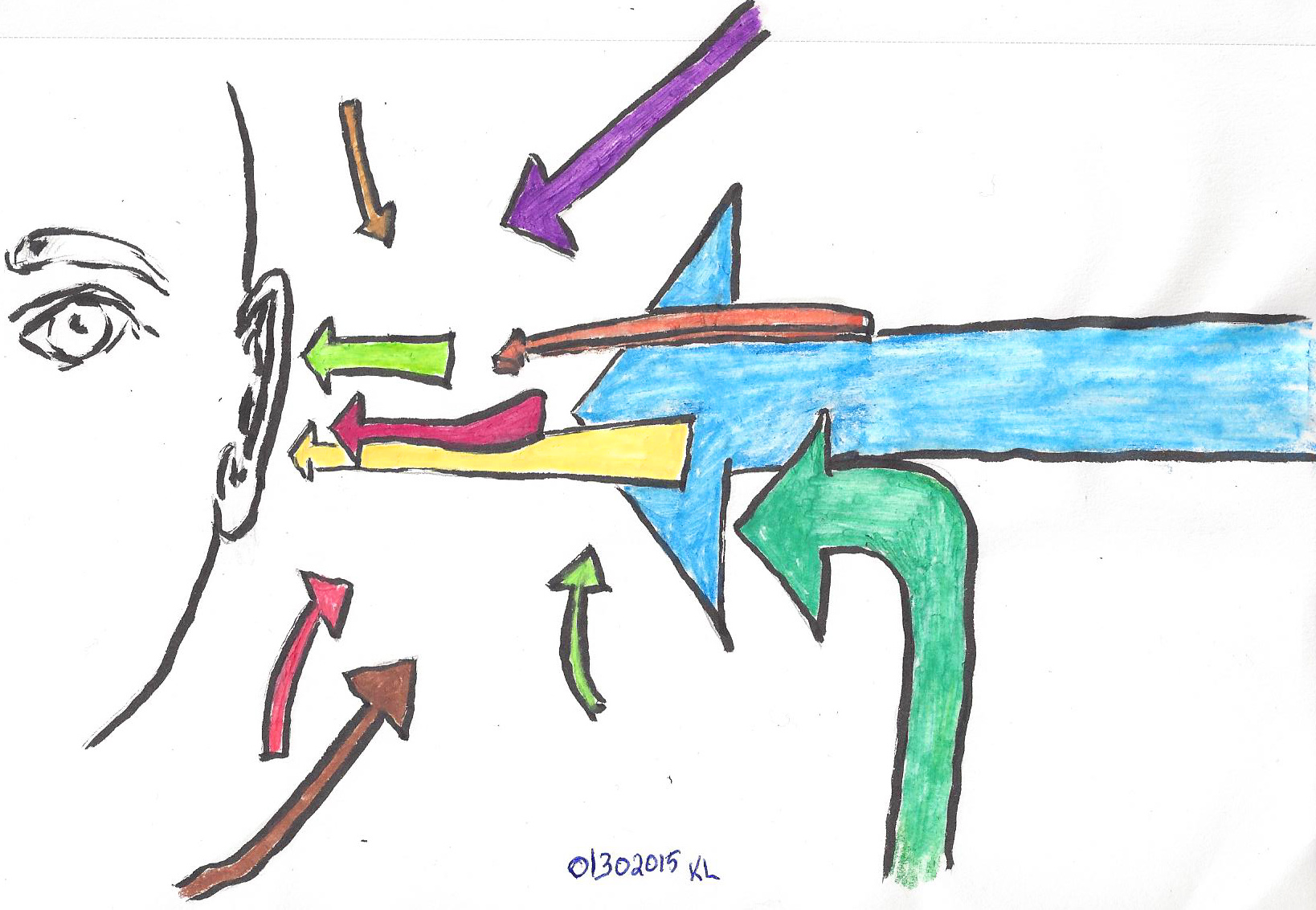
The Truth That Sounded Like a Lie
The truth that sounded like a lie was that I make a bunch of stuff up for my clients. “How so?” wondered the class. It’s like this: the writer’s work is to think forward and then tell the story of how all the parts fit together. Whether writing a white paper, a journal article, an advertising campaign or refreshing a brand, writers do what writers have always done: make stuff up. They grab bits and pieces of facts and directions and fit them into a coherent whole. As they move forward, they gradually replace false with true and so learn as they go.
That is the creative process.
You fill up your head with facts and premonitions and assumptions. Many are true, some are false. But the process itself—and the subsequent reviews reveal what it is true. Writing is very much a process of trying things on for size and then using them or discarding them. And sometimes we used facts “for position only,” as a stand-in for the real, true fact on our way to building the honest, coherent whole.
The Aspirational Lie
We also talked about backgrounds and how one prepares to write. I explained how degrees in philosophy and theology are an asset to business writing. Yes: I was making that up on the spot. But not really, because I have believed that for some time, though had never quite put it in those words. Pulling from disparate backgrounds is a way out of the narrow ruts we find ourselves in. Those divergent backgrounds help to connect the dots in new and occasionally excellent ways. Which is also why we do ourselves a favor when we break from our homogeneous clubs from time to time.
Comedy writers do this all the time. I just finished Mike Sacks excellent Poking a Dead Frog: Conversations with Today’s Top Comedy Writers (NY: Penguin Books, 2014), and was amazed all over again at the widely different life experiences comedy writers bought to their work.
The more I’ve thought about the aspirational lie that philosophy and theology contribute to story-telling, the more convinced I am it is true. That’s because I find myself lining up facts and story bits and characters and timelines according the rhythms and disciplines I was steeped in during school. In philosophy it was the standing back and observing with a disinterested eye. In theology it was the finding and unraveling and rethreading of complicated arguments—plus a “this-is-part-of-a-much-larger-story” component.
Our studies, our reading, our life experience—all these help line up the ways we hear things and the ways we connect the dots. Our best stories are unified and coherent because of this.
###
Dumb Sketch: Kirk Livingston
Here’s the Story of a Man Named Quady
Who was living with three alloys of his own
Yesterday I met Quady* for coffee. I was impressed all over again by the executive function of his brain: how he seems to effortlessly order complicated systems and businesses and talented people and even his own life. Quady** told me how he was weaving consulting with business acumen with creativity. I could not help but be impressed with the forward motion the guy exuded.

…and here’s the dumb sketch you ordered.
In fact, it was about ten years ago I met Quady at (yet) another Dunn Brothers on another side of Minneapolis to talk about how he grew the business he was running at that time. He was president of a firm that placed creative people in creative positions and his firm was on fire (that is, busy). At the time he gave me some solid advice which I resisted for years until embracing it fully: make a daily/weekly habit of reaching out to make contact with varieties of people.
And listen to them.
These days Quady is weaving together a consulting life that draws on his outsized executive function and his creativity plus a desire to walk alongside people. He’s a kind of CEO-for-hire and he’s currently working some high-level gigs. It’s the melding of these three threads that seems to open doors for him: the organizing gene plus the creative gene plus the people-smarts gene. Because he understands the moving parts of business, he can give solid, real-world advice to people. He gives the kind of advice that encourages from some deep place: the sort of advice like,
“Look. You’ve got this. It’s a stretch, but you can do it.”
And who doesn’t want to hear that?
###
Dumb sketch: Kirkistan
*Not his real name.
**His real name was Markothy.
Write Alone And Send To Collect. (Copywriting Tip #11)
Except for Bill Holm

Bill Holm, by Brian Peterson, Star Tribune
The late poet and writer Bill Holm spent his days teaching at Southwest Minnesota State University. In the context of daily teaching, he was too busy to write his own works. But when class finished for the semester, he wrote his poems and stories and memoirs long-hand on the back of the memos he received at school. Interestingly, he was a gregarious soul who often welcomed people into his house but continued to write at the kitchen table even as he engaged in discussions with visitors.
But for many of us, writing is a solitary activity. Oh, sure: ideas pop in conversation. Careful, committed writers take note of the idea on whatever scrap they have handy. And that scrap becomes useful when the writer is, yet again, sitting before blank screen or page.
Unless you are/were Bill Holm, it is the typical writer’s fate to sit alone.
This is not to say writers must be loners or introverts. Those are not necessary conditions, although they do often fit together.
But creating is only one part of writing. Yes, it seems like the biggest part of writing, doesn’t it? Creating and the aura around creating are certainly the most celebrated bits of writing.
But another part of writing is reading. Specifically, getting read. And that requires publishing, in one form or another. At its essence publishing is getting read by someone else. And for all the (quite true) advice about “just sitting down and writing” and “writing = butt-time-in-chair,” it seems to me there is still a missing piece: the reader at the other end of the writing. Written words need to find and land on their audience.

Here is a place where writers might learn something from copywriters. Copywriters have deadlines. They have people who expect copy at a certain time and quite often that copy is delivered verbally—often read aloud by the copywriter to the client.
Something happens when writing is read aloud to an audience. The text itself tends to shape and reshape and the writer hears it differently because of the people listening. The writer cannot help but see things differently when another person is also hearing the copy.
Many will say that some of their best writing happens during revising. I agree. Especially after having read something aloud to someone else and seen their reaction. It can be thrilling. Or depressing.
Butt-in-chair time is essential for writing. But sending your writing out—scary though it might be—is equally essential to hear how the ideas land and to revise with creativity and gusto and possibly increased motivation.
###
Image credit: Kirk Livingston, Brian Peterson/StarTribune
The Talking Part of Writing
Talking Through the Valley of the Shadow of Death
When it comes to brand new, unpaged ideas (that is, not yet written), J.K. Rowling is right:
But at some point every idea needs to make contact with an audience. Writers want their idea fully-formed with beautiful plumage before they exhibit it to anyone (lest someone call my baby ugly). Copywriters know this is not possible when it comes to collaborative writing—writing that serves some mission or purpose for an organization or cause—which needs client eyeballs as a part of the process.
Because Lillian Hellman is also right:
And Nora Roberts is especially right:
There’s the writing. And then there’s the fixing. I often think of the fixing as equally creative as the original writing. Great and wonderful things happen at the fixing/revising stage.
There is a point in every copywriting project where it must be discussed. It must be read aloud. And the key is—especially with new clients—fail faster.
I recently made a category error with a new client and I’m wondering how high a price I’ll pay. Rather than insisting on an early reading and sharing first thoughts when the bar was low, I let my content slide through several holidays until the deadline is an approaching storm and the bar is high for the copy to be right on the first reading.
Which it isn’t: it’s full of questions.
Which is almost always the case with a new client. Especially if the topic has a lot of moving parts.

So lesson learned (again): insist on failing faster and earlier.
###
Image credit: Kirk Livingston
Kotter: Why do leaders fail at transmitting vision?
“a gallon of information…dumped in a river of routine communication”
John Kotter’s Leading Change (Boston: Harvard Business School Press, 1996) does an excellent job explaining the difficulty of vision moving through an organization. A guiding coalition may take hundreds of hours to study a situation and come to conclusions. But as they do this intellectual work, they are also doing the emotional work of “letting go of the status quo, letting go of further options, coming to grips with the sacrifices, coming to trust others….” (88)
This is all part of the process and when that guiding coalition finishes and forms their conclusion they naturally feel their work is done.
Their work is not done.
That’s because nobody outside the coalition has done any of this difficult intellectual and emotional rejiggering. In fact, most will be blindsided because they’ve been hard at the tasks they always do. They don’t have a clue what is coming.
This is typically the point of failure. Someone from the coalition gives a speech or authors an article in the company newsletter. Or maybe a series of three articles. Here’s Kotter, very bluntly:
So a gallon of information is dumped into a river of routine communication, where it is quickly diluted, lost, and forgotten.

John P. Kotter, Leading Change (89)
Compacting and condensing and boiling down the intellectual and emotional journey is essential before anyone else can or will sink their teeth into the vision. But who budgets time or money for that piece of the process?
Those who understand vision needs legs and motivation to run through an organization.
Transmitting vision must be an intentional invitation.
###
Image credit: John Kotter, Leading Change (Boston: Harvard Business School Press, 1996)

 conversation is an engine