Archive for the ‘Audience’ Category
Richard Rohr: “be prepared for much resistance”
Maybe real wisdom first helps others see the path and potential obstacles.
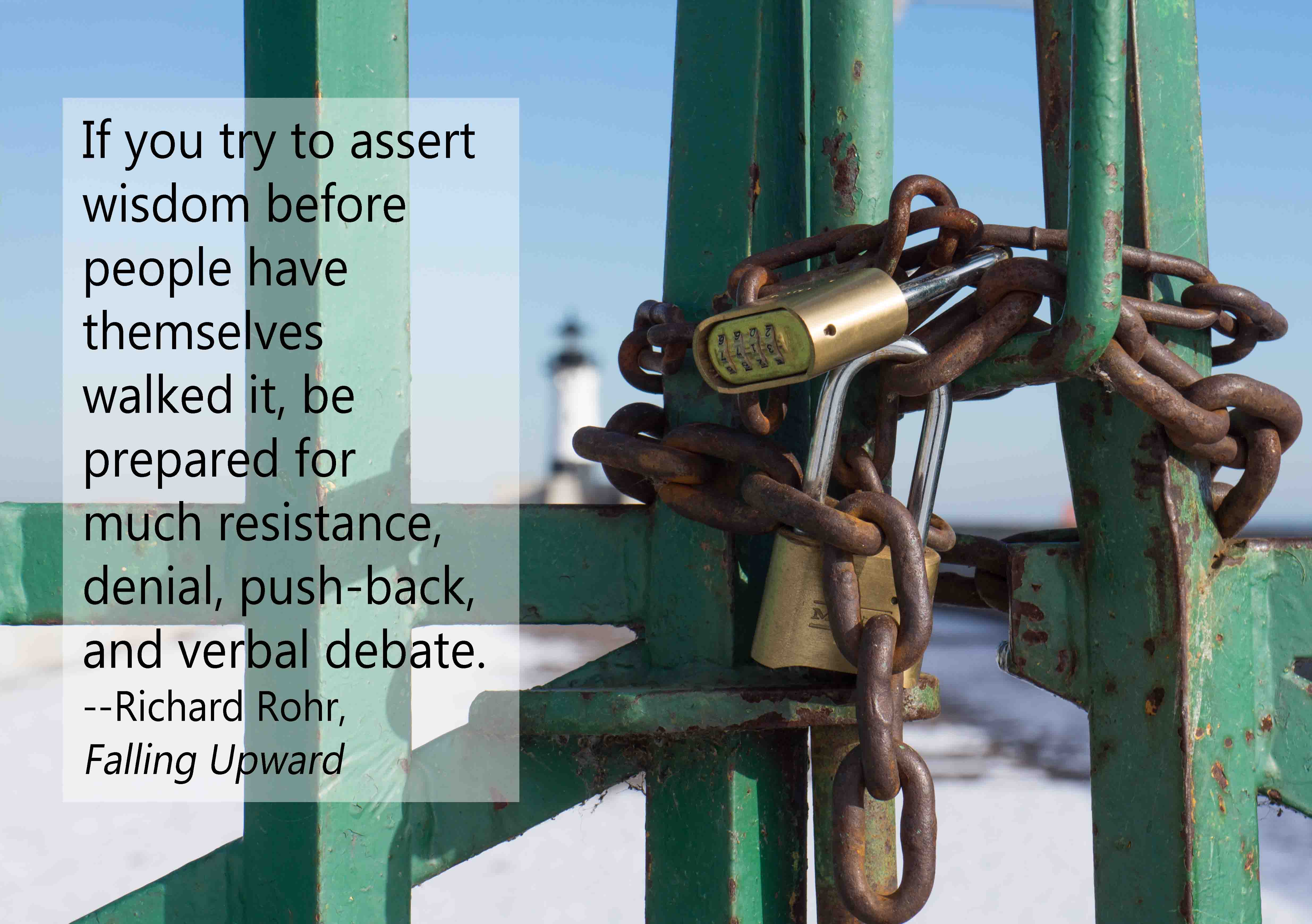
And maybe real wisdom also listens for the additional perspective.
###
Image credit: Kirk Livingston
Tune-up the Voices Talking Inside Your (Corporate) Head
Pitch the preachy. Scrap the sing-song. And definitely lose the lingo.
Sometimes a certain tone will flip a switch for me. And all the person says next is covered in darkness because the tone pointed me elsewhere—so I miss the message entirely:
- The VP standing before the group launches into a sermon and 93% of the audience tunes out before she takes her first breath
- The newsletter from internal communications plays out cheery, one-sided copy that feels as manufactured and questionable as a tuna sandwich from the vending machine
- A poetry recitation where the sing-song voice seems to have come from a different century
- The prayer that sounds like a sermon. The sermon that sounds like a lecture. The lecture that shows no interest in connecting with an eager audience.

Each communication event is an opportunity to pass information, true. But each event is also an opportunity to deepen relationship and build trust—both of which may be more valuable than the information in transit. To squander those communication events on vacuous, preachy or condescending fare seems a waste of time, money and consciousness.
Perhaps certain situations activate your autopilot and you slip into a particular communication mode. The status meeting, the Sunday sermon, talking to an employee. Talking to a child. Maybe we even have a special voice reserved for praying with other people. We may not even realize that we adopt a slow-meter pacing, using parlor words we pull from our big-bag-of-sacred-stuff.
Our autopilot mode can learn from the practice of that old poet-king. That old poet-king had a special voice for prayer too, but it wasn’t from the big-bag-of-sacred-stuff. Instead, it was the voice of desperation, of falling and not being able to get back up, of righteous anger on the dudes who done him wrong. The poet-king’s voice was a real voice, based on real bad stuff that seemed to be happening.
The lesson from the poet-king is this: keep it real.
Employees appreciate hearing what’s really happening, not some vetted-party-line version. Use your real human voice as often as possible. Real voices—the ones that we believe—find a way around buzzwords and corporate lingo.
Real conversation with real voices is the engine moving all of us forward.
###
Image credit: Kirk Livingston
Don’t use that (brand) voice with me
Brand Voice Should Invite Not Forbid
My friend Dimitri* asked leading questions.
They weren’t the impossible questions like “What is the meaning of life?” or “Why five toes? Why not four or seven?” where you could speculate together and combine ignorance.
No, Dimitri’s questions were contrived and assembled to manipulate your emotions and response. In conversation with Dimitri, you knew he was looking for some specific answer. But he would never tell what he wanted. He engineered his question so the one plain answer was what he wanted you to say. Then he could launch into a lengthy response. That game left us weary, frustrated and eventually vetoing most of Dimitri’s questions.
Lots of firms play Dimitri’s game: their communication is guided only by a desire to sell (which is, after all, the point of corporations and not necessarily bad). But when the only conversation a company will entertain is one that leads you to buy their product, that looks more like monologue. People veto those conversations and/or walk away.

No one wants to be reduced to a number on a spreadsheet or a statistic. That’s why the used car salesman with the plaid jacket is a favorite target in our culture. It’s also why manipulative sermons and boring lectures are easily dismissed. Of course, some brands are famously annoying, like the “Save Big Money” voice of Menards and we tune it out—except for when we remember it because we want to save big money.
There is more opportunity today to invite participation instead of hijacking it. And invitation, while harder because it requires thinking about someone else’s need or desire, has the advantage of building relationship.
Monologue and the preachy/lecturey voice have limited shelf-life.
###
*Not his real name. His real name was Smitty.
Image credit: Kirk Livingston
You Gotta Find Ways to Tell Your Story
Don’t dumb down. Don’t be boring.
One client is a thought leader in her particular industry. She writes and presents papers around the world. In doing so she thinks brand new thoughts, adds to her credibility and drums up potential clients for her firm. She is disciplined about two timetables:
- Timetable #1: Industry Papers. She includes time in her schedule to research and write, which allows her to build out topics of interest to her customers. Those topics also interest editors of professional journals, so she maximizes her research and writing time to open up new venues to be heard as an expert.
- Timetable #2: Everyone is a Publisher. My client also understands that she is not just speaking to the industry-folks who crave the details she has synthesized. She is also speaking to a broader group of people—those who have a nominal but urgent interest and may benefit from what she has to say. This second, broader group of people drop their questions into the oracle of Google. My client hopes her investment in social media (her firm’s blog, Twitter, and Instagram accounts) will reach these people. She routinely takes papers she has published and breaks them up into smaller chunks that more easily relate to the rest of life.

We need your annotations.
But this second piece is less about research and more a journalistic/writerly function. This part is more about connecting the dots with the work and life and less about laying bare abstract research findings. She understands this second communication need has nothing to do with dumbing the topic down. In fact, just the opposite she employs her best writing to say things as simply as possible without relying on buzzwords and tribal knowledge.
Marketers of consumer products have long focused on Timetable #2. Academics and specialized industries have long focused on Timetable #1. How long before we all use Timetable #2 as the route to Timetable #1?
Remember: we are the gatekeepers now.
###
Image credit: Kirk Livingston
Moments of Impact: Making Work Conversations [actually] Work
This third kind of work conversation involves divergent thinking
In Moments of Impact: How to design conversations that accelerate change (NY: Simon and Schuster, 2014), Chris Ertel and Lisa Kay Solomon make the case that we need a third kind of conversation at work. Here’s how Solomon and Ertel categorize most work meetings:
- Typical meeting where someone stands at the front blathering on with slides while attendees multitask with Facebook, Twitter and occasionally, actual work.
- Brainstorming meeting where people attend to think brand new thoughts (and to eat donuts). But brainstorming meetings are routinely dismissed today as producing far fewer ideas than if the attendees sat in isolation producing ideas before coming together.
- Strategic Conversations. This is Ertel and Solomon’s new kind of conversation. Rather than engaging in the typical presentation/multi-tasking meeting, they want attendees to deeply and viscerally engage in a compelling question.

Mindful like a hungry hawk.
Moments of Impact is all about how to make this third kind of conversation happen. The book develops five points to help make strategic conversation an experience versus another bout of human downloadment:
- Declare objectives/define the purpose

- Identify participants/engage multiple perspectives
- Assemble content/frame the issues
- Find a venue/set the scene
- Set the agenda/make it an experience
Nothing earth-shattering so far, right?
And yet, as it is so often, our connections provide the earth-shattering stuff, rather than any consultant’s formula. Where we connect—with 100% attention—that’s where the magic happens. In connection there something mystical that lies beyond engineering technique and management principles. Moments of Impact is about setting the stage for that connection.
One thing is becoming clearer very day: when we employ mindfulness rather than pursuing mindlessness, we find ourselves deeply engaged rather than seeking more distractions.
Mindfulness in the service of creating an experience also seems to honor humans as human (versus as corporately-owned human capital to be rejiggered at will).
That old attitude may have worked for an assembly line (doubtful), but for our volatile, uncertain, complex and ambiguous world, we need the best each of us can bring.
###
Image credit: Kirk Livingston
If a Customer Shouts in the Forest and No Customer Service Rep is Around to Hear it…
Should she post a comment on Yelp?
Nancy Beiersdorf of Medtronic’s e-Commerce and global strategy hinted (in this SAP talk) at the medical device company’s evolution from a product company to a solutions and service company. One important ingredient in this new recipe will be hearing from the people with problems (people in need of a solution) and helping them solve those problems (that is, service).
But hearing from customers is not easy—even for other customers.
If you’ve ever used Yelp to locate a restaurant while traveling through a new city, you know to toss 30-50% of the comments as someone having (a) evil intent or (b) a bad day. Even our favorite national parks suffer from poor Yelp reviews:
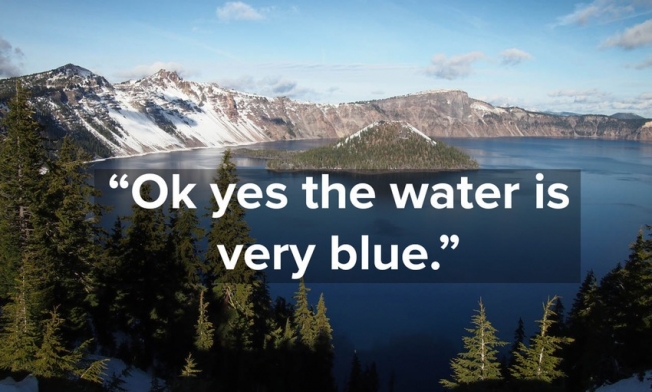
Sorting fact from fiction has been a traditional problem with hearing from the customer. Customer service must wade through long, rabbit-trail narratives to finally get to the actionable item. That is the way of human conversation—sometimes it takes a while to get to the point. All this unquantifiable blather plays havoc with our quality systems. Surely customer service will soon chart a metric like “Time to actionable issue” and pay employees accordingly.
Hearing from customers is an inherently messy business. Especially for Medtronic: where reps once talked only with cardiologists and electrophysiologists now there will be all sorts of real people on the phone (or more likely, placing orders and comments on a web site).
All this conversation cannot help but change things upstream and downstream. In particular I expect at least two results:
- Increasing masses of consumer-to-company interactions will train consumers over time to use certain words and press certain buttons to get what they want. Much in the same way we are conditioned by repetition to bypass our bank’s introductions to get to a real human.
- Corporations may grow more sensitivity toward customer voices–the very thing Ms. Beiersdorf advocates. By that I mean conversations have a way of working backward into the machine-gears of a corporation. As solutions and service show up more clearly on the P&L sheets, people will start to pay more attention to human interaction.
At least that is what I hope.
Let there be more advocates for the customer voice.
###
Image credit via Adfreak
Clothe Your Team with Inspiring Briefs
Creatives are natural problem-solvers. Start them with a tantalizing puzzle to solve.
In stark contrast to the meeting where the boss wanted creatives morphed into analysts, Adrian Goldthorpe (Lothar Böhm London) has such faith in the creative process he thinks creatives are proper problem solvers. All they need is the right question, which turns out to be a really good puzzle to solve.

One Artist’s Solution: 262 Studios, St. Paul Art Crawl
The creative brief (as you know) provides a quick take on a new assignment. All too often the brief is prepared and presented as a sleepy, non-essential document. But for copywriters and art directors, that brief can and should be a vital link to starting with the right focus.
Goldthorpe laments the mindless filling of briefs and checking of boxes, which is how many creative projects begin. Instead, at a meeting in Moscow earlier this year, he recommended short, informative briefs that facilitate (versus block) creative solutions. The brief should succinctly answer five questions:
- What should the creative do?
- What do we want to achieve?
- Who is the audience?
- What is the brand proposition and how is that supported?
- What is the tone of the voice?
Of course there is more to say in a brief and we all experiment with different ways to communicate this information. But I like Goldthorpe’s succinct, concrete statement of the problem. It is enough information to provide a frame to begin the creative process.
Naturally the creative process is not just for “creatives” at an ad agency. Presenting our problem or opportunity for others to consider and collaborate with is something authors deal with, and parents and professors and bosses. And coworkers.
It behooves any of us to consider how we succinctly introduce a topic to others, especially if we want help.
###
Via POPSOP
Image credit: Kirk Livingston
A Tale of Two Meetings
Collaboration in person and on paper
Meeting #1: The entire department was gathered at tables shaped into a horseshoe, to facilitate discussion. Twenty to thirty of us waiting for the director to come in and explain his vision. And his vision was that the creatives needed to become analysts. Art directors, designers, copywriters, production personnel—everyone an analyst. Everyone focused on metrics. Give away the creative to outside agencies.
The director talked for 30 minutes and then asked for questions.
Not a single question.
Meeting #2: The entire group was gathered at tables shaped into a horseshoe, to facilitate discussion. Twenty to thirty of us waiting for a series of speakers to come in and explain their vision. Speaker after speaker explained their vision, the metrics they used to decode that vision, and the outcomes they experienced.
Each of the seven speakers spoke for a few minutes and then paused and waited for responses. Then they spoke again and waited. The entire group learned quickly that each speaker truly sought interaction.
Every pause elicited questions. Tangents were followed despite time constraints. After all, the point was the responses.

In my social media marketing class we spend time talking about how to get interaction and comments from the communities we are building. At first it is discouraging for the students, their work feels like shouting treasured thoughts into a hillbilly hollering convention. Nearly impossible to be heard.
But gradually a few people show up at each student’s attempts. And we learned to treat comments from these few with great care: responding immediately. Thanking those who show up for reading. Engaging the thoughts of the people who showed up. Then the students learned to go visit others building similar communities and listen and comment. And soon they found their community growing (in the social world, people follow back those who show up). And they learned not just to put questions at the end of diatribe but to design pauses in the middle of their thoughts so people could respond. And they learned to break up a lecture into a series of engaging posts. And they learned to let their thoughts be shaped by what the people who showed up said.
Those two meetings had key differences: In Meeting #1 each audience member reported to the director so there was very little debate. Debate in that particular firm seemed not too far from mutiny. But in Meeting #2 (same company, oddly enough), the audience was composed of potential customers. And as each speaker spoke, they did their best work with verbal and body language to engage the audience. And each of the potential customers spoke freely, calling “BS” when they heard it, disagreeing vocally, undaunted by executive titles.
Our verbal collaborations point to our literate collaborations. Pauses in copy, short copy, even shorter copy, copy that talks about what people are interested in—all of these allow collaboration. But the key is how you think about the audience: do you really want their response? People are not stupid: they know when someone is lecturing. And lecturing is a sure-fire way to shut down collaboration.
###
Image credit: Kirk Livingston
Why Medical Device Twitter Feeds are Boring
It’s because monologue can be enforced. Dialogue cannot.
Twitter is all about the quick, personality-laden human voice. Twitter carries truncated thoughts by design—more like a human talk—one thought at a time.
Official medical device Twitter feeds are boring because the communicators behind those feeds are trussed and bound by legal and regulatory protocols. The feeds are boring because competing lawyers have police scanner-like attention for claims that fall outside of the FDA-vetted matrix. And those feeds are also boring because many of us are not in chronic pain, or worried about going through airport security with a defibrillator or insulin pump or mechanical heart valve. If we were, we might get those medical device tweets instantly on our smartphones and find them very interesting indeed.
I’m glad those tweets are boring. I hope they continue to bore many of us because we don’t need the product.
How could medical device tweets be more interesting? Clearly the human voice must be involved. When Omar Ishrak tweets (@MedtronicCEO), the tweets are at times more personal, like when his daughter runs a marathon:
But generally medical device tweets lack the sound of the human voice. They tend to sound like monologue-rich press releases:
https://twitter.com/MDT_Cardiac/status/518422795077042177
Some companies don’t even try:

Ok: SJM does tweet over here: https://twitter.com/SJM_Media
Granted, medical device firms will never sass it up like DiGiorno pizza
But surely as we move forward into deepening inter-connections between professionals and regular humans, every company must find a way to sound human or risk not being heard.
Maybe that means special release from the legal/regulatory straightjackets for certain chatty employee/storytellers. Let them tell their stories in ways that are unique to them while continually repeating “My Opinion Only.” Can medical device firms institute official unofficial-storytellers? People who claim nothing but that they work at the place and this is what they see?
That might result in fun tweets that gather an audience and endear a company to a larger public.
The era of siloed communication is fading quickly in the rear-view mirror.
###
How to Make Your Message Permanent
A tip from a prehistoric consultant
First: Forget about it. Nothing is permanent—at least not in the way advertising mavens augur.
Second: OK—if you insist—make your message about someone else. Make your message give back more than it takes in. “GE” branded on a rock would never last. Even the Apple logo will be chiseled away by Microsoft rebels. But a man with jointed wings, well, who can resist that story?
![Who can resist the story about the “Thunder Being”?]](https://conversationisanengine.space/wp-content/uploads/2014/10/birdman-2-10022014.jpg)
Who can resist the story about the “Thunder Being”?
Prehistoric peoples stopped by these ancient rocks to tell their version of the human condition. So they carved/picked/incised/abraded their messages into the exposed Sioux quartzite outside Comfrey, Minnesota long before there was a Comfrey or a Minnesota or a U.S. of A. Maybe before the pyramids and Stonehenge. Ancients left messages here to direct and entertain passers-by.
Why make your message permanent? We understand marketing communications for companies—it’s about keeping the wheels of commerce turning. But you personally—what messages do you have to communicate? And why would you make them permanent? I argue that your take on the human condition comes out in the way you do your work, the way you interact with family, friends, colleagues, and even the way you see/refuse to see the homeless guy at the end of the exit ramp. And all these daily interactions amount to a carving and incising that is far more permanent than any of us imagine.

The Jeffers Petroglyphs tell a story that became a destination.
Our conversations have an enormous (cumulative) effect on the people around us. An effect that may move through generations.
What exactly is your message, anyway?
###
Image credit: Kirk Livingston

 conversation is an engine