Archive for the ‘Brand Promise’ Category
Stuffing Spinach and How Engagement Takes a Lifetime
Not page hits or likes, though comments get closer to true engagement

Anybody who has tried to communicate a message knows it takes time, effort and budget. Or if not budget, patience and persistence. But budget helps.
Our writers know this. Louise Erdrich in a recent talk at Concordia University about her National Book Award-winning “The Roundhouse” talked about how she incorporated themes that were important to her in a way that would still be read by readers:
“As a writer, I want to get this message across. But I’ll only do it if it is a suspense novel. I wanted to make a book that you could not put down.”
“And then I would stuff in the jurisdictional legal issues like spinach in a sandwich.”
Spinach stuffed in so you hardly realize it’s there. To get her message across, she had to write a story so compelling that a reader would willingly read on.
Today we talk constantly about apps and software and sites and techniques that allow a brand to engage with consumers. Paul Dunay writing for Forbes wonders if engagement advertising is the future of brand advertising. He thinks we are approaching a fundamental shift in brands talking with, not just at consumers. Dunay named innovative companies already pursuing dialogue over monologue using mobile platforms. Of course, we’ve been thinking about dialogue over monologue for quite a few years, but just now we’re starting to see technology that enables monologue with more ease and simplicity.
But it’s more than technology, of course. It is a firm’s willingness to listen. Listening is on the uptick. Listening is the new thing (which is so absurd it makes me laugh). It’s new because companies realize they left money on the table by constant monologue.
But getting people to care about the stuff you think is important: it’s the writer’s problem. It’s the brand’s problem. Both want to engage to such an extent that one actually takes action. Erdrich wants her readers to do something. Dunay wants to make it easier for all of us to buy the stuff we are thinking of right now.
I argue engagement takes a lifetime.
No brand manager wants to hear this, but writers in it for the long haul know this instinctively. They know they have to write to engage and inform, but engagement comes first. Teachers know this as well. Brands and their managers have yet to learn this. That’s because most engagement strategies still put the brand first, not what’s best for the consumer (though consumer need and desire rank high in engagement messaging). Those brands that have begun to succeed are learning to well, shut up and stuff the spinach inside.
###
Image credit: Street art by Nuxuno Xan via 2headedsnake

How to Close Your Believability Gap
Is Your Message Mind-Ready?
- North Korea threatens to turn Washington and Seoul each into a “sea of flames” with “lighter and smaller nukes.”
- Dennis Rodman says Kim Jong Un is a “great guy.”
Sometimes our words create a believability gap. You can see the believability gap between words spoken and the possible results. You can also see the believability gap between the words spoken and the credibility of the speaker. The two bulleted statements above both suffer results- and credibility-deficits, so we don’t believe.
Personally and corporately, we know that we have to speak and communicate in ways that build credibility. That usually means not over-promising. And it means delivering on the few promises we do make. Most of us understand this, even if we don’t always practice it perfectly.
Closing the believability gap involves looking inside (again, personally and corporately) to identify those skills, motivations and insights that can support the results we want our friends, clients and customers to know us for. Sometimes that look inside shows us we’ve been emphasizing the wrong things to the wrong people. It takes courage to step away from a wrong-headed direction, especially when that wrong-way seems to work, for the moment.
Making our messages mind-ready means making sure we have the skills, values, motivations, insights and practices to carry out what we say. Mind-ready messages are credible and result-oriented. People see through bluff and bluster.
But that doesn’t mean we should take threats from North Korea lightly. I guess we’re back to pouring food into their corrupt system again. And Rodman? Let’s make sure he always negotiates when traveling with the Harlem Globetrotters.
###
Image credit: Ali Gulec (Turkey) via 2headedsnake
The Case for Believability
Is Deeper than You’d Think—Especially for Those Outside Your Tribe

We believe words in context
I try to help clients understand the limits of their messaging. After we get past the glory of the features (many would stop there and pronounce their marketing “Done!”), we get to benefits. That’s a good place to hang because we are facing outward: how this product/service will help their customer accomplish X. For my medical device clients, after getting beyond the glory of the features, our conversation turns to the benefit promises that can ring true and still be within the legal and regulatory parameters, and still be within what the journal articles support. And still make emotional sense to their intended customer.
Beyond benefits and features, a message is believable because it comes from a much deeper place of fit and truth. A message becomes believable when it suddenly snaps in place with the other factors we already know. The best copywriting does this: it offers words (really ideas) that help place the benefit message into a frame that suddenly makes all sorts of sense.
That snap is why we believe anything. Words “ring true” when we see how they fit our context, where we live. So when we want someone to believe us, we find ourselves building out the context so they can see how and why this idea fits. This is time-consuming when you are talking with someone from outside your tribe, because they don’t see things the way you see them. They have not been inculcated in your doctrine of how we see things around here.
I guess that’s why it’s easier to mostly hide in my tribe.
###
Image credit: Christopher David White via 2headedsnake
Living On One—100 Pennies Per Person Per Day
How can I personally understand poverty and wealth?
 There is a fetching honesty to Living On One, the film from four documentarians out of the Claremont Colleges. These economics and film majors—all graduates within the year—set out to ask what it might look like to live on a dollar a day. “Living on a dollar a day” is one of those generalized statistics used to illustrate how a staggering number of people on our planet (over 1.2 billion?) live with so little.
The four friends set up shop (that is, a squalid camp) for a summer in a rural village in Guatemala and proceeded to shed pounds and acquire bug bites and diseases as they submitted to the economic rigor of making a life on the equivalent of 100 pennies per person per day.
Watching these friends sort out what to eat and how to eat it and how to cook it (firewood was a major draw on their 100 pennies) was a lesson in itself—especially when they realized that 1200 calories per person per day would not sustain them. They stepped over some invisible line the moment they bought their first bit of lard to cook in their daily ration of beans and rice—simply to get enough calories to keep lethargy partly at bay. They grew radishes, lusted after fresh fruit and longed for a chicken to nurture and then eat. The stories of the people who came to their aid and with whom they formed friendships are without question the most touching part of the film. All in all it’s an entertaining and affecting first-person account of trying to sort out the demands of poverty and wealth.
The honesty came in letting go of any pretense of actually being poor. They knew—and we the audience knew—they were choosing a particular limit. For a limited time. Resources were a phone call away, of course. But the thought experiment of trying to come to grips with a hand-to-mouth existence was compelling and begat practical lessons. The result was a kind of pragmatic knowledge that a textbook can never supply. I applaud their courage.
The Living On One bus stopped in Minneapolis a couple days ago. They played the film and took questions at the Bell Museum on the U of M campus, before a robust group of students and others. As they filmmakers took the stage I could see they were once again healthy people but also deeply affected by their experiment.
Their parting shot to the audience was to “Do something. Anything.” This final word was also an intrinsically honest call to action. The four friends had partnered with different micro-finance and poverty-fighting organizations, so they could and did recommend places to give cash toward the problem. But the big take-away was the struggle to personally understand this immense inequality.
That is a challenge that will stick with me.
###
Memo To My People Updating My Facebook Page
How about a few less quotes from old dead white guys?
 Post-election, let’s have a little less constitution-driven stuff. I need to sound hip and with-it (You kids still say that?). Sprinkle a few Malcolm X quotes in there (Yes?) and maybe—I don’t know— Nietzsche (why not?). Our business partners and potential clients need to see we’re deep and edgy. But trustworthy—so, ok—maybe a few quotes from Jefferson, but way less than three a week.
Jenny: Put the business books and blogs down: Covey and Collins are sounding stale. Give me more of that pithy stuff like Seth G. puts out. In fact—give Godin’s people a call and tap into that well they are pulling from. I want to sound more like Godin. And Spike Lee.
Jerrold: Give me more comments on human interest stuff. I need to sound warm and supportive. Potential clients need to see the entire organization as approachable—so that starts with me. And do the same with Ivan in the St. Petersburg office. He needs to sound a lot less like Putin, that grandstanding old propagandist. Ivan needs to sound like New Russia—starting now.
Jamison: you gotta tune my Twitter feed. Post-election, work with Jenny on the Godin and Spike Lee stuff—get me solid tweets that pull in about a thousand more young managers. Skew young!
All of you—people tell me I should read beyond history books. Make me current! Wired. Salon. The New Yorker (within reason). Whatever.
Jenny–What’s that? Godin writes his own stuff? Which of his people said that?
###
Image credit: Sammy Slabbinck via 2headedsnake
Texts as Tools for Sorting What Matters to Your Firm
Your words make me so mad—and that’s good

words can wake us to the believable center of our purpose
I spend my days poring over texts. Reading internal notes and documents. Rereading interviews and meeting notes. Writing questions, asking those questions and writing the answers. And sometimes rereading the answers. Then I start making texts: mind-maps and cartoons and diagrams for starters. Then the short (or sometimes long) text that will go back to my client—ordered arguments and assertions. Emotive elements. Narrative. Jokes and anecdotes—whatever it takes to communicate the essence of what I take as my client’s central point.
And then I send it to them.
And they react.
Reactions vary from “you are right except for this point” to “that’s fine” (the worst possible reaction, it means my copy was so bland it stirred exactly nothing) to “you nailed what we’ve not been able to say” (my favorite reaction) to “We are deeply offended by this.” That last is my second favorite reaction—it means I got under their skin, though not in a good way.
And then we trim the right copy as a text for the target audience.
What’s remarkable is how the process of sorting through all the internal dialogue and the organization’s unexamined thought actually helps in finding the believable center of the organization’s identity. It’s got to be believable because if you can’t imagine an employee saying it with a straight face, you’ve not hit it. It’s got to believable or the promise won’t match reality—and that never gains traction with the target publics.
But the words themselves—right there on the page—can stir such a reaction from the client that they can sometimes catch a quick vision of what they aren’t. Or what they are. And that glimpse carries forward to what a team does next. And that glimpse can fold backwards into how an organization thinks about and treats itself.
That’s why copywriting is fun.
###
Image via 2headedsnake
Endo Brochure Silent on Vital Bits—2 Skills for Tonight’s Debate
Read the White Space. Hear the Silence.
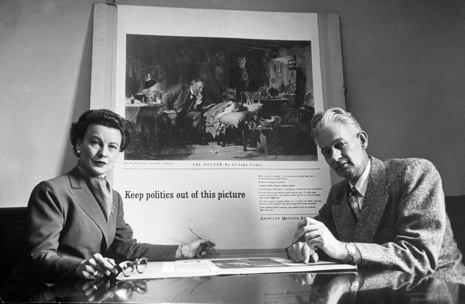
Campaigns, Inc.: My Antiheroes.
MedCity News reports on an Endo Pharmaceuticals brochure under scrutiny by the FDA. The problem was a lack of transparency about the dark side of the therapy—a therapy designed to slow the growth of prostate cancer cells, namely:
- paralysis that may result from the risk of spinal cord compression
- the increased risk of diabetes/heart attack/sudden cardiac death/stroke
In a lively debate in comments section of the Pharmalot blog, the consensus seems to be that the FDA made a good call. Commenters began by speculating this was likely more than just a slight oversight as the Endo communicator skipped regulatory/legal review in a rush to meet a deadline. Then commenters started tracing the language to the Vantas Implant website and began speculating on the rest of their messaging and promotional literature.
The debate amuses me because it is the rare product brochure that is read outside of a sales presentation. And it is even rarer for a brochure to withstand extended exegesis. That the FDA does this regularly earns my respect/awe/fear. Love them or hate them, the FDA’s dogged attention helps medical copywriters and marketers hew to the high road.
The debate also serves as a reminder of the skills needed for watching tonight’s presidential debate. It’s the white space and silence that may be most eloquent. The skill of reading the white space and hearing the silence means the audience must be equipped with the fuller argument. The FDA certainly was. But to read Jill Lepore’s recent New Yorker essay (“The Lie Factory: How politics became a business,” Sept. 24, 2012) is to come away with all the history and reasons as to why the American populace remains a happily uninformed audience. Whitaker and Baxter of Campaigns, Inc. helped set the stage for the current state of our spectatorship:
In tonight’s debate, I’m trying to break free of my usual indolence to hear between the lines (as it were).
###
Image credit: The New Yorker
I Believe Your Story. God Have Mercy if it Proves False.
Sucker turns scrapper when story unravels

Duped is Dangerous
The woman shouting optimistic, full sentences from the top of the dune (that story here) highlighted my own willingness to be entrapped by a story. Although I have much of the cynic/skeptic in me, my basic approach to communication is to believe what is in front of me. This bit of openness (or blindness, as the case may be) allows me to enjoy stupid movies. Example: I watched and even finished Fast Five the other day. Fast Five is nothing but a string of car chases. In Rio. That’s it. I guess there was gunplay and corrupt officials and a few pretty girls. But the cars steal the show and the vault (I’ve said too much).
The movie never really asked me to believe it. From the beginning it was just a string of car chases.
Mrs. Kirkistan costumes theater productions. We often talk about what happens to actors the first time they put on their costume: they inhabit the clothing in a very visible way. The actor in costume becomes the character before your eyes. You believe, partly because the actor now believes all the more.
In the same way, we also talk about what happens when the costumes in a staged production are wrong. It’s not just that the production looks bad; it’s that the believability is sucked from the room and the play turns sour. The ill-fitting or badly adapted costume shouts, “This is a fiction.” Of course, the audience knew this already, but they had suspended disbelief. Until now.
And when the story unravels and proves false, you feel duped.
Duped is Dangerous
No one wants to be sold something. No one wants to be taken advantage of. And when we find we have been sold a bill of goods (as the cliché goes), our cynical/skeptical knob gets turned a notch or two. Sometimes we even become enemies. This is true for advertising. This is true for the company line the CEO utters from the podium. It is true for the pastor’s manipulative reading of a text from the pulpit. It is true for the talkative salesperson at the AT&T store. People turn when duped: loyal employees, devoted congregants, potential customers—each has the capacity to become the opposite when the truth is revealed.
Keeping things believable is tough work and a big challenge all the way through a communication event. Maybe that is why evangelizing for something you don’t fully believe is so hard if not impossible.
###
Image Credit: assorted schmidt via thisisnthappiness
Two Inane Commercials. One Purposefully So.
“Perfect place to build a town” defies believability
The folks at Casual Films tell the story behind making one of the dumbest commercials I’ve seen in a long time. In their work for Dassault Systemes, the filming is cinematic, the visual effects are stunning, the soundtrack and entire setup is urgent and important. But in the short form of the clip, when the supposed explorer speaks, the bottom drops out of the story. Her words—and her delivery from the top of the dune—flip the believability switch that says: this is utter fiction.
If we could supply fresh water this really would be the perfect location for the new town.
Her words send me to this set of questions: Really? You’ll build a town in the desert? And you think people will come because you have fresh water? Have you really studied what it takes to build a planned town—has it ever worked? Who wants to live in such a place? And then I start thinking about colonialism and all the unsustainable projects my country has initiated over the years.
Maybe Dassault Systemes really is going to do this and icebergs in the desert really will supply nomadic tribes for years to come. I hope they are changing the world. But the actor’s long sentence yelled across the desert—heard perfectly despite the distance and the howling wind—made everything suddenly seem like a middle school play. In fact there are a couple other points where the supposed conversation sounds like a PR flack talking to schoolchildren.
Wexley School for Girls: Take Me to Copper Mountain Now
Compare what Casual Films did with what Seattle’s Wexley School for Girls did for Copper Mountain. They hammered the silly button with no pretense at believability and completely own my attention. I don’t even ski, but I want to go a place with this sense of humor.
See a fuller set the Wexley commercials here.
By the way, I find the Dassault Systemes tagline pretty compelling:
If we ask the right questions, we can change the world.
###
Via Adfreak

 conversation is an engine