Archive for the ‘Collaborate’ Category
Rob Moses & the People of Calgary
“Have you ever ridden a horse?”
If you’ve had the pleasure of going to Calgary you’ll know it is truly a western city. Situated not far from Banff and Jasper National Parks, it is also quite spectacular. And rich, fueled by oil and gas money flowing into the city.
Rob Moses is a photographer based in Calgary. I follow his blog because of the extraordinary portraits he takes of complete strangers. His method is to approach someone, have a conversation, and shoot the photo. The endearing thing about this process is the conversation he has. He records it verbatim —or so it seems. His written text includes nervous laughter, indecision, and ricocheting answers. His recorded conversations sound like real conversations to my ear.

Stopping complete strangers is not easy in the best of situations. Asking to take their picture sounds like a scam, but Mr. Moses pulls it off with what seems to be a fair bit of joy. And he always asks if his subject has ridden a horse—critical information for Calgarians, evidently.
The optimism of sharing his talent with photography is not lost on me here. It’s kind of an amazing way to self-promote and, well, bless people. And for those lucky enough to find their way into his lens, they come away with a phenomenal view of themselves. Scroll through his blog and be amazed at the composition, lighting and the ease written on the faces of his subjects. If you’ve ever asked to take someone’s photo, you know it typically ends badly. Unless you are Rob Moses.
May there be more of his talented tribe.
###
Image Credit: Rob Moses
How Buzzwords Prey on the Unsuspecting (DGtC#24)
Speak up to reclaim your humanity
They’re there. Circling overhead in the hallways between C-suites.
They move in a dense cloud between boardrooms and conference rooms.
They are those words of the moment that seem scalpel-sharp. But when you stop to define them, meaning vanishes. These are the words Dilbert makes fun of most every day.
That is the way of buzzwords and lingo of the moment. Whether you are a business or a church (wait—what’s the difference?) or a university or a think tank: you have a set of words insiders use to show they are insiders. And especially in our early meetings with new clients or the new VP, we trot out these words to show we really, frankly, know our stuff.
The problem with buzzwords is how easily they come to mind. Just like any cliché, buzzwords pop to mind free of conscious thought. And to your conversation partner those words give the appearance of a genuine thoughtful reaction. But any SEO specialist will tell you that tossing a buzzword into a headline ups your clicks. Same with conversations: say the thing you heard the CEO say and, presto, you are in the club.
Do buzzwords make you less human? No. They just make you sound robotic.

Please point us back toward connection
Frequent talks with clients move toward “dumbing-down” versus “simplifying.” Those are not equivalent concepts. Dumbing-down takes out gradation and difference and nuance to present a black-and-white version of something. Simplifying hints at gradation and difference and nuance to make a piece of the complex easier to grasp. Mark Twain simplified complex stuff and generations talked about it.
Dumbing-down does not respect the audience. Simplifying recognizes that smart people are smart in different disciplines. And smart people can understand all sorts of stuff.
Buzzwords are a kind of dumbing-down that takes concepts off the table by hinting that we all know this so it is beyond discussion. Because of buzzwords many useful conversations never happen.
What if we consciously worked toward vulnerability in our business interactions? It’s scary, this notion of revealing you have no clue what the boss just said, but could she explain it again using words like other humans use?
Be the thorn in the side today, the vulnerable fool who insists on clarity.
It’s a way of ordering the chaos of your workplace.
###
Image credit: Kirk Livingston
I’ve Already Forgotten Your Main Course
Savory sides stay in memory
Your big-name plenary speaker is the draw to your conference—certainly. But will she deliver the memorable moments your participants will take away and actually use?
Probably not.
What’s more likely is that the interactions your attendees have with new acquaintances from neighboring departments/cities/industries will leave a more durable impression. These are the folks that swap stories and shop talk and contacts. Street-level talk makes an impression that is actionable because the stories relate to our everyday experience.
A very smart client did this very thing recently. My client invited rising industry stars to be part of a conversation round-table. My client scheduled their executives to speak—but not to dominate with sermons and monologues. Instead—and this is the bit of genius I most appreciated—the executive talks were conversation-starters. And these executives actively shared their authority out. That is, they invited participation during their allotted time.

Do your thoughts invite listeners in?
And, most amazing, they paused to wait for responses.
Responses came. Too many responses which all took too much time. Time slots overran. But that was the whole point: the conversation. And true to form, sparks of insight came as the rising industry stars reacted. I left with pages of notes from the conversations and I’m certain the participants left with brand new knowledge lodged in their brain pans. That new knowledge came not because the speakers’ messages were so good, but because the participants actively connected those messages with others and their own experiences.

May it ever be so with all professors and pastors and executives and professional pulpiteers: let them stay open for the conversation to follow.
###
Image credit: Kirk Livingston
Edward Bernays and Jolly Manipulation
Gather round, kids: here’s how you sway public opinion
Edward L. Bernays is called the father of public relations and his book Propaganda (NY: Horace Liveright, 1928) shows why. Bernays is absolutely jolly as he lays out the psychology of manipulation. He doesn’t just talk about the formulas, he gleefully demonstrates them in paragraph after paragraph. Much like one might describe building a shelter to a group of boy scouts, Bernays is positively beaming as he writes about how to pull self-interest into the equation to get publics to do your corporate bidding.
The modern propagandist studies systematically and objectively the material with which his is working in the spirit of a laboratory. (48)
Edward L. Bernays is the ur–flack.
If you can influence the leaders, either with or without their conscious cooperation, you automatically influence the group which they sway. (49)
Reading Propaganda today, it is clear Bernays thought corporations and government leaders and those in power would certainly use his manipulation techniques for good.
How could it be otherwise?

Look through here. You’ll see what you’re supposed to see.
But World War II was just around the corner and every nation developed their own propaganda machines. In the US, we still react viscerally to the imagery and code words used by Nazis. Today old Stalinist imagery has it’s own unique draw. The US had powerful PR apparatus as well. We continue to feed that machine. And since, then, of course, unending sets of military skirmishes/wars, each equipped with God-given reasons for why we must respond. Then Watergate and totalitarian despots revealed and deposed, and, well, it’s a long list of fails that contribute to today’s cynicism and “Question Authority” stance. People found their voice and collected it to push back with outrage at corporations and governments and to call attention to wrong doing when it appears.
Eighty-six years later, the entire population of the US—possibly the planet—is wise to Bernays’ techniques. Not that we’ve studied them: those techniques study us all day every day. Especially in countries like the US where consumption is our patriotic duty. We know manipulation from the inside out.
Bernays would be impressed were he alive to see it. I imagine him smacking his head and saying, “Wait—they know they are being manipulated, and …they still buy it? This is even better than I hoped.”
Why talk about manipulation? Not just because Bernays book is fun to read and easy to contrast with today. In particular, why would a copywriter talk about manipulation? Isn’t that secret sauce you trade in all day? Why pull back the curtain?
As a copywriter my goal is to tell my client’s story in the best possible light. I continue to argue that persuasion is a natural piece of how people interact with each other all day long. It’s part of the human condition. But I argue our efforts at manipulation damage actual conversation. When we use words and techniques with manipulative technique, we shut off further conversation. At that point it is about winning not connecting. Maybe there is a fine line between persuasion and manipulation. Propaganda is the textbook for manipulation.
As a copywriter, I want my clients to engage in conversations not endless manipulative monologues. That seems a more human approach to communication. I continue to think conversation is what today’s market will bear.
###
Image credit: Kirk Livingston
Letters to Father Jacob
And when your life work is revealed as futile:
Stacks of letters arrive daily at blind Father Jacob’s house. People ask for help and he prays for them. Sometimes he does more. Father Jacob’s previous reader is now in a nursing home. So he hired the convicted murderer who was recently pardoned: Leila. But these readings, followed by Father Jacob’s out loud prayers, feel particularly pointless to Leila.
And they start to feel pointless to Father Jacob as well.
And quite possibly Father Jacob is slipping into dementia.
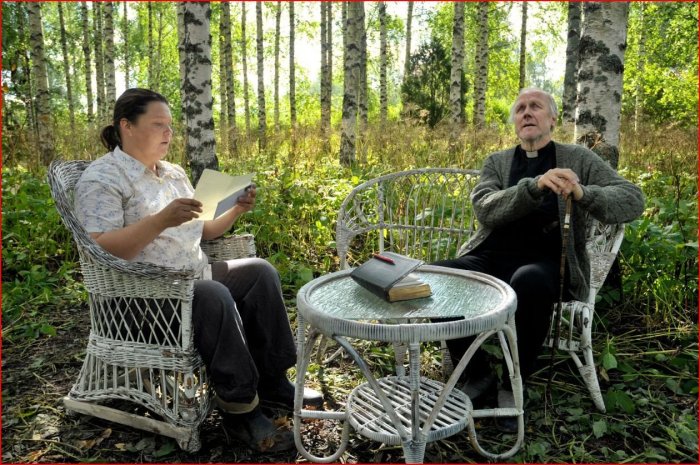
This 2009 Finnish film, which is beautifully photographed, has the pace you might expect of a hermit or ascetic. Not exactly slow, but each frame full of meaning. The film asks about the result of our life work. Where did that passion lead and what was the result?
Our literature of success in the United States hints that passion + patience + perseverance lead directly to success. But real life is more full of falling forward and marching backward: ups and downs that depress and invigorate. Despair swings by. Elation makes an appearance.
Letters to Father Jacob is more like real life than our success literature. And the conversations between Leila and Father Jacob reveal far more than mere words let on.
The storytelling in this film will stay with you long after the 74 minutes it takes to watch it. That is because after joy turns to sorrow you begin to see the real story threaded already in your brain.
It’s masterful stuff.
Letters to Father Jacob left me hopeful.
###
Image credit: IMDB
“Viral” is Fool’s Gold
People often have legs and feet. So do collaborative ideas.
Years ago we noticed the threshold to globalization falling to the point where anyone could step over it. Back then advertisers talked about music or images that could transcend language with television and radio. And it was true: cloak your message with a mainstream song and off your product flew to sell among lands and languages previously unknown.

Today we routinely interact with people across the globe. Tweets and Tumblrs and blog posts and comments can and do come from anywhere at any time (because it’s always 17:01 somewhere). It’s mostly asynchronous. But not always—my WordPress friend in Hong Kong responds to my morning posts (his evening) and I respond to his evening posts (my morning) and it feels like real time.
Marketers and advertisers want to promise a viral result from the work they do for clients. But the bar for viral gets higher every day: interweb participants stand amazed at less and less.
More realistic: go back to the old way of focus on the important people. In this we make sure our message can be carried in a style to which our target audience is accustomed. Making sure our messages are sticky for the primary and secondary audiences we care most about is better than shooting for viral. And the first step toward sticky ideas is to simplify (not the same as dumbing-down) so the idea is quickly grasped and possibly even elegantly presented.

This simplifying process is a natural result of collaboration. Just explaining an idea in the course of a normal conversation is a step away from Teflon toward sticky. That simple act of saying it aloud helps you realize what works and what doesn’t: it’s all written in the face of the person you are explaining it to.
Start with a simple collaborative conversation to begin to move toward sticky.
###
Image credit: Kirk Livingston
Your Office Needs More “Yes, and…” Men and Women
How to Grow Collaborators 1-2-3
- Share your first thoughts as if they were dumb sketches.
- Wait for—look for—and welcome reactions.
- Then say “Yes, and ….”
- Rinse & repeat.

Clear a space for your team.
You model commitment to collaboration by sharing your first thoughts. This dumb sketch approach to life makes you vulnerable and open to criticism. And there will be criticism. But vulnerability + time creates serious ballast around the notion of getting full engagement from all those around.
Your “Yes, and…” is the other shoe that drops to indicate you are also taking your colleagues seriously. It doesn’t matter whether your colleagues are bosses or employees, “Yes, and…” works up and down the corporate food chain. “Yes, and…” is your go-to reaction to ideas. People will gradually come to understand you think the world needs more ideas with legs and feet, ideas that accomplish stuff.
As kids we taunted each other with how sticks and stones break bones but words, well…you know. But it turns out words have a more complicated existence. In many respects, words have far more power than we ever guessed. And in this growing of collaborators, our words can make stuff happen out in the world (a “speech-act,” one might say). It only takes one committed collaborant (I think I just made up a word or re-purposed a French word) to begin to clear a safe space for collaboration. That space will invite collaborators, who become a nucleus to change a team, a group, an organization—and more.
How will you encourage collaboration today?
###
Image credit: Kirk Livingston
Do your best ideas come in two stages?
Maybe that’s where collaboration fits: between.
A story: In second grade we all had to talk about what we did over the summer. I wrote a story that included lots of driving to far-away parts of the U.S. I wrote about camping and swimming and mountains and lakes and trees.
When finished, I read it to myself and thought, “This is boring.”
So I went back at it and remembered mishaps along the way. Flat tires and people falling into lakes and instances of poor judgment from my brothers. Especially instances of poor judgment from my brothers. Then I started inserting instances of poor judgment all over the story and it got very, very interesting.
When I gave my speech to my second grade class, the instances of poor judgment got the biggest laughs.

Share that raw thought with a clear-eyed friend.
Today I write stuff for a living, so I think in terms of drafts: There’s the rough draft, with all its heartache, hollering and hoopla just to wrestle a topic onto my screen. There’s the review with a stakeholder/client/colleague. Then there is the excellent revision. The goal is the excellent revision. But few people can begin with the good stuff that came out of the revision.
But you need not write stuff to realize that first ideas can often be improved by a clear-eyed, objective second glance. And often that clear-eyed glance, especially from someone hearing it for the first time, can tell you a lot about where the idea needs to go next. What your reviewer sees or doesn’t see, what causes them to pause, what causes them to guffaw, what causes them to restate or reread—all this is grist for the revision. And revisions are potent parts of the process.
With my clients I am very up front about wanting them to review a draft on the way to the final. And that is how I present it—I’ll write this thing and then you’ll look at it and give me your scathing criticism. And together we’ll move toward what we wanted all along. And the final will be that much better.
That’s what collaboration looks like to me: at least a two-stage process.
###
Image credit: Kirk Livingston
We Landed a Medtech Account—Now What? 3 Understandings
Bollixed and castrated and then we begin
Advertising agencies and marketing firms are eager to land medical device accounts. These prestigious accounts are much desired and would seem to enlarge the status of an agency because of the exacting, rigorous work that helps the human condition. It doesn’t hurt that they seem to pay on time. But having worked with a number of ad agencies once they land such an account, there are a few common threads that surprise principals and employees:

- You’ll need experts: people who know how to work within a regulatory framework (“Claim this.” “Never claim that.”). People who know the words that soothe lawyers while still making sense to humans. And especially people who know their sinus node rhythm from their rhythm method. You will stay on message and every claim must be neatly tied to an article from a respected (first or second-tier) journal.
- Your creatives are (already) wringing their hands. That’s because creative solutions lie on the other side of a legal/regulatory/corporate culture grinder.
- Yes: the company has come to you for creative solutions.
- No: they cannot/will not back-off their own internal legal/regulatory controls. Their own internal machinery will bind and castrate many of those solutions you have used in the past. What a great beginning point!
- There will be rounds of changes. Many rounds. Way more than you are used to. Far more than you can reasonably put in your bid. They will seem…unmanageable. Taming revisions will take your best customer service manners and may take you deep into the internal relationship structure of the firm. But that is exactly the kind of partnering that is needed
If your agency can come to grips with these three understandings without imploding or driving sane people mad, you’ll begin to build a reservoir of expertise.
###
Image credit: Kirk Livingston
Year Without Pants: What’s Your Conversation Prompt?
Must Hierarchy Always Trump Collaboration?
In the excellent Year Without Pants (San Francisco: Jossey-Bass, 2013), Scott Berkun detailed his efforts to direct a team of programmers working for Automattic/Wordpress. This team was distributed around the world and gathered only occasionally. Most of their collaboration was mediated through computer screens and telephone lines. Curiously, email was not a major player. Instead, in-house blogs contained most of the collaborative communication (~75%), along with IRC (Internet Relay Chat), Skype and then e-mail (~1%). Blogs had the advantage of being entirely public (to the other players) and displaying the entire conversation. So potential collaborators could get up to speed as needed by simply reading/re-reading what had been said. And others could ignore the whole thing (which is the way of blogs).

Does your conversation prompt work?
Berkun found the prompt at the top of the collaborative blog was largely ignored—so common it was invisible (much like Twitter’s “What’s happening?”). It started with,
What’s on your mind?
and then
How can Team Social help you?
migrating eventually to:
Hi Scott: Do you know where your pants are?
That changing prompt became a way to wake up the conversation. It also demonstrated the playful nature of the team—a key factor in all Automattic/Wordpress collaborations. The prompt also turned into a good book title.
Berkun’s conversation prompt gives me hope that hierarchy need not trump collaboration. In my most collaborative projects, there was always a sense of fun/playful/silly/ridiculous that settled like a bubble over team meetings. In contrast, my more onerous jobs and projects carried a sense of duty and chain-gang attention to a boss hammering out a beat.
Creating that collaborative environment requires a light touch, a willingness to explore liminal spaces, record results and allow others access to the longer conversation. Creating collaboration also involves attention to conversation that results in replies, rather than monologue that begets numb pseudo-attention.
###
Image credit: Kirk Livingston

 conversation is an engine