Archive for the ‘Collaborate’ Category
Guns & God & GOP: Why Listen Beyond What I Know? (Dummy’s Guide to Conversation #20)
Why listen to a different viewpoint?
Q: I’m a passionate guy. I have strong beliefs and I know what’s true about the world. And yet coworkers and neighbors blather on with their ill-founded stupidities. Why won’t they listen to reason?

A: I’m glad you ask because we all fall into this state from time to time—often without realizing it. What stands as a clear and obvious reason to me looks like wishy-washy BS to you. And your clearly developed opinion looks like ideology-driven, fact-picking to me.
One guy in the Bible talked about an opportune time for everything: birth and death, crying and laughing, speaking and shutting your pie hole. Maybe there is a time to shout your opinion and maybe there is a time to listen to what someone else has to say.
We do a lot of shouting in this country.
What if we experimented with listening?
If there were a time for listening, it would happen in a conversation where we truly wanted to hear what someone else wanted to say. Perhaps we’re talking with someone we respect a great deal. Maybe we’ve purposefully sought out a friend with a different opinion—just to try to hear it clearly.
What if we listened intently to the pieces of reason and fragments of story our friend uses use to tell her side of things? What if we intentionally entered a conversation with the purpose of listening rather than doing battle or proving our point? We all know that the purpose we bring to a conversation has a big bearing on the outcome. We’ll get a fight if we want one. We may get an interesting eye-opener if we listen properly.
Note how different that intention is from the half-listening we typically do while we form our rebuttal. We’re all guilty of preparing a torrent of words to combat the wrong-headed notions spewing from our worthy debate opponent.
But what if it was not a debate we wanted? What if, after listening we tried to summarize what our conversation partner said to see if we could get it right? And only then, after hearing and summarizing, we formed a response. And what if we didn’t reach for the phrases we heard on TV or trot out the canned responses our club’s magazine produced? What if we stayed in the moment—with this friend—and voiced our disagreement even as we continued to listen?
Here’s what can happen: You and I can remain passionately eloquent about what we believe. But we also can say with certainty what our friend believes-though we disagree.
That kind of talk can feed your passion, feed a relationship as well as make for an interesting and engaging few moments of human connection.
That’s why we listen to a different viewpoint.
###
Image credit: Kirk Livingston
Words Make Stuff Happen
What must you say today to move forward?
And who do you need to hear from?

###
Image credit: Kirk Livingston
Today I’m Listening
What can you hear between the lines—and where will it take you?
I’ll start by listening to a set of phone conversations my medical device client fields constantly. I want to hear the questions. I want to hear the responses. But I especially want to hear the tone of the questions. I’m listening for urgency and for actual language used. I’ll write down the words and note the flow and capture quotes. These notes and my listening will guide the communication that takes place next.

Listening goes places.
I’ll spend the balance of the day listening between the lines for another client. But this time I’ll be listening to the text I am creating for them. And I’ll listen to the process they use to serve their customers. Listening and revising and re-jiggering and re-listening.
Listening is required to know where to go next
What—or who—are you listening to today?
###
Image credit: Kirk Livingston
Brian McLaren’s Poke at Orthodoxy
Our blindness is one thing the emergent church may have right
Syncretism is the melding of different philosophies or religions or schools of thought. The term (“syncretism”) becomes a pejorative that casts some practice in a negative light. My Christian missionary friends will talk about, say, Hindus who have converted to Christianity. And they’ll notice that some of the Hindu practices have found their way into the expression of Christianity—maybe harmless. Maybe not.
Once upon a time fundamentalist preachers would decry drums as a pagan beat that has no place stirring up emotion in a church service (somehow they missed the use of percussion instruments in Old Testament singing—and dancing).
Are those examples of syncretism? Possibly. I doubt there is a black and white standard about such things—there’s no on/off switch for what’s right and what’s wrong. More likely there is a continuum. And at some point along that continuum we decide (that is, someone claiming authority arbitrarily decides based on their understanding) this other person has crossed the line. The convert has gone too far and now that person has mixed the gospel with paganism.
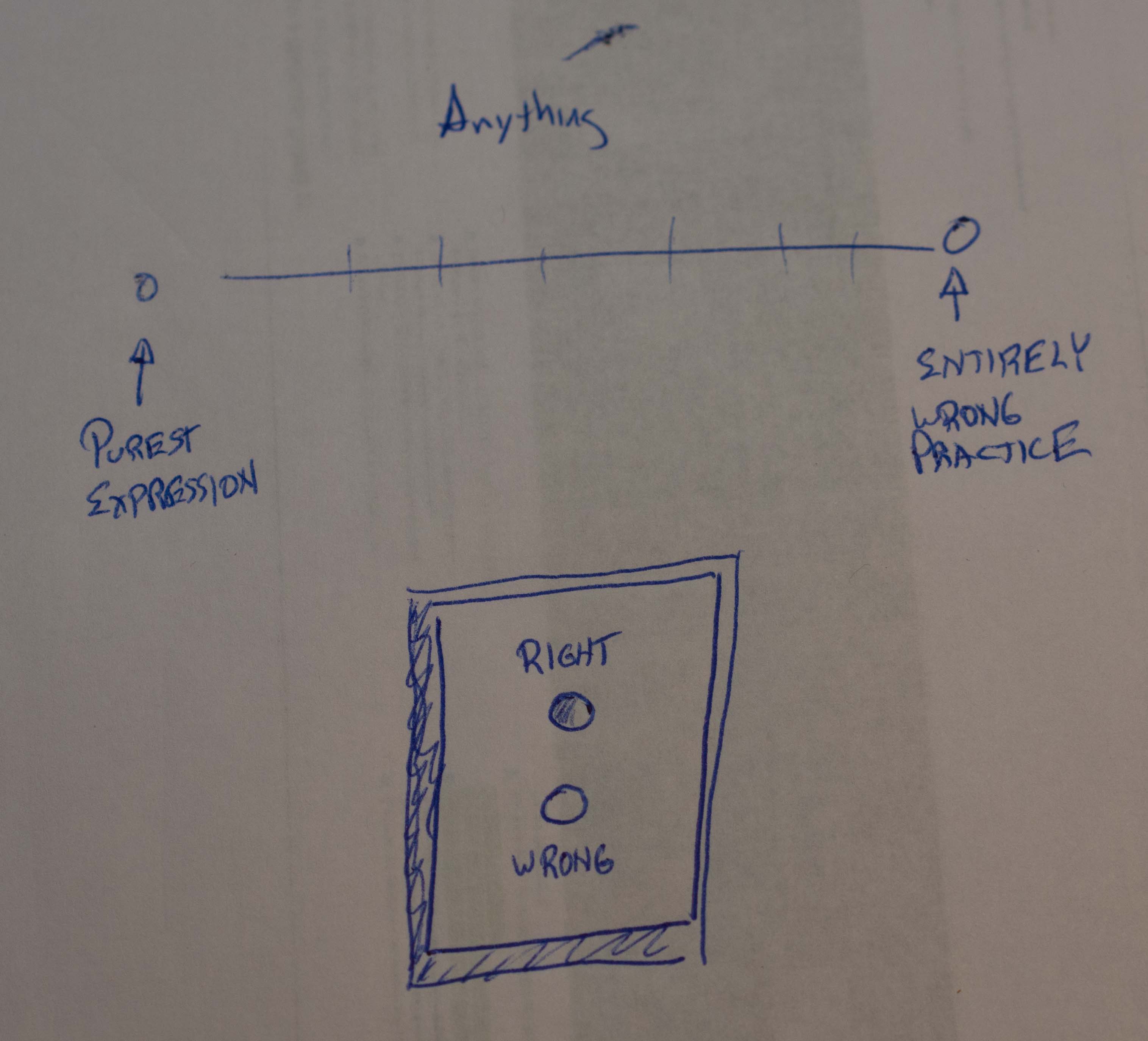
You’re doing it wrong?
Brian McLaren might say: “Not so fast.”
McLaren’s A New Kind of Christianity: Ten Questions That Are Transforming the Faith points out that modern reflections of Christianity (even/especially modern evangelicalism) may themselves owe a lot to this syncretistic impulse. In A New Kind of Christianity, McLaren argued that the reading of the Jewish Bible (the Old Testament) and the New Testament have been overtaken by platonic thinking. He describes a six-step formula that many Christians immersed in the Bible would subscribe to—and then he goes on to point out that formula owes much more to Plato than it does to the Torah. Some argue that McLaren’s is a naïve reading of Plato, which may be accurate: whenever we reduce this to that, we lose nuance and insert our own biases.
McLaren’s notion that we are at cross-purposes with the Bible when we read it as a constitutional law document rather than diligently seeking out (and sticking to) the purposes for which the documents were written also rings true for me. I’ve been on the giving and receiving end of too many interpretations that conveniently keep the people in power in power. But McLaren’s notion has lots of layers that require extensive teasing out and discussion.
Brian McLaren is a lightning rod. People love him. People hate him. It’s not hard to see why, when he accuses the entire ecclesiology industry of syncretism.
I like McLaren’s book because it is a beginning of trying to strip away our syncretistic impulses. Especially those impulses we are so embedded in that we can’t see them, sort of like the fish who doesn’t understand the concept of water. Sure—McLaren’s book has flaws. It turns reductionistic every so often. It makes huge leaps. Yes.
And yet we need real help to see where we have inserted our own thinking into a holy document and called it God’s word. Because this happens over and over again. And I think God doesn’t dig that tendency on our part. I would guess he would prefer the attitude behind, “I am blind. I would like to see.”
McLaren points out some of our blindness.
###
Image Credit: Kirk Livingston
Think “Plant” Not “Preach” (Dummy’s Guide to Conversation #18)
Monologue is dead. Long live dialogue.
You’ll be much more effective if you give up telling people what to do and instead invite them into an idea.

It’s more work on your part, of course.
Inviting your conversation partner into an idea has the advantage of letting the notion grow in their native cerebral soil versus boxing them about the ears and head with your command.
Planting seeds can also change the shape of your internal discourse. And that can become a fresh, personal beginning point.
Check out the other 17 tips from the Dummy’s Guide to Conversation.
###
Image Credit: Kirk Livingston
Love: A Working Definition
Congratulations Paul and Lindsey!
Isaac: Have you sorted out the meaning of love?
Paul: I can tell you I have a working definition.

###
Image Credit: Kirk Livingston
Try “Yes, and…” Today
Let there be a Science of Deep Collaboration
When I hand out a group project in my writing class I hear audible groans.
It’s because we’re trained to work at things on our own—that’s how scholarship and schoolwork and academics have worked for a long time. The groans come from all the extra work of communicating and all the expectations around not knowing if others in the group will keep their end of the group-work bargain. The groans come from the anxieties that hover around roles and responsibilities and knowing you’ll have to sell your ideas.
I am eager for new and deeper research into collaboration. Let’s call it a Science of Collaboration. Maybe it is a social science. People like Keith Sawyer and Edgar Schein are moving this science forward—along with many others. I am fond of the work Patricia Ryan Madson has done around Improv, which seems the perfect gateway for anyone to learn the fun of collaboration. And Keith Johnstone seems to have spawned many thinkers along these lines.
 I’d like for this science to do (at least) two things:
- Invite people in who have been working alone for forever. But gently, and independent of the introvert/extrovert divide. I want the invitation to show the fun of the process. I want that invitation to promise more aha moments and then to quickly deliver on that promise.
- Show next steps to working together. What can an ad hoc team do to quickly get grounded enough to toss ideas that build on each other? There are techniques out there, certainly, but I’d like this to be second nature, part of our emotional intelligence, something we come to expect. Something we’ve grown up with.
“Yes, and…” seems a perfect place to start. This is the old improv notion of building directly on what the last person just said. And quickly, without lots of deliberation. It requires a certain fearlessness.
What if “Yes, and…” was built into our educational DNA from grade school up?
###
Image credit: Kirk Livingston
Ratcheting Expectations in World that Demands Viral
Again: what does success look like for my project?
Do you have outsized notions of what is important?
Of course you do.
We all do, because we assume (wrongly) that what is important to me is important to everyone. Turns out that is not the case. For all the videos or stories or songs that go viral, there are countless that arrive stillborn—at least as far as numbers go.

What shadow will your project cast?
It’s easy enough to see that not everyone shares our passions and drives. Not everyone is fascinated by Star Wars or Wes Anderson films, for instance. Not everyone longs to spend hours tinkering with their lawn, or building perfect pectorals or diagramming the stars in the night sky. Not everyone asks “Why?” Not everyone asks “How can I do that myself?”
So if we are looking for our idea to go viral, we had better negotiate together what we consider viral. Will my idea get 3 million views? 3000? 30? And which am I satisfied with? What can we be satisfied with? That’s worth talking about before a project goes out the door.
I’m reminded of that bit of faith that writing will find its audience. As we prepare to launch our idea, and as we talk about who is open to hearing/acting on the idea, some frank talk about what success looks like will help immensely. Realistic expectations at the beginning of the project will help set the stage for the eventual self-scourgings or pats on the back, in a week or month or year, when you see how the project did or did not do.
And for the artist or writer—just doing the work may be enough.
And maybe that is not a bad place to dwell.
###
Image credit: Kirk Livingston
Please Read Dave Eggers: The Circle
In a world where everyone sees everything…
If you’ve ever wondered where complete transparency might lead—as I have—consider reading Dave Eggers’ excellent novel The Circle.

Don’t worry–no one’s watching.
Mr. Eggers has created a very comfortable world (for some) of deep collaboration, where everything is provided to those lucky enough to work for the Circle. The Circle, the corporation at the center of the story, looks more than a bit like our most celebrated high-tech companies brimming with smarts, cash and outsized ambition. Think Google or Apple or what Microsoft once was—and then add in a cast of characters each with an overweening and boundary-less high EQ—and you’ve got a world that is totally supportive—as long as you move in the same direction. The novel traces the story of Mae Holland as she “zings” (tweets) and “smiles” (likes) her way from outsider to the inner circle.
The story gets uncomfortable at times, especially when it shows the intent behind the use of social media and the social pressures applied. Especially when you start to recognize product placement on a very, very personal level.
Mr. Eggers has me rethinking my eagerness for employees up and down the corporate ladder to use their outside voice. I’ve been advocating, among my clients and when teaching Social Media Marketing, that helping employees reveal their work to interested outsiders is a move toward a new kind of marketing that looks less like selling and more like a conversation among interested parties. I still think that is a good move, but Mr. Eggers has explored the boundaries of that notion, and it is a bit, well, totalitarian.
I will consider using The Circle as a supplemental text for my next class on Social Media marketing. Well-written and consistently engaging, Mr. Eggers’ book is well worth your time.
###
Image Credit: Kirk Livingston, just before a recitation of photography rules within a non-public space
Can we finally reject being defined as “Consumers?”
How about “citizens” or “persons”? Maybe not “fleshists.”
Must everything in U.S. life be about ingesting?
Eating. Watching TV. Shopping. Listening to music. Watching movies. Amassing tablets and apps that allow us to consume more and faster and on-the-go. Talking about what we are eating/watching/buying. These are our pastimes. These are the things that define us. None are bad, many are necessary, but should they be at or near the core of our essence?
Is this why we landed on the planet?
I like all these things as much as anyone, if not more. But I wonder if my rush to consume has blinded me to other definition-inducing activities? Consuming is good for brand managers because they can play on this emotive, definitional piece of life and squeeze money from our attempts to be a certain kind of person. We buy this car or those dungarees or those shoes (or watch that show) because of certain aspirational desires. If we own that property, then we become that person. Yes?
In Cognitive Surplus, Clay Shirky makes the cogent point that watching TV is very like a full-time job for many of us. It consumes our hours outside of work like nothing else. I understand why: many of us are so busy at work, spending so many hours, stressed about so much that all we can muster—all we can look forward to—are those blessed, mind-numbing moments on the couch before the screen.
I’m right there. That’s me, too.
Shirky’s book goes on to point out example after example of people banding together in groups small and very, very large to accomplish things that would not otherwise exist. Wikipedia comes to mind, along with open-source software. As social media allows us to connect, I wonder if our collaborative selves will beckon us from the couch more and more often. It’s not some new magic of social media I’m talking about, it’s the very old and known quantity of human connection. Relationship stuff has always motivated our species.
But we’ll need to step away from constant movement and blessed numbness to get back to seeing ourselves as co-creators and collaborators. Relationship-builders rather than consumers.
###
Image credit: Kirk Livingston

 conversation is an engine