Archive for the ‘Collaborate’ Category
Repeat, I say, Repeat Others’ Words
Weird Kid’s Trick that Boomerangs (Boomerangs!) in Your Own Brain
Someone told me about Lifehacker not long ago and I’ve been trying all sorts of the suggestions that flow through their stream of articles. But Melanie Pinola’s recent article “Make Better Conversations by Repeating the Other Person’s Words” caught my attention both for what she wrote and how the Lifehacker community responded:
If you want to be great at making and continuing conversations, you have to be a good listener. Barking Up the Wrong Tree’s Eric Barker points out one way to do active listening that hostage negotiators use to build rapport: repeat the last few words your companion said.
She goes on to give a very few specifics about repeating the last two or three words–it is enough to make you think about your own conversations. But the commentary that pops up after the article is almost as compelling as the article itself, with different folks chiming in by parroting the last two or three words. It’s actually not that easy to differentiate true interest from sarcastic banter. It’s all sorta hilarious.
Of course, kids learn repeating words early as a way to drive parents and siblings to the hard edge of sanity. I did it. My kids did it to me. But the surprise is that repeating others words—when not done with ill will or as a bit of customer service trickery, is quite cyclical: what you say again and again finds its way back into your own brain.
I have a client meeting today and I know that at some point I will repeat what my client says. Aloud. It almost always happens. It’s a basic part of understanding—it lets the other person know I am listening and it also gives me a chance to try on the words/concepts my client offers, to see if they make sense coming from someone else’s mouth.
We need more active listening in this world—but less repeating as a parlor trick.
###
Image credit: crazytales562 via Lifehacker
Thad Starner: Multiplex Don’t Multitask
What Personal Protocols Do You Observe?

Long before Google Glass, there was Mr. Thad Starner and his wearable computer. Clive Thompson in Smarter Than You Think tells the story of how Mr. Starner, a Georgia Institute of Technology professor and eventual developer of Google Glass, put the computer together himself and devised a discreet keyboard he could hold and use without drawing attention. Mr. Starner’s computer did not visually record all that was happening around him (making this less likely), but it did give him the ability to quickly query any question before him and take notes on his conversations.
Mr. Starner has been making notes on conversations for upward of two decades. Through experience Mr. Starner found that he needed to “obeys strict social protocols” around his wearable computer:
He uses it his wearable only to look up information that augments a conversation he’s having. If he’s talking with someone about the Boston Red Sox, he might pull up statistics to sprinkle in, but he’s not secretly perusing cute-cat videos. (p.142)
And he definitely did not check email while in conversation with people. That would be bad. Really bad. Anyone with a smartphone should know: bad form to check your email with in conversation with the human before you.
Mr. Thompson’s point in Smarter Than Your Think had to do with “transactive memory,” how sometimes we offshore our knowledge to a reference book or Google—or to other people. We come to depend on the knowledge of a professor or spouse or friend because we know they will indeed hold on to that information. And they’ll release it so us if we ask. So we need not try to remember it. Transactive memory is a pretty big deal when thinking about learning communities and organizations. Transactive memory is helped by free and open dialogue. Transactive memory is short-circuited by members of an organization who hold a knowledge-is-power ethic.
I like how Mr. Starner’s ethic developed over time: as he witnessed how his own computer searches took him offline from humanity. I also like how he reframed his searching to look like multiplexing rather than multitasking. Still: one person’s multiplex may well look just like multitasking.
###
Image credit: lacedartillery via 2headedsnake/generic–eric)
50 Years Later We’re Masters of Industry
Look how far we’ve come
 50 years ago, give or take, Herbert Marcuse and others struggled to understand where industrial society was taking us. He and others saw dark overtones in corporate goals and increasing standardization.
Would industrialization harness men and women? Or would it be the other way around?
Could it be the other way around?
“The industrial society which makes technology and science its own is organized for the ever-more-effective domination of man and nature, for the ever-more-effective utilization of its resources. It becomes irrational when the success of these efforts opens new dimensions of human realization.”
Herbert Marcuse, One-Dimensional Man: Studies in the Ideology of Advanced Industrial Society, (Boston: Beacon Press, 1964)
Social media is one place where technology has seemed to thwart efforts at ever-more-effective domination. Collaboration is increasingly common, and with collaboration, more instances of human realization. So the humans won, right?
Wait. The story’s not done.
###
Image Credit: Kirk Livingston
Tell Me What You Know. Wait: Mime It Instead.
Nancy Dixon & Is there a best way to transfer knowledge?
Lecture is not effective.
As one who has lectured and been lectured unto, I’ll insist that listening is hard work when seated before a droning human. Sermons are the same species. Occasionally sermons are more spirited than lectures but both have roughly the same effect. Maybe there is a continuum for lecturing: previous generations felt ripped-off if the person in front did not speak at length and without interruption. For the generations I teach, 15 minutes is the absolute maximum before reengaging with questions or activities or just standing and moving chairs around the room.

Working alongside someone is amazingly effective at transferring knowledge. To have a common task with a colleague or mentor bypasses much of the resistance and passivity that comes with the classroom “listen-to-me-I’m-the-expert” experience. The focus is on the doing and learning takes care of itself.
Nancy Dixon in her Common Knowledge: How Companies Thrive by Sharing What They Know (Harvard Business School Press, 2000), breaks the transfer of knowledge into manageable buckets as she shows how organizations do the work of helping teams and individuals learn. She starts by making a distinction between tacit knowledge and explicit knowledge: tacit knowledge is what we just sort of know. It’s the multiple bits of knowledge that would be difficult/impossible to write down. Explicit knowledge is written: it’s explicit in the sense that someone could pick it up, read it and know. Dixon cites five ways teams have successfully transferred what they know:
- Serial Transfer: team does a task and then does the same task again in a different location/venue. The team collects and discusses what they learned between, so each time they do the task a bit more efficiently.
- Near Transfer: Transferring knowledge from a source team to a receiving team doing a similar (routine) task.
- Far Transfer: Transferring tacit knowledge from a source team to a receiving team doing a non-routine task.
- Strategic Transfer: Knowledge transferred impacts an entire organization rather than just a team. Maybe that knowledge comes from the entire organization.
- Expert Transfer: Team facing problem beyond scope of its knowledge reaches out to an expert or expert team.
 I like how Dixon positions the expert as a sort of higher-order transfer: where the audience is engaged and invested and eager for the solution. I also like Dixon’s discussion of knowledge as both dynamic (knowledge is less of a warehouse and more of a river) and also becoming more of a group phenomenon.
Working alongside learners and experts is a great benefit of day-to-day work, though we don’t always appreciate it.
###
Image credit: exploitastic via 2headedsnake
70 Sheets. 700 Signals.
My $1.25 Grist Mill
For years I’ve kept notes on conversations with clients.
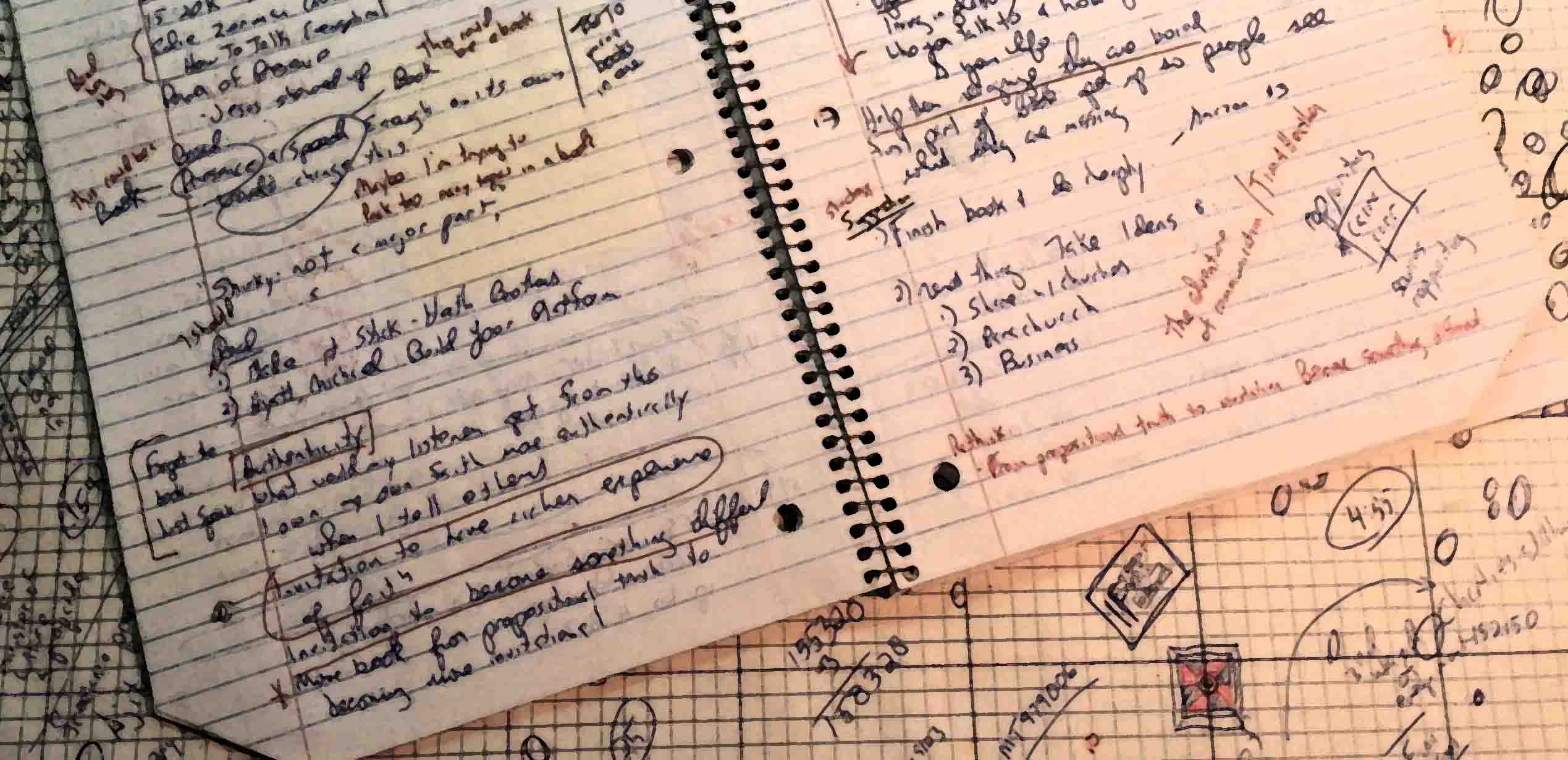
Anyone in business (or anyone in the business of getting something done) knows the value of accurate notes from a conversation. These quick jottings record promises made, delivery dates, special circumstances and conditions.
As a copywriter, I’m also poised to record quotes from my client or team: small summary statements, overview quips, self-proclaimed “dumb” analogies and tangential jokes. These little asides often prove valuable to solving the communication or marketing problem we’re gathered to work on. It’s curious how often the seed for the solution is in the conversation we had that defined the work we would do to solve the problem.
I know this because I often look back through my notes. I go back using a red pen and highlight notes that are proving critical (that’s right: reviewing notes in real-time is productive. Reviewing notes after the work is done is even more illuminating.).
Just today I found myself paging back through my notes looking for a particular conversation and stumbled on another conversation I had forgotten. And that forgotten conversation announced in red ink the precise answer to a communication question I’ve been asking for the last six days.
What good fortune!
###
Image credit: Kirk Livingston
When Twitter Visited Third Baptist Church
What Church can learn from Business #1: Acknowledge the Pain
Scene from a Sunday Service
Pastor Smith: We’ve jumped into the 21st century today with our projector up there tuned to the Twitter Channel! Today: don’t silence your smartphones. And you Twitterites, dial in your Twitter smart app and shoot your questions, comments and tweets to At ThirdBaptistRightNow. And remember to use the hash ticket number sign SubmitAndLove!

Acknowledge questions to unlock the door you’ve invited your audience to walk through
Pastor Smith: Open up your Bibles to Ephesians 5 and let’s get right down to the text and how wives need to submit to their husbands and husbands should love their wives.
@ElderEli: You’ll acknowledge how the passage has been abused for years, right? ThirdBaptist is just as guilty as anyone.
Pastor Smith: Now let’s start reading right from verse…what’s that? AtElderEli—I sort of mention that, but I’ll not spend a lot of time on it. Wait—let me see if I can work that in. Now, let’s start with verse…
@SingleSally: Go to the Bahamas in my mind or the coffee shop with my feet? Either way is more interesting than another sermon about marriage.
Pastor Smith: Now you stick around AtSingleSally, I can promise you’ll find something interesting in…
@ILikeBigBibles: Preach it! Submit and love!
@MsBankCEO: Before you go all gender-wars, can you at least acknowledge that in Christ there is no male or female (Gal 3.28). Seems worth mentioning.
Pastor Smith: Well now, AtMsBankCEO, this passage is pretty specific about the ancient household code, but, well. Let me think for a moment how that verse from Galatians might augment my comments about roles. But turn to verse 22 and…
@BlancheWife: You’ve got to start with 5:21! Mutual submission turns your old role argument on its head!
@BlancheWife: All that follows is an outworking of 5:1-21! Please at least acknowledge that!
Pastor Smith: Hoo boy. Preaching and Twitter make an uneasy couple. Let me do something different today. Blanche, why don’t you come up here and let’s start with an old-fashioned conversation. Just you and I and the microphone and all these fine friends out here. Let’s do something new and get your perspective…
@ILikeBigBibles: No! That’s not right. The brother should preach!
@SingleSally: You have my attention.
Consider Starting with People Rather than Texts
This is not heresy. This is basic pedagogy: when explaining an ancient text, gently help people over the hurdles by showing what it meant as well as how it has been understood over the years. Because your audience is thinking these thoughts already.
Twitter is a huge help in the work of naming the things people are already thinking. While churches are not likely to employ Twitter for anything beyond amplifying their monologue, they should begin to see that the conversations they once directed are happening without them.
Learning to listen and then getting at the truth together—that’s worth exploring.
###
Image credit: Kirk Livingston
Op-Ed Wars: Putin on Obama. McCain on Putin. Rouhani on Conversation
Words are The Best Kind of War
As far as wars go, this one is easily sustainable. And we all have a vested interest in sustaining it, because when we’re talking (even combatively), we’re, well, talking.
Just talking. Not bombing. Not spying (well, OK, probably still spying). Not releasing nerve gas on civilians (well, OK. Some of us can talk and still gas/butcher/jail civilian populations). But talking directly to our various populations is at least different than cold-warring it. Talking is the opposite of the silent treatment.
Talking accomplishes stuff: McCain’s sharp criticism of Putin comes on the heels of Putin’s criticism of Obama’s Syria plan. And Obama’s Syrian plan floated out with words and met all sorts of ridicule and resistance and ire and…success (or at least the beginning of movement toward success).
What if more of our conflicts started in our enemies op ed pages, long before we took action?
What I like most about all this talk is the corollary comments that come out when McCain or Putin or Rouhani poke their sharp sticks in the eyes of the audience. The audience responds bringing up all sorts of truth and innuendo and implications that may apply or may not apply, but all of which allows us to think together. All this talk allows us to stay engaged. Engaged audiences are a good thing.
Keep talking Mr. Putin. Say on, Mr. McCain. Let’s grab a chai, Mr. Rouhani. You are right: “constructive dialogue” is a great win for everyone. Even if Iran is on a PR spree with their new reasonable-sounding president. Let’s jump on this bandwagon. We’ll need to move to the next step, of course: if Iran’s nuclear program is truly for fuel only, then allowing third-party inspections will be not big deal, right? Inspections could begin to put the rest of the world at ease about Iran’s seeming bomb-making proclivities. On the other hand, the US also needs to offer movement toward transparency: we’ve certainly hid plenty. Being a superpower should not make us bullies—we need to play by the same rules.
Yes. Let’s chat.
We may not believe everything each other says, but talking is a start.
###
Image credit: Times of India
Why We Need a Science of Collaboration
Whatcha talkin bout Willis?
When I assign a report that must be completed as a team, my college writing classes get very still. When I explain the assignment will be graded as a team, I hear barely audible groans and see ever-so-slight grimaces. (These are polite writing students, after all.)
It is much simpler to be an individual contributor than a collaborator. The fun of writing is in the discoveries you make as you write. Collaboration seems to negate all that.
So many unknowns in collaboration: will my team care the way I care? How will we divide the work? What if that slacker is on my team? Who will lead this group?
(“Please let it not be me.”)
(“Please, not me.”)
(“Please.”)

Elegant work from Ogilvy, Honduras
And yet working together—collaborating—is one of the essential skills our business communities (and academic communities and faith communities) desperately need. This story from the Association of Clinical Research Professionals (via the ACRP Wire) highlights just how big the stakes might be for future collaborations:
An essential new way to move discoveries forward has emerged in the form of multistakeholder collaborations involving three or more different types of organizations, such as drug companies, government regulators, and patient groups, write Magdalini Papadaki, a research associate, and Gigi Hirsch, a physician-entrepreneur and executive director of the MIT Center for Biomedical Innovation.
The authors are calling for a new “science of collaboration” to learn what works and doesn’t work; to improve how leaders can design, manage, and evaluate collaborations; and to help educate and train future leaders with the necessary organizational and managerial skills.
Part of the problem is that we think collaboration will just happen on its own.
It doesn’t. Someone needs to organize the task. That organization can look like top-down authoritarian leadership or it can look like colleague-helping-colleague asides. Both approaches have their place, as well as the infinite variety of other ways to help a team move forward. People who study and practice these things are my heroes.
I can’t help but agree with Papadaki and Hirsch in calling for a new science of collaboration.
And for those of the writing persuasion, I plead for patience with group work.
Because sometimes the lightning bolt of writing also strikes in a conversation.
###
Image via Ads of the World
What Business Can Learn From Church #3: Build Relational Trust
Trust Takes Time. Talking Helps.
In conversation with Groundswell coffeehouse owner/Third Way Church pastor Seth McCoy, we discussed the overlap between business and community. Mr. McCoy pulled out a few business lessons that take a slightly different shape when seen from a faith perspective:
Mr. McCoy also noted how relational trust is essential for business and community.
Relational trust drives collaboration. Relational trust is what allows a collaborative leader to step away from shrill monologue and invite others to contribute their voices and experience. Leader trusts colleague (and vice versa) because they know each other’s intent and because they have recognized the giftedness each possesses.
Building trust things take time. Mr. McCoy voiced a principal that is worth examining: Make it easy to show up or leave a group. And make it hard to become a member. Because membership is the route of committing to shared direction. Spending a year in relationship with a person before marriage lets you see the person in all the seasons. Spending a year in a job helps you fully appreciate the economic cycles, urgencies and payoffs. Human just need time to process stuff. Over the course of four seasons, we interact, voice concerns, we are delighted at some things and taken aback by others.
The truth is that relational trust takes time and patience and lots of conversation. While there are no shortcuts, the words we bring to our time together have a way of spurring us forward and helping each other absorb the direction.
###
Image credit: we apologise for the inconvenience via 2headedsnake

 conversation is an engine