Archive for the ‘Collaborate’ Category
The Infallibility Problem
Sacred texts don’t change so it must be our reading
When I was a kid we made fun of Roman Catholicism because they had a guy in a robe and funny hat who told everyone else what was right and wrong for all time. But what was right and wrong for all time seemed to change depending on the robed/hatted officeholder. This was hilarious to us: how could what was right become wrong and vice versa? If things were really true they would not change. Ha ha—gullible people. My people took marching orders straight from the Bible and that didn’t change.
 Years later I realized nearly every one of us erects our own pope: someone who interpreted the sacred texts for us and whom we believed without question. Whomever stood behind the pulpit was a potential pope. For some it was Billy Graham or John Piper. Others looked to Carl Sagan. For a while Richard Dawkins seemed to be pope for hard-line atheists, but a new batch of atheists are sounding sympathetic to what can be learned from conversation with the faithful.
Mind you, I’m not arguing there is no truth. I believe in truth and I believe it can be known by regular people. And I’m arguing for sacred texts (not against): I scour the Bible, want to hear from it and I try hard not to believe everything I think. Only because we humans have this odd predilection to read whatever we want into a text. Any text. Especially a text composed hundreds of years ago in very different cultures by wildly different authors. But what pulls me back to the Bible is the sense of hearing what God might be saying to us today, across generations and cultures and centuries. And the stories about Jesus the Christ pull me back big time—has there ever been anyone like him?
That’s why I don’t believe any one guy or gal owns it. Just like I don’t believe any single reading is the perfect reading. We’re all flawed and we all have only imperfect understanding of the truth. But when we combine our understandings of the truth, that’s when stuff starts to happen. My point is that none of us has a handle on the complete truth—and we desperately need to hear from each other.
I was reminded of this as Alan Chambers, president of Exodus International announced last week the closing of the ministry that aimed to help gay folks become straight folks. His announcement included something of an apology for the people that had been hurt through the years, including the notion that the ministry had been responsible for “years of undue suffering.” How Chambers said it was pretty interesting, at least as reported by David Crary for the Associated Press (and appearing in the StarTribune):
“I hold to a biblical view that the original intent for sexuality was designed for heterosexual marriage,” he said. “Yet I realize there are a lot of people who fall outside of that, gay and straight … It’s time to find out how we can pursue the common good.”
Two things I like about this story:
- I like hearing people of faith apologize for inflicting suffering. Mr. Chambers’ apology strikes me as bold. People will take that apology as real or lacking or simply more PR (letters to the Strib include all of the above and Salon finds the apology lacking), but it is a statement out there in the open that would most certainly produce a substantial loss of funding, were the organization to continue. I like the apology also because I’ve wondered what suffering I’ve inflicted on others because of my faith. Apologizing seems like a good communication strategy for repentant bullies like me.
- I like hearing Mr. Chambers hold to his understanding of the sacred texts. There is no getting around the fact that the texts do not point to the broad acceptance our culture seeks. And for those of us who hold those texts in high regard as words from God, our deep listening must include lots of wrestling: were they just unenlightened back then or are there theological truths we must still unearth and process together in conversation? And what do those truths look like, given the great varieties of people on the planet?
###
Image credit: Kirk Livingston
Dan MacPherson: “Employees [will] make up their own reality”
Days of Whine and Poses
“At least you have a job.”
That used to be a compelling argument for paying attention and doing the work—but not so much today.
StarTribune columnist Neal St. Anthony recently teased out a few details about our work attitudes. He cited statistics about employee engagement from the National Employee Engagement Study conducted by Modern Survey:
Employee disengagement among U.S. workers rose this spring to a record 32 percent, MacPherson said of the semiannual National Employee Engagement Study. Another 36 percent are “unengaged’’ — or not fully committed on the job.
Meanwhile, the percentage of fully engaged employees fell to 10 percent this spring, down 3 points from last fall. The remaining 22 percent of us working stiffs are “somewhat’’ into our work.
St. Anthony talked with Dan MacPherson, a founding partner with Modern Survey, to get behind the numbers. MacPherson laid blame for disengagement on both employees and bosses—which seems reasonable. And then MacPherson did a good job of filling out the picture of why these things are so. The column is worth reading. And this quote caught my attention:
“It takes three to five years to change an organization,” MacPherson said. “If senior leaders don’t communicate effectively, employees make up their own reality.”
Three to five years to change an organization seems optimistic. And for those bosses still using power poses and monologue to enforce their will—I would argue such communication is near the heart of our problem with disengagement. Maybe we are just beginning to get a sense of exactly how vision for our day-to-day work oils the cogs that keep everything running.
MacPherson is dead right that vision will emerge, one way or another. The question bosses and employers should be asking is “What true thing can I contribute to that vision?” and perhaps, “What do my employees already know about this emerging vision?”
###
Image credit: Kirk Livingston
A Stage for Prince and a Grave for Tiny Tim: What Music Says About Minneapolis/St. Paul
Minnesota Theology of Place: Live Performance Matters in the Twin Cities

If one were rooting around trying to sort what values and practices make a place unique, music would be a good start. Jon Bream, music critic for the StarTribune recently wrote about why Minneapolis/St. Paul has become a home away from home for many rising musical stars. Bream cited four very different artists/bands (Dawes, Brandi Carlisle, Eric Hutchinson and JD McPherson) and noted how audience turn-out in the Twin Cities fuels these artists. Mr. Bream commented:
The key factors are open-minded audiences who love live music; a variety of venues that help artists build a career, and support from radio and other media.
The Current, of course, is a vocal apologist for the new music that grows outside the mainstream (and often, eventually, moves mainstream). I would argue the Cedar Cultural Center has been doing that same good work for years and years. Then there are the high profile, historied venues like First Avenue that have helped audiences and artists form connections. There are many more, of course.
A few days back I wondered aloud what a theology of place might look like for Minnesota. I cited all sorts of influences that would speak to that question.  Developing a theology of place is to look at a community from a perspective unfamiliar to most of us. It is a perspective that begins with a commitment to belief in God and then wonders what God is doing in that place, among those people, through their history. It’s a deeply rooted sort of activity: digging down and back to find out who did what and asking what they thought when they did it. And then asking how what they did affected others. And also asking how their belief structure enabled the outcomes before us.
To be intensely local for a moment, what would a theology of place look like for the Twin Cities—just starting with music? Bream’s observation of how audiences love live music fits with the general interest in theater in the cities. Apart from the Guthrie, there are dozens of small theaters in the cities that are producing memorable performances. Does a population that welcomes new music and new artists and helps support dozens of very small theaters mean we like the notion of “live performance” and see it as a way to connect with each other? Maybe we like to see our meaning made right before us—because we know that an audience is part of the meaning making.
Maybe the notion of a fondness for live performance accounts for the 20,000 people who showed up in St. Paul’s Lowertown last weekend for Northern Spark. And maybe our love for live performance accounts for the bike and craft beer cultures that are all about connecting (this year’s Artcrank pulled in an overflowing crowd).
Not that we’re unique in these things—but there’s something happening. As a curious person and one with belief in God, I cannot help but wonder what it means—even as I rejoice in the vibrant commitment to connection.
###
Overheard: “I’ve never felt more effective.”
Every Day We Create Conditions Around Us
My friend had finished his Ed. D but had no luck finding a teaching position. We blamed it on the glut of Ph.Ds and the poor economy and higher education cost-cutting and whatever. And yet as we talked he said this memorable phrase which I’ve rarely heard anyone voice: “I’ve never felt more effective.” In fact, my friend had continued with the same work he had been doing for the past two decades, but something was different. Yes he had expanded responsibilities and slightly-widened authority—but it still was not the final vocational resting place. Or was it?
Walk with me.
 There’s an old, old story about a warrior-king who wanted to build a house for God. But God said, “No—there’s too much blood on your hands.” So the warrior-king laid up stocks of all sorts of precious materials so his son could build this house.
Warrior-king died.
Poet-philosopher-son king took his place and commenced building the house for God. But the Poet-philosopher-king understood no building could house God. The best he could do was to make a place where people could come and seek God. The Poet-philosopher-king understood that despite his power and wealth and position, there was much of life still outside the control of even the most powerful person around.
Back to my newly doctorated friend: though he had not found the permanent faculty position of authority or leadership he wanted (yet), his old work yielded a fresh effectiveness. Why is that and how?
Feeling that you are in a place of effectiveness is a rare and memorable event—at least from my perspective. Much of life is spent wondering if what we do impacts anyone at all, let alone feeling effective at it. Sometimes we see results from our work, but not nearly as often as we might like.
I wonder if the best any of us can do is to work at creating conditions around us that help others walk as they are meant to walk. The Poet-philosopher king created a space where people could cry out to God with their needs. My newly doctorate friend bundled his expanded learning/vision into his old work found new ways to help the students he spent time among.
Maybe seeking out some fabled position of effectiveness is less the answer than finding ourselves effective where we live right now today this moment.
###
Image credit: Kirk Livingston
How To Speak Stupidier
To Know Deep, Speak Freely
My early college days taught me this valuable lesson: “Shut up.”
When I didn’t have a clue what was going on in class, when the professor appeared to speak English but I couldn’t make sense of his words, I remained quiet and took notes. Maybe the notes would make it clear. Eventually.
Later in college and then in graduate school I learned an even more valuable lesson: “Speak my ignorance.” I learned there are worse things than appearing foolish. Not knowing is worse than looking foolish. Bypassing an opportunity to learn is way worse than looking foolish. Looking foolish, it turns out, is not an inhospitable place to hang out. Today I’m settling into general foolishness quite comfortably, thank you. If I want to know how stuff works (how a millstone works, why Ulysses S. Grant didn’t buy a home in the swank section of Galena, Illinois, why flour explodes), I’ll need to risk looking foolish. I’ll need to ask.
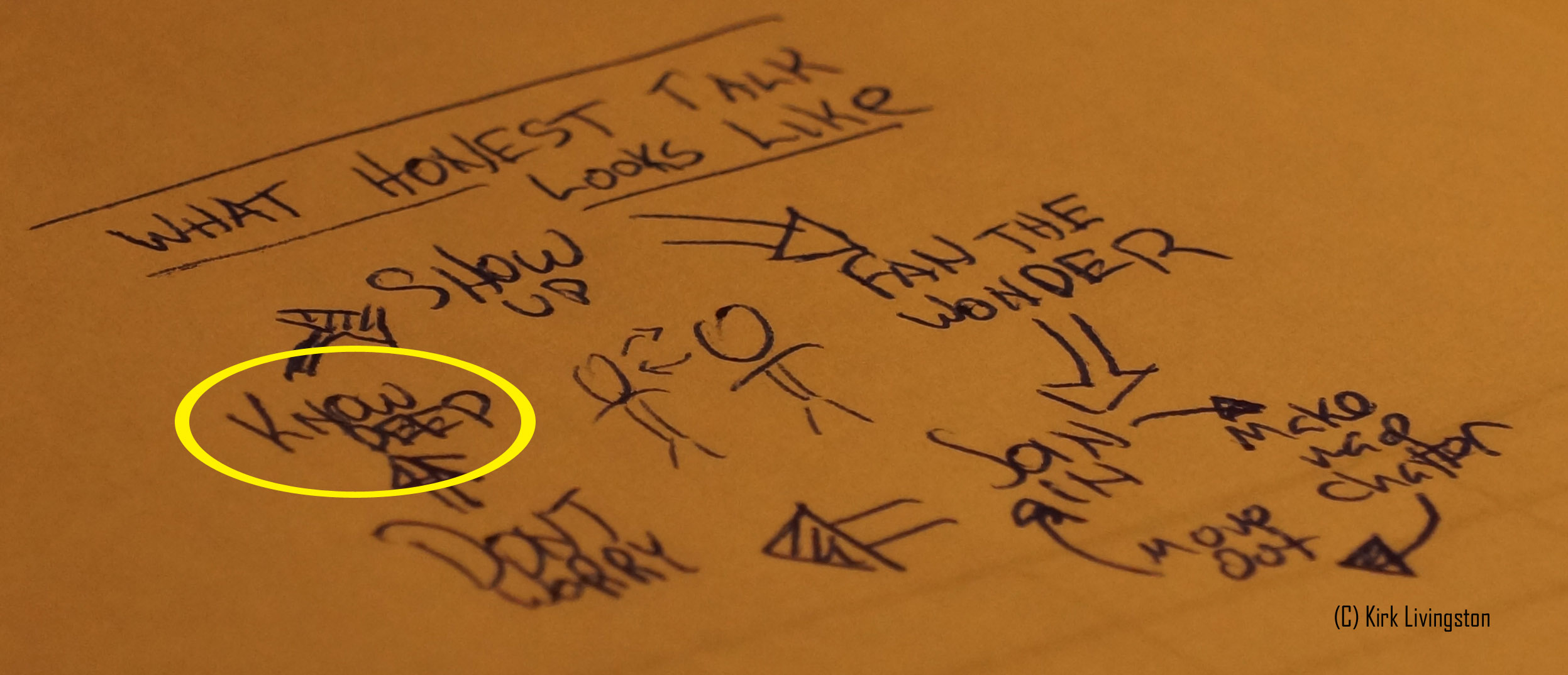 In this cycle of events that occur when we connect with each other, the “Know Deep” part is standing out to me today. What I know depends on what I’m willing to ask, which means I’ll need to reveal I don’t know something. Such revealing can be hard. But if I don’t tell someone what I don’t know, I risk never knowing. In the end, I must name the things I know so I can begin to realize what I don’t know. This may be a lifelong process.
Not knowing and being willing to look foolish can make for stimulating conversation: people like to help us know. And a child’s “why” and “how” questions can be refreshing, no matter what aged person they come from.
###
“You can’t change something that doesn’t exist.” (Copywriting Tip #7)
Where to find courage to create
Designer/entrepreneur Mike Lundborg uttered it dozens of times over a few projects we collaborated on. For me this quote nearly perfectly encapsulates the dance between creativity and work that is the business of freelance life. That’s why I keep the quote front and center in my work space.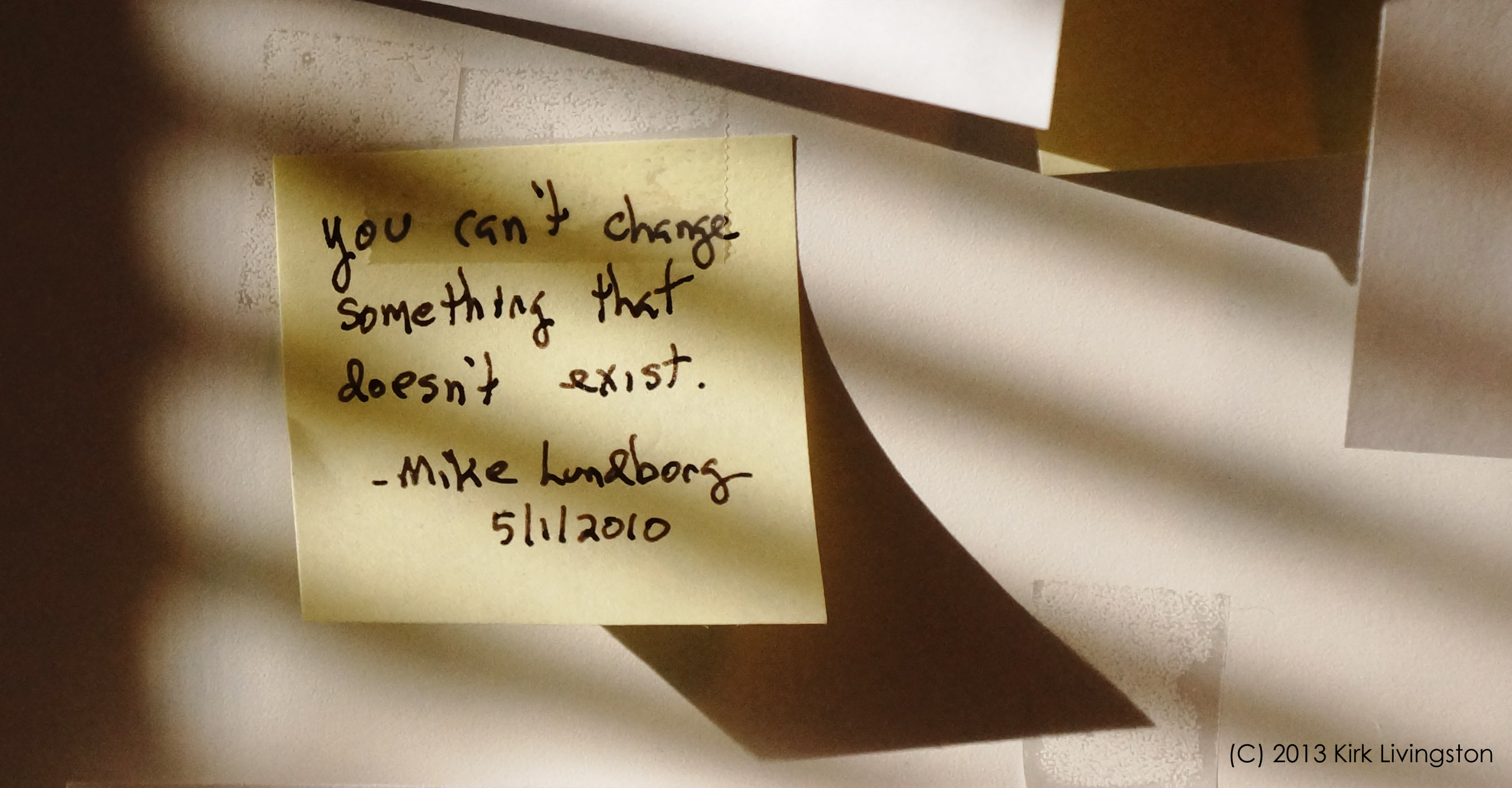
Even today I’m working on a story intended to invite prospective patients to participate in a clinical trial. But early review comments indicate my client wants to buff out the narrative parts (that’s right, losing the story itself) and swap it for clinical and corporate language. The story was meant to pull prospective patients toward a clinical trial, but it won’t if the corporation keeps talking.
But this is not a lament. It’s only a statement of reality and maybe a celebration—because this is how we create together. My sizzling hot interpretation of a marketing objective is held in the tongs of review and hammered into shape by my collaborator. And by me. This is my expectation for my ideas and the resulting words, just as it is my expectation for each part of the process.
And now this: as we release a few of the projects physical constraints, my story bounces back—which makes me glad. This is what collaboration looks like. Successive drafts change but the central objective continually informs all the collaborators as we take our turns shaping the project.
Amazingly, it is this very collaborative process that needs to inform my less commercial writing projects. The courage to create actually springs (again) from the sometimes difficult conversations that surround the project. But it also takes courage to produce a rough draft.
###
Mrs. Wheeler’s Back. And She’s Gone Existential.
Fan the Wonder
Your 2nd grade teacher showed up. The one who always said “Listen to your neighbor.” She just dropped in—several decades later—but now she’s wearing a black beret, smoking unfiltered Gauloises and sipping espresso.
 Mrs. Wheeler is no longer concerned with making things simple for you. In the training for everyday life that was part of 2nd grade, listening was a critical skill. She thinks you’ve forgotten it today, based on how you treat people.
Mrs. Wheeler wants you to start seeing the people around you. And then she wants you to assign value to these others that surround you. Not just your gang. You already value them and you listen to them (more or less). It’s those others—those not in your group. The ones you barely acknowledge, let alone listen to. Mrs. Wheeler says a true interest in others means allowing those others to be themselves.
“Of course, Mrs. Wheeler,” you say. “How could it be otherwise?”
“Ah,” she says, smoke slowly drifting up.
And when people show up with words different than yours? Different language entirely? Or just a different set of words that are not the key words you watch for? What if these others wear clothes that are provocative? Or not at all stylish? What assumptions do you automatically process? And how do those assumptions affect how you listen?
“No,” says Mrs. Wheeler. “Pay attention. These others are saying something you need to hear. Fan whatever wonder you find.”
She slowly stubs her cigarette on the saucer.
“This is the way,” she says as she steps out your front door.
###
Image credit: Kirk Livingston, All Rights Reserved.
How to Hack the Bully’s Monologue (Dummy’s Guide to Conversation #16)
Resist the rhetoric of control
Every person has worth. Every person has something meaningful to communicate to us and vice versa.
But sometimes the guy in the corner office just wants to yank your chain. Sometimes your colleague comes in your cube too close and berates you for something that riles only her. And sometimes these work contexts make you question your worth. Today we call this bullying and officially frown on it, though bosses of all stripes let their primordial managers get away with it as long as they post results.
 In the face of the bully’s monologue, we may need to set down our goals of understanding and hearing each other. We may need to pick up tools that will help protect us from the bully. And especially as our culture talks more about innovation, we must recognize that the enemy of innovation is the bully who uses monologue to quell thinking and drive over dissent.
- The hack begins with dropping sycophancy. Just because the VP of marketing is telling you a personal story about his cabin doesn’t mean he isn’t trying to put you in the low place he wants you. There’s no need to continue to play the prop: the underling enamored by all the person in power does.
- Be present. Don’t go to the Bahamas while the bully drives his verbal tank into position.
- Stand. Even if sitting, assume a mentally poised place to challenge.
- Challenge. Is there another way of looking at the perspective the bully shouts? What is the truth here? Speaking fast and loud does not make something true.
- Know two things
- You are a person, too. A person of value.
- That language can be encouraging or damaging. Every communication encounter has a shaping effect on both conversation partners. Don’t let the bully continue unchecked.
- Turn the other cheek. Yes: quite. Back to Jesus the Christ who knew something about handling the bully. He knew the most effective thing long-term was to offer the bully even more. Not in every case, but dealing with the bully from a place of peace and, yes—faith (in God)—may just cut power to the BS generator the bully madly operates. This counter-intuitive step holds much promise for moving forward as a human.
Some reading this may think no modern/post-modern workplace has bullies like this. You could not be more wrong. It is interesting that the tools used to shine a light on the bully’s madness are also effective in ordinary conversations.
How do you handle the bully’s monologues?
###
Image credit: Used with permission from Paul Rivoche via 2headedsnake
Our Questions Help Us Do More Than Just Show Up
No one expects a lightning bolt on Monday

don’t be that gal
Daily routines condition us to low expectations for our everyday conversations. We assume most of today’s banter will be transactional (for instance): we’re just exchanging information or spreadsheets or paragraphs or money or whatever. I don’t expect anyone to reach down into my box of personal perplexities and provide a custom answer. We don’t expect to be changed by the people we see every day. We kinda know what they will say already. Right?
Some people in my life are thinking through career and other life questions. They are in the process of making decisions and perhaps a decision is due right now—so those questions are up near the surface of their daily experience. When questions and decisions lie near the surface, we show up with all our intentionality poised and ready to fire. Our impending decisions attune our antennae for anything that could help confirm or reject the choice—any help will do from whatever source, before we jump from pan to fire.
Living with clearly articulated questions makes it more likely we will ever find an answer. That’s not a bad strategy for everyday living.
What if we spent some of every day listening for answers to our own deep perplexities? What if we kept looking and hoping for lightning to hit us with insight? It is possible and even likely that answers and insights may flow from the very familiar people who surround us. But we would need to listen to them in a different way.
And sometimes we don’t realize we’ve been lighting-bolted until we’re walking down the hall after a chance encounter.
###
What Do You Need To Move Forward?
Applause? Permission? Donuts?
Twice in the past week I’ve asked myself this question.
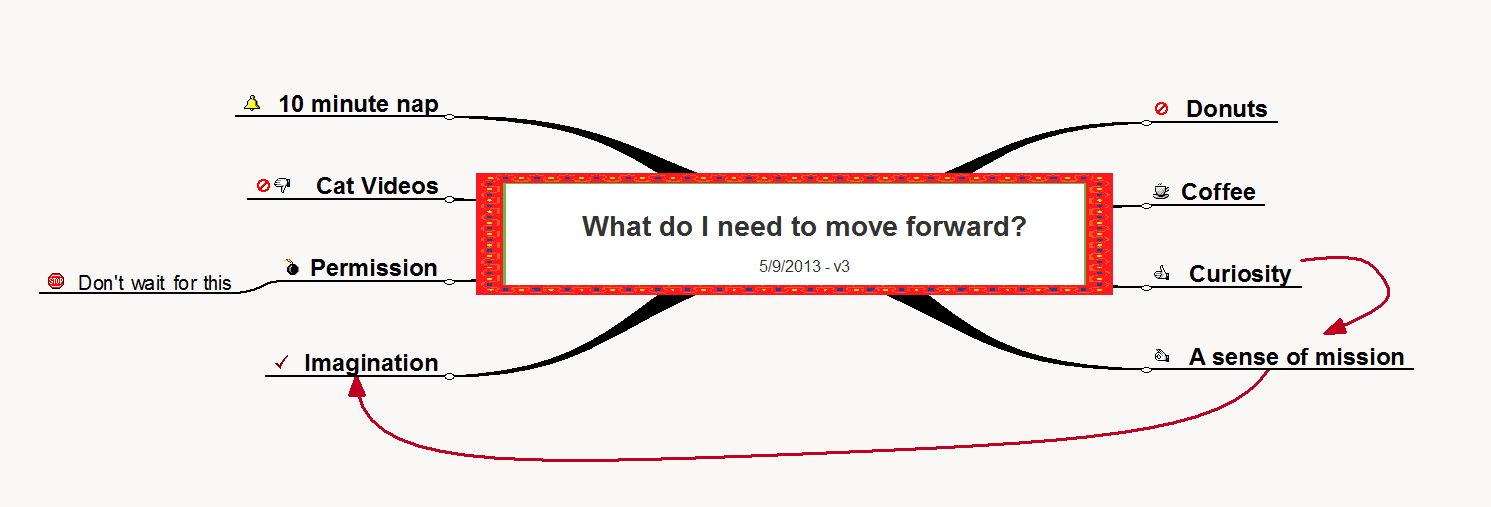 In one case I had just started a large writing project requiring all sorts of information that is not available and will not be available any time soon. My topic is partly in a shipping container in the Pacific, partly in a guy’s head in Scotland, partly in a set of computers in Minnesota and mostly nowhere near complete. But the need is approaching and my content must move on a parallel path with product development. A very specific audience needs very specific information.
In another case the blank page itself kept reminding me of the limitless intrigue of cat videos and TED talks. There’s nothing like a blank page to send you to all the advertising blogs and newspapers you’ve not checked on the web lately.
In both cases a conversation helped me mend the tracks to send the idea and task trundling forward. As I heard myself describing what I was trying to do with the idea and what I needed to complete the task, I realized I have the tools before me right now. There is nothing holding me back.
Waiting for permission to move forward is nearly as fruitless as waiting for someone to applaud your work or tell you what to do.
We move forward and the work has a role in showing us how to do it.
###
Image credit: Laurent Millet via 2headedsnake, kirkistan

 conversation is an engine