Archive for the ‘Collaborate’ Category
Care Guides: In Praise of Knowing Nothing
The better to listen
 Allina employs people to work the space between a physician’s prescriptives and the patient’s adherence to said advice and prescriptions. (May 6 StarTribune: Care Guides show another face of health reform)
Maura Lerner’s story shows a comical side to healthcare that should surprise no one. The comedy is not that hospital systems would employ people with little to no medical training (that makes good sense to me). The comedy is how many patients and physicians have learned all sorts of dysfunctional ways of interacting and not listening to each other.
Betsy Snyder, 23, never wears a white coat on the job. She wouldn’t want her patients to get the wrong idea.
Care guides make sense because they feed corporate efficiency objectives of moving physicians quickly from patient to patient, which serves to maximize those costly human assets. And certainly care guides will try hard to work within their contractual obligation to not practice medicine not matter how hard the kindly older woman pushes for such advice (especially since they’ll quickly be out of a job if they do).
The key common-sensical notion here is that the care guide becomes another interpreter of the physician instructions. And as they discuss prescriptions and compliance with the patient, they are another voice advocating for improvement. And since they arrive without the baggage of years of training they are free to listen.
And listening is the key. Listening and talking—such simple things—but these are the missing ingredients in treatment. Just because a physician prescribes doesn’t mean a patient complies. But talking it through, why, maybe it is actually a kind of therapy trigger.
Care Guides are a positive development as healthcare corporations try to relate to humans and their conditions.
###
Image credit: Courtney Perry via StarTribune
I hate you so much love from me to you
When to poke your target audience in the eye
My client needed to reinforce the why behind a clinical trial. We needed physicians to remember their tried & true therapies didn’t always apply under this particular set of calcified conditions. We hoped for a visceral reaction to help change fixed treatment habits toward a killer disease. The poster was both over the top silly and aimed at the gut of a largely intellectual audience.

Some hated it. Some loved it. Some thought it went too far and was not appropriate for a clinical setting. Some found their rage against the disease. The poster polarized even as it got attention. And that was the point.
Not all our communication is meant to slip into the space between us like links in a chain moving meaning smoothly from your mouth to my brain. Sometimes you need to jar me from my stupor so I can really understand what you are saying. Because what you are saying is urgent and important and not business as usual. This is why teachers make students stand and move every 15 minutes or so—to restart the brain. This why street preachers are uncomfortable and often memorable.
Rather than automatically aim for consensus, challenge your team about the kind of reaction you want from your target audience. When does it make sense to provoke?
###
The Riddle of the Difficult Person
Run Away Vs. Run Toward
My instinct says run. Or at least avoid. Either way, get out of the line of fire.
And my instinctual response to the difficult client/boss/colleague/family member is completely wrong. Entirely and utterly misguided. That is because avoiding the difficult person gives them a kind of power over you that will come to no good. Not only is avoiding the difficult person impossible (for such people will always and forever show up in your life), it is not smart. There is something you are to learn from this difficult person. Some hard life-lesson.
One of the ancients spoke of iron sharpening iron and his words describe precisely the mechanism of action with the difficult person. Something about this person grates on us: she is too bossy. He is too passive. He only thinks of himself. Everyone knows she is mentally unstable.
To be present with the difficult person we must step out of our usual ways and do something different. Perhaps we start by biting back the caustic retort. Maybe we stand up and against the sudden wrath which is our difficult person’s typical communication pattern. Perhaps we need to force a clear “Yes” or “No” from the mouth of our difficult person. Perhaps we offer the solution to them in the form of a question so they can take credit for the idea.
 We all have these people in our lives and there are as many different types as shades on the color wheel. That’s because our interactions are dynamic and each of us constantly responds to a bevy of moment-by-moment inputs and impulses.
So take heart: there is some opportunity to move forward in the difficult encounters that hang like a cloud around this person. Learning to say no. Learning to clarify. Learning to probe for what is bothering this person. Learning to probe and learn from our own responses. These are all life lessons that sometimes come at a dear price.
And there is more: there may be something deeper going on. When you choose to show up with the difficult person, it’s with your physical and mental presence. And your emotional presence—all these can help inform your response to the difficult person. And one more: your spiritual presence. No, I’m getting all religious here, but wouldn’t you agree that some of the people you meet during the day need far more than you could ever provide?
Sometimes running toward the difficult person looks like an internal prayer offered to God on behalf of a conversation that is about to happen.
###
Image credit: red-lipstick via 2headedsnake, Wikipedia
Marissa Mayer May Be Right: Show Up (How To Talk Series #1)
You can’t talk if you’re not there.
With your colleague, maybe with your spouse when you left the house. Maybe your sister on the phone, the friend in London using Skype. Nothing happens when you don’t show up.
 Today we continually fine-tune our understanding of showing up: we show up with a tweet, with a blog post, with a telephone call. We show up by email (and sometimes our explanatory emails mark us absent). And then there is actual, physical, atoms and genes-on-the-scene showing up. But even that is not so clear, because despite standing here as you jabber, my mind is seated on the couch reliving that scene from Terminator (was it II?) where the semi-truck-trailer shoots off the bridge to land in the concrete spillway to continue chasing our heroes.
Maybe this is part of the “Why?” behind Marissa Mayer monkeying with the Yahoo! work-from-home policy—to help people be present:
Mayer defended her decision by first acknowledging that “people are more productive when they’re alone,” and then stressed “but they’re more collaborative and innovative when they’re together. Some of the best ideas come from pulling two different ideas together.” The shift in policy affects roughly 200 of Yahoo’s 12,000 employees. (reported by Christopher Tkaczyk, CNN Money)
I hope and believe collaboration and innovation are at least partially behind the Yahoo! change (which is to say, I hope the change is not a retrograde movement toward tighter control of knowledge workers and the corporate monologues they produce). There is some truth in the move: we cannot collaborate without being present. Also true: there are a lot of ways to be present when the collaborator is not physically there just as there are a lot of ways to be absent even while your carcass sits upright at a desk.
So today, choose to show up. Signal your decision with active listening skills. Refuse to be put off by anti-collaborative rants and power plays—say what you need to say to contribute. Refuse the director’s feigned emotion over this or that decision and tell the truth.
Show up today. It feels way better than hiding on the couch and watching your internal TV.
###
Secretary of State Kerry: Please Send Dennis Rodman to North Korea to Sing This Song
It’s too late, baby, now it’s too late.
I doubt any of the Kim Jong’s have ever been “light and breezy,” though Un may be so with Mr. Rodman. But certainly they have just stopped trying.
Is it time to call North Korea’s bluff?

[Click to play]
Of course, the inbred regime may actually believe the rhetoric they spout—that is the danger. Un may well be unhinged enough to push the button—no one really knows.
On the other hand, is there a way to keep pressure while allowing them a face-saving out. Some way to move toward dialogue while not giving in?
###
Illegal Inscriber: We Are Brothers
Warning: NSFL Image (Not Safe for Librarians)
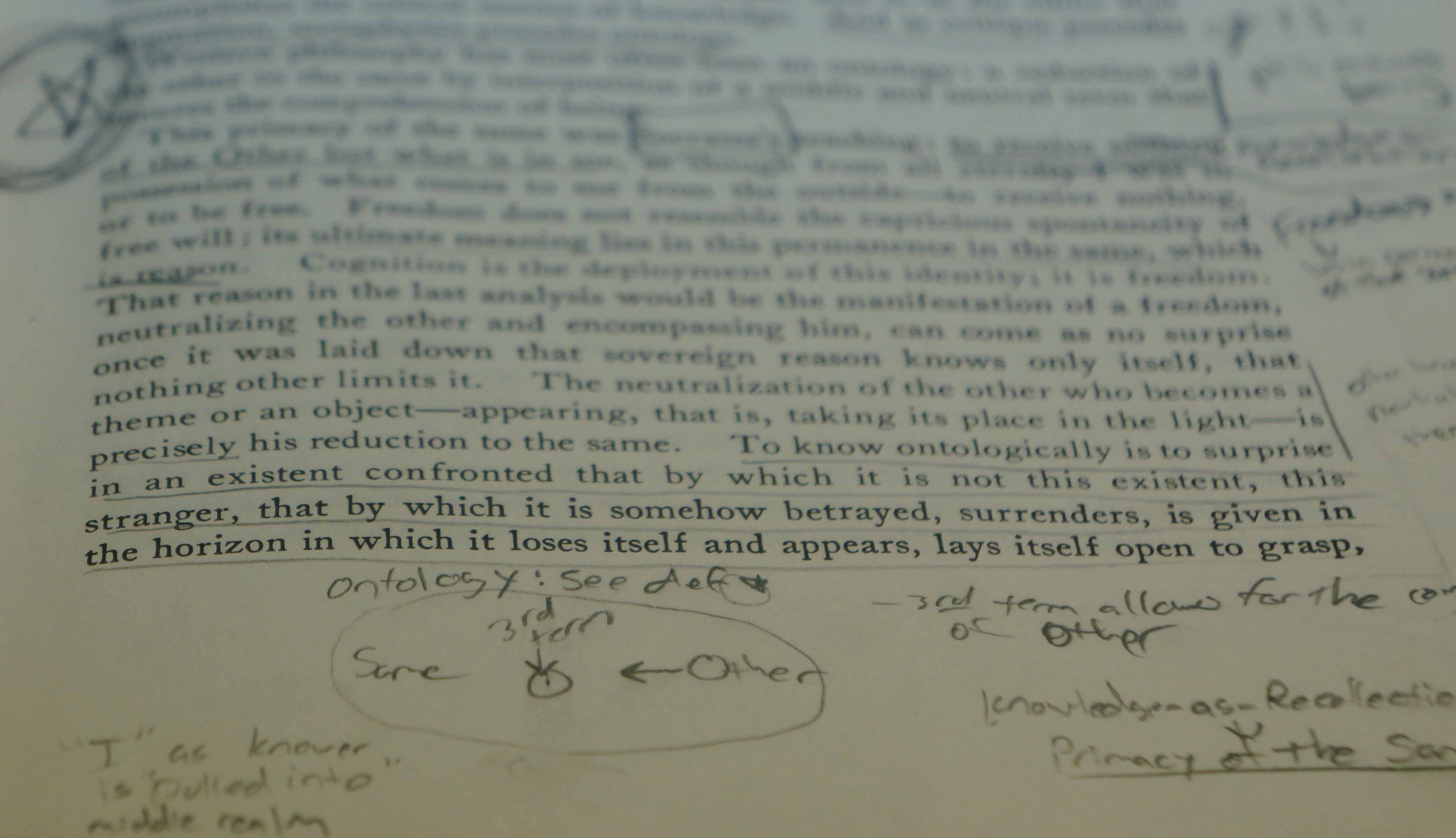 Sometimes Ramsey County goes far afield to procure my desired book through their interlibrary loan system. Not so long ago a book about Levinas written by Sean Hand made its way to me all the way from Janesville, Wisconsin. I had not thought of that working community as a hot spot for continental philosophy, but life is full of surprises.
This copy of Levinas’ Totality and Infinity came from St. John’s University in Collegeville, Minnesota. And somebody there did his thinking on paper. I say “his” because this scrawling looks like it was made with a masculine hand. I would like to buy this thinker a cup of coffee—his processing of the text is spectacular. He outlined sections of Levinas’ thought, he responded with gusto (exclamation points and double/triple underlines) to the sometimes obscure Levinasian sentences. His notations in the margins show him connecting Levinas to Hegel, Nietzsche, Sartre and Descartes. He is surprised when he finds “another way!” He offers a sad face upon realizing “the state is a totality.”
In fact the first 1/3 of the book is full of his incidental reactions and understandings, all scrawled in remarkably clear pencil in the margins. By half way through the book his interest seems to wane. The latter half of the book is free from all pencil inscriptions. Did he fall asleep in the library and miss his deadline? Did he finish his paper based “the same and the other” without ever getting to “exteriority and the face?”
I suspect so.
Even so, I’d like to have a chat with this illegal scribbler. This person has a lively mind, reaching out to make mental connections even as he reached out with graphite to record those firing synapses. Maybe this guy was even considering the poor dolt (this next other) who would pick up the text next—showing a kind of mercy on him.
I think the Ramsey County Librarian would also like to meet this scribbler. She wrote (for the tiny but loopy handwriting on the transfer label looks like a feminine hand to me) —wryly, to my mind: “pencil marks noted.”
###
The Boss Problem: When Does Your Purpose Become Mine?
Tell Me About It.
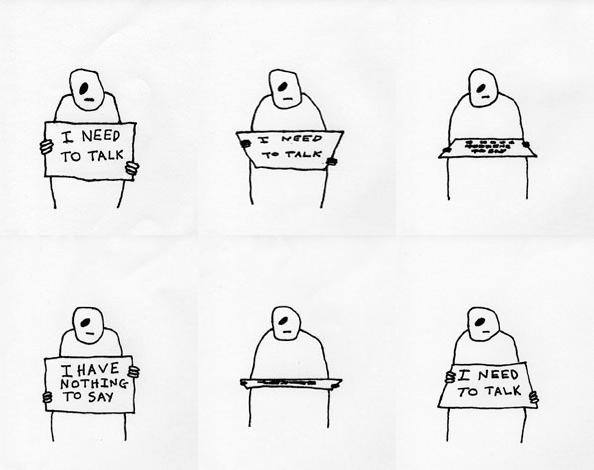 One of my bosses gently chided me for my language: I kept saying “they” in reference to her boss and the leadership structure and the stated purposes of the medical device company we both worked for. She was exactly right: I did not use “we” because I felt separate from the decisions being made and the direction chosen. It was not a conscious choice on my part; I was just reacting to all the pre-conscious activity that happened outside my engagement. My language, which seemed to choose itself, was the telltale.
The boss problem is how to engage employees (or a team) with the problems and purposes at hand.
“What’s the problem?” you might say. “We pay these people so they should do with that boss says.”
That’s true, they should. And they likely will perform at some level, though giving an employee a reason for doing something is a step toward improving performance. Better yet: if the employee feels ownership, that they are personally involved in this task, that they have something at stake, perhaps that condition generates the best performance.
But getting someone to feel ownership for a task is something of an art. There is also an inherent compassion to it: a boss must understand that transferring ownership starts with a shared purpose that sits prior to her command. Sharing ownership begins with the relational approaches in the team long before the purposes and problems come in view. Sharing ownership brings risk for the boss—his reputation is at stake as well. Words by themselves—though always the beginning point—cannot accomplish the transfer if the boss does not believe it. Employees and teammates come equipped with highly-attuned BS indicators and can spot a fake before a word is spoken.
But isn’t sharing ownership the only reasonable solution when fully-grown humans are involved together in a work process?
###
Image credit: thorelimo via 2headedsnake
The Naked Anabaptist by Stuart Murray
What’s on the other side of imperial Christianity?

How do you think of church? Many readers of this blog find the church experience painful and reductive: at best irrelevant. At worst, dangerous agitprop. Other readers soar. I’ve been on both sides and I prefer soaring.
Church is an institution forged from a less-than-stable amalgam: people and Other. People are the weak link. But people can also surprise.
On several occasions I have written critically about church (like here and here and here and here plus about a dozen other places on this blog—just type “church” in to the Search bar to the right). For me lately, most churches resemble all the other CEO-driven marketing machines in our culture. But this marketing machine sits at the local level pulling in spectator-consumers to fund the local brand.
Yes that sounds cynical.
But just read through the New Testament and compare the multi-voiced organizations that sprung up with any of the big box affairs we love in this country. Those small communities in the text were chock full of the risen Christ and were spinning changed participants out (and back in and out and in. And out). Notice that growing spectators was not their goal and participation in shaping the organization and experience was expected.
But this book makes me less cynical: The Naked Anabaptist. Tracing a history back to the sixteenth century dissenters (who died for taking Jesus seriously, often at the hands of reformers), the book gives a fresh take on our waning years of Christendom (that is, the curious intertwining of culture, power and religion that started with Constantine in the 4th century establishing Christianity as the state religion and continued to today, give or take).
Many lament the loss of cultural power of Christianity in the U.S.
Not me.
My reading of the gospels puts the poor and weak and needy at the center of what Jesus intended. His was/is an ethic markedly different from the mandates we pursue that force a top-down approach. And The Naked Anabaptist hints at what the church could look like if it were not a univocal marketing machine. Murray’s seven core convictions lay out a compelling picture. And it is not a picture with one pastor/president/CEO at the top. The book probably gives more shortcuts to Anabaptist thinking that some Anabaptists would be comfortable with, but it is thought-provoking and vision-building.
Woodland Hills in Saint Paul, Minnesota is considering joining the ranks of Anabaptists. The church came to the conclusion after realizing the kinship they had with the doctrines. But I wonder: can a mega-church be a multi-voiced church?
###
The Office: Neither Crib Nor Playpen. Not Preschool. Not Kindergarten.
The Role of the Declarative in Every Day Life
 This has the power to change you: say what you stand for rather than saying over and over what you are against. To declare what you stand for is to say a positive about yourself and your situation in life. Declaring takes courage because others will disagree, they may say “That’s not true!” Others may despise you for saying what you think, they may not believe and many will simply find your declaration irrelevant.
But you must say it anyway.
Declarational speech expresses us at work as agents of truth. –Robert Sokolowski, Phenomenology of the Human Person (New York: Cambridge University Press, 2008)
Corporations and organizations are at their best when their people take ownership of processes. Taking ownership means making that process one’s own. Remember in school when the teacher said “use your own words” versus cribbing from the encyclopedia? (An encyclopedia was a set of “books” made of “paper” that sat on a “shelf” gathering dust until a “report” was due) That process of using your own words is the very reason for the staying power for your odd assortment of facts from childhood.
Taking ownership and using your own words is the same process that makes you a grown-up human today. A necessary condition of taking ownership is that the result will look different from what someone else might have done. If you are a boss and chide your employee for doing things differently than you, stop and rethink your relationship with the work and the client and your employee.
No organization can grow—no people in an organization can grow—if they are not using their own words to say what is happening.
###
Image credit: Gregory Norman Bossert via Wofford College/thisisnthappiness
When Talking with the Queen: Do You Avoid Conversation Because of Social Status?
Have you had this experience?
Tell me in a comment (I won’t make it public unless you grant permission)
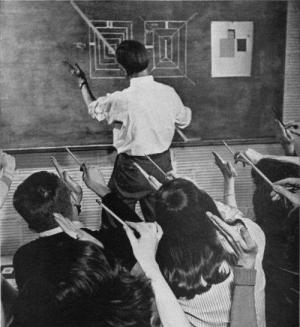 Consider the lowly species of a short, thin 7th grade boy. This particular boy wants to ask a girl to the school dance. As a 7th grader, he is on the lowest end of the social structure: 8th– and 9th-grade boys cherry-pick the pretty and popular girls and have no problem asking out the 7th grade girls out. This particular 7th grader has his eye on a brown-haired girl he likes. She is pretty and popular and funny—and also very much out of his league. She seems to exist in an alternate universe at the center of activity and power in his 7th grade class. To even speak with this lovely being would be a huge, baffling step. How to accomplish such a feat from his place of dwelling in weakness?
This is one of the problems of conversation. We sometimes find ourselves tongue-tied around people we perceive as having higher social status. Talking with the teacher or principal or Queen or CEO or chief cardiologist or the pretty, popular girl can bring to mind our inadequacies. And with those neon inadequacies before us, we lose all semblance of ordered thought and advance toward becoming the tittering sycophant.
When our kids were in middle school and high school I sometimes tried to convince them that social structures and cliques were all enculturated figments of the collective imagination. Some people seemed more popular, some people seemed at the center of things, but if you asked them, nearly everyone felt alienated and isolated.
“Pretend power is the nature of our schools,” I would say. “Any school.”
Social structure is all make-believe: blow through it. Talk to whomever you like.
But then I would remember my own high school experience where cliques were both fiction and real and ruled the place—somehow the student body agreed on who the cool people were. How did that happen? And then I remembered the same unwitting agreement happened in other organizations. In fact, get a group together and there always seems to be some popular person at the center. And then there is everyone else.
But today: do you ever avoid conversations because you feel less powerful or less popular than the person you would speak with? And how do you overcome that? Do those feelings still exist in the adult world and if so, how do they hold you back?
###
Image credit: queataquemasgratuito via 2headedsnake

 conversation is an engine