Archive for the ‘Communication is about relationship’ Category
Kotter: Why do leaders fail at transmitting vision?
“a gallon of information…dumped in a river of routine communication”
John Kotter’s Leading Change (Boston: Harvard Business School Press, 1996) does an excellent job explaining the difficulty of vision moving through an organization. A guiding coalition may take hundreds of hours to study a situation and come to conclusions. But as they do this intellectual work, they are also doing the emotional work of “letting go of the status quo, letting go of further options, coming to grips with the sacrifices, coming to trust others….” (88)
This is all part of the process and when that guiding coalition finishes and forms their conclusion they naturally feel their work is done.
Their work is not done.
That’s because nobody outside the coalition has done any of this difficult intellectual and emotional rejiggering. In fact, most will be blindsided because they’ve been hard at the tasks they always do. They don’t have a clue what is coming.
This is typically the point of failure. Someone from the coalition gives a speech or authors an article in the company newsletter. Or maybe a series of three articles. Here’s Kotter, very bluntly:
So a gallon of information is dumped into a river of routine communication, where it is quickly diluted, lost, and forgotten.

John P. Kotter, Leading Change (89)
Compacting and condensing and boiling down the intellectual and emotional journey is essential before anyone else can or will sink their teeth into the vision. But who budgets time or money for that piece of the process?
Those who understand vision needs legs and motivation to run through an organization.
Transmitting vision must be an intentional invitation.
###
Image credit: John Kotter, Leading Change (Boston: Harvard Business School Press, 1996)
FastCompany: The Beguiling Dangers of Insider Language
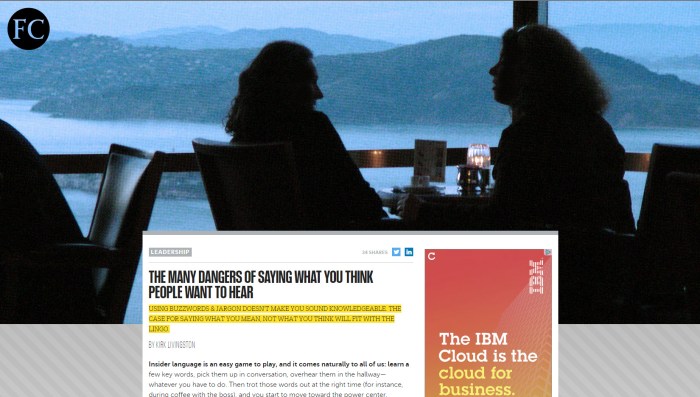
Check out my article in today’s FastCompany: The Many Dangers of Saying What You Think People Want To Hear
 ###
###
Image Credit: FastCompany
What Freelance Knows that You Don’t
For starters: Work is permanent while jobs come and go.
When I first considered life as a freelance copywriter, a friend said,
Welcome to the wonderful world of floating icebergs.
And it was so: projects fall off (the glacier of corporate planning) and float off to sea (so to speak, to the market) and you stand on them for a time, work on them, even as they melt under you. And then you step to the next iceberg. Or you tread water while another iceberg comes into view.
It’s a refreshing cycle—in a painful, polar-dip, take-this-horrid-medicine-it’s-good-for-you—kind of way.

Ice sheet, not iceberg. Don’t step on it.
I like to tell my copywriting students that the freelancer goes into it knowing this is how the game works. Then I tell them this knowing is in sharp contrast to nine-to-fiver’s who instinctually trust their jobs will remain, and are too often deeply surprised to find themselves waiting for the bus one day at 11am holding a cardboard box containing their office posters and mug.
But students typically have no mortgage or kids to feed or insurance to buy. So I’m pretty sure the comment doesn’t register until five years later, when all those conditions are true.
Recognizing the impermanence of today’s job is a great benefit, because it means one must always—always—be thinking about what’s next. The freelancer understands this in her bones. The smart nine-to-fiver rehearses this bit of knowledge every time she crosses the corporate threshold and enters the air-locked doors.
One thing that happens while I tread water is I make contact with dozens of old colleagues. I am no longer surprised by how often people change jobs, get laid off, start their own business or agency. Not to sound like an old guy, but way back when, people expected to stay at a single company for an entire career. Today I could count on one hand the number friends who have done that.
Friends often ask about work. I typically say, I’m busy and I’m looking. Always looking. In fact, this way of working has two benefits I cherish:
- Vision is no esoteric word for me. It is a hard-edge guide to what’s next. And I can never not pursue it. If I neglect to think ahead, those icebergs will float by without me ever noticing.
- The work itself become the focus. I get to burrow down into communication and copy and the telling of stories. The craft itself is a never-ending wonderland that shape-shifts as it leaps between clients and industries. The work, and the process toward the work, become the marathoner’s stroke for swimming toward the next iceberg.
In fact, faith, hope, and love remain as essential ingredients to this way of working. There is no space for taking-for-granted.
###
Image credit: Kirk Livingston
Richard Rohr: “be prepared for much resistance”
Maybe real wisdom first helps others see the path and potential obstacles.
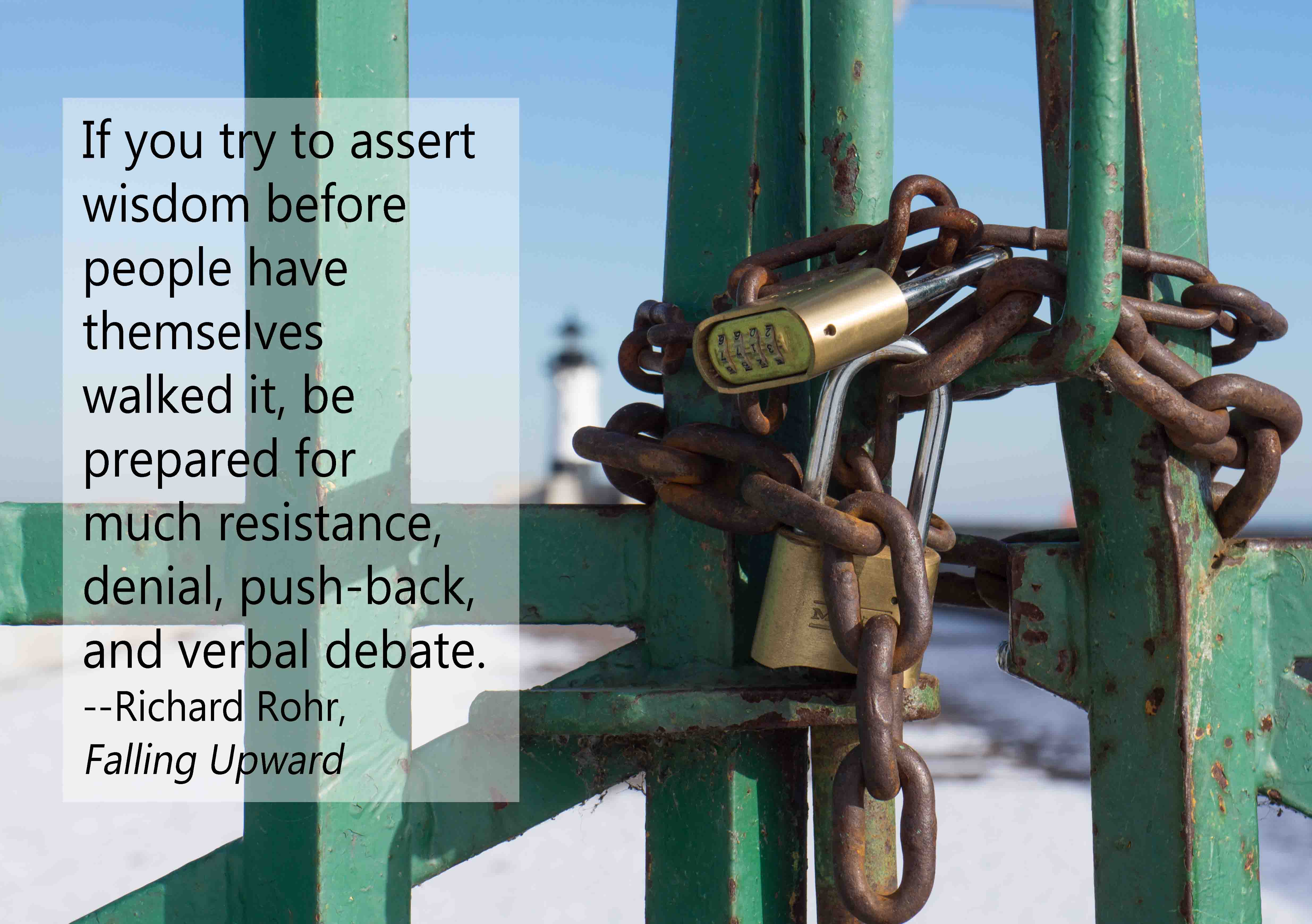
And maybe real wisdom also listens for the additional perspective.
###
Image credit: Kirk Livingston
Writers at Work: “How do you imagine that will unfold?”
Seeing Need and the Power of Imagination
The leader’s peculiar gift is to help followers imagine how their work makes meaning. The leader makes personal how the organization’s work helps others, solves a human problem, makes the world better/more beautiful/safer, for starters. From that position of ownership (note that leaders may appear anywhere in an organization, position does not equal leadership) the leader imagines the next steps needed to move the organization forward. The leader acts on that vision and invites others in.

If you accept that the writer’s art is at least partly a reimagining or reordering of life, then you may be willing to consider the work of writing in business. Can writers in business look forward to how next steps unfold and then follow that thread backward to make those steps happen?
I say, “Yes.”
But not just because I do this for a living. [Full disclosure: I do this for a living]
It’s because writers in training are blind to this side of the life/work/art equation.
That’s a premise I’m toying with as I consider how entrepreneurship and professional writing fit together. I’m working through an entrepreneurial focus to the next Freelance Copywriting class at the University of Northwestern—Saint Paul, and I want to help English students see beyond self-focused essays and creative writing. A necessary starting point is inviting them to use their writerly tools to imagine life from that leadership/ownership/need perspective. I believe this can shift ownership to the writer and provide useful insight for right now.
Julian Sanchez’s tweet as the Senate report on CIA torture was released gets at this very concept:
Imagine forward and trace backward to locate solid actions. That is the leader’s gift—and possibly the writer’s.
###
Image credit: Kirk Livingston
The Cost of the Silver Hand
In versus out—does it even matter?
It does in Minnesota. It’s 33°F right now—not so cold—but in less than 30 days we’ll plunge well below 0°F and stay there for a month or two. Being inside matters when the outside temperature is cold.
About “inside,” you remember high school, yes? Being an insider seemed to matter there: being part of the groovy clique seemed to say a lot about your identity. But it turned out that the cost paid for being an insider was higher than we realized.
You get inside by exploiting insider behaviors: hang with other insiders, use insider words, allow the insider frame of reference to settle on you and gradually think insider thoughts. There is a certain warmth to being inside. Sometimes it’s safe and cozy. Sometimes staying inside means forming alliances and battling for diminishing territories. A friend recently used those words to describe his years inside a large retailer based in Minneapolis—he left when the cost of alliances and battles was greater than his paycheck.
The classic insider mistake is to think inside is all there is. And that mistake is murder when the layoff discussion happens in the HR office on a bright, cold Friday afternoon. Or when you graduate high school.
But being on the inside is good when you also recognize voices from the fringe. That sort of consciousness allows new thoughts to infect the inside, possibly even countermanding the inbred thinking of insiders talking to insiders.
Lately I’ve been stimulated by reading The Power of Pull: How Small Moves, Smartly Made, Can Set Big Things in Motion, by Hagel, Brown and Davison (NY: Basic Books, 2010). In particular, their talk about what the edge person brings to the discussion seems fitting. The edge person is working at something different than the insider. The edge person is trying to accomplish something in a different way and so is asking different questions. The edge person asks questions the insider doesn’t even consider. And it turns out those questions are sometimes the very questions the leaders of the insiders wish they were asking.
My favorite scene in Canal Digital’s “Silver Hand” is at the bar when our hero tries to casually drop the Silver Hand reference.
What a lovely fail.
The smart insider acquaints herself with the habitat and questions of the edge person.
And vice versa.
###
Via Canal digital
Tune-up the Voices Talking Inside Your (Corporate) Head
Pitch the preachy. Scrap the sing-song. And definitely lose the lingo.
Sometimes a certain tone will flip a switch for me. And all the person says next is covered in darkness because the tone pointed me elsewhere—so I miss the message entirely:
- The VP standing before the group launches into a sermon and 93% of the audience tunes out before she takes her first breath
- The newsletter from internal communications plays out cheery, one-sided copy that feels as manufactured and questionable as a tuna sandwich from the vending machine
- A poetry recitation where the sing-song voice seems to have come from a different century
- The prayer that sounds like a sermon. The sermon that sounds like a lecture. The lecture that shows no interest in connecting with an eager audience.

Each communication event is an opportunity to pass information, true. But each event is also an opportunity to deepen relationship and build trust—both of which may be more valuable than the information in transit. To squander those communication events on vacuous, preachy or condescending fare seems a waste of time, money and consciousness.
Perhaps certain situations activate your autopilot and you slip into a particular communication mode. The status meeting, the Sunday sermon, talking to an employee. Talking to a child. Maybe we even have a special voice reserved for praying with other people. We may not even realize that we adopt a slow-meter pacing, using parlor words we pull from our big-bag-of-sacred-stuff.
Our autopilot mode can learn from the practice of that old poet-king. That old poet-king had a special voice for prayer too, but it wasn’t from the big-bag-of-sacred-stuff. Instead, it was the voice of desperation, of falling and not being able to get back up, of righteous anger on the dudes who done him wrong. The poet-king’s voice was a real voice, based on real bad stuff that seemed to be happening.
The lesson from the poet-king is this: keep it real.
Employees appreciate hearing what’s really happening, not some vetted-party-line version. Use your real human voice as often as possible. Real voices—the ones that we believe—find a way around buzzwords and corporate lingo.
Real conversation with real voices is the engine moving all of us forward.
###
Image credit: Kirk Livingston
That moment when you only want to say truth
Come, blessed ignorance.
Early in my writing life I let on that I knew more than I actually did.
You did too. We all did. We all do.
It’s part of the human condition: the word or name dropped, the subtle nod that hints we are in the know,
“…and, yes—please—carry on…certainly I get it.”
Whatever it takes to not appear stupid.

I tried to impress Madison’s potato vendors with my potato knowledge. I failed.
I learned this subterfuge early in life: laughing at my big brothers’ jokes and then stopping by the dictionary later to sort that word they used. Thankfully, there was no Urban Dictionary back then.
I squandered educational opportunities by pretending to know. Maybe my early undergrad years were perfectly set up to encourage the ignorant to remain so—and I jumped into that. It wasn’t until later in school that I went for broke and displayed my ignorance. That’s when I started learning.
One benefit of writing copy for a living is you get to ask the stupidest, most ridiculous questions. Questions to which everyone in the room obviously knows the answer. And actually that is when the fun begins, because the answers that pour forth are often strikingly dissimilar and uniformly telling, in that everyone has a different expression (and possibly a different idea) of this commonplace.
At some point stupid questions become a way of life: after you realize you’ll learn a whole lot more if you just admit you don’t know something. It turns out there’s really not that much to lose. Maybe you lose face with the boss. If so, your boss probably wasn’t that great. Maybe you gum up some well-greased process. If so, your question from the edge may actually open new ways forward.
The benefits of ignorance realized are immense:
- The dumb questions is a verbal mark in the sand. And on the other side of that mark you get to actually start learning.
- It is highly likely others have the same ignorance. You do everyone a favor by asking your question.
- Asking the dumb question often unearths brand new, productive ways of looking at something.
Please—for the sake of humanity—ask your stupid question today.
Do us all a favor.
###
Image credit: Kirk Livingston
Policy is the Gulag of Good Ideas
Good Ideas Sour and Stink When Enshrined as Law
“We’ll do it this way going forward.”
If you could do a quick, very honest poll of employees listening to their boss say those words, how many would silently be saying, “No. We won’t do it that way.”
- 50 percent?
- 99 percent?
- 100 percent?

HM Prison Geelong
It is possible the very nature of the hierarchical or “push” corporation lends itself to sapping motivation from good ideas. When ideas come from above as pre-packaged laws-of-this-workplace, a piece of humanity goes dormant in the otherwise engaged employee. Enough of those pre-packaged laws-of-this-workplace and work becomes full of half-functioning automatons.
A room full of automatons working only for the weekend or the money or to keep a job or to avoid the boss’s wrath may have succeeded 50 years ago, or even 25 years ago. But smart corporations and organizations will study how to turn their hired automatons into full-fledged, interactive humans while at work, not just after work.
Inevitably, that involves hearing from employees. It must be about hearing from more than the boss or those favored few. And know this: engaged people talk and discuss. That is the way of owning a process. Automatons cannot own a process. But engaged people can own a process, no matter where they fit in the organization.
Once upon a time, the lovely Mrs. Kirkistan and I spent a few years at a volunteer organization that had a compelling mission. But that mission was hindered by a hierarchical leadership approach that treated volunteers as cogs in an unyielding machine. There was no room to engage, revise, add-to or direct from within the roles we played. Only a few key leadership voices could do that. We eventually walked, as did other talented people in a variety of roles.
Coming generations of working stiffs will expect their voices to be heard. Or they will walk.
We can all grow in listening for engaged voices with solid ideas.
###
Image credit: Kirk Livingston
Why Listen to the Odd Fringe Person?
Can the outsider say anything of interest to the consummate insider?
Every organization has concentric circles of members.
As new people come in they are indoctrinated into the ways of the tribe and so become insiders and holders of the knowledge. True for businesses, churches, non-profits, ad agencies crocheting clubs and sometimes even families.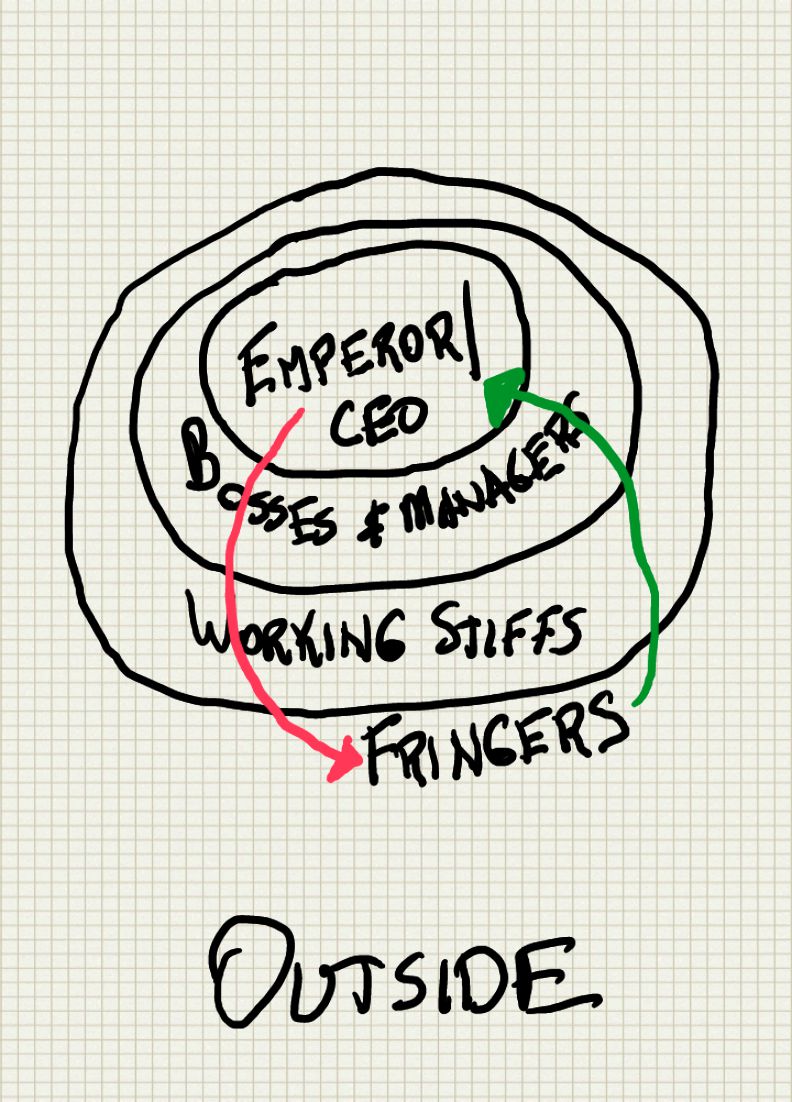
It used to be that the people on top were the ones with the power and the voice. That was back when an organization pushed its one right way of doing things down through the hierarchy. Members either did things the one right way or they walked.
But times have changed and the consummate insiders are desperate (more or less) for new ways to do things to keep the big machine moving. In fact, the big machine seems to be wheezing and seizing more often lately (think Sears or Radio Shack), unable to offer the intimate experience their audiences seek. Part of that has to do with the realizations coming from many voices that there is more than one right way to do things.
What to do?
In The Power of Pull: How small moves, smartly made, can set big things on motion (NY: Basic Books, 2010). Authors John Hagel III, John Seely Brown and Lang Davison advocate, for starters, listening to the people on the fringe. After showing examples of people on the fringe who went on to change everything—like Olympic snowboarders and Malcom McLean the inventor of containerized shipping—they observe:
It is no accident that these early examples of performance improvement come from various edges, because it is exactly at the edge that the need to get better faster has the most urgency. Incumbents at the core—which is the place where most of the resources, especially people and money, are concentrated, and where old ways of thinking and acting still hold sway—have many fewer incentives to figure out the world, or to discover new ways of doing things, or to find new information. They’re on top, and they’re ready to keep doing what got them there. But simply accessing or attracting static resources no longer cuts it. Accessing and attracting have little value unless they are coupled with a third set of practices that focus on driving performance rapidly to new levels. (18)
That is why it is starting to make more sense to listen to the person who has just signed up—they might just have a better, more serviceable idea than those invested in the status quo.
###
Image credit: Kirk Livingston

 conversation is an engine