Archive for the ‘Communication is about relationship’ Category
Here’s a note to excuse my absence
I’m sorta here and please carry on without me
It’s Monday so I’m sitting in my work chair.
But honestly, I’m sorta still sketching tombstones in the peaceful, cool graveyard. And I’m sorta still walking Dayton’s bluff above the Mississippi thinking how little control we exert over this force of nature overflowing the boundaries we set.

I’m sorta still at the party commemorating an 83-year-old’s deeply human connections and I’m sorta still cycling through Northeast Minneapolis marveling at the fancy systemic alternative to internal combustion. I’m sorta still reclining in an armchair sorting through Robert Sokolowski’s argument for how little time we’ve spent exploring the notion of absence.
So—yes—I’m here.
Just put your post-it reminder on my forehead. And when I return I’ll send you that copy you wanted yesterday.
Or was it tomorrow?
###
Image credit: Kirk Livingston
People hate me. Immediately. (Dummy’s Guide to Conversation #21)
Can I have a conversation even if I’m in customer service?
Q: Help: I’m in customer service and my conversation partners are harried, angry and nasty. The moment I speak, they hate me and the company I speak for. Conversation is no engine for me most days.

Am I my company’s keeper?
A: I’m sure you’ve found that a quiet, buoyant response to explosive negativity is a good first step. It is nearly always good to avoid matching anger and volume with anger and volume. If you can help your conversation partner feel heard you’ve accomplished a huge thing—especially when your company really wants to hear (your firm does want to make things right, yes?). Repeating what the person said is common in customer service circles these days and is a useful tactic in the rest of life as well. Repeating what someone says without any rhetorical or sarcastic flourishes is a useful moment in saying and hearing.
What other tactics do you practice? I’d be curious to hear them.
But don’t despair: conversation can still be an engine for you, despite each day’s avalanche of problems. Here’s how: consider each conversational event a moment to serve rather than looking for “Thank you.” Because that’s exactly what this is about: how can I (company representative) help you (respected customer) get some satisfaction? There can be immense joy in helping someone. You can create your own meaning by adopting that purpose. And it really works best with no strings attached: you can derive meaning whether or not your hear “Thanks!” or “You changed my life, Mr. Customer Service Guy!”
Some of my favorite people routinely live in this subversively helpful way and their attitude is infectious, possibly even life-giving.
See also #6: Listen to other people’s stuff
###
Image credit: Kirk Livingston
Are You In—Or Are You a Loser?
Is club membership really that critical to you?
Sometimes we observe similarities between work and church. Here’s a way work and church similarly lose momentum with every conversation: making club membership their most important feature.

At work VPs and managers and employees speak in Dilbertesque code. Acronyms are just the beginning. In the medical device world, there are shorthand words for landmark studies, shorthand words for device features and benefits, shorthand words for certain technological functions. Shorthand words for the management focus of the quarter. Unless you’ve been around the team for a time, you wouldn’t understand 60% of the conversation. That’s why advertising agencies routinely hire translators when they get projects with medical device firms—they just don’t get the gibberish these smart people are talking.
At church we put on holy language and use words that make us seem like we are in the know. We deliver these words calmly as if they were on our minds all the time. The language of doubt is mostly unwelcome in this setting—this is where the faithful come for their weekly booster shot. And so language becomes subterfuge.
The problem with insider language at work or church is that it sets up participants for failure again and again. In both settings, many of the folks in the conversation don’t understand the very words they are saying—and don’t even realize they don’t understand. Or maybe they realize it but the insider current is so strong they are afraid to admit their lack.
Plain speech is a subversive force. Not only does plain speech out those not in the know, it actually forces those who think they know to explain or realize they know less than they thought. Plain speech is a force for progress because it breaks down hidden barriers and destroys a primary rhetorical tool for those who want to sit on their knowledge and keep it for themselves and to protect their kingdom.
This is why…again…no question is a dumb question. The simplest questions often carry great power.
As organizations (like work and church) realize they need to evangelize and draw outsiders in as a matter of survival, insider language must die.
Insider language is dead!
Long live language!
###
Image Credit: Kirk Livingston
Should You Make Your Boss Cry?
Just draw me a picture
In a conversation yesterday my new friend self-identified as one who enjoys the “messy work” of helping groups get on the same page. To that I say: may her tribe grow. Because that is messy work indeed—fraught with bruised egos, sullen colleagues and cross-purposed tasks.
I maintain there is a fair amount of artistry involved in helping a group begin to move forward. Those who help others catch a vision for a project or cause have a knack for painting pictures. These pictures help team-mates understand just what is at stake. Those pictures may be dumb sketches or verbal images. The word “picture” here is important because an image conveys emotive content often missing with words alone. Without the emotive content of a picture, we are back to just using our intellect. And intellect only carries us so far. We can know the reasons behind a purpose, walk through spreadsheets and examine data without ever getting our emotive selves involved.

For many of us, real meaning has an emotional nexus. Pushing forward together springs quite naturally from that place where reason and care have linked arms.
The picture my new friend painted drew people from different business units in her organization—each armed with very different purposes and possibly their own rhetorical axes to grind—into a shared objective. The painting of the picture and telling of the story helped gradually align those cross-purposes.
What pictures are you sculpting for those around you today?
###
Image credit: Kirk Livingston
Team Leader As Artist: Let Your Team Crop Your Problem
What does your team see?
Photographers routinely crop and display just the section of the photo they want their audience to attend to. Cropping—possibly the easiest, most straightforward thing a photographer can do—changes the information the photo provides. Cropping also changes the feeling the viewer gets.

The right crop can stir emotion.
Most photographers work at getting composition right and so avoid cropping. Henri Cartier-Bresson famously accomplished that. Alec Soth gets this done too—though his process seems mysterious. The success of their composition looks like an invitation into another world, something frozen in time. Something clearly different from our own daily life.
That is the memorable artistry of the photographer.

Teams can be very gifted at cropping. Since we all naturally see a problem from a different perspective, collecting those perspectives in an open discussion can do a lot to reframe a problem into a most excellent opportunity. For a team to function this way, there needs to be a premium on open discussion. It helps if team-mates learn to value each other’s opinions. Listening and assigning value to each other’s contributions can be learned. I would argue it starts from the team leader (or manager/VP/CEO) and work its way down. Valuing each other’s perspectives (or not) is very much a part of corporate culture. But value can also move from the other direction: I’ve had teammates who valued different perspectives and taught the rest of us to find great joy in listening and considering.
Seth Godin routinely reframes art to include “making connections between people or ideas.” Some reading this will create art today by running a meeting that will make it possible for all around a conference table to hear a new thing. Their process for creating this art will be an examination of a problem that gets cropped from five or seven different perspectives. The result will be a well composed opportunity that has emotive power for each of the people at that table.
What art will you create today?
###
Image credit: Kirk Livingston
Guns & God & GOP: Why Listen Beyond What I Know? (Dummy’s Guide to Conversation #20)
Why listen to a different viewpoint?
Q: I’m a passionate guy. I have strong beliefs and I know what’s true about the world. And yet coworkers and neighbors blather on with their ill-founded stupidities. Why won’t they listen to reason?

A: I’m glad you ask because we all fall into this state from time to time—often without realizing it. What stands as a clear and obvious reason to me looks like wishy-washy BS to you. And your clearly developed opinion looks like ideology-driven, fact-picking to me.
One guy in the Bible talked about an opportune time for everything: birth and death, crying and laughing, speaking and shutting your pie hole. Maybe there is a time to shout your opinion and maybe there is a time to listen to what someone else has to say.
We do a lot of shouting in this country.
What if we experimented with listening?
If there were a time for listening, it would happen in a conversation where we truly wanted to hear what someone else wanted to say. Perhaps we’re talking with someone we respect a great deal. Maybe we’ve purposefully sought out a friend with a different opinion—just to try to hear it clearly.
What if we listened intently to the pieces of reason and fragments of story our friend uses use to tell her side of things? What if we intentionally entered a conversation with the purpose of listening rather than doing battle or proving our point? We all know that the purpose we bring to a conversation has a big bearing on the outcome. We’ll get a fight if we want one. We may get an interesting eye-opener if we listen properly.
Note how different that intention is from the half-listening we typically do while we form our rebuttal. We’re all guilty of preparing a torrent of words to combat the wrong-headed notions spewing from our worthy debate opponent.
But what if it was not a debate we wanted? What if, after listening we tried to summarize what our conversation partner said to see if we could get it right? And only then, after hearing and summarizing, we formed a response. And what if we didn’t reach for the phrases we heard on TV or trot out the canned responses our club’s magazine produced? What if we stayed in the moment—with this friend—and voiced our disagreement even as we continued to listen?
Here’s what can happen: You and I can remain passionately eloquent about what we believe. But we also can say with certainty what our friend believes-though we disagree.
That kind of talk can feed your passion, feed a relationship as well as make for an interesting and engaging few moments of human connection.
That’s why we listen to a different viewpoint.
###
Image credit: Kirk Livingston
Help: My Friend Talks Past Me! (Dummy’s Guide to Conversation #19)
Vary Your Response to Train Your Friend
Q: My friend and colleague stops by many times a day to chat. We do a similar job but in different areas so it’s helpful to compare notes. The interruptions are mostly welcome, save for this one habit of hers that drives me crazy: she cannot seem to hear me. It doesn’t always work this way, but when she gets agitated, she keeps saying the same thing over and over. She doesn’t seem to hear my answer and then she just keeps repeating herself. Sorta endlessly. I want to thump her forehead with my index finger to get her attention, but that seems improper behavior between two adults. What to do?

Wait–let’s talk.
A: It’s good you hold off from thumping your friend’s forehead. Treating each other as adults is a top-notch approach to human interactions and is definitely the right way to go. Your friend gets stuck in an endless anxiety-driven loop she cannot escape. The loop and anxiety are so strong she gets a little lost.
Help you friend by coaxing her off the endless merry-go-round of anxiety. Start by slowing her down—you are trying to break into the endless loop and it may take more than words. Stand. Look into her eye. Hold her shoulder. Speak slowly. Do what is necessary to get her attention. Bring the kind of attention you reserve for those serious situations where you might be delivering bad news, say.
Mind you: you are not talking down to her. Try not to say, “Calm down!” as you might a child who has lost control. This is not a time for condescension or disparaging or ridicule. Your adult friend just needs another perspective to intervene, that’s all. And that’s what you are going to provide. We all need another perspective—probably more often than we realize.
Deliver your response in slow, measured tones. Your point is not to solve the anxiety loop, but just to engage in conversation. Your goal is to work through the problem together, to discuss and sort out next steps. It’s the conversation that is the remedy.
That’s what friends are for.
Keep that up and—just possibly, given time—your friend may see the anxiety loop before she steps on.
###
Image credit: Kirk Livingston
Words Make Stuff Happen
What must you say today to move forward?
And who do you need to hear from?

###
Image credit: Kirk Livingston
Today I’m Listening
What can you hear between the lines—and where will it take you?
I’ll start by listening to a set of phone conversations my medical device client fields constantly. I want to hear the questions. I want to hear the responses. But I especially want to hear the tone of the questions. I’m listening for urgency and for actual language used. I’ll write down the words and note the flow and capture quotes. These notes and my listening will guide the communication that takes place next.

Listening goes places.
I’ll spend the balance of the day listening between the lines for another client. But this time I’ll be listening to the text I am creating for them. And I’ll listen to the process they use to serve their customers. Listening and revising and re-jiggering and re-listening.
Listening is required to know where to go next
What—or who—are you listening to today?
###
Image credit: Kirk Livingston
Brian McLaren’s Poke at Orthodoxy
Our blindness is one thing the emergent church may have right
Syncretism is the melding of different philosophies or religions or schools of thought. The term (“syncretism”) becomes a pejorative that casts some practice in a negative light. My Christian missionary friends will talk about, say, Hindus who have converted to Christianity. And they’ll notice that some of the Hindu practices have found their way into the expression of Christianity—maybe harmless. Maybe not.
Once upon a time fundamentalist preachers would decry drums as a pagan beat that has no place stirring up emotion in a church service (somehow they missed the use of percussion instruments in Old Testament singing—and dancing).
Are those examples of syncretism? Possibly. I doubt there is a black and white standard about such things—there’s no on/off switch for what’s right and what’s wrong. More likely there is a continuum. And at some point along that continuum we decide (that is, someone claiming authority arbitrarily decides based on their understanding) this other person has crossed the line. The convert has gone too far and now that person has mixed the gospel with paganism.
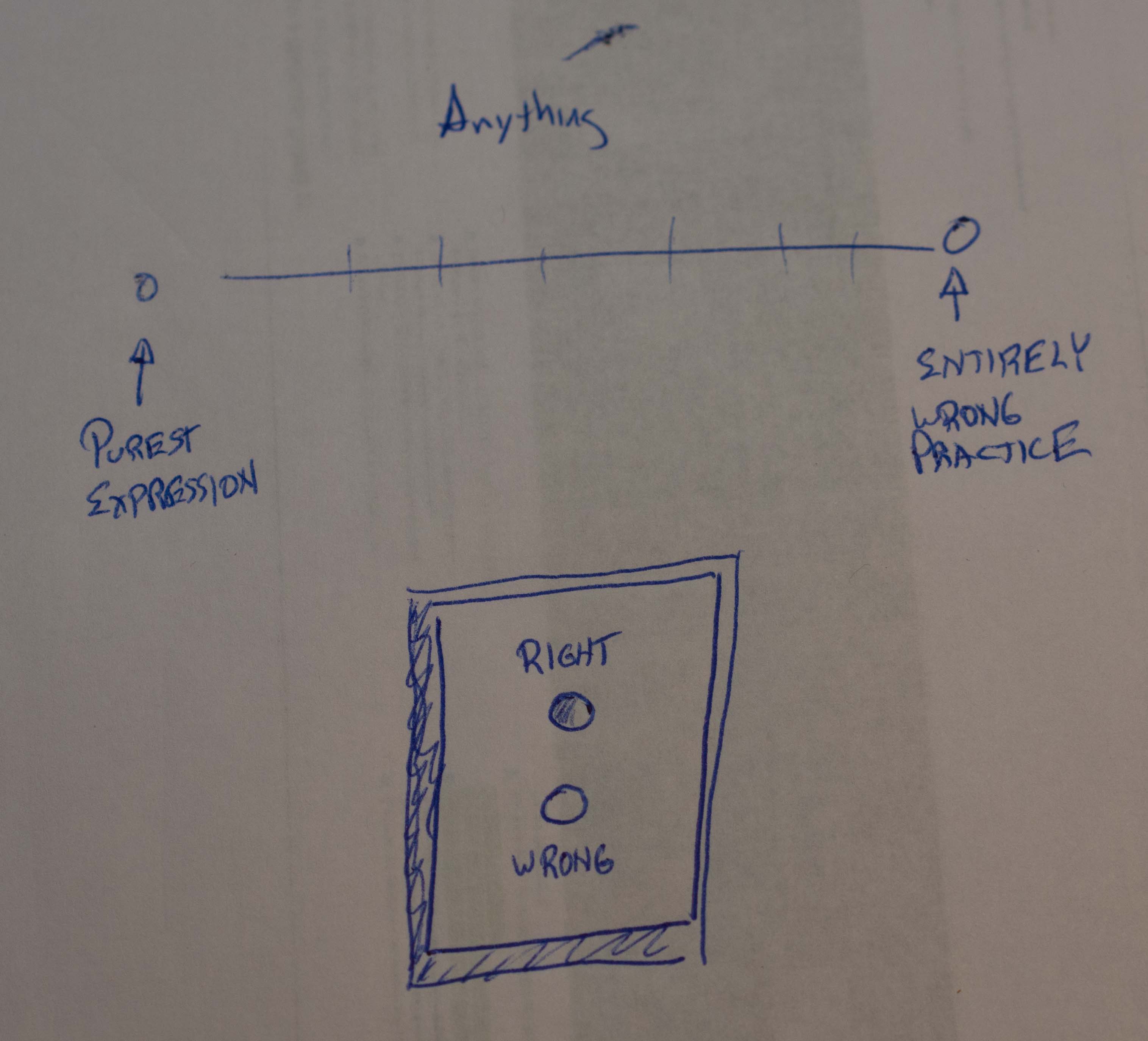
You’re doing it wrong?
Brian McLaren might say: “Not so fast.”
McLaren’s A New Kind of Christianity: Ten Questions That Are Transforming the Faith points out that modern reflections of Christianity (even/especially modern evangelicalism) may themselves owe a lot to this syncretistic impulse. In A New Kind of Christianity, McLaren argued that the reading of the Jewish Bible (the Old Testament) and the New Testament have been overtaken by platonic thinking. He describes a six-step formula that many Christians immersed in the Bible would subscribe to—and then he goes on to point out that formula owes much more to Plato than it does to the Torah. Some argue that McLaren’s is a naïve reading of Plato, which may be accurate: whenever we reduce this to that, we lose nuance and insert our own biases.
McLaren’s notion that we are at cross-purposes with the Bible when we read it as a constitutional law document rather than diligently seeking out (and sticking to) the purposes for which the documents were written also rings true for me. I’ve been on the giving and receiving end of too many interpretations that conveniently keep the people in power in power. But McLaren’s notion has lots of layers that require extensive teasing out and discussion.
Brian McLaren is a lightning rod. People love him. People hate him. It’s not hard to see why, when he accuses the entire ecclesiology industry of syncretism.
I like McLaren’s book because it is a beginning of trying to strip away our syncretistic impulses. Especially those impulses we are so embedded in that we can’t see them, sort of like the fish who doesn’t understand the concept of water. Sure—McLaren’s book has flaws. It turns reductionistic every so often. It makes huge leaps. Yes.
And yet we need real help to see where we have inserted our own thinking into a holy document and called it God’s word. Because this happens over and over again. And I think God doesn’t dig that tendency on our part. I would guess he would prefer the attitude behind, “I am blind. I would like to see.”
McLaren points out some of our blindness.
###
Image Credit: Kirk Livingston

 conversation is an engine