Archive for the ‘conversation’ Category
You and Joe and Industry 4.0
Can we grow the ways we talk together?
Some say Industry 4.0 will be about Cyber-Physical systems, the Internet of Things and the Internet of Services. But I cannot help but wonder if, along the way, some genius with a high EQ will also find ways to bring out the best in people and unearth fresh ways for us to work together.
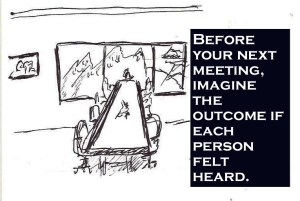
As hierarchy gives way to connecting mission with ideas and tasks, as people learn to bring their whole selves to work (emotion + logic + ethics + spirit—because they are rewarded for it), as people exercise agency and autonomy and ownership at work—things will look different.

Buber: Come on, folks: It’s “I/Thou” not “You are my tool.”
Maybe these geniuses, with the ginormous EQs, will help us understand what happens as we form ever more confining boxes around employees. Maybe they’ll show us that using metrics that note every eyebrow twitch and hand movement, metrics that reward those movements that fit the company goals, those metrics actually measure the wrong things and defeat innovation before it is even begun. Maybe these geniuses will notice that our levers of control over employees also inhibit the very thing we most need to move forward.
I imagine stepping into the office of one of these high EQ geniuses and glancing at the portrait of Martin Buber on the wall—their patron saint of collaboration. I imagine being lectured by these geniuses on strategies around deep listening and meetings that matter and how to disagree with each other productively and how they aggressively eradicate authority-rhetoric & boss speak because it is so demotivating to be reminded that someone owns you. And it is also, by the way, not true.
Let industry 4.0 grow to include people.
Please.
###
Dumb sketches: Kirk Livingston
What we mean when we say “PC”
Conversations will sometimes offend
“We’re all so PC today.”
When I hear this I wonder what the speaker means:
- Does she mean we work so hard to not offend each other that what we say is meaningless?
- Or does he mean he wants to get back to days of privilege (white, male, boss, pastor/priest, authority—name your privilege), back to when a part of our daily lexicon meant disparaging others deemed “less” because they did not line up with us?

If political correctness impinges on our ability to speak freely, that is not good. We must find ways to speak our thoughts—even if it means threading our words through verbal and perceived obstructions and pitfalls. Even if it means offending. But that’s the same with any relationship. Our conversations aim toward pulling others in more than pushing others away (Otherwise why talk at all? Just walk away.), so we take care speak to where our conversation partner is coming from. The end game of speaking our thoughts to each other is greater freedom, better articulation, and deepening friendships. Comedy sometimes makes that leap quickly by abruptly articulating a hidden thought. Those hidden thoughts, when exposed to air, can carry great meaning.
If there is one positive to come from the mouth of the patent-medicine salesman Trump, it is recognition that privilege exists in our nation and now we simply have to talk about it as a nation.
But if political correctness makes us long for a return to days of privilege where we verbally bully anyone perceived as different, then we must work against that. Others are to be understood, not hated. If political correctness helps us begin to see the inherent blindness of our particular place of privilege—let’s embrace that and learn.
We are at our best when connecting with each other.
We are at our worst when building walls.
###
Image credit: Kirk Livingston
The Lies We Love
How to Believe the Preacher’s Story
Let us now name this category of lie: The Preacher’s Story.
We’ve all been here: sitting in church or a political meeting or even in class. The preacher/politician/professor behind the lectern tells a story that illustrates her or his point perfectly.
Too perfectly. And we think:
Wait-that sounds almost too good to be true. So then it must be… false. But who cares? I agree with the point and I’m in agreement with that way of looking at the world. I’ll just check the “true” box for that story.

The Preacher’s Story is a quasi-factual tale the congregation wants to believe and will believe. The point of the story isn’t whether or not it is true, but whether the story advances our cause. We’ve gathered to stoke our fires and that semi-truthy story works just fine for that purpose.
I’m putting most Trump talk in the category of “The Preacher’s Story”: though demonstrably false, still believed because it stokes the tribe’s purposes. Trump’s not alone in this, of course, his preacher’s stories are just the most recent potent poison.
Writers continue to try to make sense of evangelical support for Trump. The last few days have produced several articles citing similarities between the current batch of authoritarian presidential candidates and the authoritarian leadership style many megachurch pastors exhibit (for instance, Katelyn Beaty’s opinion piece from The New York Times). Authoritarian leaders depend on the willing to turn off their fact-meters as they absorb the preacher’s stories. Evangelicals are possibly more willing because of close familiarity with this rhetorical tool.
Can we now name the downside of “The Preacher’s Story”? It appears we’ve been groomed to be gullible.
###
Image credit: Kirk Livingston
Why Honesty is Catnip for Collaboration
In Class Today: Here’s Where I Failed
I first encountered “fail faster” in Clay Shirky’s book Here Comes Everybody. In that book it started to make sense to me that getting something right was a goal, but perhaps not the first goal. Maybe I saw traces of “fail faster” in The Cluetrain Manifesto. As a writer I knew I had to write many (verily: many, many) drafts before I started to approach the thing I really wanted to say. I also knew that the work of moving toward that thing I wanted to say was built on failure after failure, and that each failure left me with something closer to what I intended. Each step in the work shaped the next step in the work And each step in the work also shaped the one doing the work.

motivational pictures
In our Social Media Marketing class last week students presented their critique of their community-building activities (we publish content to define and attract the student’s desired target audience). Midway through these presentations I remembered why I love this day so much. There is an honesty to it. Students describe what they’ve used blogs and Twitter and Facebook (and Instagram and Pinterest and Reddit) and other tools to create for the past six weeks. They show successes. They describe failures. They talk about what they would do differently. In some cases they reimagine the entire exercise for themselves and their team. And sometimes I can see the seeds of a much larger purpose. Sometimes it is quite clear that this person’s passion will push them toward building this community for a long, long time.
And then we discuss failure. Truly, these are fascinating moments in the Q&A that follows each presentation. The great news: everyone fails. Not the course, but in building the grand vision they set out to build. Six weeks in they realize how they could have adjusted their purpose, how they could have set more clearly defined metrics to reach very specific goals. Some realize they did not give it their best shot but instead rushed through and sort of wasted their moments of contact with their target audience. Some realized they could make a solid point with 350 words when they came into the class needing at least 1000 words. Some realized their target audience lived over in an odd unlit corner of the Interweb and this other particular tool would have faithfully delivered them to this audience.
The Big Reveal: It isn’t until you try to actually build something real, with real people and real purposes toward a real end, that you realize life doesn’t not just coalesce around your pet purpose. In fact, this shouting into a crowded, noisy concert hall that is social media must be very deliberate for even the smallest thing to happen. And I mean even the tiniest purpose to move forward.
And as we detail our failures together (I have my own dozens of examples to share), new ideas pop to the surface and classmates who had not talked with each other are now offering ideas and are engaged in the purposes of this other community.
It’s the honesty bit that pulls in collaboration—the telling it like it is. The missing the high mark in a major way that when shared, evokes collaboration rather than pity.
That seems like a solid life lesson to me.
###
The Alchemy of a Thought Remembered
Follow the Instinct to Say Again
We talk endlessly about the question “What is remarkable?” in my social media class. I am convinced that the bits of life that we remember to tell someone else are the very things that make for great conversations. It is that instinct that also powers engaging social media.

Say I run into an old friend and remember I finally read that book she told me about two years ago. Why did I wait so long? “The chapter about the train ride through the Alps was unbelievable and may have changed my life,” I say. I just remembered all this when I saw my friend and she said “train.” I can see that she is happy I read and enjoyed the book—one of her favorites.
Curiously, it is the running into the friend that pulls the trigger on the remembered thought. That instinct to pull from memory a thought stored for a particular person is one to follow. But maybe I did not store a thought for a person. Maybe I just registered a reaction to the book and I’ve been telling anyone who will listen—simply because I think they might find it interesting
Three things about this instinct to remark:
- We often remember for someone—we know they will like this thing and so we tell them.
- In a simple remark, we break complex thoughts into pieces and parts that can be verbalized. We want to be heard so we anticipate the questions our friend will say and pepper our talk on the fly with the answers they seek.
- The connection powers the thought and the communication. And so this memory or thought that becomes a remark goes on to cheer or enlighten or delight our friend.
The answer to “What is remarkable?” has its roots in a mystical intersection of connection, remembering and communicating. We might wish for such connection in our social media practice. The model for true connection is our plain old remarks to friends.
###
Image credit: Kirk Livingston
Marcia Brady and ListenTalk and Learning in 2015
Even the Gray and White Outside Points In
 Surely you notice all the 2015 retrospectives: photography, music, film, advertising. Every industry has some writer summing the year into the ten best. These waning days lend themselves to a bit of reflection.
2015 was a year for trying things. Today I’ll produce my 365th dumb sketch—a sketch a day since January 1, 2015. Did I produce art? Not a single time. But I did learn to see shadow and light and the crazy, limitless variation in the people around me.  I did learn that very few lines exist out in the physical world and that Marcia Brady can look like the Joker when drawn spectacularly wrong.
From publishing ListenTalk: Is Conversation an Act of God? I learned that I need to simplify my argument for listening to each other. In fact, the mystery and promise of conversation has taken hold of me so that I am listening to conversations in a new way. I continue  to wonder what might happen if people at work listened to each other more closely. I continue to hope my nation can learn to listen to people outside our tribe rather than label and dismiss them. I suspect conversation is an engine will continue to sketch out the parameters of useful conversation in 2016.
Outside my window are variations on gray and white. Gray sky. White snow. Dark gray  branches thrusting up toward blue-gray clouds. Lighter gray shadow on snowy edges. It’s the perfect climate for asking about the fruit of a year’s worth of effort.
How about you? What’s got your attention as 2015 melts into the gray?
###
Dumb sketches: Kirk Livingston
And Before You Were Born
What was life like then?
Before Instagram. Before Twitter. Before games on screens.
Back where your people came from.
Will you run into anyone who can answer that in the next week?
###
Dumb Sketch: Kirk Livingston
The State of Conversation is Strong
Despite the stupid stuff we keep saying
My fellow humans, the state of our conversation is strong—though “strong” may not the first word that comes to mind.

I’ve spent the last few weeks in a funk. Given Trump’s call for banning Muslim entry into the U.S, and Franklin Graham’s approval of that plan (never mind that Graham’s inherited salvation-industry hinges on reaching out to the very people he wants to ban, which is bad for his business model); and given Jerry Falwell Jr.’s call to arm his student body; and given what seems to be tacit agreement with these lunacies by a too-large percentage of my nation’s population, it seems the voices calling us to act on fear are winning.
But here are two hopeful signs:
- A poll out today suggests that the majority of Americans do not agree with Trump’s fear-mongering.
- An open letter from Wheaton College students to Jerry Falwell Jr. rejecting his strange twist on Christianity and reminding him that the religion he espouses has little in common with the hostility he voices.
Beyond those signs, the inflammatory rhetoric flying about can at times serve to stimulate solid conversation. For me those conversations have come out of a pit of despair, but they can still be productive. Just saying aloud what we really think can be like draining the pus from a wound: ugly but necessary. Maybe our conversations can start a long-term suturing that can help us heal. But we’ll need to listen to each other and not respond out of our instinctual fear.
All this fear-rhetoric is pivoting me away from the rabid voices and back toward seeking conversations with people who are different. At our best we welcome people even as we trust. We start by engaging in conversation.
Fie on the fear-mongerers.
###
Image credit: Kirk Livingston
Tag:
From “You Suck” to “Say More”
Advance Your Conversations by Providing Wee Bits of Pivot

My client has a big agenda for her healthcare organization: she wants her colleagues to reconsider how they purchase their millions of dollars of medical equipment every year. As we talked we realized there are a set of steps her colleagues take to see things differently. Every conversation can be a step, bringing in information, yes, but more importantly, bringing in emotional connection, along with wee bits of pivot. She needed to provide the right information at the right time at the proper emotional setting.
That’s because we use rational thought to change our minds. But changing our minds is also an emotional activity. Reason and emotion together help us see and do things differently.
If you are convinced you are right about something—and most of us are dogmatic by default on dozens of topics—then you state your opinion flat out and your conversation partner is forced into a binary response:
- “Yes—I agree. You and I, we are brothers.” or,
- “No. You suck and now I hate you forever.”
But if we dial dogmatic back a notch and consider that another opinion may help us, we are poised to deliver words with wiggle, words that help us move forward in a conversation. What we say next allows us to bring more information along with our own emotional force. And even if we don’t persuade someone of our opinion, we’ve had a conversation where we’ve learned something.
And that is significant.
We need a lot of wee bits of pivot just now. Conversations about race, about policing, about religion, about politics—all of these are ripe areas for letting go of the dogmatism that leads to binary thinking.
Can’t we all just have better conversations?
###
Image credit: Kirk Livingston

 conversation is an engine