Archive for the ‘copywriting’ Category
Get a Job. Or Don’t.
Rethinking My Standard Line on Employment
What to say to folks starting in this job market?
I’m gearing up to teach a couple professional writing classes at the University of Northwestern—St. Paul. I’ll be updating my syllabi, looking at a new text or two. I’ve got some new ideas about how the courses should unfold and about how I can get more discussion and less of that nasty blathery/lecture stuff from me. I’ll be thinking about writing projects that move closer to what copywriters and content strategists do day in and day out.

Yeah: don’t bind your legs when you really need to take action.
One thing I’m also doing is reconsidering the standard advice for people on the cusp of a working life. I usually tell the brightest students—the ones who want to write for a living and show every indication of being capable of carrying that out—to start with a company. Starting with a company helps pay down debt, provides health insurance (often) and best of all, you learn the ropes and cycles of the business and industry. I’ve often thought of those first jobs out of college as a sort of finishing school or mini-graduate school where you get paid to learn the details of an industry (or industries). Those first jobs can set a course the later jobs. And those first friendships bloom in all sorts of unlikely ways as peers also make their way through work and life. You connect and reconnect for years and years.
But I’m no longer so certain of that advice. While it’s true that companies and agencies and marketing firms provide terrific entry ramps to the work world, they also open the door to some work habits that are not so great. Every business has its own culture, of course. Sometimes that culture looks like back-biting and demeaning and discouraging. Sometimes the work culture can be optimistic and recognize accomplishment and encouraging and fun. Mostly it’s a mix of both.
But one thing I don’t want these bright students to learn at some corporate finishing school is the habit of just doing their job. By that I mean the habit of waiting for someone to tell them what to do. Every year I watch talented friends get laid off from high-powered jobs in stable industries where they worked hard at exactly what they were asked to do. And most everyone at some point says something like:
Wait—I should have been thinking all along about what I want to do. [or]
How can I be more entrepreneurial with my skill set? [or]
What exactly is my vision for my work life?
Some of these bright writing students are meant to be entrepreneurial from the very beginning. Though a rocky and difficult path in getting established with clients and earning consistently, it may be a more stable way to live down the road. Maybe “stable” is not quite the right word for the entrepreneurial bent—“sustainable” might be more appropriate. The quintessential habit to learn is to depend on yourself (while also asking God for help, you understand) rather than waiting for someone to come tell you what to do.
I’m eager for these bright, accomplished people to think beyond the narrow vision of just getting a job. The vision they develop will power all sorts of industries over time.
###
Image credit: arcaneimages, via rrrick/2headedsnake
70 Sheets. 700 Signals.
My $1.25 Grist Mill
For years I’ve kept notes on conversations with clients.
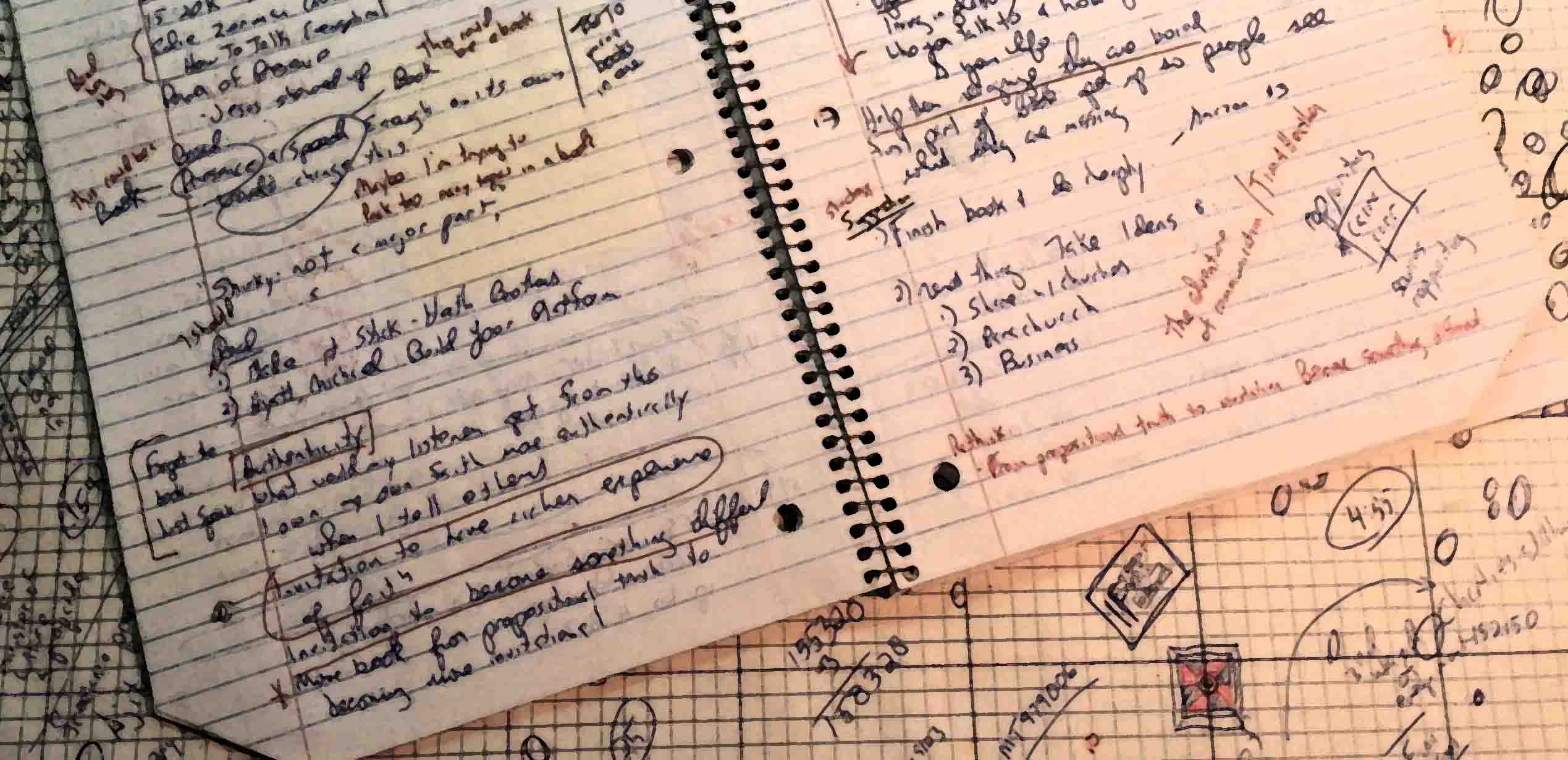
Anyone in business (or anyone in the business of getting something done) knows the value of accurate notes from a conversation. These quick jottings record promises made, delivery dates, special circumstances and conditions.
As a copywriter, I’m also poised to record quotes from my client or team: small summary statements, overview quips, self-proclaimed “dumb” analogies and tangential jokes. These little asides often prove valuable to solving the communication or marketing problem we’re gathered to work on. It’s curious how often the seed for the solution is in the conversation we had that defined the work we would do to solve the problem.
I know this because I often look back through my notes. I go back using a red pen and highlight notes that are proving critical (that’s right: reviewing notes in real-time is productive. Reviewing notes after the work is done is even more illuminating.).
Just today I found myself paging back through my notes looking for a particular conversation and stumbled on another conversation I had forgotten. And that forgotten conversation announced in red ink the precise answer to a communication question I’ve been asking for the last six days.
What good fortune!
###
Image credit: Kirk Livingston
Copywriting Tips for English Majors #8: Work Past Your First Thought
Instant believability is a must + clowns are not a message
This ad is like a DVD scratch that hits at the climax of Inception: all plot and story get stuck and there is no movement forward.

Copyranter offers a mini-lesson in copywriting from this ad from Kazakhstan. Too many times we go with our first gut idea without knowing how the pieces fit. When the pieces do not precisely fit the message is lost.
Check out Copyranter’s list of questions/thoughts about the ad.
###
Via copyranter
VW Ad: Sometimes Copy Carries All the Weight
 ###
###
PSA running in South Africa. Via Copyranter
Writing with Sheet Metal (ShopTalk #2)
The Pull of the Factory Floor
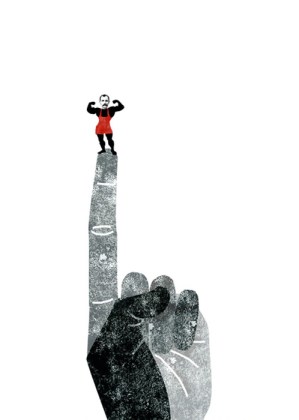 As a copywriter I spend my days in front of a pair of computer screens. Writing. Yes, I have meetings with clients and colleagues, brainstorming sessions and updates and phone calls. But mostly I remain planted before my computer, sorting through masses of information, ordering data that came with competing priorities and generally figuring out new ways to present the right facts to the right people in a way that causes a reaction.
Then there are days I visit a particular client’s factory. It’s a factory with a whistle that blows, union members who take 15-minute breaks, safety glasses and focused workers at benches doing macro and micro tasks. It’s a factory that stamps and welds metal, where electricians wire metal carcasses as long and tall as a semi-trailer. This factory is lit so everything is visible and produces a hum of activity across the concrete floor, which is the size of several football fields.
Why give so much detail? Because many who read this—myself included—spend our days in offices. But a factory floor is a different sort of place—a different world, with a different set of priorities and where production is king but craft sits near the throne.
I like this factory floor because it is different from an operating room, different from a cath lab, different from a conference room during an endless PowerPoint presentation, different from a row of cubicles and different from the Livingston Communication Tower (high over St. Paul). There is an irresistible, energizing activity on this factory floor that flows out of the scores of workers. But maybe that energy also comes from my past, because I grew up watching my dad craft furniture from oak and walnut. Maybe that’s where I absorbed the notion that producing a solid piece someone might actually use is a great way to spend your time and a fulfilling thing to do.
In this ongoing discussion of what makes for fulfilling work, I want to trace fulfillment down a different thread. This thread places the writer in a team with a goal of productivity. The writer and the team are focused on this goal of shipping something real and substantial. At the same time this team is also sort of doing life together—because in the middle of work there are the discussions about the rest of life. For a writer, this team-ness is a different way of spending the day and not to be missed.
Don’t take this as a romantic view of factory work. Instead, see it as the reality of the life situations where your craft takes you to meet a need.
###
Image credit: Yael Frankel via 2headedsnake
The Genius of Aldi OUS
“I don’t like tea.”
I’ve been on a jag of watching Aldi commercials lately. A couple days ago I posted this. And then there’s this odd man with his peculiar fondness. But this is one of my favorites:
Does Aldi in the US make commercials?
###
“You can’t change something that doesn’t exist.” (Copywriting Tip #7)
Where to find courage to create
Designer/entrepreneur Mike Lundborg uttered it dozens of times over a few projects we collaborated on. For me this quote nearly perfectly encapsulates the dance between creativity and work that is the business of freelance life. That’s why I keep the quote front and center in my work space.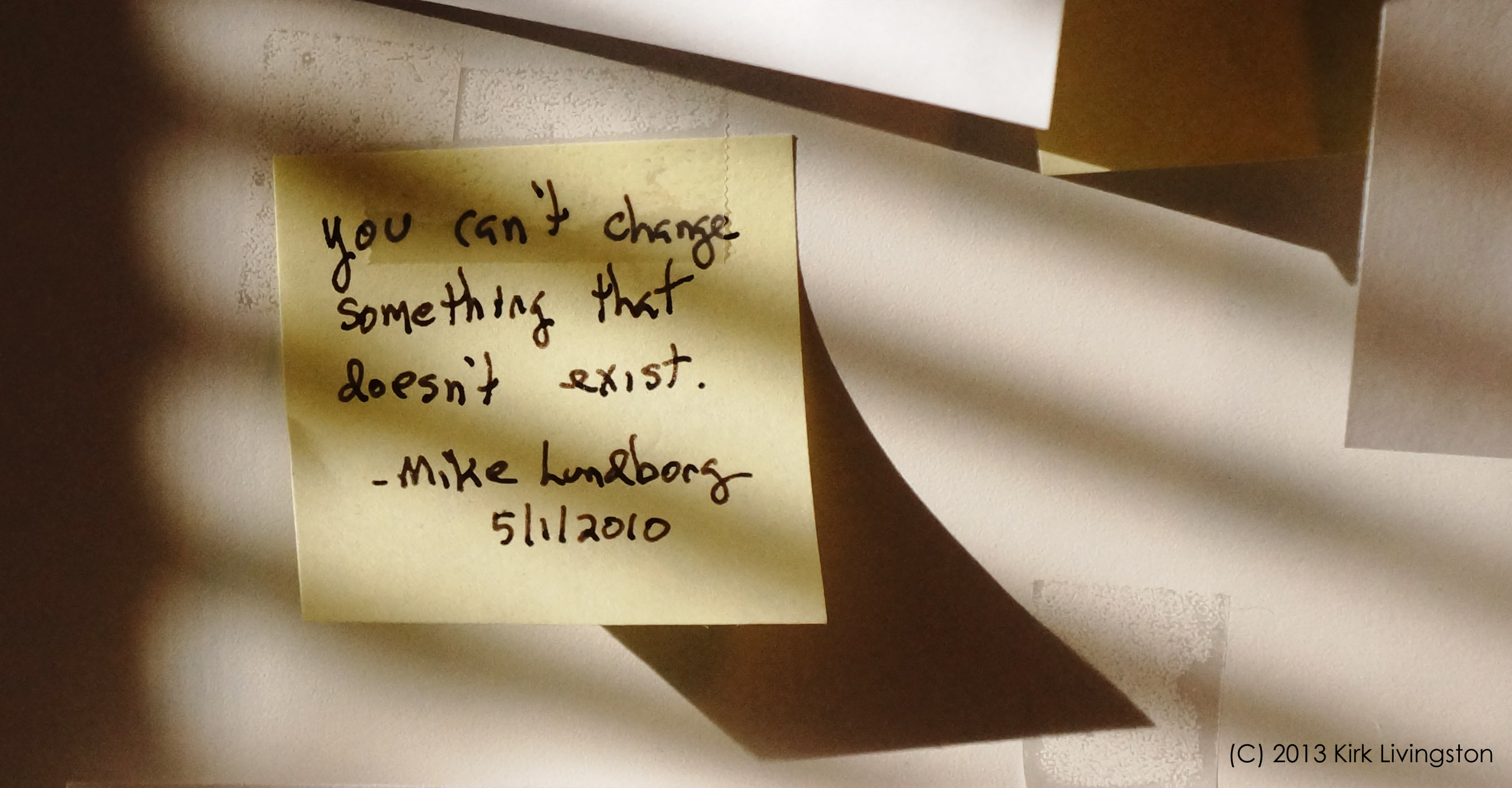
Even today I’m working on a story intended to invite prospective patients to participate in a clinical trial. But early review comments indicate my client wants to buff out the narrative parts (that’s right, losing the story itself) and swap it for clinical and corporate language. The story was meant to pull prospective patients toward a clinical trial, but it won’t if the corporation keeps talking.
But this is not a lament. It’s only a statement of reality and maybe a celebration—because this is how we create together. My sizzling hot interpretation of a marketing objective is held in the tongs of review and hammered into shape by my collaborator. And by me. This is my expectation for my ideas and the resulting words, just as it is my expectation for each part of the process.
And now this: as we release a few of the projects physical constraints, my story bounces back—which makes me glad. This is what collaboration looks like. Successive drafts change but the central objective continually informs all the collaborators as we take our turns shaping the project.
Amazingly, it is this very collaborative process that needs to inform my less commercial writing projects. The courage to create actually springs (again) from the sometimes difficult conversations that surround the project. But it also takes courage to produce a rough draft.
###
What Do You Need To Move Forward?
Applause? Permission? Donuts?
Twice in the past week I’ve asked myself this question.
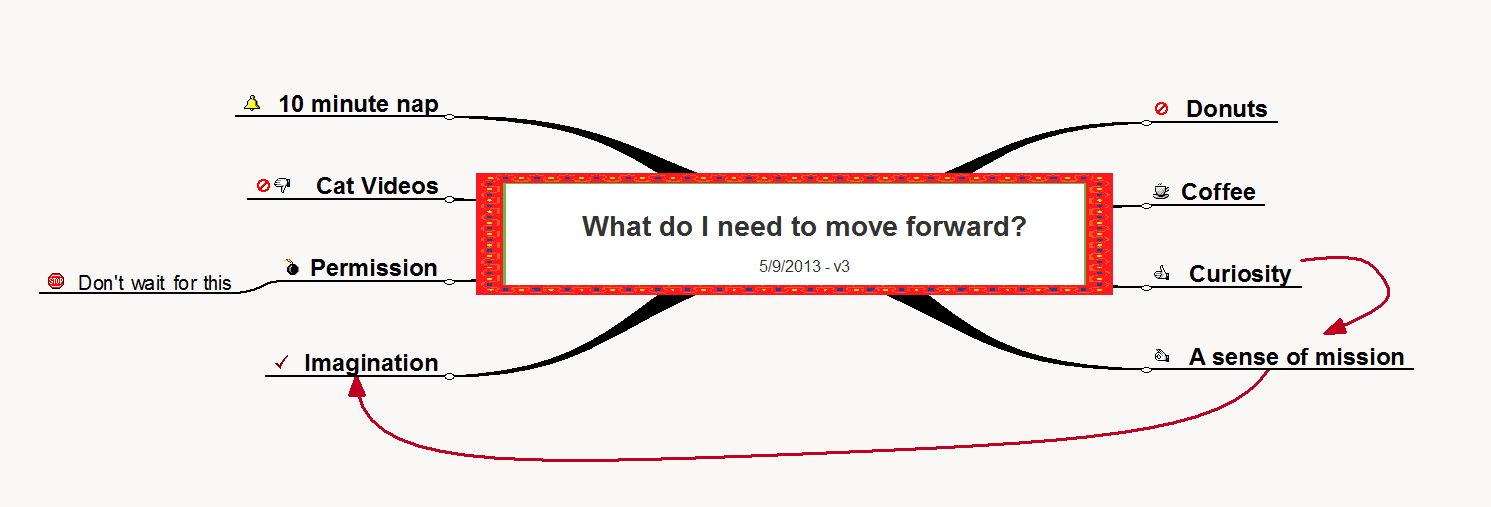 In one case I had just started a large writing project requiring all sorts of information that is not available and will not be available any time soon. My topic is partly in a shipping container in the Pacific, partly in a guy’s head in Scotland, partly in a set of computers in Minnesota and mostly nowhere near complete. But the need is approaching and my content must move on a parallel path with product development. A very specific audience needs very specific information.
In another case the blank page itself kept reminding me of the limitless intrigue of cat videos and TED talks. There’s nothing like a blank page to send you to all the advertising blogs and newspapers you’ve not checked on the web lately.
In both cases a conversation helped me mend the tracks to send the idea and task trundling forward. As I heard myself describing what I was trying to do with the idea and what I needed to complete the task, I realized I have the tools before me right now. There is nothing holding me back.
Waiting for permission to move forward is nearly as fruitless as waiting for someone to applaud your work or tell you what to do.
We move forward and the work has a role in showing us how to do it.
###
Image credit: Laurent Millet via 2headedsnake, kirkistan
I hate you so much love from me to you
When to poke your target audience in the eye
My client needed to reinforce the why behind a clinical trial. We needed physicians to remember their tried & true therapies didn’t always apply under this particular set of calcified conditions. We hoped for a visceral reaction to help change fixed treatment habits toward a killer disease. The poster was both over the top silly and aimed at the gut of a largely intellectual audience.
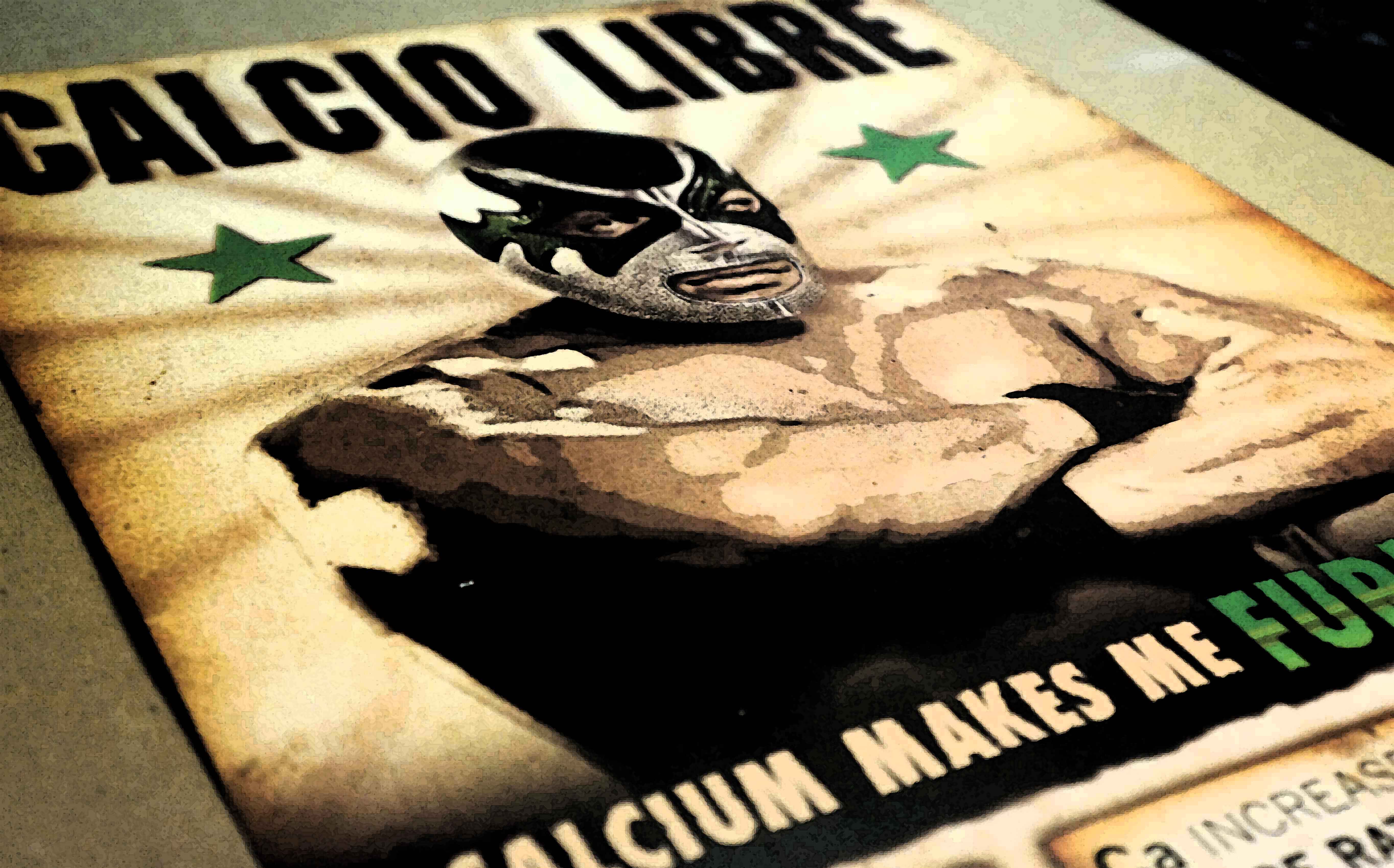
Some hated it. Some loved it. Some thought it went too far and was not appropriate for a clinical setting. Some found their rage against the disease. The poster polarized even as it got attention. And that was the point.
Not all our communication is meant to slip into the space between us like links in a chain moving meaning smoothly from your mouth to my brain. Sometimes you need to jar me from my stupor so I can really understand what you are saying. Because what you are saying is urgent and important and not business as usual. This is why teachers make students stand and move every 15 minutes or so—to restart the brain. This why street preachers are uncomfortable and often memorable.
Rather than automatically aim for consensus, challenge your team about the kind of reaction you want from your target audience. When does it make sense to provoke?
###

 conversation is an engine