Archive for the ‘copywriting’ Category
Stuck and Reframe
Just How Real is Our Imagined Beginning?
I’m stuck on a client project. Late in 2015 I devised a social media communication strategy that calls for weekly themes. But one of my weekly themes provides very little fodder for producing content. And so I’ve been spinning my wheels and getting exactly nowhere.

Maybe it’s a good time to be stuck, because this is the season of reframing. Old things ended as 2015 shuffled out and new things began with the calendar change. Everything outside my window looks the same, but we’ve all group-thinked (group-thunk?) ourselves into what we call a new year. Is it an imagined new beginning? Of course. But that doesn’t make it any less real. Somehow that calendar change gives a bit of courage to consider releasing the strategies that don’t work.
Reframing—trying to see a problem or need differently—is a way out of stuckness. My tools for building a new frame around a client need or personal problem include words on pages and dumb sketches and mind-maps and fartleks and conversations. You already know that conversations hold quite a bit of promise: telling someone else about your stuckness has the effect of bringing to light a problem and beginning to find your way through it.
If you are of the tribe that makes resolutions, you also know that telling your resolution to someone can have a positive effect on keeping those resolutions. And you may even have someone who holds you accountable.
I’m stuck on a client project.
I’m going to talk with my client.
Staying stuck is not an option
###
Image credit: Kirk Livingston
The Naked Copywriter (NaNoWriMo)
I’ll be absent for a month or so.

November is National Novel Writing Month. Last year I wrote the 50,000 word Fresh Water Fetish. This year’s 50,000 words are dedicated to story and explication around what it means to live a creative life. This may be a novel. It may be creative non-fiction. But in 30 days and 50,000 words I’ll have a better idea.
If, in my absence, you wonder what “conversation is an engine” might say about any particular topic, just type your term in the search bar. There are more than 1130 posts here–feel free to browse.
Alternatively: write your own novel for NaNoWriMo!
###
7 Questions that Shape Your Art/Work Life
Please Write this Book: The Freelancer’s Attitude Kit
I’m working out new ways to present the freelance life to college writing students. They are interested in this independent life but not clear about all it entails. They wonder: is there more to it than sitting around in your underwear all day?

I’d like to present them with a textbook that answers these seven questions. Because these are seven questions that freelancers and other independents continually ask and occasionally even answer. These questions are useful for anyone trying to figure out the relationships between work, craft, art and employment.
- How do I balance art, craft and economics? Is it even possible? Because there is stuff I want to do that has no audience. There is stuff I’m less interested in that has a larger audience. And there is stuff I can do to pay the bills, which frankly doesn’t engage me much. I feel less fulfilled when I do that third category of stuff. Then again, I feel pretty fulfilled when I cash the check from that third category. Part of the answer has to do with what your time in life allows. Part of the answer has to do with the economic choices you make.
- Is it me or is it you? What does it mean to care for others with my work? Is it possible to use my art or craft or skill to truly look after the needs of another—or perhaps to look after the needs of an organization? One point I’ve made repeatedly to students is that while introspection is one way to sort out who you are—and our creative lore pegs introspection as the main work of writers and artists—there is another way. And that way is finding places and people to work alongside and, well, serve. Sometimes we begin to sort out who we are as we seek to help others. Sometimes our collaborator and our collaborative processes reveal more than we could ever sort when isolated at our desk or easel.
- What unseen forces are at work? I am a copywriter who also believes that God answers prayer. I am a copywriter who is also comfortable with artists who say the universe provides. My point is that the independent person has a better perspective when convinced there is more going on than what they can muster on their own. For example: every client I called last week said “No.” But then two new calls came in from completely unexpected sources. And these calls said “Yes.” Coincidence? Faith of one kind or another plays a role in this life—especially if a spouse/children/mortgage are part of the picture.
- Where does my ladder lean? Aiming for the approval of your boss is not bad, just limited. Bosses change—and sometimes very quickly. Better to climb toward a larger goal. In corporate life, we climb toward this position or that responsibility. In freelance, we climb toward this kind of project or that kind of project. Freelance does not have titles and offices that automatically designate how important you are. Are you ready for that? Freelance depends on intrinsic motivation—the stuff that bubbles out from inside. In fact—it turns out—that corporate life does too. The intrinsically-motivated colleagues are far and away the happiest, because they do the work out of willingness and mission. Just like freelancers.
- What do I look like, an entrepreneur? In fact you do, if you are someone who sees a need and starts to figure ways to meet that need. One textbook defines entrepreneur this way:

Entrepreneurship is the process of identifying opportunities for which marketable needs exist and assuming the risk of creating an organization to satisfy them.
–Hatten, Timothy S. Small Business Management, Entrepreneurship and Beyond (New York: Houghton Mifflin Company, 2003)
There is risk with the approach: you might fail. It might take a long, long time. This approach requires turning that intrinsic motivation into an engine that chugs along every single day. That can be exhausting, especially when met with a daily chorus of “No.”
- What’s sharing go to do with it? Today artists and writers and crafters and tribe members find each other online. Not exclusively, but frequently. Part of the independent life has to do with finding generous ways to talk about your passion. This is not shilling for work, this is giving away good stuff. Good stuff that people can use. It turns out that clients just might find you this way as well
- What if people knew how weird I was? That’s right, you are strange. Really strange. But everyone is. Freelance capitalizes on weird by you doing what you do in the way you do it. Freelance is the opposite of cookie-cutter. It is niche-building with much of your weirdness intact (not all, people will run from you).
That’s the book I want to use as a text. Some books I’ve read come close.
What questions shape your work life? Tell me if you’ve read this book.
###
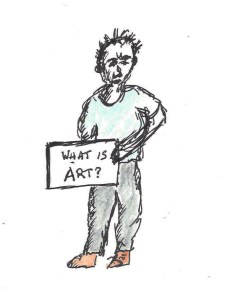
Image and dumb sketch credit: Kirk Livingston
Recast Your Story
Melt. Turn. Form. Repeat.
More and more of my work is recasting. Telling an old story in a new way: finding the locus of interest for today, for these people, living right now. These people who don’t care how the story used to be told—it meant nothing to them and seemed irrelevant if not invisible.

My industrial-controls client wants a new way to talk about a neglected product. I write to find the words and the approach to make it interesting for today’s audience. My medical client wants to recast the backbone of their selling proposition with proper science and citations (versus just their own internal studies, which were not wrong, just limited). A consulting client wants to turn their expertise into a broader story that pulls in people outside the narrow audience with which they’ve been successful.
My process is to play with the story element. That’s why writing often seems like play or goofing off. It must be so: that’s where key discovery happens. Sort of like the process in my daily failures at Dumb Sketch Daily. I don’t know what’s right until I draw it wrong.
It occurs to me this recasting process is going on all over my life. Writing and faith and parenting and exercise are all changing before my eyes. A new story keeps getting told about each and it is important each story is told—telling and retelling the story helps me understand life. Maybe the retelling is all about making meaning.
What’s changing in your life and what story do you need to recast or retell? And who might benefit from that retelling?
###
Image credit: Kirk Livingston
Volkswagen up!: Takes you places
Here’s a tagline with a brand promise you can believe
This approach appeals to the utilitarian cynic in me.
Via Ads of the World
NOLA: Same words. Entirely different experiences.
Your Interpretation May Vary
Maybe you’ve seen a version of these New Orleans tourism spots. What is remarkable is how the same voiceover is used in all, but each depicts an entirely different experience. Tim Nudd has some smart comments on the three at Adfreak.
I watch these and cannot help but think about how we interpret any text, And how each understanding of a text is different because of the intentions we bring to a text and the experience/baggage we also bring to our reading. That’s why we talk through how we read things—your interpretation gives a fuller perspective to mine. And, I hope, vice versa.
These three ads tell that interpretation story well.
###
Via Adfreak

 conversation is an engine