Archive for the ‘Creativity’ Category
If you say a dumb sketch, will others pay attention?
Engineers aren’t the only ones who love to correct you
I’ve been repeating myself recently to different people and groups within my client’s shop.
I’ve been saying aloud the oral version of a dumb sketch. I’ve been telling and retelling the story of how I thought one thing but then in conversation with different experts, came to see what I thought was really not so at all, but something different. I know this is terribly abstract and I apologize: We’re working on a new proprietary idea at the moment, so I cannot be too specific.
I thought X was like Y. But it turns out that X is very like Z. And when I tell that story—of trying and failing and trying—my listeners get it. They learn something. They jump to Z and each gets pretty excited about Z—they had not seen Z before. But now that Z is named and out there, Z may just change everything (and not in a breathless marketing-hype way, but really change how people move forward in this particular industry) (Which I cannot name.) (Sorry.) Each mini-audience put the pieces together and then leaps forward in a way my didactic, linear, word-driven paragraphs did not succeed at.
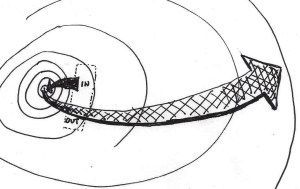 The point of a dumb sketch is to be not-finished. A sketch is the opposite of the heavily produced diagram or slide. The “unfinishedness” of a sketch is the very crux of usefulness as a communication tool. By being unfinished, the sketch invites collaboration and improvement. And people seem to not be able to turn away—at least from the oral version. Failure is built right into my story, and who can resist gawking at a car wreck?
Maybe this is an engine behind John Stepper’s notion of “working out loud.” Maybe this is a key to how we collaborate with each other. We already do this with friends and family, but what if we extend our try-fail-try circle to include many others?
###
Dumb sketches: Kirk Livingston
What Good Is a Group?
The occasional spark. The intentional fire.
I’ve been wondering this lately: what good is a group?
Mrs. Kirkistan and I lead a small group that regularly meets together to read ancient texts. At the moment we’re slowly going through Jesus’s Sermon on the Mount. It’s riveting stuff.
There comes a time in the life of every small group where people start to bow out. Life gets in the way. Work, sickness, commitments and gradually the small group is, well, really small. Only a few show.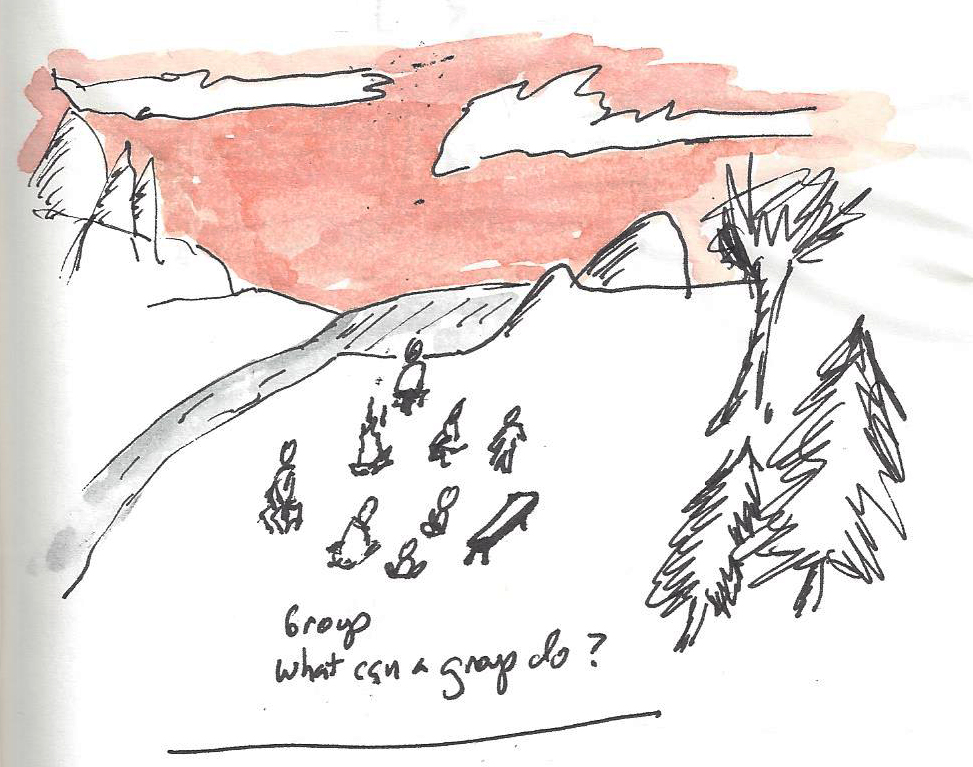
Even so—with only one or two showing up—some magical spark can happen in the course of an ordinary conversation. We talked about the pointed words Jesus had to say about lust and adultery—old terms we don’t hear much in our culture—experiences so common they seem to be just expected parts of everyday life. In the course of hashing through those words, we talked about seeing people as objects. And suddenly I was making connections with Levinas and Buber and realizing I am also in need of reforming bad thought habits.
These conversational sparks happen at work too. Yesterday I was lamenting to myself the ways large corporations dampen the enthusiasm of otherwise bright, motivated people. In the middle of that thought a client returned a call that we had cut short the day before. He had been thinking through our conversation and had five or six things to add. This client—from a very large corporation—had found a way to take personal ownership of the process and our discussion had a sort of breathless excitement to it.
This is rare.
And cool.
Our seemingly ordinary conversation had unearthed some live wire. And a group of us were doing our best to act on it.
So—all this to say that groups can do things individuals cannot. And sometimes a group conversation can create something brand new.
###
Dumb Sketch: Kirk Livingston
George has a superpower. You do too.
Problem: How to get people to appreciate something they already have?
Solution: Dramatize it.
Nicely done.
###
Via Adfreak
Can 78 bad sketches change your life?
Don’t stunt your growth by reaching for fame
It’s funny we gauge personal success by numbers of followers. It’s as if we’ve adopted the business transaction as a model for every area of our lives.
Business wants more eyeballs for more attention for more revenue for more profit. And that makes perfect sense for our business goals.
What’s problematic is when we confuse business with what humans need to move forward: Doing what attracts attention and gathers “Likes” is often very different from the stuff our souls need to grow.

Your business factory is not a solid model for personal growth
One thing I’m learning from the artists and photographers I’ve been interacting with at Dumb Sketch Daily (currently at bad drawing #78) is that while today’s drawing is (clearly) imperfect, there is always tomorrow’s drawing. And I know what I’ll do different in that drawing. I know I’ll try this technique, or that view, or this topic. I’ll do it again and create yet another imperfect representation of the world.
And that’s OK.
Because the pursuit is about learning to see, learning how to draw, learning how to write. Learning how to tell the truth. Learning how to interact with each other. Learning how to be human. Perhaps even learning how to interact with God.
The goal is not fame, unless you really want to turn this pursuit into a business. But learning itself—whether crowds acknowledge you or whether you plod silently and alone—learning is its own reward.
But I still argue your growth is also a benefit to the humans around you.
And while I don’t think 78 bad sketches have changed my life, I can say with certainty that I see things differently than I did 78 days ago.
###
Dumb Sketch: Kirk Livingston
Where Can I Buy a Fine-Art Mode?
The Beauty of Knowing Nothing
I don’t have a fine-tuning mode that tinkers with physical detail. I draw and it is mostly crude. I cut plywood and pine shelves and they are rough enough to make my craftsman-father scoff into his hand. I make dinner and it is mostly broad-stroke stuff that requires very little finessing. I will confess my popcorn is a work of art, combining yellow and white kernels, salted and buttered and mixed to a sensuous, savory smack of flavor. And I am learning how words interact on a page—though it is slow going.

How does someone get to the point of crafting from rough cuts to fine finished detail? It is possible that in this age of ordering clothes, pizza and romance from a button on our mobile devices, that some things still take time. Some things require beginning at the beginning. The question for each of us: do I have the courage to begin at the beginning? To know nothing for a time and do things badly?
The beauty about not having been taught drawing is that you are in a position of the acquirer: the process of figuring it out might take a while, and you will most likely continue to figure stuff out as you go, but that process is yours. There are no shortcuts and no tricks. Just the plain practice of drawing, screwing up, and drawing some more.
–France Belleville-Van Stone in Sketch! (NY: Watson-Guptill, 2014)
You cannot buy personal processes. Not really. You have to make them from scratch—those processes that help you make meaning in the world. And you have to begin at the beginning.
Mistake will be made.
You will make those mistakes.
And that’s OK.
###
Image credit: Kirk Livingston
3 Lessons I Learned Hanging With 70 Artists
See. Do. Share.
A group of artists in the Minneapolis-Saint Paul area gathers monthly to sketch. They call themselves MetroSketchers. These are talented people with facility for capturing life on a page. Yesterday I showed up to sketch alongside them at the Como Zoo in Saint Paul.

- Look To See. It’s easy to spot these sketchers in the crowds at Como. They are the ones balancing a sketchbook, and possibly watercolors or an arsenal of color pencils. They are the ones looking up and down and up and down at the very scene I dismissed with a quick glance. It’s the lingering look with an intent on capturing what they saw that was meaningful to me. Sketchers linger far longer than the causal passer-by. They must.
- Do It. Right now. That’s it—just get it on paper. Whatever you can. This is a lesson that carries over for me from writing. Do it badly, but just get one good stroke on the paper. One good mark among many bad marks. My great contribution to the day’s artistry was the Polar Bear Butt (the only animal who insisted on posing). Bad as it is, it is still a move toward representation.
- Share It. These uniformly talented people were also great encouragers. To a person they were all about what you saw and the marks you made in response. They found good stuff to say even when good stuff was pretty well hidden behind lots of not-good stuff. They also loved to talk about paper weight, the best inks to use, how small they can pack a watercolor kit and, “…here, let’s just walk through my sketchbook together.”
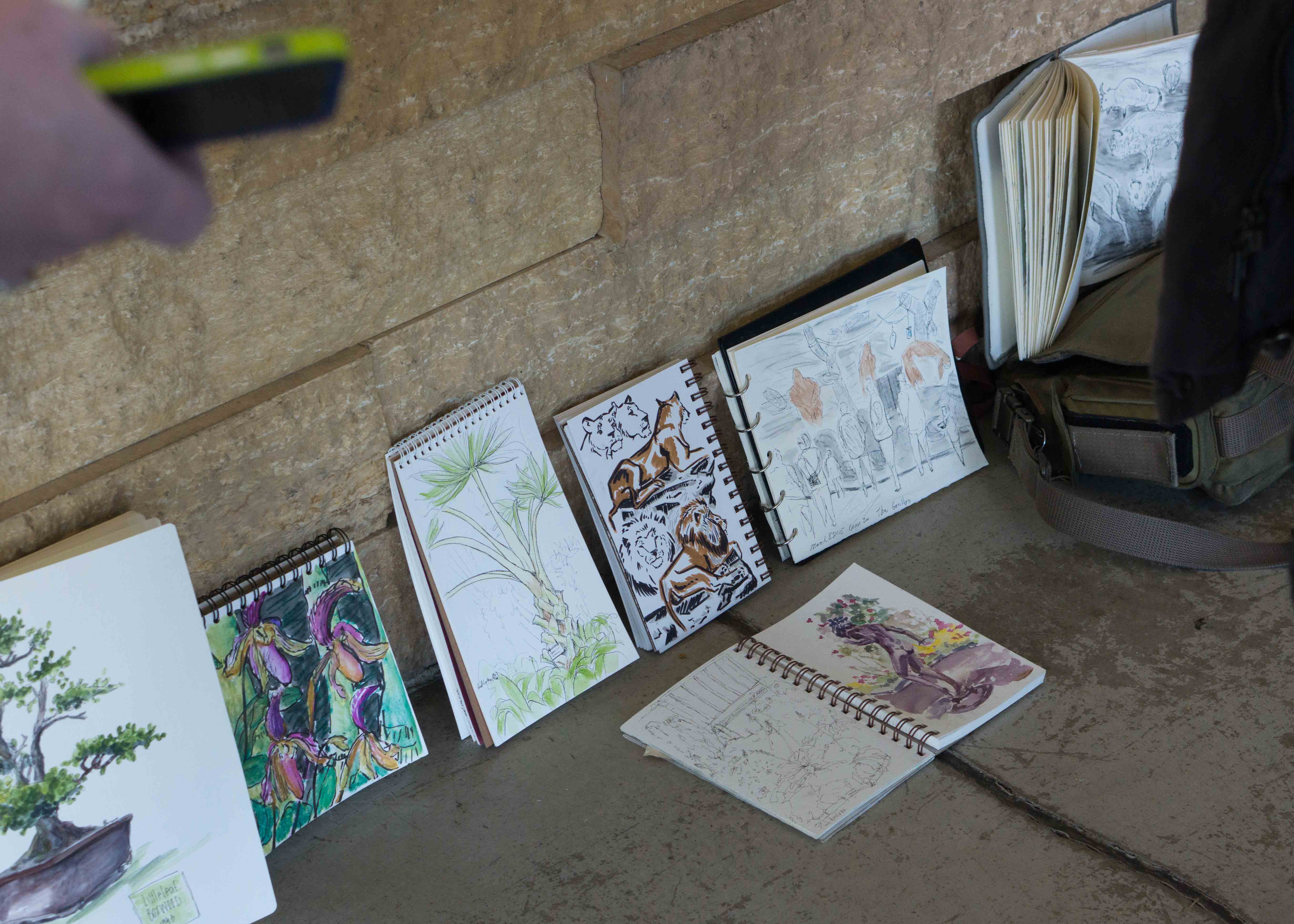
I spoke with many during the sketching and they were more than happy to show what they were doing, to describe how they were seeing and to talk about the difficulties in representation.
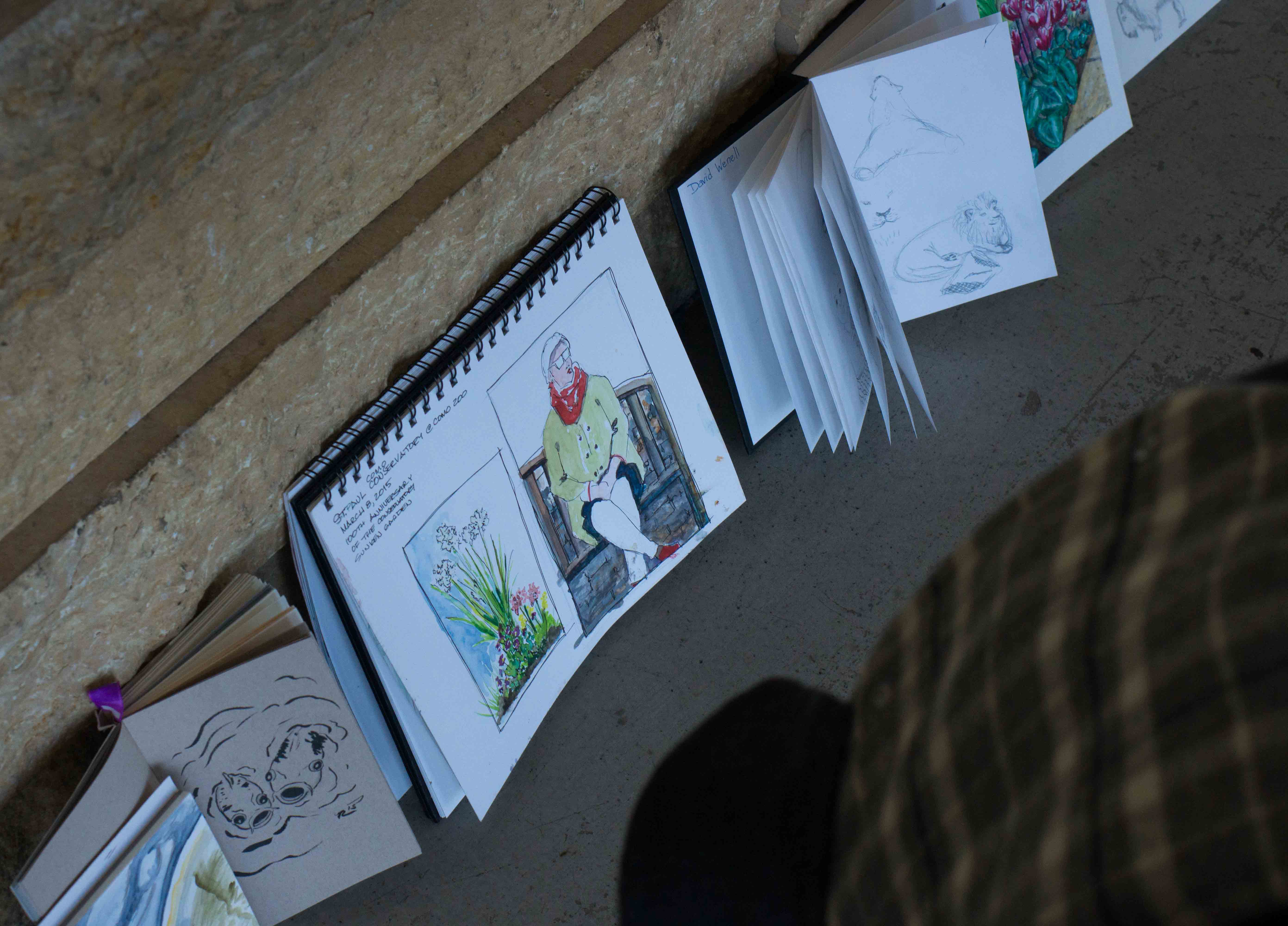
More than one sketcher expressed delight in what they were seeing—and if that is not a perfect reward for the interaction between drawing and seeing, then I don’t know what is.
###
Image credit: Kirk Livingston
Mary Oliver: “Here you are, alive. Would you like to make a comment?”
Just so.

…for always the new self swimming around in the old world feels itself uniquely verbal. And that is just the point: how the world, moist and bountiful, calls to each of us to make a new and serious response. That’s the big question, the one the world throws at you every morning. “Here you are, alive. Would you like to make a comment?”
–Mary Oliver, Long Life (Cambridge, MA: Da Capo Press, 2004)
###
Image credit: Kirk Livingston
Josephine Humphreys: When writing from the center of things
The world keeps aligning with what I just wrote.

Interviewer: When you’re writing, is it that you notice things more acutely?
Humphreys: Yes. You notice everything, and everything seems to be full of meaning and directly centered on the thing you’re writing about. I heard E.L. Doctorow say something like that—that when you’re writing, all experience seems to organize itself around your themes, which can give you some really strange feelings of coincidence and ESP. You start to think you’re onto the secrets of life.
–Josephine Humphreys, quote by Dannye Romine Powell, Parting the Curtains: Interviews with Southern Writers (Winston-Salem, NC: John F. Blair, 1994) 192
###
Image credit: Kirk Livingston
Pat Conroy: How to tell when the story has started
Sometimes Mr. Subconscious arrives at the work site before Mr. Conscious

I think dreams are very important. I think dream journals are important. Extremely important. I have dreamed the ends of books. When I start dreaming about the book, I know it’s now starting.
–Pat Conroy, quoted by Dannye Romine Powell, Parting the Curtains: Interviews with Southern Writers (Winston-Salem, NC: John F. Blair, 1994) 51
I can’t vouch for dreams, but I cannot help but notice how Mr. Conroy’s stories seem to start without him. Writing is hard work, but there’s no denying these bits where the subconscious fills in gaps at the work site before you even arrive.
###
Image credit: Kirk Livingston
Why Academic Writing is so Boring
Insider language bores the outsider
Researchers, scientists, academicians marshal their facts to a higher standard, but with their neglect of the emotive power of language they often speak only to each other, their parochial words dropping like sand on a private desert.
–Sol Stein, Stein on Writing (NY: St. Martin’s Press, 1995) 11.

And please don’t equate “emotive” with flowery.
###
Image Credit: Kirk Livingston

 conversation is an engine