Archive for the ‘Creativity’ Category
What skill will you grow in 2015?
I write and I want to draw and take photos. And write.
I’ve been trying to sketch lately. My son and I started a blog called Dumb Sketch December where we try to produce one sketch a day (inspired by OneDrawingDaily). I enjoy sketching more and more and I am less and less happy with the results. Unlike writing where I have a growing sense of being able to say what I need to say, sketching seems to have plateaued at capturing very little of real life.
I’m at the point where I don’t even know what I don’t even know.
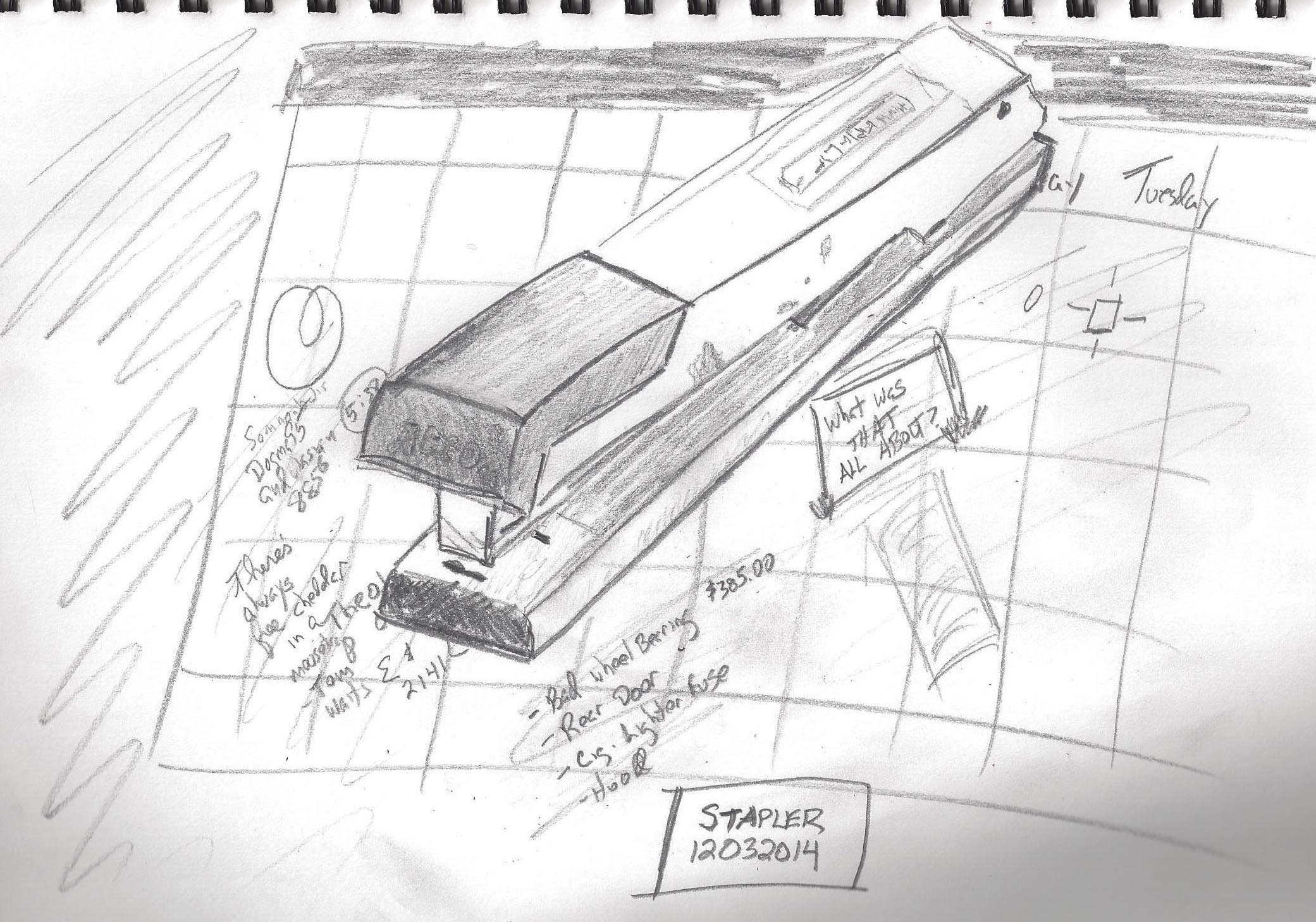
My stapler rocks. My people don’t.
Other kindly sketchers and drawists chime in with encouragements like “Keep going!” and “Huh.” Of course, I’m committed to the dumb sketch approach to life, and I can find a bit of joy in a well-capture shoulder, or when I drew something very similar to that woman’s posture or her pony-tail. I am increasingly drawn to the very black carbon laid down to hint at a clear edge. I’m trying to take lessons from Edward Hopper, though I think he would have given up on me long ago:
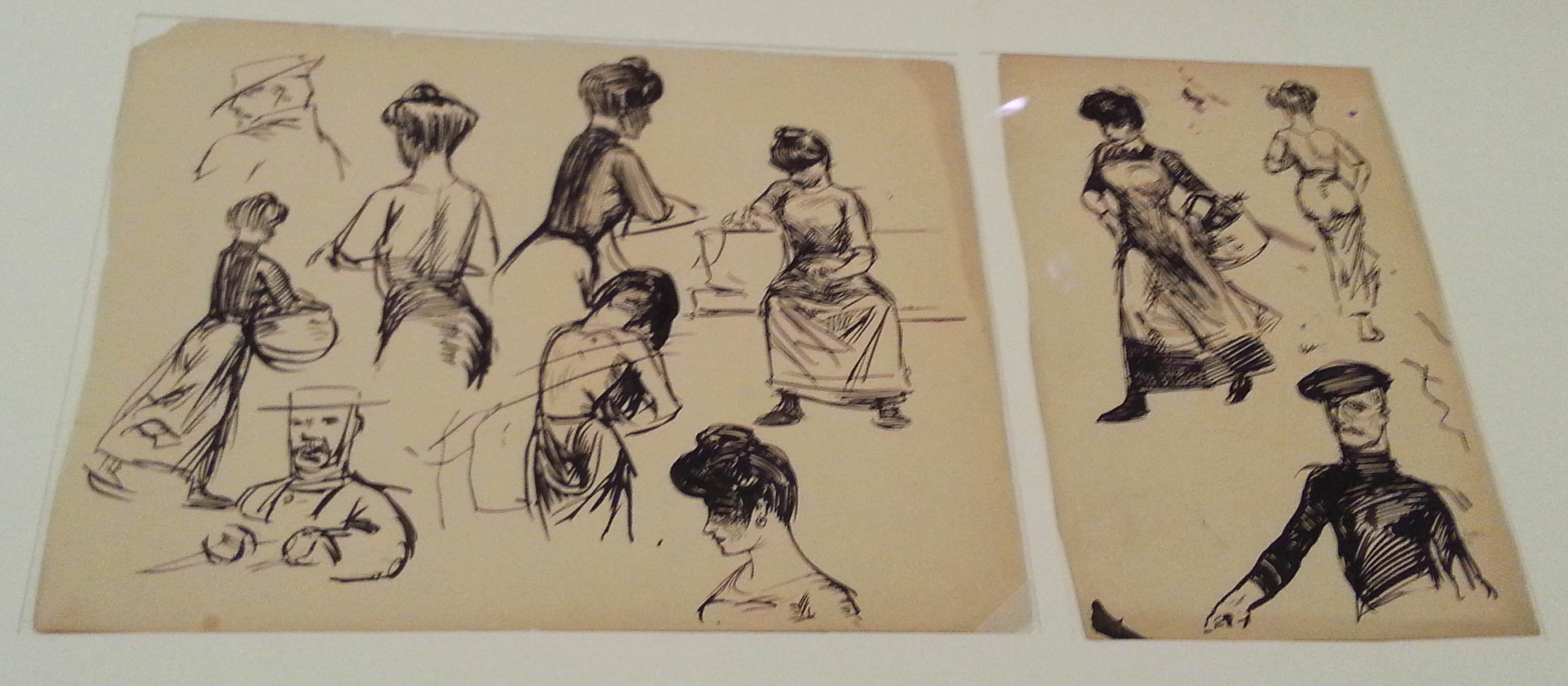
I think we can guess what fascinated Edward Hopper.
But all this to wonder aloud at skill-building. There is something about the intentional action—committed in public—that has a way of squeezing us forward. NaNoWriMo used that force, our more successful diets use that force, weddings are a celebration of the force of intentional actions publicly committed.
What skill do you want to grow in 2015?
How will you make it public so we all can take courage from your actions?
###
Kirk Livingston, Edward Hopper via The Walker Art Center
Policy is the Gulag of Good Ideas
Good Ideas Sour and Stink When Enshrined as Law
“We’ll do it this way going forward.”
If you could do a quick, very honest poll of employees listening to their boss say those words, how many would silently be saying, “No. We won’t do it that way.”
- 50 percent?
- 99 percent?
- 100 percent?

HM Prison Geelong
It is possible the very nature of the hierarchical or “push” corporation lends itself to sapping motivation from good ideas. When ideas come from above as pre-packaged laws-of-this-workplace, a piece of humanity goes dormant in the otherwise engaged employee. Enough of those pre-packaged laws-of-this-workplace and work becomes full of half-functioning automatons.
A room full of automatons working only for the weekend or the money or to keep a job or to avoid the boss’s wrath may have succeeded 50 years ago, or even 25 years ago. But smart corporations and organizations will study how to turn their hired automatons into full-fledged, interactive humans while at work, not just after work.
Inevitably, that involves hearing from employees. It must be about hearing from more than the boss or those favored few. And know this: engaged people talk and discuss. That is the way of owning a process. Automatons cannot own a process. But engaged people can own a process, no matter where they fit in the organization.
Once upon a time, the lovely Mrs. Kirkistan and I spent a few years at a volunteer organization that had a compelling mission. But that mission was hindered by a hierarchical leadership approach that treated volunteers as cogs in an unyielding machine. There was no room to engage, revise, add-to or direct from within the roles we played. Only a few key leadership voices could do that. We eventually walked, as did other talented people in a variety of roles.
Coming generations of working stiffs will expect their voices to be heard. Or they will walk.
We can all grow in listening for engaged voices with solid ideas.
###
Image credit: Kirk Livingston
Ecotricity Collapsing Cooling Towers: One Memorable Brand Voice
One gets the sense they don’t take themselves too seriously.
Old 2012 ad. Still cool.
Via: copyranter
Can You Engineer a Conversation? (How to Talk #2)
Depends: Are you looking for control or insight?
In Moments of Impact: How to design conversations that accelerate change (NY: Simon and Schuster, 2014), Chris Ertel and Lisa Kay Solomon argue that some of our most productive conversations come from deciding ahead what we want from the interchange. Their book presents a system of on-ramps that will be particularly useful for anyone charged with gathering a group with the intent of going further than the old, fallow brainstorming sessions allowed.
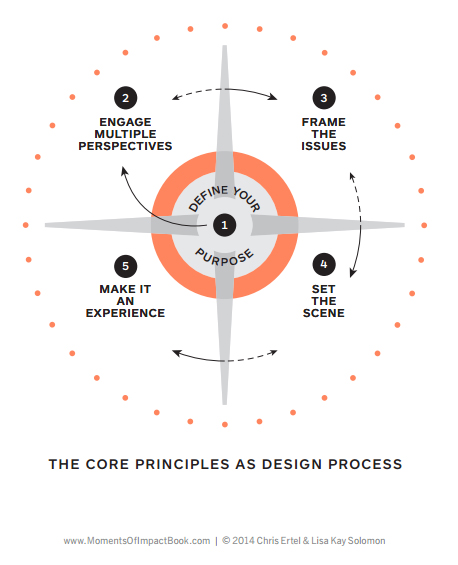
Conversation, as everyone knows, can be far from benign. For those looking to control a conversation, unless highly skilled, the better (and far less productive) option may be to continue with monologue.
Because a strategic conversation consists of live interactions between people with different perspectives and passions, you can never predict exactly where it will lead. (41)
That is the beauty of conversation: the whimsy factor can drop participants in places they never expected to arrive. That is also the danger—especially in corporate settings where a particular outcome has been strongly hinted at, if not guaranteed.
For those daring souls willing to let go, but who still retain a preferred outcome, Ertel and Solomon’s notion of a “strategic conversation” may just fit the bill. Start by sorting what you are trying to accomplish: build understanding, shape choices or make decisions. And then employ divergent and convergent thinking and other group exercises as necessary.
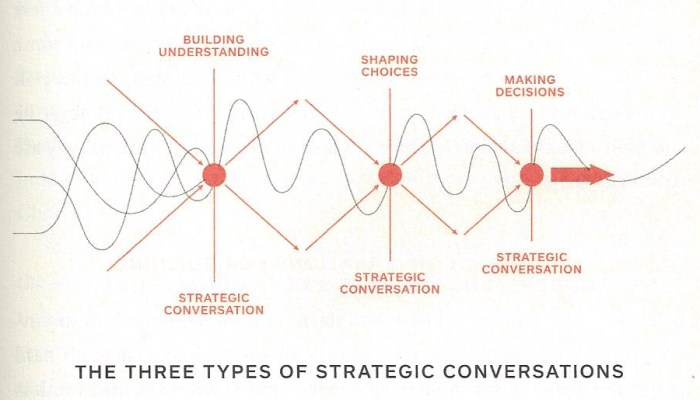
What I appreciate about Ertel and Solomon’s work is they have built a framework around the basic serendipity of conversation and brought it as a tool into even very hierarchical structures.
I am convinced we’ll find strategic conversations a formidable tool indeed, especially as we create brand new stuff out in the world.
###
Image credit: http://www.momentsofimpactbook.com
#NaNoWriMo Update: Twin Cities—15 Million+ Words in 15 days
24449 are mine
Nobody claims their words are any good—just to be clear. It’s all quantity over quality—so take that, Mr. Internal Editor. Anyway, that is the whole point of National Novel Writing Month.
I will say an unexpected suicide started the whole thing and now I think I see resurrection on the horizon. Loyalty and romance have turned up, plush a flash of skin and a skinny guy unafraid to take two jelly-filled donuts even with everyone watching. My main character is a strong, passionate woman who can make a CEO bite his lower lip–oh, and she’s been dead for at least a week. Did I mention the oracle named Franklin Delano Sjogren? I’d like to get a coffee with this guy and ask him my most vexing questions. My hometown of Stoughton, Wisconsin took a hit sadly. City fathers will not be pleased.

As always, I have no clue how (if?) this will all wrap up. But for now I’m rooting for a couple characters as I move toward 25000 before midnight. But I sense danger.
Does this count as working out loud?
###
Image credit: National Novel Writing Month
Wait—English Majors Win in the End?
Start Writing Your Own Future
- Announce your goal to lose weight and chances are better the pounds will flee.
- Sign up for NaNoWriMo and chances are better you will actually write that novel (no matter how badly it turns out).
What we tell each other has a way of happening. What we tell each other about our preferred futures has a way of guiding next steps.
- Write a letter to your collaborative, inventor friend about a business idea and find yourself planning concrete marketing and distribution steps at Spyhouse Coffee.
- Write a business plan for your startup and suddenly remember your friend who became a venture capitalist. And then remember the friend who bootstrapped her idea.
See the pattern? Each step forward started with communication. You may say,
“No. the idea came first.”
True—maybe.

Create in real time as you go.
But consider: the communicated idea created a spark. And—given the right collaborative conditions—the spark lit a fuse. And the fuse burned, gathering other ideas until the explosive, disruptive future no one had considered.
What if English majors learned entrepreneurship and began to see their talent for orderly, persuasive, deeply-rooted writing as a way to help themselves imagine new futures and chart forward-movement for others? What if they learned to solve real-world problems with story and emotion and analytics? Their solutions would drop-kick the spreadsheet & PowerPoint crowd. What if some English majors created Lake Wobegon while others created the next Google?
What if English majors learned business lessons alongside the standard fare of reading and writing? What if they were expected to serve up the occasional business plan or marketing strategy along with the usual essay, short story and poem?
If that happened, English majors would connect earlier in life that art and work and commerce and fiction and meaning-making all fit together in the same world. And they would begin to write their own future vocation.
By the way: 16 Wildly Successful People Who Majored in English
###
Caveat #1: I was never an English major.
Caveat #2: I teach English majors. They are smart, innovative people.
Image credit: Kirk Livingston
Tom Dimock: Work & Art & Plein Air
Do [not] Disturb
Leave me alone to do my art—and leave cash on the table on your way out.
Who doesn’t imagine free hours to focus on your art or craft?
I’ve been trying to connect with a local filmmaker to chat about how she balances art and commerce. She’s already hinted once that “Commerce wins.” And though she says that, the truth is that she keeps producing her own films, which screen locally and nationally.
At the recent Art Attack at the (ginormously huge) Northrup King Building in northeast Minneapolis I ran into painter Tom Dimock. His painting of Red Wing’s Barn bluff caught my attention—so much so I had to show it to Mrs. Kirkistan as well (making it “remarkable”). In particular, Mr. Dimock had two versions of the painting: one done outside in cool Minnesota air (plein air), one done as a re-creation from a photo. Here’s the plein air version:
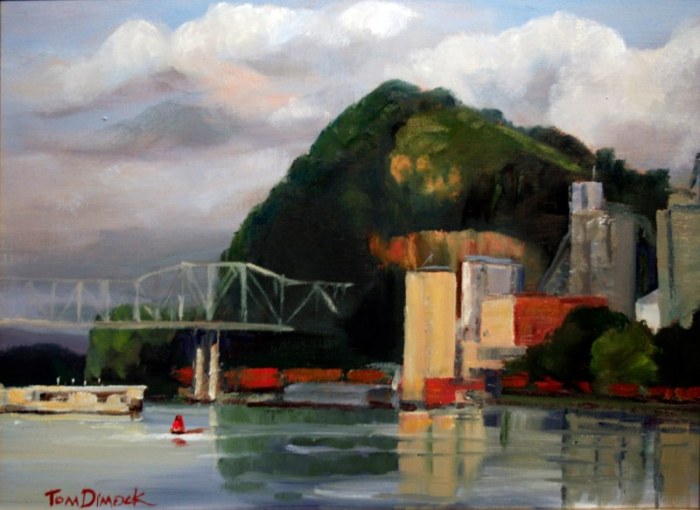
As much as we want to be free to practice our art: free of financial concerns, free of time constraints, free of any obligations, I rather think all those little tugs at our consciousness find their way into the art itself. To me, Mr. Dimock’s plein air version has a different feel than the painting produced from a photo (not pictured).
All of this to hint that waiting for enough time or enough inspiration to practice our craft or art is a fool’s wager. Instead there must be something of the plein air to our craft: doing it when we can. Practicing in whatever bits of open time we find, even out in the open. I routinely wedge bits of writing between work assignments . Big expanses of time are rare and unless I am practiced at my craft I’ll just waste time on everything but the work itself.
Plein air suggests the things we create are built more realistically in the moment, right in the context of everyday life, rather than separated and isolated. Things built in the moment, out in amidst the chaos may also yield a more true light, which is one of the keys to authenticity, whether in painting or writing or photography. It’s not hard to start applying plein air to lots of life’s bits and pieces.
Maybe plein air is the difference between what we used to call ivory tower thinking and boots on the street action (if you’ll excuse my badly mixed metaphors). Maybe that is why some of the books on my shelf go unread because they are so detached from real life while others drop me in the thick of human interaction time and again (Ian McEwen’s Atonement is doing that for me recently, as is John’s gospel).
How do you manage to practice your craft?
###
Image credit: www.dimockart.com
Brian Eno: “Everything Good Proceeds from Enthusiasm”
“Some people are more prepared to take advantage of opportunities than others.”
I’ve been a fan of Brian Eno since his Roxy Music days.
I’m not always crazy about every track from Mr. Eno, but he is always interesting. Speaking of Roxy Music here’s a first listen of Bryan Ferry’s new album “Avonmore.”

###
Via Valeria Maltoni, Conversation Agent
Image credit: NPR

 conversation is an engine