Archive for the ‘dialogue’ Category
5 Ideas that Will Change How You Talk Today
3 Philosophers, a Rhetorician and a Social Media Expert walk into a bar…
Since writing ListenTalk, I’ve continued to hear these voices echoing in my conversations at work, at home, at church, in the street, at the curling club (I made that up. I don’t curl. Nor do I hurl.).

Here’s what these voices say:
- We have responsibility for others. That’s why we greet people and learn names and acknowledge presence. Our responsibility can do deeper—or not. But it is there from first sight and we all know it. (Emmanuel Levinas)
- People are not objects. So when we treat people as objects, we devalue them and strip ourselves of excellent relational opportunities. People becoming objects can happen in the workplace: it can happen when the CEO looks down on the vast army of minions. It can happen in the home. But it shouldn’t and we do well to defy this narcissistic pull. (Martin Buber)
- Words have incredible power. We can say things and, behold, it is so. Like pronouncing a marriage. Or deciding on a goal. This may not seem so, given the river of words we issue, the mundane, seemingly meaningless conversations that make up 99% of any particular day. Despite the great volume of words avalanching through our lives, they do—at times—hold incredible power. That’s why we hang on the last words of a dying person. That’s why we want to hear the words behind our favorite writer—we want to hear them explain how their story or argument came about. You can probably recount a handful of life-changing words right now, words someone spoke to you at just the right time. (JL Austin and John Searle)
- Our best talk comes when we’re not out to win a conversation. Humans are persuasive beings—we’re constantly trying to convince each other of things. But our best thinking and talk comes when we listen as well. And our worst conversations look like monologue—when someone preaches at us without listening. Those also tend to be short conversations. (Wayne Booth)
- Say what you will. Unless you live in North Korea or Russia, you generally have the capacity to say what you want. Yes, the current Facebook effect seems to be to say only what our tribe wants to hear, but we can find and build new tribes using social media. This is very important, because the old institutional voices are veering from truth more and more frequently. We need those new voices. We need your voice. (Clay Shirky)
Do you see how any one of those five ideas might impact your conversations today?
###
Image credit: Kirk Livingston
Our Best Conversations Satisfy and Anticipate
They can satisfy a question we didn’t know we had.

They can anticipate a question still on the horizon.
###
Image Credit: Kirk Livingston
How Does Anyone Change Direction?
Living with Questions
I met a preacher at a wedding recently. He had just officiated the ceremony, which was a beautiful thing—two people creating a great beginning. Afterwards, making small talk, the preacher told me how a few people in his congregation had changed. I was curious, because I had been reading Howard Gardner’s Changing Minds: The Art and Science of Changing Our Own and Other People’s Minds. In these highly partisan days, where we carefully surround ourselves with our tribe who speak our language, agree with our view of the world and where we ingest the news biased toward our agenda, I’ve been wondering how anyone ever escapes their own personal echo chamber.

“God did it,” he said. “In quite miraculous ways. Real change. 180 degrees.”
The preacher’s story of change had to do with someone coming into his congregation and how their life was different now.
“Wow,” I said, because change is remarkable. And because I like to hear stories about God doing stuff in real life.
“Sometimes I wonder,” I said, “Whether God does stuff or whether people change to fit the new club or group they’ve joined. Because I’ve noticed that the things we attribute to God can sometimes be explained by communication dynamics—how this new club or group satisfies a question someone has. Or perhaps the group dynamic meets an impulse they have, and they are more than happy to abide by the rules and unspoken ways this tribe works. And that looks like change. And perhaps that’s where change takes place: as we adopt a new moral code and sort of work ourselves into it.”
Was the preacher backing away?
“Which is not so say God is not in it,” I added, quickly.
“Hmmm,” he said.
“Because I absolutely believe God works through ordinary conversations in very big ways (now’s when you would mouse over and order a copy of my new book ListenTalk. Or just click here.)
“But I’m just sort of eager to cite the proper authorities when we talk about change,” I said. “Because change seems more nuanced, more a response to the questions we carry with us.”
Was he nodding in agreement?
Wait—where did he go?
What questions do you carry into everyday life? Those very questions may be the beginning of change.
###
Image Credit: Kirk Livingston
How to Talk to Yourself for Fun and Profit (DGtC#29)
How can you learn something?
It seems like teachers stand and teach. But the truth is more like teachers stand and talk. Teachers try to arrange words so students will grab an idea and monkey with it themselves. The learning is in the student, not the teacher. Same with preachers and CEOs: when they blather on endlessly, chances of some party line changing anyone’s mind diminish greatly.
Copywriters and artists and comedians and sculptors and storytellers know this. So they trim their words/images/jokes/granite/story to the bare essentials. Among those bare essentials must be something that resonates with your experience. Something among those bare essentials must ring true—otherwise you won’t listen and you’ll go back to playing Angry Birds. Those few bare essentials stand the best chance of actually engaging you to work with the idea and even try it yourself.

Talking to yourself can build a way to let light in.
Successful communicators want you to talk to yourself. They want you to ask questions and to question assumptions and to wonder how your old behaviors fit your old assumptions. Working with an idea is part of processing an idea. The end result of processing an idea is a change in behavior.
But it comes back to talking to yourself. Even when talking with a friend or spouse or family member, you are also talking to yourself: testing words to see if they are true. Processing life stuff. You are even listening to and learning from what you say.
People who find a way to hold a conversation with themselves about what they see, think, hear and believe are some of the most interesting people you can run into. They are interesting because their self-talk and interior questioning boomerangs out to project a different way of looking at those things we thought were a done-deal. Their self-talk often resonates with the questions ambling about in our own minds.
Where is self-talk leading you? And with whom does your self-talk resonate?
###
Image credit: Kirk Livingston
See Also: Dummy’s Guide to Conversation
Have That [fearful, painful, embarrassing] Conversation
It’s how humans move forward
We find all sorts of ways to not say something important.
I do this all the time: there are things I need to say to several people in my life—but I hold back, fearful of how my words might be received, questioning where the conversation will lead. Am I able to follow where this potential conversation might go? Do I even have the emotional capacity to stick with that conversation? Will I fall into weeping or fly into a rage?
I’m not talking about drive-by conversations that release a damning monologue and then run away. I’m talking about those sustained conversations with people we are close to, conversations begun with a desire to say and hear. True dialogue about something important—where our thoughts are modified by someone else’s—and something new arises.

Atul Gawande’s book Being Mortal: Medicine and What Matters in the End (Metropolitan Books, 2014) has reminded me of the need to get very specific when talking about end of life stuff—though the entire topic is crazy difficult. One simply does not know how much time anyone has left.
But it is not just death and life stuff that wants a conversation. There is life-direction stuff, talk about fears and hopes and dreams. Talk about how we understand something: what we think of faith now compared to what we thought 30 years ago.
Does that sound like a heavy conversation? It sure could be. But, in fact, we release bits and pieces of this stuff all the time. In conversation with those close to us we always find ourselves talking about these things. But sometimes those conversations need to be ramped up.
A couple years ago I wrote that it is better to have the conversation than not. More and more I think that is true. When we bring up a topic with a friend or family member or colleague, great things can happen. We can find new resolve, or new intimacy. Sometimes the talk conjures raw emotion. But on the other side is a movement forward.
What do you need to say today—and to whom?
###
Image credit: Kirk Livingston
“ListenTalk: Is Conversation an Act of God?” Get it at Amazon.
How do ordinary conversations change the course of your life?
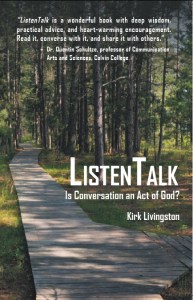
Now available at Amazon and other book sellers.
The smallest things you hear and say have the power to alter the trajectory of your life.
But you know this—just look back at a few of the most innocuous conversations you’ve had—the ones that led to a school and a life partner, or to the career you love, or to breaking with some substance.
ListenTalk rereads some old Bible stories for what God expected in conversation with women and men. A few wily philosophers show up in the book to quiz God—and us—about the power and promise of ordinary talk.
Read ListenTalk and you’ll come to look for and expect big things from even the most ordinary conversations that populate your day. Because ordinary conversations lead to far deeper connections than you’d imagine in your wildest fever dreams.
Feel free to give the book a 5-star review at Amazon.
Take me to Amazon this very instant with this link so I can order this odd but interesting book.
###
Teach Your Institution to Speak
Developing a Bias Toward Dialogue
Dogs don’t talk, but they are great communicators.
We know what they want, mostly because they want the same things at the same times every day. They’ve trained us in exactly that way: Go outside. Eat. Rub my ears.
Dogs have conditioned us well.
In the same way our corporations and organizations and institutions train us to speak in certain ways. One company I worked for required a high level of sarcasm to get through the day—it was just the way employees interacted—all the way to the top dog. Another firm with a gossipy culture built impenetrable walls of mistrust and politics between colleagues, cliques and departments—walls that interfered with work and mission. One brave boss arose from the nattering class with a zag to the well-entrenched zig: when Employee A came with a screed about Employee B, this boss would immediately summon Employee B to the office and engage their complaints together. So before Employee A went off the rails about Employee B, they had to deal with the issue together, face-to-face. This became the beginning of a solution. People stopped gossiping to the boss, for starters. But they also found new ways to talk with each other. People picked up on the message that unhinged rants about colleagues will not do—at least with this boss.

Can you spot the Ole in this photo?
You might think that the only way to get an institution to have open, revealing, useful forward-moving conversations would be from the top down. If the big boss does dialogue, then everyone else does—so goes the thinking. But in fact, culture does not always move from the top of the pyramid to the bottom. Sometimes it starts in the middle. Sometimes it starts at the bottom.
And that is good news for the 99 percent of us without a bully pulpit.
A person who demands more of conversation will butt up against others who are not so demanding, and sparks will fly. Or not. If you cannot find a place for forward-moving conversation in your organization, chances are good you will leave to find an organization where your voice will be heard.
But there are not a lot of good reasons to put up with less than genuine conversation.
###
Image credit: Kirk Livingston
Counterintuitive: Listening Beats Talking?
Persuader Vs. The Persuaded

The Russian polymath Mikhail Bakhtin—one of the titanic minds of the twentieth century, though too neglected now—believed that in a dialogue the position of primacy is with the person who listens rather than the one who first speaks. After all, he said, we do not speak unless we anticipate a response; and we shape what we say in light of possible reactions.
–Alan Jacobs, The Pleasures of Reading in an Age of Distraction (NY: Oxford University Press, 2011) 55
Without some listener—you see—there would be no words launched.
###
Image credit: Kirk Livingston

 conversation is an engine