Archive for the ‘Opportunity’ Category
Pick a Door: Blessed are the Poor
How do you read this?
Jesus went up the mountain with his followers, as the great teachers do. His first words:
Blessed are the poor in spirit, for theirs is the kingdom of heaven.
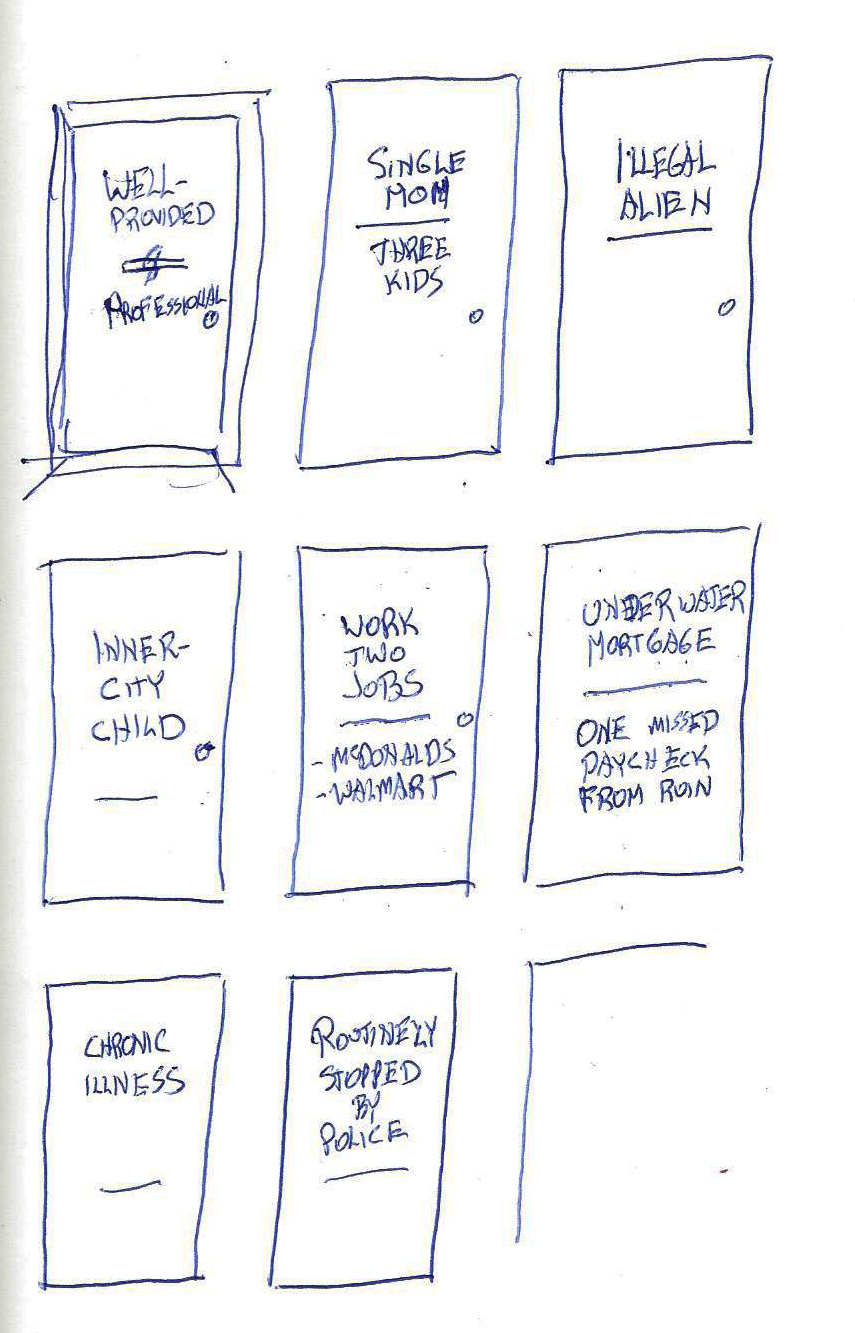
How you hear those words depends on where you come from. The images that come to mind, the connections you make, the hope or lack of hope—much is prefigured and preloaded by the conditions you bring.
What did the original hearers hear? That is the question.
But we make a start toward answering that question by asking what door we just stepped through.
###
Dumb sketch: Kirk Livingston
To Flee Corporate Dysfunction or Not?
Where will you run?
My friend just quit her corporate job. She does not have another job.
“Too much dysfunction,” she said. “Why spend my days in a cube, following through on poor choices our leaders made under the guise of collaboration? There’s got to be a better way.”
“I hope you are honest in the exit interview,” several people said to her. Other top talent had quit as well and those remaining cherished a hope of productive work.

Every company has these bouts of employee-flight. Maybe the department director is a megalomaniac. Maybe the boss simply doesn’t know what to do next and is not open to advice. Maybe the department trolls rule the roost. Every so often dysfunction catches up with a department or company and talented people throw up their hands and march to the exit. It is more common when the economy is on the rise, but even in a down economy, talented people choose flight over fight, even with no job on the horizon.
So it is with my friend.
She had had enough and hoped to parlay her high-end employee history into a freelance life. I often talk with people considering this move. What I liked about this conversation was that my friend could identify a few key skills and passions that she wanted to pursue. And she had already begun to push on these passions. She knew what she wanted to build next. So her “I quit!” was less about fleeing and more about “now is when I do this thing I love.”
Because, the truth is, you can never be entirely rid of dysfunction.
“Why is that?” you may ask. (I can hear you.)
It is because you bring it with you. Disagreeing and disagreeable. Seeing issues from your personal, rigid perspective. Combative. Megalomania. These seeds are planted in every one of us. Sometimes it doesn’t take much to cause them to flower. A good conversation harnesses different potentials in those seeds and helps us move forward. A dysfunctional environment feeds the bad seed and strife rises to the surface.
Such is the human condition.
But moving forward toward our passion, finding time to do those things we love—the things we are meant to do, even if no one else cares—that feeds the productive functional seeds in us.
Is there a way to do the things you were meant to do today—right now—even as you wade through the current dysfunction?
That is the question.
###
Image credit: Kirk Livingston
Seeing Past Childish Symbols
Step 1: See the Template You’re Working from
I’ve been trying to learn to draw and Betty Edwards’s Drawing on the Right Side of the Brain has been particularly helpful. Edwards looked at why it is so many adults say they can’t draw, which is especially odd since nearly every child loves to draw. How did we move from love to incompetence? Edwards answers that by tracing our development as artists, and here is one milestone:
By around age five or six, children have developed a set of symbols to create a landscape. Again, by a process of trial and error, children usually settle on a single version of a symbolic landscape, which is endlessly repeated. (73)
As we age we become dissatisfied with those symbols but we have not worked out new ways to put on paper what we see. And so we give up, and our drawing gets stuck in that old symbolic system. Edwards provides a much richer discussion, but at least one result is that we must set aside our childish system of symbols to begin to see.
Which is not so simple.
I still start with a circle.
Not so simple because of the confusion that sets in as we try to translate real world scenes into a two-dimensional representations. To set aside the sun as a happy face in the upper right corner means I must look at how the sun reflects off, well, everything. To look at a face and see that—no, there is no outline—is off-putting. How to draw a face without starting with an oval?
This is why Edwards starts with learning to see as a precursor to learning to draw. In my 70+ days of drawing daily, learning to set aside my childish symbolic language has proved difficult. But the answer to seeing better and especially to seeing past the old symbols is to do things badly. And maybe do them badly for a long time. To do things so bad they are cringe-worthy. But that is the price one pays to learn.
I cannot help but think this life lesson and applies across the board. Learning to see and hear, and learning to form your own opinion and make your own representation applies universally. Growth from child to adult means you find new ways to interact with parents, so you set aside some (not all) the old relational cues. The ways we interact with colleagues and bosses must change as we take ownership for our work. Even the childhood symbols that directed our understanding of life purpose and how one knows God must be rejiggered. There is a template for romance we would do well to look at again. Nearly every part of life is helped by reexamination.

“Cutie Pie” + “Let’s Read” seems like a good place to land.
But make a deal with yourself : be patient and give yourself time to move beyond the immediate confusion.
###
Image credits, including dumb sketch: Kirk Livingston
Ritz Flats: Handyman Special
Seems like a solid investment.

###
Image Credit: Kirk Livingston
Give Your People Presence
Is Drawing a Spiritual Discipline?
Betty Edwards, in her Drawing on the Right Side of the Brain (NY: Jeremy P. Tarcher/Putnam, 1999) calls for a different way of seeing as a beginning point for drawing. In my 60+ days of producing a dumb sketch daily I can say with certainty that my seeing has been altered. I’m open to and actively looking for much more detail in ordinary life. In particular, in the back of my mind I spend my days looking for scenes or objects or people I can reproduce (badly) on paper. And I see far more detail in buildings and structures and postures and faces than I did two months ago.
Starting to see differently feels like a small victory.

Can a dumb sketch help you be present?
Edwards has a long section on brain functionality, how the left brain works versus the right brain. I have a growing skepticism about the neatness of those two categories. I think there is some truth in the distinction. And the distinction works well for release from our typical analytical state into a more meditative zone of creativity. I’ve long depended on that zone for more creative writing assignments. But the research citations feel a bit dated and frankly I’m always a bit skeptical of forced black and white interpretations of complex physiology.
But this notion of sitting with stillness before a scene to observe, capture and (potentially) understand—it feels like a life skill that could and should translate into all sorts of different settings. Slowing to see and hear has begun to awaken all sorts of new thoughts in my brainpan. I find the practice encroaching on normal conversations, on meetings, on writing, on driving and even as I pray.
Especially as I pray.
I cannot help but wonder if learning how to observe, capture and (potentially) understand is a step toward being more present with all the beings in our lives.
###
Dumb Sketch: Kirk Livingston
English: I still believe in you.
Get in that job-machine, mister.
More dire news for university English departments: from the University of Maryland, English majors are bailing like mad. And faster and faster.

The humanities have been getting a bad rap for, oh, half a dozen decades or so, because they don’t lead directly to a slot in a job machine. And, as the thinking goes, without the job machine you fail at life. Or at least paying for life’s good things (like a huge TV and plenty of Lean Cuisine) (Or rent and clothing).
We’ve certainly seen this coming. We’ve wondered: Why go into college debt just to be a philosophy-talking barista? We’ve lamented the pitiful conditions of adjuncts. Colleges in my area cut budgets and then cut more, from fat to bone. And now wholesale amputation to accommodate the demands of producing souls for job machines.
True: English departments that focus solely on esoterics need to undergo change. I’ll argue that any academic program (or any institution, frankly) that promotes the inward-gaze as the end-all, top-function of the human condition is currently being rudely awakened.
Smart English departments are tuning in to this—just like businesses have been realizing people don’t really care about their product all that much. Even churches are starting to realize there is a world of people living and working just outside their doors—people not interested in joining the club but crazy-interested in the meaning of life. Speaking of churches, we used to call it “evangelism” when we invited others in. Business evangelists understand all too well the benefit of going where people are and adapting their product to current conditions.
But reaching out to the rest of humanity—that’s where the action is.
It’s because we’ll always need to reach out, to communicate something to someone else, that I’m optimistic about English, if not exactly English departments. Rather than an either-or approach (deep-thinking/creative expression or assembly line training), we need both-and: deep-thinking and creative expression that leads to more conscious assembly line work. And perhaps that thinking will help us move beyond assembly lines entirely.
As I prepare my next set of writing classes for college English majors, I am beefing up the entrepreneurial end. Because the way out of a soulless slot in a job machine is to invent your own job machine.
That’s something we should train writers to do. And some of those writers will be English majors.
###
Image credit: Kirk Livingston

We’re All In Construction
We build every day with actions and words
Sometimes our work is purposeful.

Sometimes we build walls with ice.
Sometimes we joke that our habits and actions and speech patterns amount to nothing. But that is false: if nothing else, what we do and say affects us. And there is no telling the power of example and well-placed words in the circles we travel.
Don’t think for a second you are not building.
Something.

###
Image credits: Kirk Livingston
Here’s the Story of a Man Named Quady
Who was living with three alloys of his own
Yesterday I met Quady* for coffee. I was impressed all over again by the executive function of his brain: how he seems to effortlessly order complicated systems and businesses and talented people and even his own life. Quady** told me how he was weaving consulting with business acumen with creativity. I could not help but be impressed with the forward motion the guy exuded.

…and here’s the dumb sketch you ordered.
In fact, it was about ten years ago I met Quady at (yet) another Dunn Brothers on another side of Minneapolis to talk about how he grew the business he was running at that time. He was president of a firm that placed creative people in creative positions and his firm was on fire (that is, busy). At the time he gave me some solid advice which I resisted for years until embracing it fully: make a daily/weekly habit of reaching out to make contact with varieties of people.
And listen to them.
These days Quady is weaving together a consulting life that draws on his outsized executive function and his creativity plus a desire to walk alongside people. He’s a kind of CEO-for-hire and he’s currently working some high-level gigs. It’s the melding of these three threads that seems to open doors for him: the organizing gene plus the creative gene plus the people-smarts gene. Because he understands the moving parts of business, he can give solid, real-world advice to people. He gives the kind of advice that encourages from some deep place: the sort of advice like,
“Look. You’ve got this. It’s a stretch, but you can do it.”
And who doesn’t want to hear that?
###
Dumb sketch: Kirkistan
*Not his real name.
**His real name was Markothy.
How to Focus. And Why.
Sometimes it’s hard to see past the niggly imperfections of the day.

Fie on the dirty windscreen.
What glories have we missed?
And sometimes we use other tools and attitudes and conversations to get clarity.
###
Image Credit: Kirk Livingston

 conversation is an engine