Archive for the ‘philosophy of work’ Category
Wendell Berry Wrote Death Right
The Memory of Old Jack: Is it passion or habit that overtakes us at the end?
Now he feels ahead of him a quietness that he hastens toward. It seems to him that if he does not hasten, his weight will bear him down before he gets there. He reaches the door of his room and opens it….
He goes slowly across the room to his chair, an old high-backed wooden rocker that sits squarely facing the window. This is his outpost, his lookout. Here he has sat in the dark of the early mornings, waiting for light, and again in the long evenings of midsummer, waiting for darkness. He backs up to the chair, leans, takes hold of the arms, and lets himself slowly down onto the seat. “Ah!” He leans back, letting his shoulders and then his head come to rest.
For some time he sits there, getting his breath, grateful to be still after his effort. And then he rises up in his mind as he was when he was strong. He is walking down from the top of his ridge toward a gate in the rock fence. It is the twilight of a day in the height of summer. The day has been hot and long and hard, and he is tired; his shirt and the band of his hat are still wet with sweat….
He does not know why he is there, or where he is going, but he does not question; it is right. Under the slowly darkening sky the countryside has begun to expand into that sense of surrounding distance that it has only at night….
Slowly the glow fades from the valley, the sky darkens, the stars appear, and at last the world is so dark that he can no longer see his legs stretched out in front of him on the ground or his hands lying in his lap; he has come to be vision alone, and the sky over him is filled and glittering with stars. Now he is aware of his fields, the richness of growth in them, their careful patterns and boundaries. In the dark they drowse around him, intimate and expectant.
And now, even among them, he feels his mind coming to rest. A cool breath of air drifts down up on him out of the woods, and he hears a stirring of leaves. He no longer sees the stars. His fields drowse and stir like sleepers, borne toward morning.
Now they break free of his demanding and his praise. He feels them loosen from him and go on.
(Wendell Berry, The Memory of Old Jack, excerpted from Chapter 9)

This is the only way Jack’s story could end. Though, of course, this is not where Jack’s story ends. Pick any story by Wendell Berry and you’ll find the dead very much alive in the memory of the living—just like in real life.
The Memory of Old Jack is another immersive reading experience from Wendell Berry. I’ve never been to Port William (no one has, as far as I understand fiction), but I feel like I grew up not far from there. Mr. Berry presents a way of life that lies just on memory’s periphery for many of us—toward the far end of what we once knew. For others, there will be no memory of such a way of life. It will seem like pure fiction.
One wonders whether memory does not come flooding back in just this way, more real than our many screens today, until in the end it simply overtakes us. I think something like that was behind Dallas Willard’s comment on death.
I hope someone told him.
###
Image credit: Mark Peter Drolet
Get a Job. Or Don’t.
Rethinking My Standard Line on Employment
What to say to folks starting in this job market?
I’m gearing up to teach a couple professional writing classes at the University of Northwestern—St. Paul. I’ll be updating my syllabi, looking at a new text or two. I’ve got some new ideas about how the courses should unfold and about how I can get more discussion and less of that nasty blathery/lecture stuff from me. I’ll be thinking about writing projects that move closer to what copywriters and content strategists do day in and day out.

Yeah: don’t bind your legs when you really need to take action.
One thing I’m also doing is reconsidering the standard advice for people on the cusp of a working life. I usually tell the brightest students—the ones who want to write for a living and show every indication of being capable of carrying that out—to start with a company. Starting with a company helps pay down debt, provides health insurance (often) and best of all, you learn the ropes and cycles of the business and industry. I’ve often thought of those first jobs out of college as a sort of finishing school or mini-graduate school where you get paid to learn the details of an industry (or industries). Those first jobs can set a course the later jobs. And those first friendships bloom in all sorts of unlikely ways as peers also make their way through work and life. You connect and reconnect for years and years.
But I’m no longer so certain of that advice. While it’s true that companies and agencies and marketing firms provide terrific entry ramps to the work world, they also open the door to some work habits that are not so great. Every business has its own culture, of course. Sometimes that culture looks like back-biting and demeaning and discouraging. Sometimes the work culture can be optimistic and recognize accomplishment and encouraging and fun. Mostly it’s a mix of both.
But one thing I don’t want these bright students to learn at some corporate finishing school is the habit of just doing their job. By that I mean the habit of waiting for someone to tell them what to do. Every year I watch talented friends get laid off from high-powered jobs in stable industries where they worked hard at exactly what they were asked to do. And most everyone at some point says something like:
Wait—I should have been thinking all along about what I want to do. [or]
How can I be more entrepreneurial with my skill set? [or]
What exactly is my vision for my work life?
Some of these bright writing students are meant to be entrepreneurial from the very beginning. Though a rocky and difficult path in getting established with clients and earning consistently, it may be a more stable way to live down the road. Maybe “stable” is not quite the right word for the entrepreneurial bent—“sustainable” might be more appropriate. The quintessential habit to learn is to depend on yourself (while also asking God for help, you understand) rather than waiting for someone to come tell you what to do.
I’m eager for these bright, accomplished people to think beyond the narrow vision of just getting a job. The vision they develop will power all sorts of industries over time.
###
Image credit: arcaneimages, via rrrick/2headedsnake
Tell Me What You Know. Wait: Mime It Instead.
Nancy Dixon & Is there a best way to transfer knowledge?
Lecture is not effective.
As one who has lectured and been lectured unto, I’ll insist that listening is hard work when seated before a droning human. Sermons are the same species. Occasionally sermons are more spirited than lectures but both have roughly the same effect. Maybe there is a continuum for lecturing: previous generations felt ripped-off if the person in front did not speak at length and without interruption. For the generations I teach, 15 minutes is the absolute maximum before reengaging with questions or activities or just standing and moving chairs around the room.

Working alongside someone is amazingly effective at transferring knowledge. To have a common task with a colleague or mentor bypasses much of the resistance and passivity that comes with the classroom “listen-to-me-I’m-the-expert” experience. The focus is on the doing and learning takes care of itself.
Nancy Dixon in her Common Knowledge: How Companies Thrive by Sharing What They Know (Harvard Business School Press, 2000), breaks the transfer of knowledge into manageable buckets as she shows how organizations do the work of helping teams and individuals learn. She starts by making a distinction between tacit knowledge and explicit knowledge: tacit knowledge is what we just sort of know. It’s the multiple bits of knowledge that would be difficult/impossible to write down. Explicit knowledge is written: it’s explicit in the sense that someone could pick it up, read it and know. Dixon cites five ways teams have successfully transferred what they know:
- Serial Transfer: team does a task and then does the same task again in a different location/venue. The team collects and discusses what they learned between, so each time they do the task a bit more efficiently.
- Near Transfer: Transferring knowledge from a source team to a receiving team doing a similar (routine) task.
- Far Transfer: Transferring tacit knowledge from a source team to a receiving team doing a non-routine task.
- Strategic Transfer: Knowledge transferred impacts an entire organization rather than just a team. Maybe that knowledge comes from the entire organization.
- Expert Transfer: Team facing problem beyond scope of its knowledge reaches out to an expert or expert team.
 I like how Dixon positions the expert as a sort of higher-order transfer: where the audience is engaged and invested and eager for the solution. I also like Dixon’s discussion of knowledge as both dynamic (knowledge is less of a warehouse and more of a river) and also becoming more of a group phenomenon.
Working alongside learners and experts is a great benefit of day-to-day work, though we don’t always appreciate it.
###
Image credit: exploitastic via 2headedsnake
70 Sheets. 700 Signals.
My $1.25 Grist Mill
For years I’ve kept notes on conversations with clients.
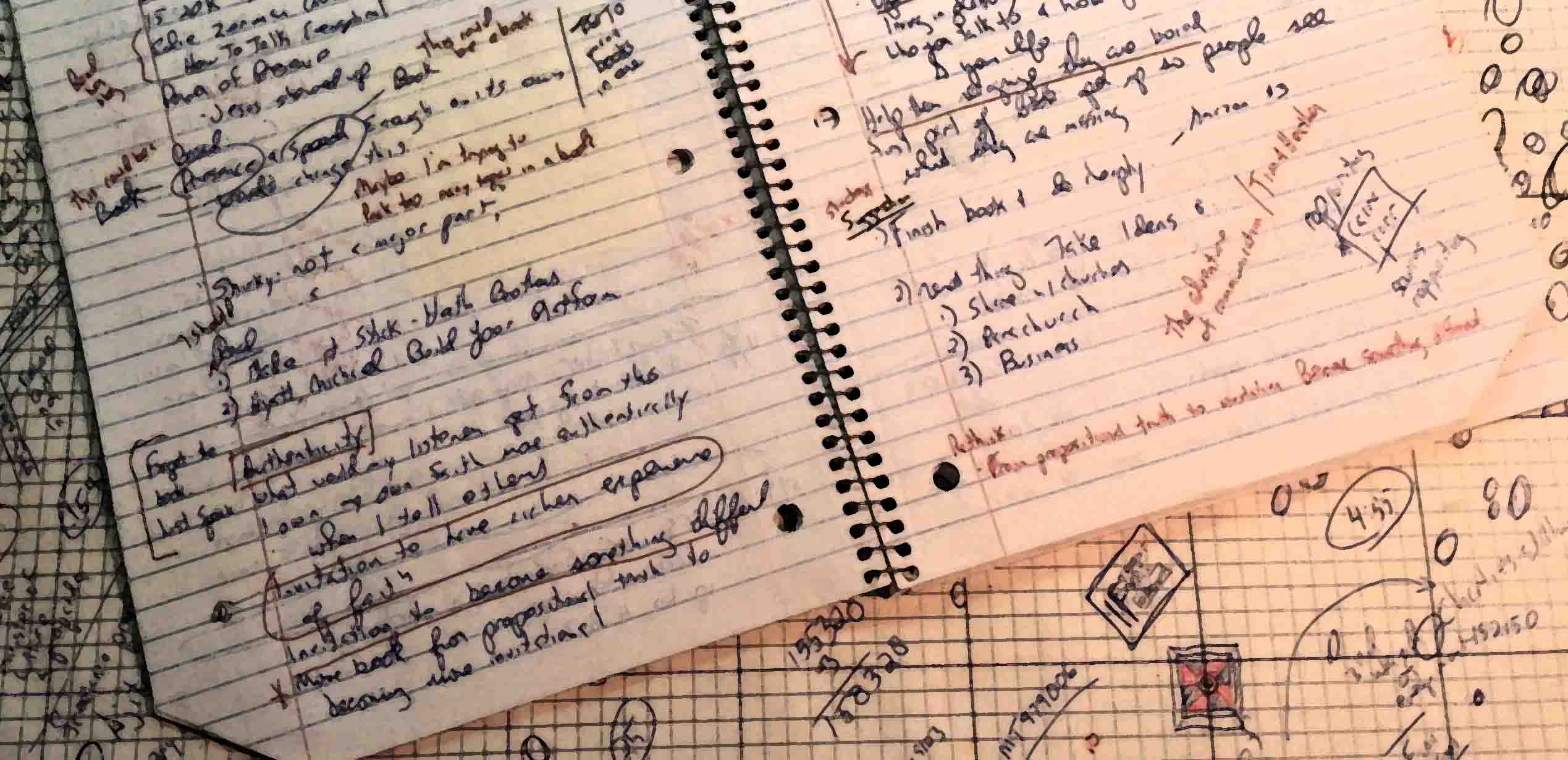
Anyone in business (or anyone in the business of getting something done) knows the value of accurate notes from a conversation. These quick jottings record promises made, delivery dates, special circumstances and conditions.
As a copywriter, I’m also poised to record quotes from my client or team: small summary statements, overview quips, self-proclaimed “dumb” analogies and tangential jokes. These little asides often prove valuable to solving the communication or marketing problem we’re gathered to work on. It’s curious how often the seed for the solution is in the conversation we had that defined the work we would do to solve the problem.
I know this because I often look back through my notes. I go back using a red pen and highlight notes that are proving critical (that’s right: reviewing notes in real-time is productive. Reviewing notes after the work is done is even more illuminating.).
Just today I found myself paging back through my notes looking for a particular conversation and stumbled on another conversation I had forgotten. And that forgotten conversation announced in red ink the precise answer to a communication question I’ve been asking for the last six days.
What good fortune!
###
Image credit: Kirk Livingston
What Business Can Learn From Church #3: Build Relational Trust
Trust Takes Time. Talking Helps.
In conversation with Groundswell coffeehouse owner/Third Way Church pastor Seth McCoy, we discussed the overlap between business and community. Mr. McCoy pulled out a few business lessons that take a slightly different shape when seen from a faith perspective:
Mr. McCoy also noted how relational trust is essential for business and community.
Relational trust drives collaboration. Relational trust is what allows a collaborative leader to step away from shrill monologue and invite others to contribute their voices and experience. Leader trusts colleague (and vice versa) because they know each other’s intent and because they have recognized the giftedness each possesses.
Building trust things take time. Mr. McCoy voiced a principal that is worth examining: Make it easy to show up or leave a group. And make it hard to become a member. Because membership is the route of committing to shared direction. Spending a year in relationship with a person before marriage lets you see the person in all the seasons. Spending a year in a job helps you fully appreciate the economic cycles, urgencies and payoffs. Human just need time to process stuff. Over the course of four seasons, we interact, voice concerns, we are delighted at some things and taken aback by others.
The truth is that relational trust takes time and patience and lots of conversation. While there are no shortcuts, the words we bring to our time together have a way of spurring us forward and helping each other absorb the direction.
###
Image credit: we apologise for the inconvenience via 2headedsnake
What Business Can Learn From Church #2: Be Accountable—Especially After Conflict
Stop to Honestly Revisit Decisions
If everyone on your leadership team has an equal voice, how do you sort through conflicting opinions?
First, know that “equal voice” is as rare in teams as it is problematic. It’s likely some team members have a more equal voice—a voice that carries more authority (like the boss, for instance. Or the one who signs the bi-weekly pay stub). And, sadly, team-members willing to scream and throw a fit will often get their way through intimidation and/or sheer annoyance.
In this space between work, craft and carrying out community described yesterday, Seth McCoy talked about a leadership style that didn’t set the founding leader as the all-knowing, final-answer seer whose verdicts were solid gold. Instead, passionate committed leaders bellied up to give their opinions, expecting always to be heard. To continue to get full engagement from these leaders and their wide-open thoughts, team decisions must be revisited and discussed after the conflicting decisions.
Say your leadership team is conflicted on a pivotal decision. You need everyone behind the decision because you know each leader will motivate themselves and their teams based on the urgency of the task. You need them engaged. Whether your team takes formal votes on decisions or just gives a thumbs-up/thumbs-down, the mechanism that allows your leaders to respond to a decision should not be the final word. Allowing the team to revisit decisions in conversation builds trust—but those revisiting conversations must be open rather than defensive.
What business can learn from church is to build enough human to human accountability to actually, really, truly revisit group decision. To ask whether it works or not. And to offer honest assessments. And to build a solid history of honesty.
This is how any organization builds relational trust.
###
Image credit: gh-05-t via 2headedsnake
You may also be interested in:
What Business Can Learn From Church #1: Relational Trumps Transactional
Identify and Hear Gifted Voices
Seth McCoy runs a coffee shop in the Hamline Midway neighborhood of St. Paul. Groundswell makes an irresistible Chai Cinnamon Roll—especially warm.
Especially first thing in the morning.
Seth McCoy also pastors a church blocks away. A new sort of church that takes seriously the notion that people benefit more from dialogue than monologue.
Church and coffee shop each vigorously pursue their mandates: Groundswell makes tasty foods and strong coffee in a high-ceilinged, inviting neighborhood space. Third Way Church takes seriously the notion that community is much more than one guy sermonizing for an hour—you are likely to hear many voices if you show up at a gathering. Groundswell and Third Way Church inhabit the same neighborhood. This community connection also begins to bridge traditional divides, like the sacred/secular myth.
Talk with Seth the business owner and he may tell you how the leadership team works at Third Way Church: discussions can get “heated,” which is to say, leaders are passionate and vocal. One gets the sense they don’t hold back. On the church leadership team they’ve identified different giftedness or abilities in each of the leaders and they try to honor that particular voice. Often leadership voices in a church can follow some of the traditional patterns of prophet/apostle/evangelist/shepherd. Team members speak consistently from their expertise—which is also their natural bent—and they speak with authority.
 Our businesses are typically more transactional affairs. Employees are hired with a set of expectations (whether narrow or wide) and expected to go about their business. Our best work situations are those that move beyond merely transactional and begin to see the various bits of giftedness each employee brings—and then honors that voice. Most of us who have worked in organizations and companies where we remained unheard—and those work situations number among our least favorite. And those best work situations were where we were identified as the person in the know on some particular aspect of the shared vision.
Business can learn from church by recognizing the gifts, abilities and particular bent of employees and hearing the authority that employee speaks from. No matter what position the employee has, there is some authority/expertise/giftedness they bring.
We owe it to each other to move beyond transactional to relational.
###
You Don’t Have to be a Professor to be a Professor
Rock Your Otium With Purpose
Australian philosopher Damon Young’s Distraction cites the fascinating example of Dutch philosopher Benedict de Spinoza. An able, talented and academic-class thinker, he did much of his work outside the academy. But in 1673 Spinoza was offered a position at Heidelberg University where he would teach while earning the salary of a full professor—opening for him a “life worthy of a philosopher.”
Spinoza refused.
He preferred to continue to practice his craft: grinding optical lenses for short-sighted friends. Spinoza wanted to earn his own income and use his free time (his otium) to uncover the mysteries of the universe and sort out how people should treat each other. Teaching would be a distraction from his primary work of writing and thinking. He refused the distraction, though the job seems a much easier route for what he was already doing.
Young wondered if there was something of the work of the mind in the crafting of the lenses that helped Spinoza move his thinking forward. That connection between thinking and craft is something Matthew Crawford (Shop Class as Soulcraft) would likely agree with. Spinoza’s lenses were renowned and admired—he did good glass work. But his philosophical writings are why we remember him.
We still read Spinoza today. Young points out that while Spinoza’s prose makes for boring reading, it is among those unusual texts that have passed the test of time.
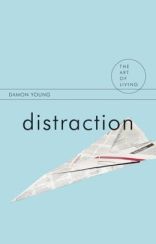 The truth is there are only so many hours in a day. If you’re an adjunct professor, you are basically volunteering your time, which might have gone toward research. If you are a full-time professor, you must diligently make clean breaks from distraction to do the research you studied for.
I relish Spinoza’s example for the intrinsic motivation that led to his colossal works. I am also intrigued by the relationship between his daily lens grinding and the sight he brought to his writing. I very much enjoyed Damon Young’s book.
###
Image credit: Philippe Ramette via Frank T. Zumbachs Mysterious World
The Future of Work: Training a Generation for DIY
Labor’s “9 to 5” and other relics

Work keeps changing before our eyes.
The front page story in yesterday’s StarTribune (Adam Belz: ‘Free agent’ is new face of workforce) showed how, in various ways, the traditional job was dead. This is not new news, but rather validation of the point Daniel Pink anticipated in his 2001 Free Agent Nation. Pink’s was an optimistic story, where people learn to package their skills to move from opportunity to opportunity. In Pink’s telling, talented people willingly embraced the opportunity and were motivated by a number of factors to skip out of cookie-cutter jobs. Pink and Belz both acknowledge that this is not for everybody, though Belz cited Kelly Services research to show just how common free agency has become 12 years after Pink’s book was published:
The economy is shifting beneath the feet of workers, pushing a growing share of them into the role of independent contractor or consultant, temporary worker, freelancer and entrepreneur. More than 40 percent of American workers classified themselves as a “free agent” by the start of 2012, according to Kelly Services research, a huge jump from 2008, when 26 percent of workers gave themselves that label.
My history with corporations is vastly different from my fathers. Layoffs were unheard of when I was growing up. People stayed with jobs for a lifetime: my father retired from IBM after 30+ years. But when I started work with Honeywell, the company was laying off thousands of workers, year after maddening year. Waiting for the axe to swing your direction was part of the corporate ethos. And nearly everyone I know (an entire generation of workers) has experienced lay-offs and downsizing in one form or another.
Corporate treatment of people as tools to be used or disposed of may be creating something that corporations will eventually regret: a generation with outsized problem-solving skills and a taste for independence. Current work conditions may be creating a generation simply unwilling to be force fit into a corporate job and unwilling to endure the politics and territory-defending commonplace in corporate life. The generation growing up watching their parents and peers worry about corporate axing may simply choose to avoid the entire thing, choosing to not have their difference-making diminished by someone else’s mandates.
There may come a time when people actually don’t want a 9 to 5 job because they understand the promise of stability is illusion and making their own way is actually more secure. I know that’s a big part of the message I’ll deliver when I teach my next college freelance copywriting class. The message goes something like this: corporations are a place to start, but not a place to stay.
Loyalty to corporate life will take a permanent hit with the free agent generation. Not everyone wants to be a free agent, but for those who do and find a way to do it successfully, corporations will pay a high price for certain skills and still never own them.
###
Image credit: psychedelicbox via 2headedsnake
Is it Time You Wrote Your Autobiography?
I’m not writing one. Then again, who isn’t adding to their autobiographical material daily, whether with words or deeds?
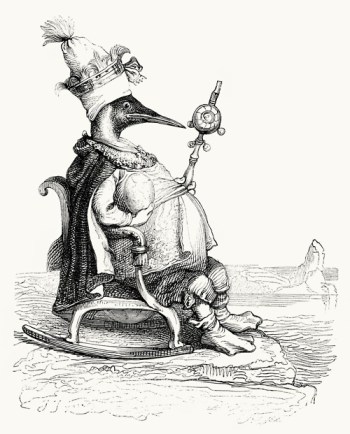
but surely I am king of something
I’ve been reading the autobiography of R.G Collingwood, an Oxford philosophy professor of the last century. He set out to trace the outline of how he came to think—a kind of personal intellectual history. Early on in his life (at 8 years old) he found himself sitting with a philosophy text (Kant’s Theory of Ethics). And while he did not understand it, he felt an intense excitement as he read it. “I felt that things of the highest importance were being said about matters of the utmost urgency: things which at all costs I must understand.” (3) That reading set one course for his life.
One thing that makes this book worth reading is his notion of how questions and answers frame our production of knowledge. Collingwood said he “revolted against the current logical theories.” (30) He rebelled against the tyranny of propositions, judgments and statements as basic units of knowledge. He thought that you cannot come to understand what another person means by simply studying his or her spoken or written words. Instead, you need to know what question that person was asking. Because what that person speaks or writes will be directly related to the question she or he has in mind. This is incredibly useful when studying ancient texts—like a letter from the Apostle Paul, for instance. It’s also incredibly useful when listening to one’s wife (ahem), or a student or to anyone we come in contact with.
Another thing that recommends this book is hearing him tell about his main hobby: archaeology. Collingwood was the opposite of a couch potato. He spent a lot of times in digs around the UK, unearthing old Roman structures and then writing about them. Here too, he explained that while some archaeologists just set out to dig, he only set out to dig when he had formed a precise question to answer. His digging (tools, methods, approach) were all shaped by this question. By starting with a question, he came to very specific answers and, of course, other brand new questions.
Questions begat answers. And more questions.
What question is your life answering?
###
Image credit: J-J. Grandville via OBI Scrapbook Blog

 conversation is an engine