Archive for the ‘photography’ Category
Are Doctors “Ethically Obligated” to Tweet?
No.
Although Wendy Sue Swanson, MD (@SeattleMamaDoc) feels that way about her social media presence (as demonstrated in this clip).
There is one piece of the Hippocratic Oath that calls for casting a wider net in “all my acquirements, instructions, and whatever I know” to those within the physician’s circle. The original oath also called all gods and goddesses to witness and observe, but these days the NSA serves that function (despite HIPAA).
Yesterday’s MedAxiom post by Ginger Biesbrock (“Has anyone seen my Dictaphone?”) makes the excellent point that any new technology adopted should make taking care of patients easier. New technology should not get in the way of treatment, it should not be another hurdle to jump. Instead, technology should simplify meeting the patient’s need. That’s why I’m pleased with the movement to hire medical scribes to complete the electronic medical records in the moment—freeing doctors to treat patients versus keyboarding.
Dr. Swanson’s strong feeling about casting a wider net is likely shared by many if not most physicians. And it just so happens that putting correct information out where regular folks might read it may also be a way to grow your practice—which has been the capitalistic promise of social media from day one.
Sure: doctors are busy. But I cannot help but wonder if more and more physicians will make outward communication (blogging, tweeting, connecting) a priority as they work to free themselves from some routine tasks.
Many already are.
###
Image credit: Kirk Livingston
Should a Doctor Blog?
Only if they want to grow their practice. Or connect with other physicians. Or with patients. Or provide thought-leadership.
Greg Matthews, author of Missing the Forest for the Trees, has been studying the online presence of physicians for years. He’s found that the credibility of their position and the connections within that position can translate to large and devoted followings today.
But all that was counter-intuitive in 2007.
Back when Mr. Matthews was formulating his questions about physicians online.

Back then he was sure—we all were sure—that talking about health information online would never fly. It’s just too personal. What kind of nut would diagnose and prescribe in public/online?
Plus, well, HIPAA.
But some physicians found a way to talk with regular folks (that is, us non-experts who live on the web) about pressing topics. Diagnosis and prescribing on the web was a non-starter, but presenting topics in a way that made sense to regular people did happen. And as we all took to the web to sort our maladies, these authoritative, personal voices became trusted sources of information.
According to Mr. Matthews, today 61% of physicians access social media weekly, 5000 physicians post daily to blogs and Twitter, and 50 physicians are followed each by more than 500 other physicians. Some physicians even feel “ethically obligated” to share on the web. Download Mr. Matthews PDF for more stats.
In this blog (conversation is an engine) we talk about conversation. We’ve noted how conversation is a two-way street: not just in words exchanged, but actually causing conversation partners to go and do different stuff. We leave our best conversations changed and with new resolve for the most important things facing us. It’s a sort of speech-act theory for anyone willing to take a dumb-sketch approach to life.
And even physicians and even patients can gain from this. And what they both gain is far more than mere information.
It makes me wonder what paths might open for collaborative conversations in lots of different work settings.
###
Blue Mounds: Broken
Blue Mounds State Park in Southwestern Minnesota is a surprise. This break with farmland rises amidst all the flatness. See for miles from the hiking trails along the top.

Sioux quartzite cliff 100 feet above an ancient quarry.
More on “broken” here.
###
Image credit: Kirk Livingston
Talk With Those Who Talk With You (DGtC#25)
Humans just want to connect
Social media, like sales, seeks an ever-expanding public. All tweeters want more followers. All bloggers—same thing. Just like the TV networks of yore, where Nielsen Media Research rated efficacy by numbers (and types) of viewers they brought in. Which just happened to coincide with increasing amounts of cash they could wring out of a sponsor for a 30 second span of monologue.
How to measure audience (and collect cash) continues in today’s social media world as various metrics are embraced and/or disgraced: clicks, views, comments, engagement, time spent on a site.
But real humans in earnest conversation don’t care about size of audience. They care about connecting with a person to tell the important thing they have to say or to hear the important thing a friend or colleague has to say. They want to remark on what is remarkable.
Call me a mystic (please!), but I still embrace the notion that the people peppered through our lives are there for reasons beyond our understanding. And those talking to you—today, right now—have something you need to hear and they need to say. Those people right beside you are worth attending to. For their sake. And for yours.
It’s not wrong to widen your audience.
Just don’t lose sight of this moment with those right before you.
Also see:
- Listen to other people’s stuff (#6)
- Dialogue is a scenic bypass (#12)
- “Good to know” and a failure to communicate (#23)
###
Image credit: Kirk Livingston
Clothe Your Team with Inspiring Briefs
Creatives are natural problem-solvers. Start them with a tantalizing puzzle to solve.
In stark contrast to the meeting where the boss wanted creatives morphed into analysts, Adrian Goldthorpe (Lothar Böhm London) has such faith in the creative process he thinks creatives are proper problem solvers. All they need is the right question, which turns out to be a really good puzzle to solve.

One Artist’s Solution: 262 Studios, St. Paul Art Crawl
The creative brief (as you know) provides a quick take on a new assignment. All too often the brief is prepared and presented as a sleepy, non-essential document. But for copywriters and art directors, that brief can and should be a vital link to starting with the right focus.
Goldthorpe laments the mindless filling of briefs and checking of boxes, which is how many creative projects begin. Instead, at a meeting in Moscow earlier this year, he recommended short, informative briefs that facilitate (versus block) creative solutions. The brief should succinctly answer five questions:
- What should the creative do?
- What do we want to achieve?
- Who is the audience?
- What is the brand proposition and how is that supported?
- What is the tone of the voice?
Of course there is more to say in a brief and we all experiment with different ways to communicate this information. But I like Goldthorpe’s succinct, concrete statement of the problem. It is enough information to provide a frame to begin the creative process.
Naturally the creative process is not just for “creatives” at an ad agency. Presenting our problem or opportunity for others to consider and collaborate with is something authors deal with, and parents and professors and bosses. And coworkers.
It behooves any of us to consider how we succinctly introduce a topic to others, especially if we want help.
###
Via POPSOP
Image credit: Kirk Livingston
Hospital Throughput at Fort Snelling
One room down from surgery

Early healthcare forged practical partnerships.
More on “interiors”
###
Image credit: Kirk Livingston
Fight Tunnel Vision. Explore Locally.
Start with the Saint Paul Art Crawl
Do two things to fight big money in politics:
- Locate the funding sources (start with OpenSecrets.org) for each particular 30 seconds of non-truth you see and recognize how those sources benefit from the twists presented.
- Stop listening.
Maybe you are tired of fame as our measure of success. Perhaps you’ve begun to realize the Kardashians are famous only for being famous. And that’s on us. That’s our fault—we keep watching, like gawkers at a crash.
Stop clicking.
If you’ve begun to think to think the NFL is a ridiculous combat ritual that channels blood-lust for the masses while siphoning public funding into the pockets of the rich—just tune out.
It’s time we dug deeper to find out what interests us rather than letting business and the business of media tell us what is important. Business and media will begin to get the message when we stop talking about their current media targets. Don’t link. Don’t litter your social interactions with keywords that build others’ businesses.
But that doesn’t mean “shut up.” Instead tell what interests you, whether it’s a local rugby game or the parks along the Mississippi or the Vietnamese Noodle Shop down the street.
We need to hear from each other.

One example: this weekend’s Saint Paul Art Crawl. Go see the crazy and inspiring stuff our local artists produce. The studios themselves are often eye-opening. You don’t have to be some effete arts patron to appreciate a welder transforming car parts into a 30-foot-tall sculpture. You’d have to be entirely heartless to not be moved by the artist who has set up shop in the back loading elevator—to sell her art as she drives the aged contraption from floor to floor.
This weekend: go and do. Maybe even…buy?
You can even get free Metro Transit passes to and from the Art Crawl.
###
Image credit: Kirk Livingston
A Tale of Two Meetings
Collaboration in person and on paper
Meeting #1: The entire department was gathered at tables shaped into a horseshoe, to facilitate discussion. Twenty to thirty of us waiting for the director to come in and explain his vision. And his vision was that the creatives needed to become analysts. Art directors, designers, copywriters, production personnel—everyone an analyst. Everyone focused on metrics. Give away the creative to outside agencies.
The director talked for 30 minutes and then asked for questions.
Not a single question.
Meeting #2: The entire group was gathered at tables shaped into a horseshoe, to facilitate discussion. Twenty to thirty of us waiting for a series of speakers to come in and explain their vision. Speaker after speaker explained their vision, the metrics they used to decode that vision, and the outcomes they experienced.
Each of the seven speakers spoke for a few minutes and then paused and waited for responses. Then they spoke again and waited. The entire group learned quickly that each speaker truly sought interaction.
Every pause elicited questions. Tangents were followed despite time constraints. After all, the point was the responses.

In my social media marketing class we spend time talking about how to get interaction and comments from the communities we are building. At first it is discouraging for the students, their work feels like shouting treasured thoughts into a hillbilly hollering convention. Nearly impossible to be heard.
But gradually a few people show up at each student’s attempts. And we learned to treat comments from these few with great care: responding immediately. Thanking those who show up for reading. Engaging the thoughts of the people who showed up. Then the students learned to go visit others building similar communities and listen and comment. And soon they found their community growing (in the social world, people follow back those who show up). And they learned not just to put questions at the end of diatribe but to design pauses in the middle of their thoughts so people could respond. And they learned to break up a lecture into a series of engaging posts. And they learned to let their thoughts be shaped by what the people who showed up said.
Those two meetings had key differences: In Meeting #1 each audience member reported to the director so there was very little debate. Debate in that particular firm seemed not too far from mutiny. But in Meeting #2 (same company, oddly enough), the audience was composed of potential customers. And as each speaker spoke, they did their best work with verbal and body language to engage the audience. And each of the potential customers spoke freely, calling “BS” when they heard it, disagreeing vocally, undaunted by executive titles.
Our verbal collaborations point to our literate collaborations. Pauses in copy, short copy, even shorter copy, copy that talks about what people are interested in—all of these allow collaboration. But the key is how you think about the audience: do you really want their response? People are not stupid: they know when someone is lecturing. And lecturing is a sure-fire way to shut down collaboration.
###
Image credit: Kirk Livingston
Ditch Your Job to Woo Collaboration
Sure it’s a mess. But it’s a glorious mess.
Focused, nose-to-grindstone is certainly simpler. Get it done so you can go home on time and watch TV.
Bring another person into your process and suddenly things get messy. You find yourself explaining rather than doing. And explanation is a time-sink—just like small-talk. Plus collaboration is not guaranteed: will you have to redo everything your collaborator attempted?
This is why students groan audibly when I introduce a group project in a writing class. Especially when their grade depends on successful interaction. They hate it hate it hate it.
And that is too bad. I’ve often wondered why we don’t teach collaboration alongside math and biology and writing and literature in grade school. But it seems collaboration is a thing you are primed for later in life, when you start to see you don’t have all the answers. It is a bent that takes root after we have an experience or two of utter delight at someone else’s contribution.
Wooing collaboration starts with shop talk: where you step out of your job’s established tracks and ask others about their experience. How do they do what they do? What do they delight in? Where does meaning enter into their work? Those answers play into our daily conversations. This is where we learn the eccentricities of our colleagues and see how they bring their diverse knowledge and experience to bear on the work. This is where we learn what it means to be alongside someone.
Just doing your job is isolating—especially when you think you have mastered it and have nothing left to learn. Inviting others into the thinking behind the job is incorporating. Yes it takes time and can be a mess, but in the end it is our connections that pull us forward.
How do you incorporate others into your work?
###
Image credit: Kirk Livingston
Bill Moyers: Serving “News” like the Butler Serves Tea on Downton Abbey
Do Not: Do Not Disturb the Master Class
All of us can stand a bit of disruption from time to time.
David Uberti wrote recently in the Columbia Journalism Review about PBS pulling ads from Harper’s Magazine as retribution for an article critical of PBS. PBS exists as a non-commercial, educational media channel. But the critical Harper’s article by Eugenia Williamson pointed out
And so, a fit of ad-pulling ensued. But it was this candid, PBS-critical quote from the patron saint of public broadcasting that caught my ear:
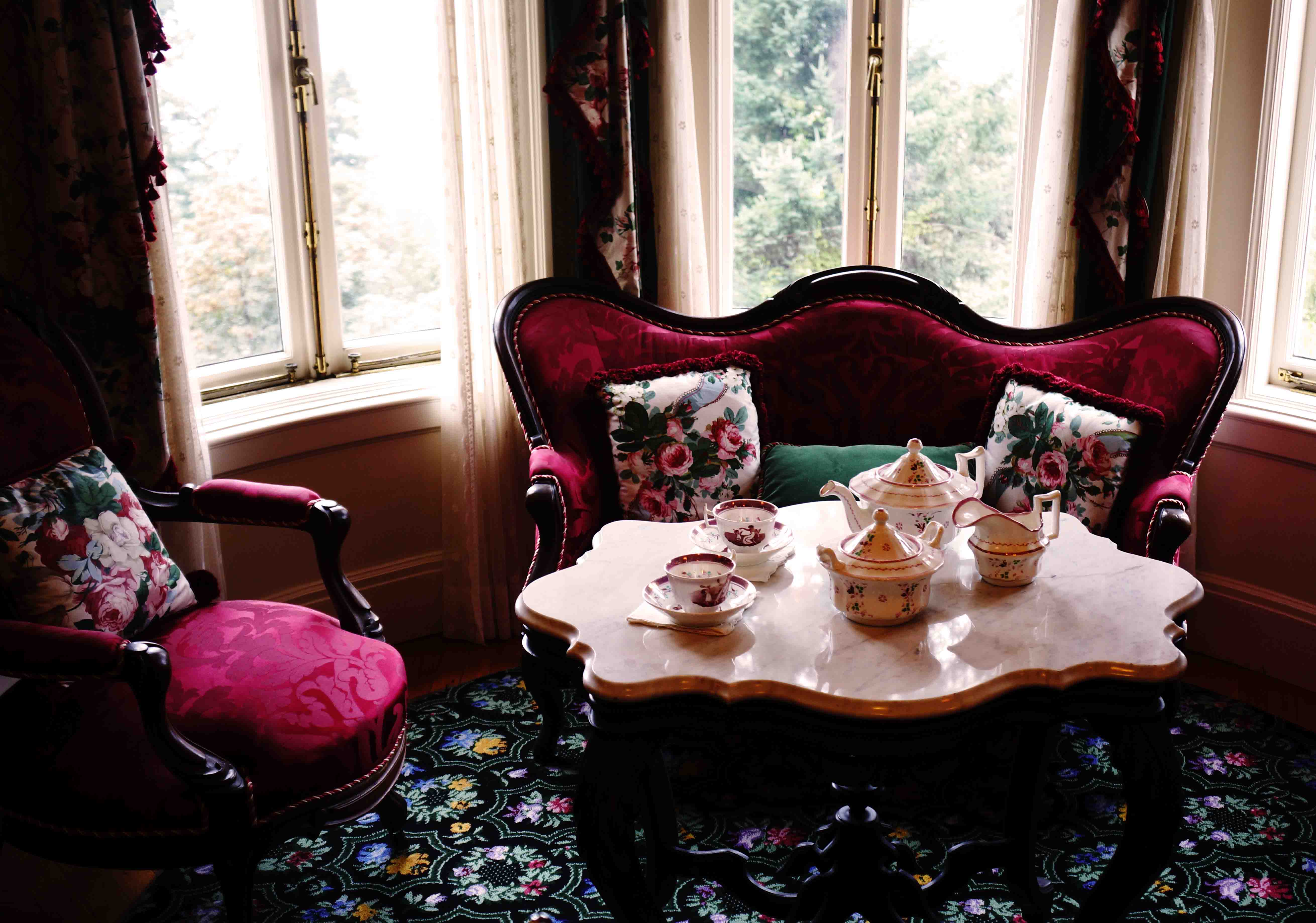
Tea is served at the Pittock Mansion
Wherever you land in your organization, there is some grand narrative at work that guides all involved. That grand narrative is often a good thing and useful. It is often laden with meaning that helps us do our jobs. But it is not a perfect narrative—never is—and parts call out to be challenged by practitioners.
After all, it is the disruptive conversations that lodge in our brain pans. Those conversations we cannot forget sometimes actually open our clam shell brains to something new. And that is the way of both innovation and truth-telling.
Many of us—especially the people-pleasers among us—are careful to assemble conversations that do not disturb the people around us. I am guilty of this. But truth-telling must necessarily veer from the party line.
If only because sometimes the party line veers from truth.
###
Image credit: Kirk Livingston

 conversation is an engine