Archive for the ‘The Human Condition’ Category
How To Talk Like Superman
Please, put the cape away.
Not so much the cartoon character, but think of the raconteur who magnetizes with stories and wit and rhythm. Or think of the person you go to when trying to sort some thorny issue. These are the people you find entertaining or interesting at least partly because they listen to you. And partly because you hear something useful from them.

That’s how to talk like superman: listen closely to what someone is saying and then respond with stories and probing questions that drill down a bit—staying focused on what you heard. To the person you are talking with, you just may be summoning superpowers. That’s because we never know when a casual word may be the linchpin that connects two or three sets of thoughts that set a life in motion.
We all have stories like this: the guy we talked with casually at the end of a club meeting mentioned a guy to talk with at the company we were interested in. We talk with that guy and he mentions someone else in the company…and then you find yourself in the company. Your online application and discussions with HR led nowhere, but a few conversations with the right people and you are in.
David Rock’s Quiet Leadership offers solid pointers about gathering the superpower of helping others learn what they already know. He shows how to help people make connections.
Please use your superpowers for good today.
###
Image credit: Kirk Livingston
Joe Lueken: The Grocer With Something To Teach CEOs About Leadership
Joe Knew Where His Success Came From
Are you one of those poor souls who does not read the obituaries?
Pity: so many memorable stories.
Like the story of Joe Lueken. A couple years ago Mr. Lueken turned down the opportunity to make buckets of cash by selling his Bemidji-based grocery store chain. Instead, as he retired, he set up an employee stock ownership program and transferred the company to his workers.
He was a philanthropist who stocked shelves and took his break with the other workers in the break room. And—most telling for me—the people who worked for him had great respect for him. He was a guy whose work ethic and his caring demeanor touched lives. And it seems—at least from my reading of a couple of articles—he did so with joy.
Mr. Lueken died on July 20 after a long battle with cancer.

As we watch the explosion of CEO salaries and look with wonder on the board members who agree to these ridiculous payouts, it’s hard not to wish many of the current batch of muckety-mucks had worked for Joe. Maybe his humanity would have rubbed off.
###
Image credit: StarTribune
George Trow: On a Reporter’s Appropriate Subjectivity
Subjectivity is part of the human condition
I dislike all talk about “bias” and “lack of objectivity” in a reporter. He is there to clue you in to his best assessment, his reading of the code of events. He has no way to be objective (other than not to have a personal stake in the argument); he doesn’t know the real facts; or if he does, it’s so rare as not to be worth the mentioning. He can’t read Arafat’s mind , or Assad’s, or anybody’s. In a way, what you value most about him or her is his or her appropriate subjectivity; his or her feel for events.
Trow, George W. S. My Pilgrim’s Progress (NY: Vintage Books, 1999) 42
How to keep talking even after you die
Independence is more than the freedom to buy a bigger television
Those who turned a conversation about independent national rule into a document that was then signed and sent—those people are long dead. Yet these 238 years later we continue to discuss what they did, what they signed, and what they paid for their declaration of independence.
Our declaration of independence.

Who doesn’t want independence?
The conversation they began is a very human conversation and so continues today, not just in the U.S., but around the world. Blood, tears, death and life show up wherever the conversation pops.
Our part of the conversation mixes in economics and justice and race and work and a lot of big dreams for our kids. Sometimes our nationalism tells our faith what to do. And sometimes our faith dresses in flags for coercive ends. And sometimes faith and citizenry collaborate in productive ways.
This declaration of independence has spurred a very long conversation and we each participate in our own way. Sometimes I wonder if our independence is only about getting bigger televisions. My hope is that we will come to increasingly relish our freedom. I also hope we’ll pay enough attention to add useful bits to the conversation, communication bits that will continue long after we’re gone.
###
Image credit: Kirk Livingston
How to help your teammate hatch an idea (Dummy’s Guide to Conversation #22)
The satisfying work of relating
Some of us find great joy in the work itself: left alone to turn the block on the lathe or write the intro paragraph—we get a tad giddy. Like we know what we are doing (more or less) and this process is stimulating and fun and I can see stuff taking shape.
A friend with a VP-of-Meetings type brain would often jab me with his love of meetings:
Meetings are great. I don’t know why people hate them so. We get so much done.
When he said this I assumed they were great for him because he enjoyed telling others what to do. And his lackeys went and accomplished real stuff. Were meetings great for his lackeys? I have my doubts.
But for many of us, it is difficult to get that sense of getting stuff done with people. Conversation is a messy business that seems to typically lead into a wilderness of tangents and false starts rather than to a place where real stuff happens. Washington is the current poster child for conversation thwarted at every turn.
Must it be that way?

Can you see how a lot of freight gets shifted in a conversation?
I can’t prescribe a cure for Washington (though targeting the removal of big money would be a positive first step), but here’s a few suggestions for helping each other hatch big ideas and get stuff done:
- Listen. For real—really listen. And repeat back what your colleague says to make sure you get it and to give yourself time to process what your colleague said. Resist the temptation to formulate a counter-argument while appearing to listen. Listen for potential.
- Ask your colleague to say more. Gain clarity for yourself and your colleague. Work out the idea together through a volley of responses.
- Breathe. That’s right, take a breath so you can stay in the moment and hear your colleague. They might just do the same for you.
- Use your words to precisely parse an idea. It’s easy to get sloppy and quickly dismiss ideas (and people, for that matter). Instead, tease out the potential idea you saw. Give it some kindling and fan it and get the fire going.
- Say it out loud to get something done. Pulling together an idea that is scattered before a team is sort of like nailing it to the wall for all to see. Once everyone sees it, they can respond. Grabbing the idea and saying it aloud can often feel like work accomplished. It feels that way because it is exactly that.
We do well to pay attention to what our colleagues are saying. And the more attention we pay, the more wealth of ideas and practical insights we might just find. In fact, some people work this way all the time:
When we toss things back and forth, there is no compromise at all. That is when it is magic.
–Millman, Debbie. How to think like a great graphic designer. (NY: Allworth Press, 2007). From Emily Oberman & Bonnie Siegler/ Number 17, p.96
Also: consider returning to David Rock’s Quiet Leadership and check out his tidy six steps
- Think about thinking
- Listen for potential
- Speak with intent
- Dance toward insight (Permission + Placement + Questioning + Clarifying)
- CREATE New thinking
- Follow up
People are never tools or things we manipulate to achieve our desired end. But honoring each other by listening and talking—that’s how real stuff gets done in the real world.
###
Image credit: Kirk Livingston
Here’s a note to excuse my absence
I’m sorta here and please carry on without me
It’s Monday so I’m sitting in my work chair.
But honestly, I’m sorta still sketching tombstones in the peaceful, cool graveyard. And I’m sorta still walking Dayton’s bluff above the Mississippi thinking how little control we exert over this force of nature overflowing the boundaries we set.

I’m sorta still at the party commemorating an 83-year-old’s deeply human connections and I’m sorta still cycling through Northeast Minneapolis marveling at the fancy systemic alternative to internal combustion. I’m sorta still reclining in an armchair sorting through Robert Sokolowski’s argument for how little time we’ve spent exploring the notion of absence.
So—yes—I’m here.
Just put your post-it reminder on my forehead. And when I return I’ll send you that copy you wanted yesterday.
Or was it tomorrow?
###
Image credit: Kirk Livingston
Team Leader As Artist: Let Your Team Crop Your Problem
What does your team see?
Photographers routinely crop and display just the section of the photo they want their audience to attend to. Cropping—possibly the easiest, most straightforward thing a photographer can do—changes the information the photo provides. Cropping also changes the feeling the viewer gets.

The right crop can stir emotion.
Most photographers work at getting composition right and so avoid cropping. Henri Cartier-Bresson famously accomplished that. Alec Soth gets this done too—though his process seems mysterious. The success of their composition looks like an invitation into another world, something frozen in time. Something clearly different from our own daily life.
That is the memorable artistry of the photographer.

Teams can be very gifted at cropping. Since we all naturally see a problem from a different perspective, collecting those perspectives in an open discussion can do a lot to reframe a problem into a most excellent opportunity. For a team to function this way, there needs to be a premium on open discussion. It helps if team-mates learn to value each other’s opinions. Listening and assigning value to each other’s contributions can be learned. I would argue it starts from the team leader (or manager/VP/CEO) and work its way down. Valuing each other’s perspectives (or not) is very much a part of corporate culture. But value can also move from the other direction: I’ve had teammates who valued different perspectives and taught the rest of us to find great joy in listening and considering.
Seth Godin routinely reframes art to include “making connections between people or ideas.” Some reading this will create art today by running a meeting that will make it possible for all around a conference table to hear a new thing. Their process for creating this art will be an examination of a problem that gets cropped from five or seven different perspectives. The result will be a well composed opportunity that has emotive power for each of the people at that table.
What art will you create today?
###
Image credit: Kirk Livingston
Obviously.
To spell out the obvious is often to call it into question.
–Eric Hoffer

Though “obviously” can never be rehabilitated.
###
Image credit: Kirk Livingston
Martin Weigel: Go to give. Don’t go to take.
Even advertising people are human.
In the spirit of “What is remarkable?” I offer Slide #43 from adman Martin Weigel’s excellent Slideshare on how brands fool themselves into thinking they matter in the grand scheme of real life.
They don’t.
Not when it comes to real human interaction.
No sir.
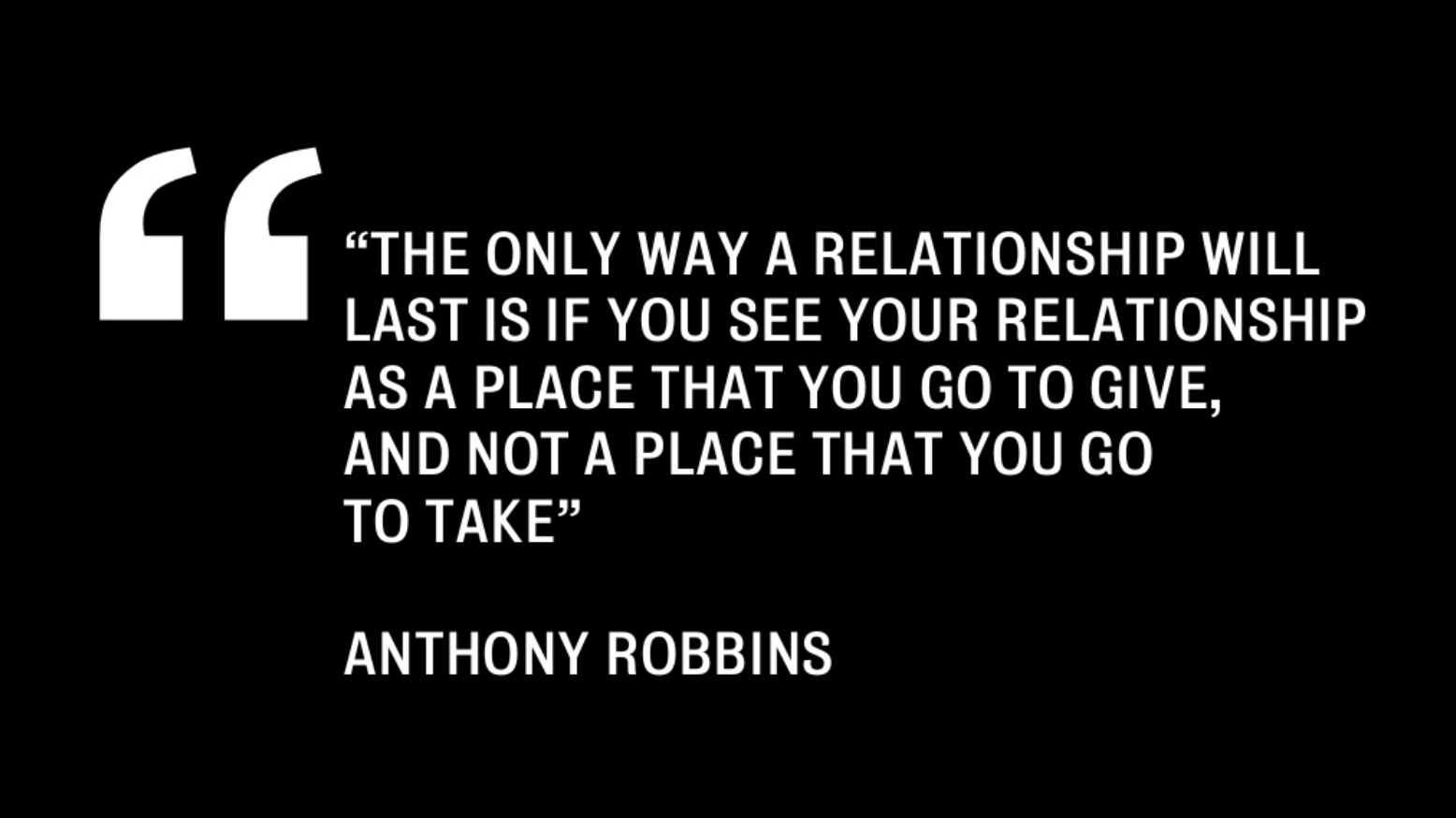
Can a brand serve? Yes. And I will argue that is the profitable space to explore.
I’m not generally an Anthony Robbins fan, but this quote has been stuck in my brainpan since I first reposted these slides. And that is remarkable.
###
Why I Don’t Listen To Christian Music
Short Answer: No One Likes Being Manipulated
On Conversation is an Engine I mostly write about communication and conversation and copywriting and how business interacts because I am fascinated by what happens when people talk. But undergirding this sense of wonder is a faith in God that makes me see much of life in theological hues. The fallout from that theological saturation means I want to approach the work of communication and persuasion from an ethical perspective—as best I can.
Lots of music labeled “Christian” does not do that.
 The college I occasionally teach at has a radio station that spins out Christian music. I stopped listening years ago when I realized my emotions were being manipulated by music that was nearly content-free. It had a veneer of faith, but seemed much more about living a good life and having positive feelings.
Especially positive feelings.
I’m not against positive feelings. Happy is good in my book. Happy makes sense to me. But if happy comes from a sugar-like high that dissipates as quickly as it formed, was it real? And is happy the point of faith in God?
I argue: No.
Happy is good. Joy is better and depending on how you define things, joy lasts longer. And true is best.
And really, what is Christian music? I might argue Tom Waits has a lot more truth to offer than whatever contemporary Christian band is currently famous. The Talking Heads seemed to provide many glimpses of truth—so do many of the folk musicians I listen to. Certainly Mr. Bach and Mr. Mozart and Mr. Telemann and Mr. John Adams and even Philip Glass provide more soaring and more depth and more truth.
Of course, music is a very personal thing and there is no right or wrong. We like what we like and I don’t want to disparage anyone’s choices—really I don’t. But if I sense I’m being manipulated by sentimental lyrics, I move on.
###
Image credit: Kirk Livingston, in response to on the move

 conversation is an engine