Archive for the ‘The Human Condition’ Category
Teach Your Institution to Speak
Developing a Bias Toward Dialogue
Dogs don’t talk, but they are great communicators.
We know what they want, mostly because they want the same things at the same times every day. They’ve trained us in exactly that way: Go outside. Eat. Rub my ears.
Dogs have conditioned us well.
In the same way our corporations and organizations and institutions train us to speak in certain ways. One company I worked for required a high level of sarcasm to get through the day—it was just the way employees interacted—all the way to the top dog. Another firm with a gossipy culture built impenetrable walls of mistrust and politics between colleagues, cliques and departments—walls that interfered with work and mission. One brave boss arose from the nattering class with a zag to the well-entrenched zig: when Employee A came with a screed about Employee B, this boss would immediately summon Employee B to the office and engage their complaints together. So before Employee A went off the rails about Employee B, they had to deal with the issue together, face-to-face. This became the beginning of a solution. People stopped gossiping to the boss, for starters. But they also found new ways to talk with each other. People picked up on the message that unhinged rants about colleagues will not do—at least with this boss.

Can you spot the Ole in this photo?
You might think that the only way to get an institution to have open, revealing, useful forward-moving conversations would be from the top down. If the big boss does dialogue, then everyone else does—so goes the thinking. But in fact, culture does not always move from the top of the pyramid to the bottom. Sometimes it starts in the middle. Sometimes it starts at the bottom.
And that is good news for the 99 percent of us without a bully pulpit.
A person who demands more of conversation will butt up against others who are not so demanding, and sparks will fly. Or not. If you cannot find a place for forward-moving conversation in your organization, chances are good you will leave to find an organization where your voice will be heard.
But there are not a lot of good reasons to put up with less than genuine conversation.
###
Image credit: Kirk Livingston
What Would it Take to Change Your Mind?
Let me draw you a picture
Howard Gardner, in his book Changing Minds: The Art and Science of Changing Our Own and Other People’s Minds (Boston: Harvard Business School Press, 2004) talked about the different kinds of intelligences he thinks exist. Dr. Gardner is a professor of cognition and education at the Harvard Graduate School, so he has solid reason to be espousing counter-intuitive theories of intelligence. Linguistic and logical-mathematical are two of the more primary and recognizable kinds of intelligence. And those two, in particular, are the focus of much our schooling.
But there are other kinds, says Dr. Gardner, including spatial intelligence, for instance, where one has “the capacity to form spatial representations or images in one’s mind, and to operate up them.” Sailors and airline pilots depend on this sort of intelligence, as do chess players. Or bodily-kinesthetic intelligence, where a person has “the capacity to solve problems or to create products using your whole body.” Artists, craftspeople, surgeons, dancers, football players, basketball players and many others work out problems in a very physical way.

Early in the book Gardner cited this important factor in changing one’s mind:
Presenting multiple versions of the same concept can be an extremely powerful way to change someone’s mind.
–Howard Gardner, Changing Minds, p. 16
I’m not yet to the end of Gardner’s full argument, but I suspect none of us are just one intelligence. We each have several (perhaps many) ways of knowing and depend on our different intelligences to walk through life. So hearing multiple versions of a concept may trigger something inside us that suddenly opens our eyes or our empathy. As advertisers well understand, presenting the beautiful woman next to the car or perfume bottle spurs an emotional leap that can bypass rationality. Words alone don’t do that as often.
My own daily experiments with drawing, though uniformly not up to par, have still showed a way forward with understanding. When stuck with words, I can switch to dumb sketch mode and begin to move forward again.
All this makes me wonder about the work we each need to do to find new ways to express those deep things inside that need to come out but have so far fallen on deaf ears.
###
Image credit: Kirk Livingston

Best Case: Stable Health + Quick Decline + Death
Reading Atul Gawande’s “Being Mortal”
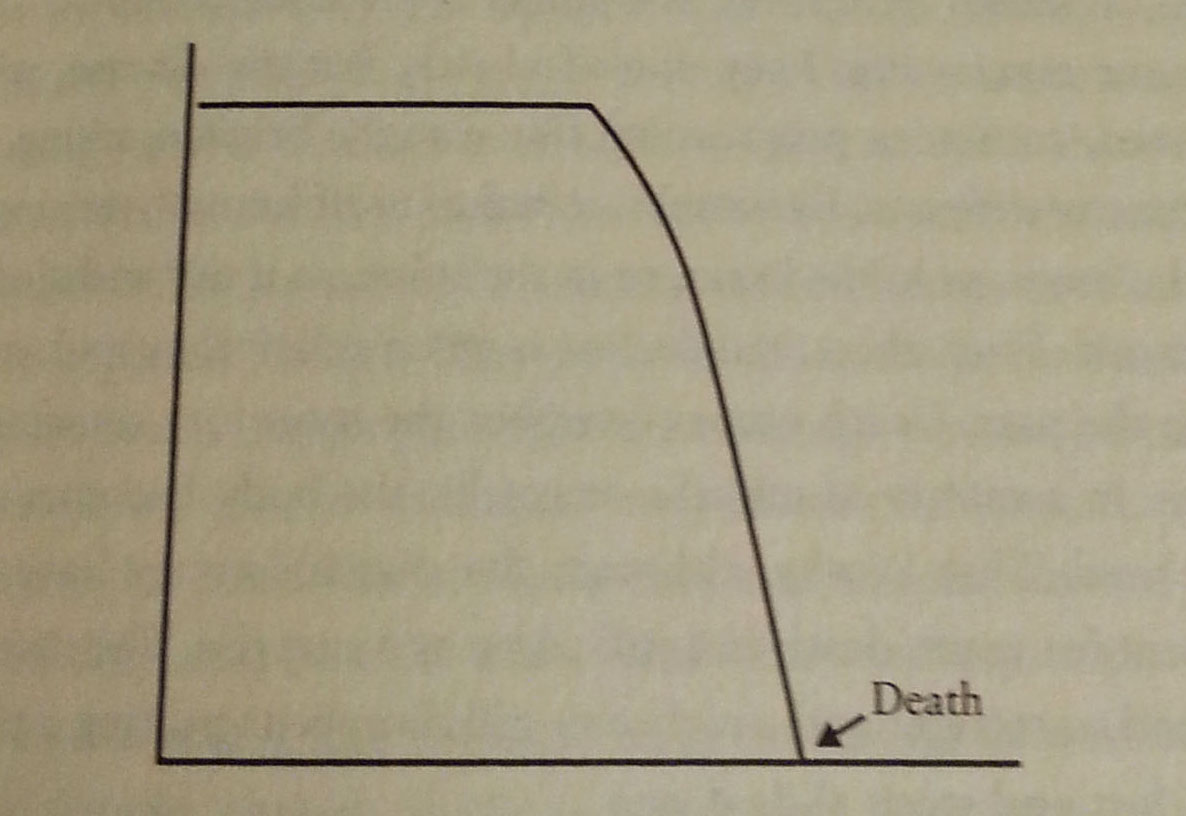
Another happy illustration from Atul Gawande’s “Being Mortal.”
Mr. Gawande is a surgeon and medical professor and writer for The New Yorker. His recent Being Mortal is a long conversation about how humans face death. Or, more to the point, how medicine and our own optimism interact to keep us from planning for this known, finite end.
This is not something you think about at 18 or 28. But it is a wedge topic that soon starts to butt into life. At some point you notice aging people appearing all around you. And then you do the math and start to think you may be aging as well—though we’re all hard pressed to say where the time has gone. Like a favorite, recently-passed in-law said not so long ago, “In my mind, I’m still 18.” No one agrees to aging and few self-select as “old.”
Still, there is this inevitable endpoint.
Mr. Gawande’s book does the reader a favor by naming the moving parts of this process. That is, the slower and slower moving parts. From the shrinkage of the brain to why it is that older people seem to choke more to the insult of not driving to the big fear of dementia. One of my favorite characters in the book is the groundbreaking geriatric physician/researcher who was active until he, well, became old. And then, in a clear-eyed fashion, detailed his decline, his motivations with caring for his wife of 70 years who became blind then deaf, and then broke her ankles. It’s a happy/sad love story of a couple who were active into their 90s.
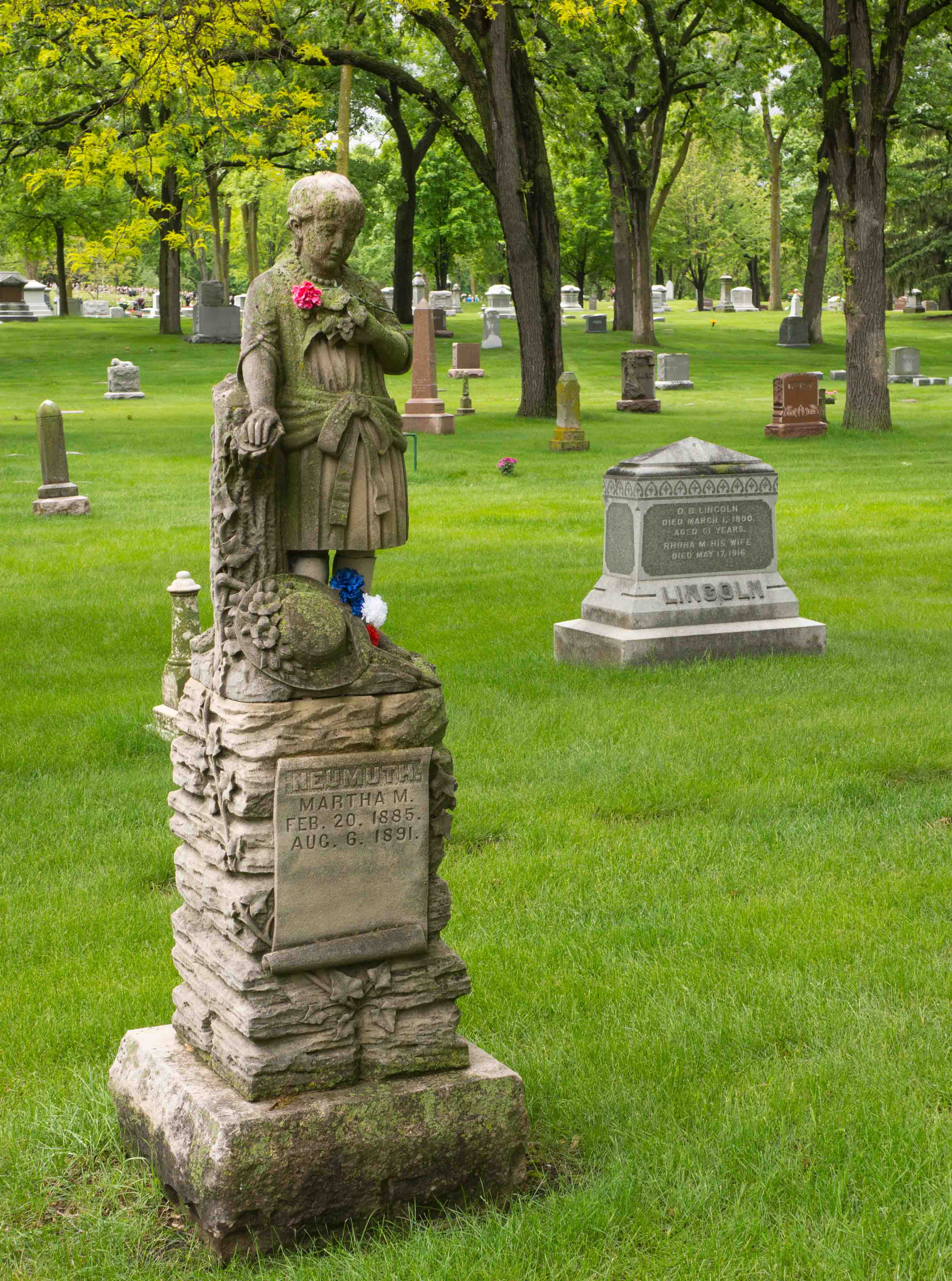 As a believer in the God who resurrects, I do not think of death as final. But as aging continues (which I don’t feel but suppose is acting on me even now), my reading of the gospels and prophets and psalms finds me looking for clues that point beyond what medicine says and beyond what my own senses say. I find a good bit of hope in what I read.
Wendell Berry explored this topic with extraordinary care. His The Memory of Old Jack is a solid antidote to our collective denial.
###
Image credit: Atul Gawande, Kirk Livingston
Some things float.

Wasn’t the calcified certainty of religion the very thing Jesus objected to most? That certainty was both misplaced and used as authoritarian cudgel.
I’m with @ChicagoRabbi on this one: “Humility keeps it real.”
###
Image Credit: Kirk Livingston
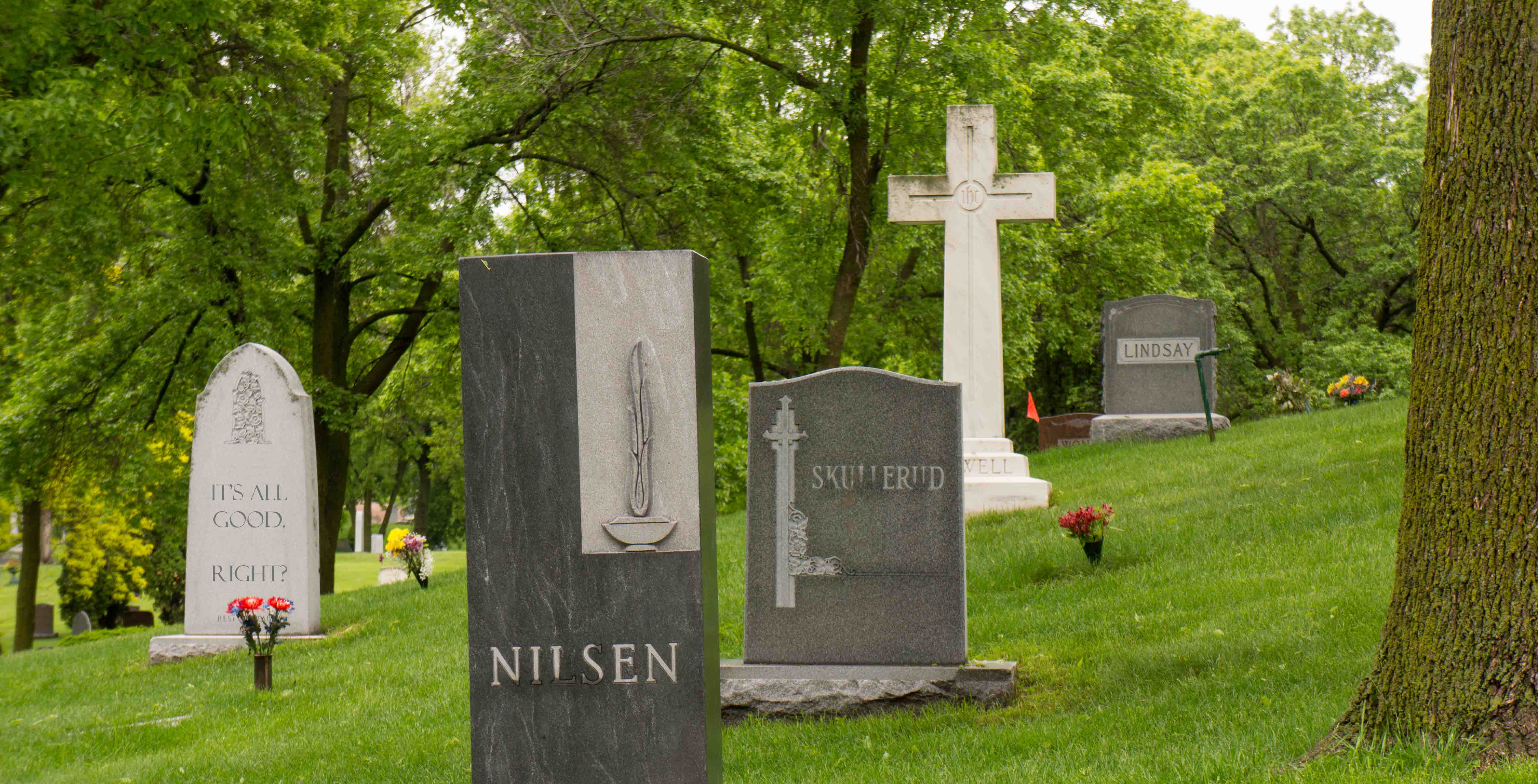
Cemetery Graffiti
That’s just not right.
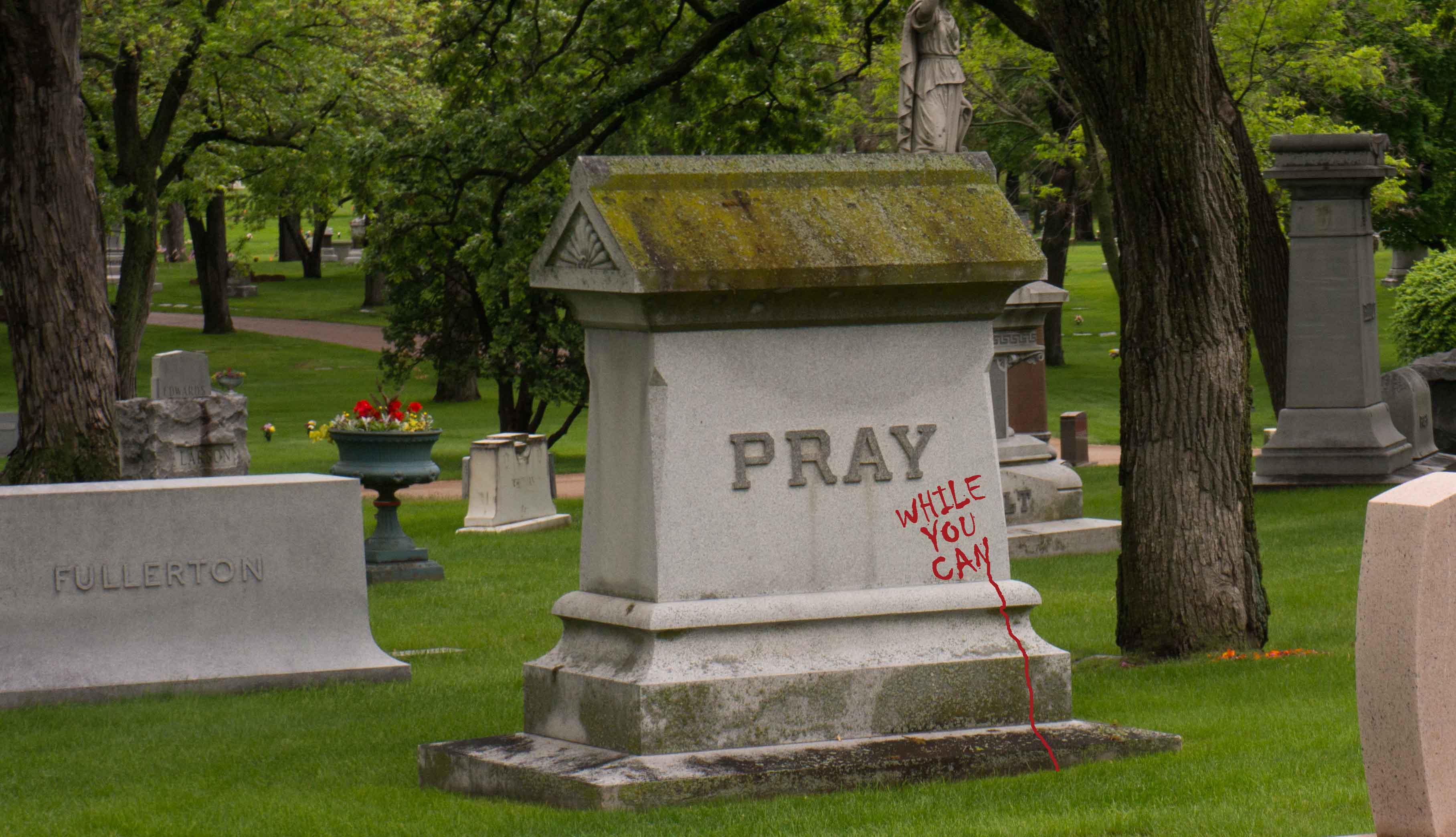
Or is it?
###
Image Credit: Kirk Livingston
Praise an Adult: “You’re a good eater and sleeper.”
And that’s saying something.
According to Mrs. Kirkistan, these are two of my (many?) positive traits:
You’re a good sleeper and a good eater.
She is right: I am. Both.
That’s the kind of stuff we say about an infant, in which case it is high praise indeed: getting that little human to sleep and eat bodes well for future growth. It’s some of the first stuff we can say with any authority about a newborn.
But we struggle to praise an adult.
If we look at those same qualities on the other end of the lifespan, “good sleeper” remains a positive. Older folks have a hard time sleeping (it turns out all sorts and ages of people have a hard time sleeping). What constitutes a “good eater” changes through the years as well. Moving from a voracious eater to a judicious eater seems an especially praiseworthy approach that can span the years.
Still, how can we offer praise to one another in a meaningful way? The trophy for “just showing up” is nearly worthless and most of us see through that. But acknowledging the contributions we each make goes a huge way toward helping each other find and lay hold of our better meaning-making activities.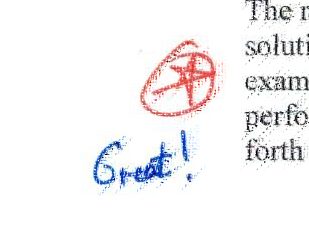
Yesterday my client drew a red star next to a paragraph he liked. It’s a small thing, but in conversation I told him it was meaningful that he did that. Our best work, it seems, goes by mostly unremarked. That’s how we know it is good—no one says anything. This is in contrast to when we are kids and our parents praise us for picking up our toys or finishing our Brussel sprouts. Even in school we look for praise from teachers and professors to know that we are doing the right thing/on the right track. But most of life doesn’t work that way.
Giving feedback can help us close the circuit for each other. Even if barely acknowledged, a complement does a whole lotta good.
But it better be true. Otherwise it’s just pandering.
###
Image credit: Kirk Livingston
Come as you are
Park right there.

Bring your baggage—your leaky car.
It’s the price we pay to interact.
These catalyzing conversations–they are a privilege.
No matter what happens to the driveway.
###
Image credit: Kirk Livingston
If you say a dumb sketch, will others pay attention?
Engineers aren’t the only ones who love to correct you
I’ve been repeating myself recently to different people and groups within my client’s shop.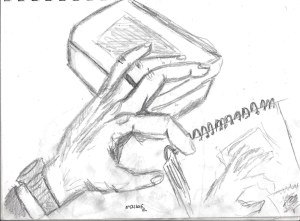
I’ve been saying aloud the oral version of a dumb sketch. I’ve been telling and retelling the story of how I thought one thing but then in conversation with different experts, came to see what I thought was really not so at all, but something different. I know this is terribly abstract and I apologize: We’re working on a new proprietary idea at the moment, so I cannot be too specific.
I thought X was like Y. But it turns out that X is very like Z. And when I tell that story—of trying and failing and trying—my listeners get it. They learn something. They jump to Z and each gets pretty excited about Z—they had not seen Z before. But now that Z is named and out there, Z may just change everything (and not in a breathless marketing-hype way, but really change how people move forward in this particular industry) (Which I cannot name.) (Sorry.) Each mini-audience put the pieces together and then leaps forward in a way my didactic, linear, word-driven paragraphs did not succeed at.
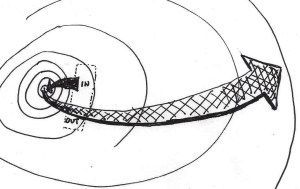 The point of a dumb sketch is to be not-finished. A sketch is the opposite of the heavily produced diagram or slide. The “unfinishedness” of a sketch is the very crux of usefulness as a communication tool. By being unfinished, the sketch invites collaboration and improvement. And people seem to not be able to turn away—at least from the oral version. Failure is built right into my story, and who can resist gawking at a car wreck?
Maybe this is an engine behind John Stepper’s notion of “working out loud.” Maybe this is a key to how we collaborate with each other. We already do this with friends and family, but what if we extend our try-fail-try circle to include many others?
###
Dumb sketches: Kirk Livingston

 conversation is an engine