Archive for the ‘The Human Condition’ Category
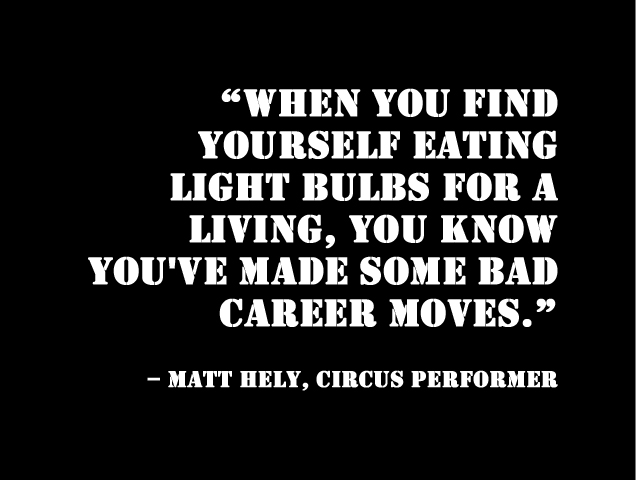
Bad Career Moves: Eating Light Bulbs
Always sound advice: Stop and notice which parts of your work you enjoy.
###
Quote Via Star Tribune News of the Weird, 5/24/2001, p. E5
Can You Engineer a Conversation? (How to Talk #2)
Depends: Are you looking for control or insight?
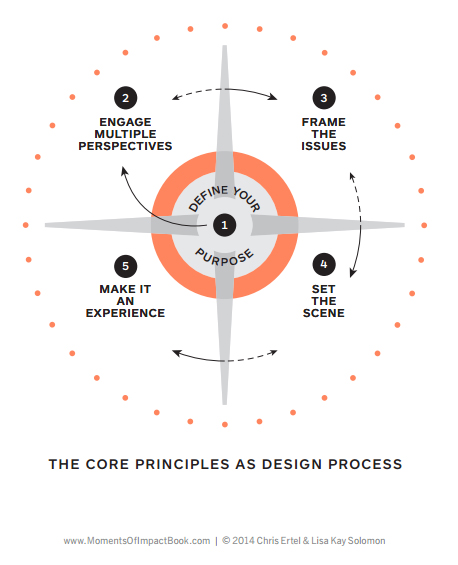
In Moments of Impact: How to design conversations that accelerate change (NY: Simon and Schuster, 2014), Chris Ertel and Lisa Kay Solomon argue that some of our most productive conversations come from deciding ahead what we want from the interchange. Their book presents a system of on-ramps that will be particularly useful for anyone charged with gathering a group with the intent of going further than the old, fallow brainstorming sessions allowed.
Conversation, as everyone knows, can be far from benign. For those looking to control a conversation, unless highly skilled, the better (and far less productive) option may be to continue with monologue.
Because a strategic conversation consists of live interactions between people with different perspectives and passions, you can never predict exactly where it will lead. (41)
That is the beauty of conversation: the whimsy factor can drop participants in places they never expected to arrive. That is also the danger—especially in corporate settings where a particular outcome has been strongly hinted at, if not guaranteed.
For those daring souls willing to let go, but who still retain a preferred outcome, Ertel and Solomon’s notion of a “strategic conversation” may just fit the bill. Start by sorting what you are trying to accomplish: build understanding, shape choices or make decisions. And then employ divergent and convergent thinking and other group exercises as necessary.
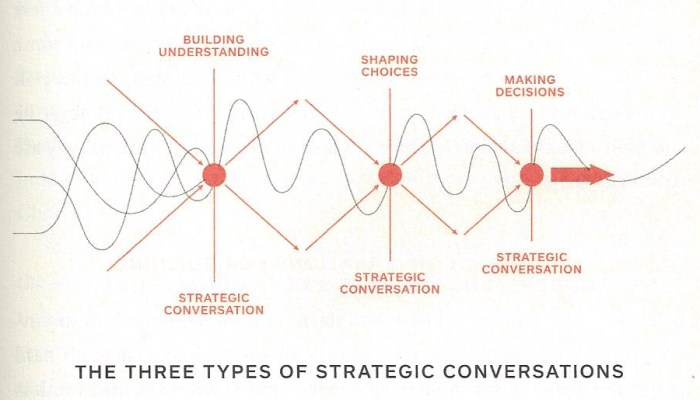
What I appreciate about Ertel and Solomon’s work is they have built a framework around the basic serendipity of conversation and brought it as a tool into even very hierarchical structures.
I am convinced we’ll find strategic conversations a formidable tool indeed, especially as we create brand new stuff out in the world.
###
Image credit: http://www.momentsofimpactbook.com
About the Node Not Taken
Steady There, Young Philosopher
My hardworking, entrepreneurial colleague surprised me in conversation the other day:
Sometimes I wonder what it would be like had I stayed in the corporate world—what would I be doing now?
My friend was in one of the periodic slumps that happen to anyone building a business of their own. Those slumps squeeze out long-suppressed questions. These are the questions that precipitate momentary crises of faith for those constructing wings as they plummet.

No. Really. Is there an actual “Afton State Park”?
Young philosophers like to ponder the “What ifs” of life:
- What if I had dated that person rather than this person?
- What if I had taken that job rather than this job?
- What if I had studied engineering rather than philosophy? (One certain answer: the world would have to cope with a very bad engineer.)
- What if had dived 12 inches to the left and missed that rock in the lake?
One problem with our casual “What ifs” is that they often assume a straight line from the point of decision. You go this way. You go that way. Two roads diverging in a yellow wood.
But what if our lives are composed of nodes that become roads? What if each decision is followed by another so that our paths are constantly changing in real-time?
Another problem with casual “What ifs” is they forget the tiny but forceful pinpricks of relationship and conversation and motivation that accompany every choice. Thousands of tiny insights and histories and dreams contribute to each action as well as each subsequent action.
Personally, I cannot help but wonder if the nodes that become roads all lead to the place/people we were meant to be in the first place. Wait—don’t call me a determinist yet. Stick with me: what I mean is that whether we stayed in the corporation or went on our own or dropped everything to join the circus, would we end up as the kind of people we were meant to be?
This is not a perfect thought: we build things into our lives, good and bad, by daily habit. We grow, or not, because of those habits and subsequent opportunities. Admittedly, the determinist take on choice has holes.
But I’m reminded of that inveterate letter writer who wrote his friends about walking in the “good works” begun in them.
Today I’m looking for nodes and roads.
And I hope to step in a good work along the way.
###
Image credit: Kirk Livingston
Are Doctors “Ethically Obligated” to Tweet?
No.
Although Wendy Sue Swanson, MD (@SeattleMamaDoc) feels that way about her social media presence (as demonstrated in this clip).
There is one piece of the Hippocratic Oath that calls for casting a wider net in “all my acquirements, instructions, and whatever I know” to those within the physician’s circle. The original oath also called all gods and goddesses to witness and observe, but these days the NSA serves that function (despite HIPAA).
Yesterday’s MedAxiom post by Ginger Biesbrock (“Has anyone seen my Dictaphone?”) makes the excellent point that any new technology adopted should make taking care of patients easier. New technology should not get in the way of treatment, it should not be another hurdle to jump. Instead, technology should simplify meeting the patient’s need. That’s why I’m pleased with the movement to hire medical scribes to complete the electronic medical records in the moment—freeing doctors to treat patients versus keyboarding.
Dr. Swanson’s strong feeling about casting a wider net is likely shared by many if not most physicians. And it just so happens that putting correct information out where regular folks might read it may also be a way to grow your practice—which has been the capitalistic promise of social media from day one.
Sure: doctors are busy. But I cannot help but wonder if more and more physicians will make outward communication (blogging, tweeting, connecting) a priority as they work to free themselves from some routine tasks.
Many already are.
###
Image credit: Kirk Livingston
Don’t Bother Me. I’m on Fire.
Too Busy: 4 Takes
- My contact is too busy to talk about collaboration: “Too many deliverables, scheduled too tightly.”
- Another colleague laments the lack of time to think ahead about the broader picture. She chides the constant race to get stuff done.
- A friend observing the inner-workings of a logistics department 2000 miles from where he was trained could identify key process components missing. The very components that created the immediate chaos the team waded through each day.
We earn our keep by being busy. None of us want the boss to wander by and say, “Fire up that keyboard/drill press/classroom/spreadsheet and get to work.”
Busy is always good.
There are no exceptions.
And yet:
- We lament “busy” but secretly get a buzz from opening the adrenalin spigot.
- Busy looks productive. But looks can deceive. We easily deceive ourselves with busyness.
- When taken out of action (for instance, when downsized/right-sized/laid-off/fired), we suddenly have time to ask:
- “Where am I?” and
- “What (the heck) am I doing?” and maybe
- “What was I thinking?”
- No one likes the off-balance, adrenalin-free stance of waiting, watching, knocking and waiting. Are we genetically predisposed to seek action? After all, aren’t verbs the action-heroes in our favorite writing?
It’s hard work to look at the bigger picture and make difficult choices about direction, use of resources, usefulness. And yet those are the very questions that help us move forward. As the wheel of seasons grind toward winter in Minnesota, we might take a page from the farmer’s playbook and let snowy fields lie.
Even on purpose: the fallow field may allow us productive time to consider what it means to be productive.
Versus just busy.
###
Dumb sketch credit: Kirk Livingston
Talk With Those Who Talk With You (DGtC#25)
Humans just want to connect
Social media, like sales, seeks an ever-expanding public. All tweeters want more followers. All bloggers—same thing. Just like the TV networks of yore, where Nielsen Media Research rated efficacy by numbers (and types) of viewers they brought in. Which just happened to coincide with increasing amounts of cash they could wring out of a sponsor for a 30 second span of monologue.
How to measure audience (and collect cash) continues in today’s social media world as various metrics are embraced and/or disgraced: clicks, views, comments, engagement, time spent on a site.
But real humans in earnest conversation don’t care about size of audience. They care about connecting with a person to tell the important thing they have to say or to hear the important thing a friend or colleague has to say. They want to remark on what is remarkable.

Call me a mystic (please!), but I still embrace the notion that the people peppered through our lives are there for reasons beyond our understanding. And those talking to you—today, right now—have something you need to hear and they need to say. Those people right beside you are worth attending to. For their sake. And for yours.
It’s not wrong to widen your audience.
Just don’t lose sight of this moment with those right before you.
Also see:
- Listen to other people’s stuff (#6)
- Dialogue is a scenic bypass (#12)
- “Good to know” and a failure to communicate (#23)
###
Image credit: Kirk Livingston
Beware the Information Hoarders in Your Office
Collaboration opens as the sharing economy pushes back into your organization
Old-School Corporate Climbers held information and doled it out on a need-to-know basis. Knowing secrets was their key to moving up and sometimes they purposely withheld information so you might fail/they might succeed.
Maybe you know someone like this.
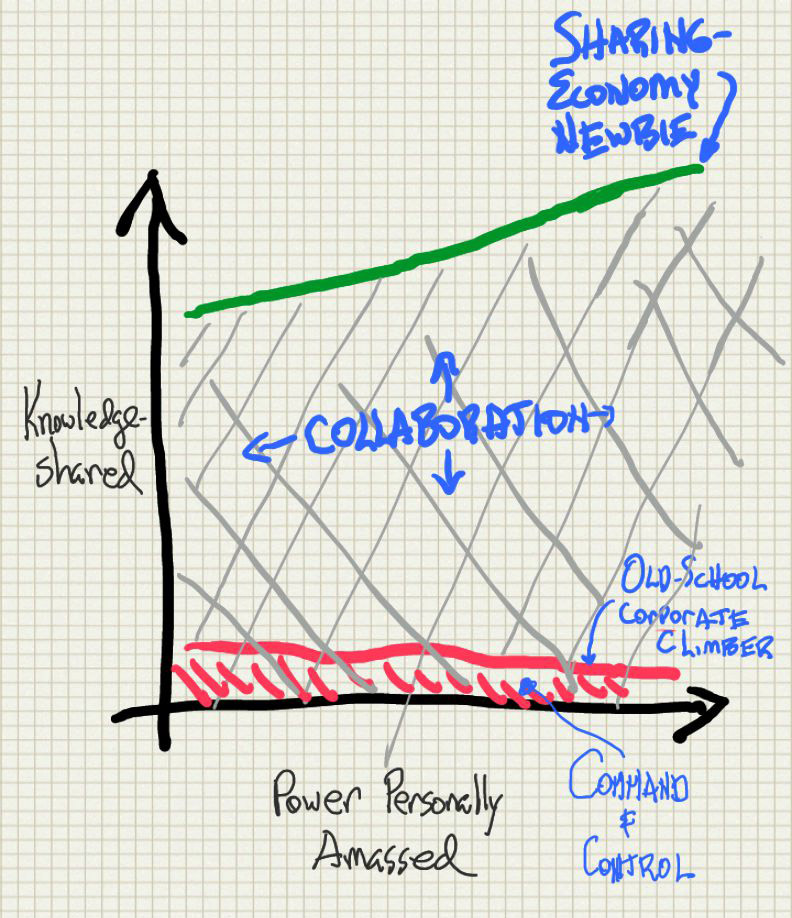
But as we watch the sharing economy slip free of social media venues and push back into organizations (simultaneously raising the expectation of being heard), I expect we’ll see another kind of corporate operative: the sharer. Maybe I’ll call that person the Sharing-Economy Newbie. In this new world of sharing information, the Sharing-Economy Newbie shares information freely and in a way that allows others to collaborate. The power the surrounds them will not be command-and-control power, it will be the power that invites participation.
Then again, human nature being what it is, there will always be information hoarders. Old-School Corporate Climbers will always find their way. But if we intentionally build cultures that reward information sharing and collaboration, the organization, its mission, and humanity are the big winners.
Maybe there are some who prefer a command-and-control culture of being told what to do at every turn, but there will be fewer and fewer every year.
###
Dumb sketch credit: Kirk Livingston
How to Make Your Message Permanent
A tip from a prehistoric consultant
First: Forget about it. Nothing is permanent—at least not in the way advertising mavens augur.
Second: OK—if you insist—make your message about someone else. Make your message give back more than it takes in. “GE” branded on a rock would never last. Even the Apple logo will be chiseled away by Microsoft rebels. But a man with jointed wings, well, who can resist that story?
![Who can resist the story about the “Thunder Being”?]](https://conversationisanengine.space/wp-content/uploads/2014/10/birdman-2-10022014.jpg)
Who can resist the story about the “Thunder Being”?
Prehistoric peoples stopped by these ancient rocks to tell their version of the human condition. So they carved/picked/incised/abraded their messages into the exposed Sioux quartzite outside Comfrey, Minnesota long before there was a Comfrey or a Minnesota or a U.S. of A. Maybe before the pyramids and Stonehenge. Ancients left messages here to direct and entertain passers-by.
Why make your message permanent? We understand marketing communications for companies—it’s about keeping the wheels of commerce turning. But you personally—what messages do you have to communicate? And why would you make them permanent? I argue that your take on the human condition comes out in the way you do your work, the way you interact with family, friends, colleagues, and even the way you see/refuse to see the homeless guy at the end of the exit ramp. And all these daily interactions amount to a carving and incising that is far more permanent than any of us imagine.

The Jeffers Petroglyphs tell a story that became a destination.
Our conversations have an enormous (cumulative) effect on the people around us. An effect that may move through generations.
What exactly is your message, anyway?
###
Image credit: Kirk Livingston
Edward Bernays and Jolly Manipulation
Gather round, kids: here’s how you sway public opinion
Edward L. Bernays is called the father of public relations and his book Propaganda (NY: Horace Liveright, 1928) shows why. Bernays is absolutely jolly as he lays out the psychology of manipulation. He doesn’t just talk about the formulas, he gleefully demonstrates them in paragraph after paragraph. Much like one might describe building a shelter to a group of boy scouts, Bernays is positively beaming as he writes about how to pull self-interest into the equation to get publics to do your corporate bidding.
The modern propagandist studies systematically and objectively the material with which his is working in the spirit of a laboratory. (48)
Edward L. Bernays is the ur–flack.
If you can influence the leaders, either with or without their conscious cooperation, you automatically influence the group which they sway. (49)
Reading Propaganda today, it is clear Bernays thought corporations and government leaders and those in power would certainly use his manipulation techniques for good.
How could it be otherwise?

Look through here. You’ll see what you’re supposed to see.
But World War II was just around the corner and every nation developed their own propaganda machines. In the US, we still react viscerally to the imagery and code words used by Nazis. Today old Stalinist imagery has it’s own unique draw. The US had powerful PR apparatus as well. We continue to feed that machine. And since, then, of course, unending sets of military skirmishes/wars, each equipped with God-given reasons for why we must respond. Then Watergate and totalitarian despots revealed and deposed, and, well, it’s a long list of fails that contribute to today’s cynicism and “Question Authority” stance. People found their voice and collected it to push back with outrage at corporations and governments and to call attention to wrong doing when it appears.
Eighty-six years later, the entire population of the US—possibly the planet—is wise to Bernays’ techniques. Not that we’ve studied them: those techniques study us all day every day. Especially in countries like the US where consumption is our patriotic duty. We know manipulation from the inside out.
Bernays would be impressed were he alive to see it. I imagine him smacking his head and saying, “Wait—they know they are being manipulated, and …they still buy it? This is even better than I hoped.”
Why talk about manipulation? Not just because Bernays book is fun to read and easy to contrast with today. In particular, why would a copywriter talk about manipulation? Isn’t that secret sauce you trade in all day? Why pull back the curtain?
As a copywriter my goal is to tell my client’s story in the best possible light. I continue to argue that persuasion is a natural piece of how people interact with each other all day long. It’s part of the human condition. But I argue our efforts at manipulation damage actual conversation. When we use words and techniques with manipulative technique, we shut off further conversation. At that point it is about winning not connecting. Maybe there is a fine line between persuasion and manipulation. Propaganda is the textbook for manipulation.
As a copywriter, I want my clients to engage in conversations not endless manipulative monologues. That seems a more human approach to communication. I continue to think conversation is what today’s market will bear.
###
Image credit: Kirk Livingston

 conversation is an engine